
Why Telling Employees to “Check Their Brains at the Door” Destroys Improvement Culture
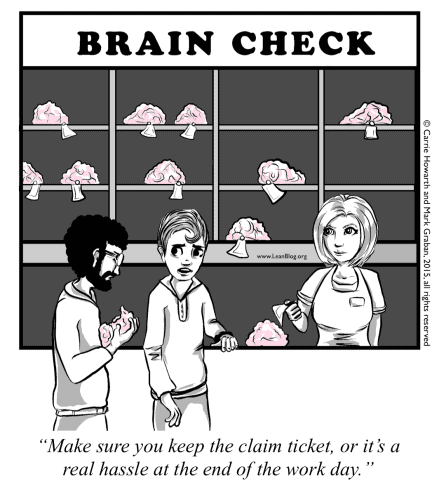
Here's my latest cartoon collaboration with a skilled artist (and medical assistant), Carrie Schurman.
You can see the whole series via this link.
A Common Workplace Message: “Leave Your Brain at the Door”
How many organizations — explicitly or implicitly — ask their employees to “check their brain at the door”?
During my time at General Motors in the mid 1990s, people were literally told that. We were “hired for our backs and our arms, not our brains.” That mindset wasn't just disheartening — it was destructive to morale, quality, and performance. And it wasn't new.
Sadly, I still hear similar stories today — in hospitals, startups, manufacturing plants, and more. It's often not said aloud, but the message is clear: “Don't speak up. Don't question things. Don't make waves.”
In healthcare, the signals are usually more subtle. But the effect is the same: fear, disengagement, and wasted potential.
“Brain Check” Culture Is the Opposite of Lean
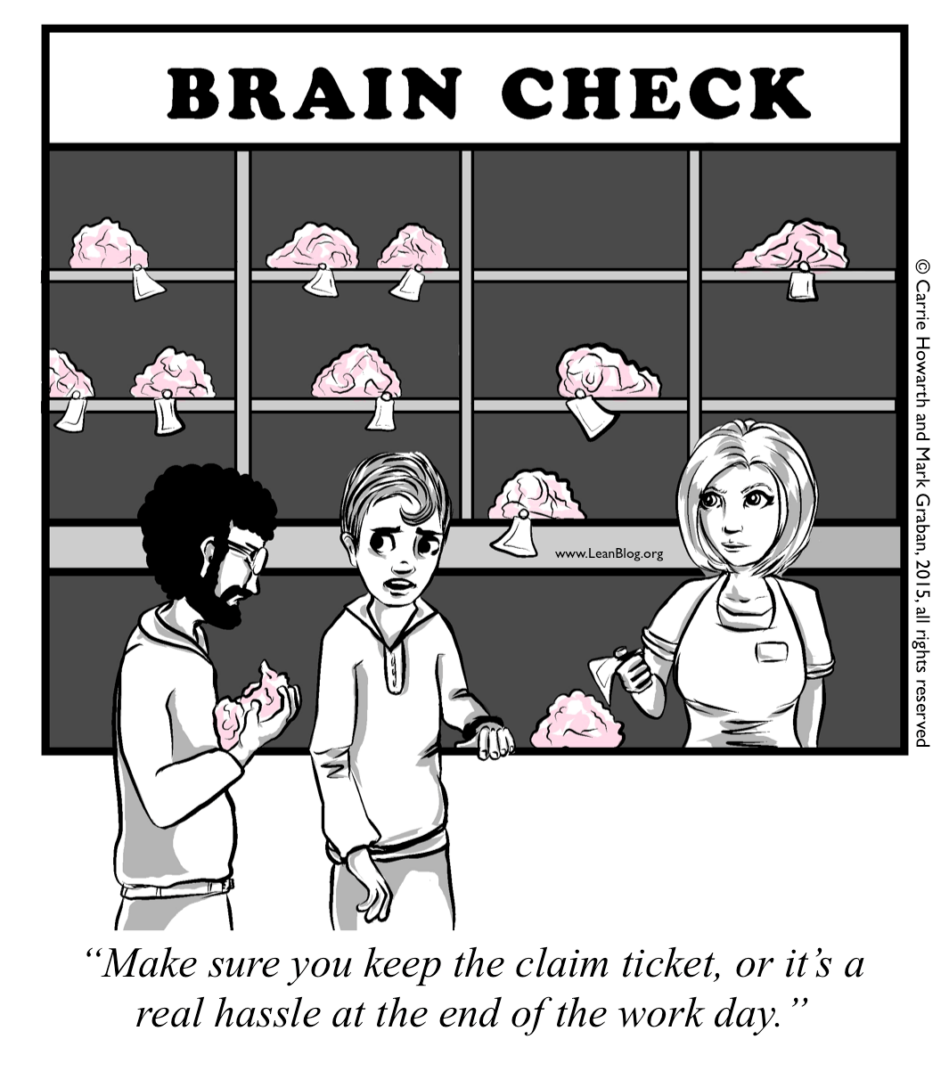
I often use this image in my speaking engagements:
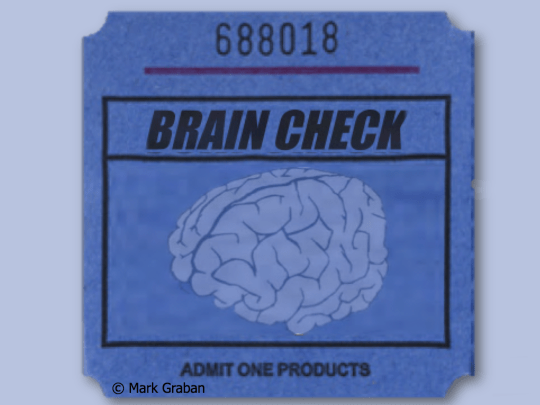
Like a coat check… but worse.
Unlike a coat check, workplaces don't give you a claim ticket for your brain. But what if they did? Would you even get the same one back at the end of the day? (And would a better one cost extra?)
Of course, that kind of joke misses the point — because Lean is built on the belief that everybody has the ability to improve their own work and contribute meaningfully. That doesn't require an advanced degree or extraordinary intelligence. It requires:
- Respect for people
- Psychological safety
- Leaders who ask and listen
- A culture that values learning over blame
When we ask people to shut down their thinking — whether directly or through subtle cues — we lose out on improvement, innovation, and engagement.
What Does Your Culture Signal?
The cartoon is humorous. But behind it is a real question for leaders:
What messages — intentional or not — does your workplace send?
Do team members feel safe asking questions, sharing ideas, or challenging the status quo? Or do they hesitate, fearing they'll be labeled a “troublemaker” or dismissed for “not staying in their lane”?
Improvement starts with awareness. Then it takes humility and consistent action from leadership to shift the culture.
Take Action: Build a Culture Where Thinking Is Encouraged
If you want to create a culture of continuous improvement, you can't ask people to leave their brains — or their voices — behind. Start here:
- Listen actively. Ask twice as much as you tell.
- Invite participation. Improvement isn't a job title — it's everyone's job.
- Reward curiosity, not just compliance.
- Reflect on your systems. If people aren't speaking up, it might not be a motivation problem — it's likely a safety problem.
Let's build better workplaces — places where everyone is invited to think, speak, and solve problems.
More Cartoons:

![[Cartoon] The Elephant in the (Board) Room](https://www.leanblog.org/wp-content/uploads/2018/02/elephant-600x451.jpg)
![[Cartoon] Money to Burn / Dumpster Fire Fighting in Healthcare](https://www.leanblog.org/wp-content/uploads/2017/05/money-burn-dumpster-healthcare-520x500.png)
![The Opposite of “Serious Emergency Care” [Cartoon]](https://www.leanblog.org/wp-content/uploads/2015/03/Screen-Shot-2015-03-20-at-5.57.09-AM-600x396.png)