

Kaizen: The Improvement System Most Organizations Talk About but Struggle to Practice
TL;DR: Kaizen means “change for the better.” Everyone improves their own work, one small change at a time, using the scientific method. It's not a suggestion box — it's collaborative, fast, and action-oriented. Success depends on leadership engagement and psychological safety.
Before getting into what kaizen is, it's worth pausing on what happens without it.
In most organizations, frontline staff notice dozens of small problems every week — inefficiencies, workarounds, things that don't quite make sense. Almost none of those observations go anywhere. There's no mechanism to capture them, no expectation that they'll be acted on, and often no safety in raising them. Each one is a small compounding cost. Not dramatic enough to trigger a project. Not visible enough to appear on a dashboard. But multiplied across hundreds of people and thousands of days, the cumulative loss is enormous — and almost entirely invisible to leadership.
The word kaizen gets used a lot in business circles. It appears on conference agendas, consulting slide decks, and organizational mission statements. But what does kaizen actually mean? And what does it look like in daily practice — not just on a poster or as a sports slogan?
As someone who has spent a long time helping healthcare organizations build cultures of continuous improvement — and co-authored the books Healthcare Kaizen and The Executive Guide to Healthcare Kaizen with Joe Swartz — I want to share what I've learned about kaizen: its origins, its principles, and why so many organizations talk about it but struggle to practice it.
What Does Kaizen Mean?
Kaizen is a Japanese word that is most simply translated as
“change for the better.”
Breaking down the word: kai means “change” and zen means “good.”
That distinction matters. Kaizen does not just mean change. A change is only a kaizen when things are actually made better in some measurable or meaningful way. A rearrangement that doesn't improve anything isn't kaizen — it's just rearranging.
As Masaaki Imai wrote in his landmark 1986 book KAIZEN: The Key to Japan's Competitive Success, “Kaizen means improvement” and “Kaizen is everybody's business.” Imai also wrote that
“Kaizen is about changing the way things are. If you assume that things are all right the way they are, you can't do Kaizen.”
In most practical usage, kaizen is synonymous with the phrase “continuous improvement.” But it carries something the English phrase doesn't: an emphasis on participation by everyone, at every level, every day. It's not a project. It's a way of working.
Kaizen as Part of the Lean Management System
Kaizen is one of the two foundational pillars of the Lean management system, which traces its roots to the Toyota Production System. Toyota defines its approach simply:
These two principles go hand in hand. Because we respect people, we engage them in improvement. Because we engage them in improvement, we show respect for their knowledge, experience, and creativity. As I wrote in my book Lean Hospitals,
“Respect for people is the reason for continuous improvement, and it is also the way improvement happens.”
The late Norman Bodek who studied Toyota for decades, described the purpose this way in his foreword to our Healthcare Kaizen book: the goal is “
to create a culture of continuous improvement with people at all levels thinking deeply about their ideal vision for the people and process, and purposefully taking steps to achieve the vision.”
He emphasized that this is “totally alien” to treating Lean as a race to implement tools and check boxes.What I've seen is that organizations that rely solely on events to drive improvement often plateau. The events produce results, but the results don't compound. The organizations that sustain improvement over years are the ones that build the habit of daily kaizen among frontline staff — the small category that Meier warned is “overlooked entirely.” That's where the compounding happens.
Related Podcast: Podcast #95 – Norman Bodek “How to Do Kaizen,” Part 1
Three Levels of Kaizen — and Which One Most Organizations Skip
Organizations sometimes make the mistake of equating kaizen with only one type of improvement activity. In practice, there are three complementary levels:
Daily kaizen (point kaizen) — Small improvements made by the people who do the work, often implemented in hours or days. A pharmacy technician rearranges her workstation so frequently used items are at arm's reach instead of in ankle-height drawers. A nurse creates a card to leave for patients whose rooms are cleaned while they're away for therapy, so they know the room was cleaned. These are quick, low-cost, low-risk, and often surprisingly impactful.
Kaizen events (rapid improvement events) — Focused multi-day efforts, typically three to five days, where a cross-functional team analyzes and improves a specific process. These are sometimes called “rapid improvement events” or “rapid process improvement workshops.” They produce larger changes than daily kaizen, but they require more planning and resources.
System kaizen — Larger-scale initiatives that address systemic or cross-departmental issues, such as redesigning patient flow through an emergency department or implementing a new approach to medication management across a hospital system.
David Meier, a former group leader at Toyota's plant in Georgetown, Kentucky, taught that he was involved in only a handful of formal improvement events during his ten years at Toyota. When Toyota did conduct events, the purpose was not short-term return on investment. It was for management to learn about kaizen. That learning could then be applied to larger problems or, more importantly, to the daily practice of continuous improvement.
In The Toyota Way Fieldbook, Meier emphasized:
“Many organizations fail to develop an effective process for capturing opportunities from all three categories. Quite often, the small category is overlooked entirely because these opportunities are viewed as ‘insignificant' or offering ‘not enough bang for the buck.'”
What I've seen is that organizations that rely solely on events to drive improvement often plateau. The events produce results, but the results don't compound. The organizations that sustain improvement over years are the ones that build the habit of daily kaizen among frontline staff — the small category that Meier warned is “overlooked entirely.” That's where the compounding happens.
The Five Steps of Kaizen
Norman also co-authored The Idea Generator: Quick and Easy Kaizen with Bunji Tozawa. Norman was also the very first guest on my Lean Blog podcast back in 2006 — he was the person who inspired me to start the podcast in the first place.
Norman and Tozawa laid out a simple five-step method that Joe Swartz and I built upon in our work with healthcare organizations:
1. Find — Search for opportunities for improvement or problems to solve. This becomes easier with practice. Melissa Horne, a pharmacy technician at Franciscan St. Francis Health, completed 109 kaizens in a single year — roughly one every 1.6 working days. She wasn't given a special project or pulled off her regular duties. She was given permission to notice things and act on them. As she put it: “At first I had difficulty finding Kaizen opportunities, but over time, as I practiced, it became easier and easier for me to see them.” What changed wasn't her ability. It was the environment around her.
2. Discuss — Talk about the idea with your team and your supervisor. This is a collaborative process, not a solo activity and not a formal proposal that disappears into a committee.
3. Implement — A change for the better must actually be implemented to be a kaizen. An idea that stays on paper isn't kaizen yet.
4. Document — Create a simple report, often called a kaizen card or kaizen report, capturing what was changed and what resulted.
5. Share — Post it, review it, discuss it with others. Sharing spreads learning and inspires others to look for their own improvement opportunities.
Norman would teach audiences about kaizen and always start by asking people to raise their hands if they considered themselves highly creative. Maybe 2% of the room would raise their hands. He'd then explain that in kindergarten, almost every child demonstrates constant creativity — but the education system and many workplaces systematically train that creativity out of people. Kaizen is, in part, about reversing that process and rekindling the creative capacity that people never actually lost.
Kaizen, PDSA, and the Scientific Method
At its core, kaizen follows the Plan-Do-Study-Act (PDSA) cycle, which is rooted in the scientific method. W. Edwards Deming popularized this iterative approach, sometimes referred to as Plan-Do-Check-Act (PDCA).
The steps are:
- Plan: Understand the current situation and root cause of problems. Develop a hypothesis about what will improve things.
- Do: Carry out a small-scale test of the change.
- Study: Observe the results. Did the change actually improve things?
- Act (or Adjust): Based on results, adopt and spread the change, or try something different.
This is important because it means kaizen is not about guessing or gut feelings. It's about testing ideas, learning from results, and adjusting. And it means that when a test doesn't produce the expected results, that's not failure — it's learning. As Henry Ford said, “Failure is only the opportunity to begin again more intelligently.”
Leaders who want kaizen to thrive need to create an environment where people are not punished for improvement attempts that don't work out. If the Study phase shows that a change wasn't really an improvement, the team adjusts and tries something else. Without that psychological safety, people become cautious and only propose changes they're certain will work — which dramatically limits the pace of improvement.
Kaizen Is Not a Suggestion Box
Sometimes when people first hear about kaizen, they say, “We already do that — we have a suggestion box!” But kaizen and suggestion boxes are fundamentally different approaches, driven by different philosophies.
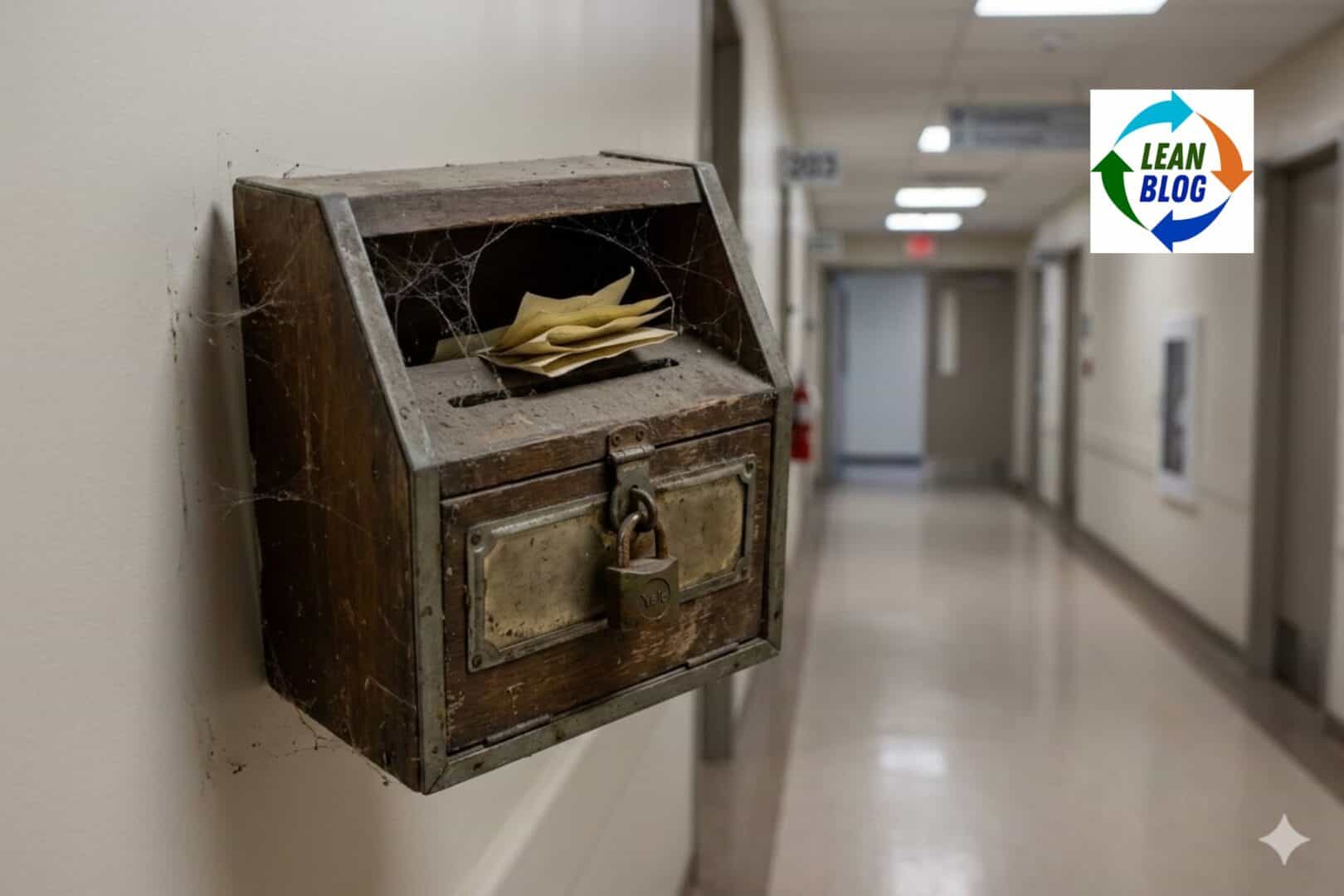
At one hospital I worked with early in their Lean journey, I found a suggestion box on the wall of the laboratory. Someone went to find the key to the locked box, returning 20 minutes later to announce that nobody could find the key.
That locked box became a pretty useful metaphor. If your current system for capturing improvement ideas requires someone to go find a key — literally or figuratively — that tells you something about how the organization actually values the intelligence of its own people, regardless of what the mission statement says.
As Bruce Hamilton, president of GBMP, has put it:
“Many companies assume that the failure of the suggestion box approach is with employees that don't care, but if we dig a little deeper we find it is the system itself that squashed enthusiasm.”
Here's what typically goes wrong with suggestion boxes:
They're slow, with poor feedback. Suggestions sit for weeks or months. Employees get frustrated by the lack of communication.
Too many suggestions are rejected or ignored. People get discouraged and, understandably, stop participating.
They put the entire burden on managers. Completed forms go onto a manager's already-long list of tasks and often get buried.
The submitter isn't involved in implementation. Someone else gets assigned to review or implement the idea. That person is rarely as invested as the one who identified the problem.
Norman Bodek drew a clear distinction: suggestions are something you (pointing at another person) should do for me. Kaizen ideas are something that I can do, often for myself and my team. With kaizen, the person who identifies the problem works with their supervisor and others to find and implement solutions.
At Toyota, more than 90% of employee ideas are implemented. Compare that with a typical suggestion box, where rejection rates of 70% or higher are common. That gap matters more than it might seem, because the rejection rate today is the participation rate six months from now. Every rejected idea teaches the person who submitted it that noticing problems is a waste of their time. Multiply that across an organization and you've built, without meaning to, an elaborate system for ensuring that small improvements never happen.
Toyota's 90% doesn't mean every original idea goes through as proposed — it means that through dialogue, a team finds something to implement, even if the idea evolves along the way. The person who raised the issue stays involved. That's a fundamentally different signal than “thank you for your submission.”
Read more: The Suggestion Box Is Dead — And Kaizen Replaced It
Kaizen in Healthcare: Examples from the Field
Joe Swartz and I wrote Healthcare Kaizen in large part because of what we saw at Franciscan St. Francis Health in Indianapolis, where Joe led their continuous improvement efforts. Starting in 2007, Franciscan built a kaizen program that grew from a single housekeeping staff member improving the way coffee filters were stored to an organization-wide culture change.
By 2011, 41% of staff had participated in kaizen that year. Their three hospitals implemented more than 17,000 improvements with an estimated hard-dollar cost savings of over $5.7 million — with very little investment other than time, focus, and leadership. And the hard numbers didn't include the “soft savings” in staff time, increased patient and staff satisfaction, reduced error rates, and reduced waiting times.
CEO Bob Brody said:
“There is every reason for any organization to encourage and support the Kaizen concepts. It creates a more efficient and productive work environment, a more satisfied patient, and a more satisfied workforce. These are linked to one another, and to hospital performance.”
Some specific healthcare kaizen examples:
- Designating a standardized location for storing open patient-care items in a patient's room
- Finding an easier way to ambulate patients who need supplemental oxygen
- Creating a better discharge medication list to avoid patient confusion
- Making palliative care or hospice available on weekends
- Teaching housekeeping where isolation signs are supposed to be stored
None of these are dramatic. All of them matter to patients and the people who care for them. That's the point.
At Allina Health, a nonprofit system with over 26,000 employees, the adoption of kaizen transformed traditional workflows into a culture of ongoing process improvement driven by staff at all levels. At Children's Medical Center in Dallas, their improvement campaign asked one simple question: “Is there a better way?” Leaders helped tie local improvement to the organization's mission by asking if proposed changes would help provide “better care for kids.”
Read more: Engaging Staff as Problem Solvers Leads to Continuous Improvement at Allina Health
What Makes Kaizen Work — and What Makes It Fail
After years of working with organizations across industries, here's what I've observed about what separates the organizations that build lasting kaizen cultures from those where it fades: Here's something worth thinking about: how many small improvements did someone in your organization notice this week — and quietly set aside because there was no clear path to act on them? Here's something worth thinking about: how many small improvements did someone in your organization notice this week — and quietly set aside because there was no clear path to act on them?
Leadership engagement is the single biggest factor. But “engagement” doesn't mean what most leaders assume. It doesn't mean approving ideas or sponsoring a program. As Masaaki Imai wrote in his foreword to our book: “Top management commitment is the only way to successfully embrace Kaizen, without which nothing else you do will matter.” What that looks like in practice is showing up where the work happens, asking questions, and visibly responding when people surface problems. It's less about doing more and more about doing something different with the attention you're already paying.
Psychological safety is the foundation. People won't identify problems, admit mistakes, or test ideas if they fear blame or punishment. As I've written about extensively, psychological safety is a precondition for continuous improvement. You can install kaizen boards in every department, but if people don't feel safe using them, the boards will stay empty.
Start small and build the habit. The Quick and Easy Kaizen approach emphasizes starting with improvements that are simple to test and implement. As people build confidence and see that their ideas are valued, they naturally take on more substantial improvements.
It takes time. James Dague, retired CEO of IU Health Goshen Hospital, said it plainly: “The first three years of this program are very tough because everybody's waiting for it to go away. You're not going to take all the negatives that got you to this point, where you need an improvement program, and wash it out of your organization in one year.” Culture change is measured in years, not months.
Kaizen should be connected to purpose. The most effective kaizen programs tie improvement to the organization's mission. In healthcare, that means connecting every improvement back to patient safety, care quality, or the wellbeing of the people who provide care. When people see how their small changes connect to something larger, participation sustains itself.
Getting Started with Kaizen
If you're new to kaizen, here's what I'd suggest:
Pick a single team or department to start. Don't try to launch organization-wide on day one. At St. Elisabeth Hospital in the Netherlands, they started with an improvement board in one department. Three years later, they had boards in 75 departments — not because the boards were forced on people, but through a process of “self-spread” as other departments saw the value and wanted in.
Teach the five steps. They're simple enough to explain in 15 minutes. Find, discuss, implement, document, share.
Make it visible. Whether it's a physical board or software like KaiNexus, make sure ideas and improvements are visible to the team. Visibility builds momentum and normalizes participation.
Celebrate early and often. Each kaizen provides benefits, even small ones. Recognize the effort and the learning, not just the dollar savings.
And keep in mind what Herb DeBarba, a vice president at Cancer Treatment Centers of America, said:
“We would rather have 1,000 little improvements than one big one.”
When frontline staff are engaged in daily improvement, they become better participants in larger improvement events too. The skills transfer.
What Kaizen Means to Me
I keep coming back to something Dr. Donald Berwick wrote in the New England Journal of Medicine back in 1989, just three years after Imai's book was published. Berwick defined kaizen as “the continuous search for opportunities for all processes to get better” and argued that a leader cannot be “a mere observer of problems” but needs to lead others toward solutions.
Berwick also highlighted something that remains true today: organizations need to replace blame and finger pointing with shared goals. They need to invest in quality improvement. And they need to respect the people who do the work — trusting that they are trying hard and acting in good faith.
That was true in 1989. It's true now. The organizations that practice kaizen well aren't the ones with the best tools or the biggest budgets. They're the ones where leaders have created the conditions for everyone to participate in making things better, one small change at a time.
Here's something worth thinking about: how many small improvements did someone in your organization notice this week — and quietly set aside because there was no clear path to act on them?
Related Posts:
- Healthcare Kaizen: Why the Suggestion Box Is Dead
- KaiNexus: Don't Digitize the Old, Broken Way of Doing Things
- Psychological Safety as a Pre-Condition for Lean
- Engaging Staff as Problem Solvers at Allina Health
- UMass Memorial Aims to Become a “World Class” Kaizen Organization
- See all posts about Kaizen
Related Podcasts:
- Norman Bodek on Quick and Easy Kaizen (Episode #1)
- The Toyota Way: Responding to, Preventing and Learning from Mistakes with Jeff Liker
Frequently Asked Questions About Kaizen
What does kaizen mean in English?
Kaizen is a Japanese word that means “change for the better.” Breaking it down: kai means “change” and zen means “good.” In business and management, kaizen refers to a philosophy and practice of continuous improvement — making ongoing, incremental changes to processes, driven by the people who do the work.
What is the difference between kaizen and a suggestion box?
Suggestion boxes rely on employees submitting ideas that managers review, approve, and assign to others to implement. Kaizen is collaborative — the person who identifies the problem works with their team to solve and implement it. Suggestion boxes are typically slow, have poor feedback loops, and reject most ideas. Kaizen aims to implement the vast majority of ideas, values dialogue over approval, and happens in real time rather than behind a locked box.
What is a kaizen event?
A kaizen event (also called a rapid improvement event or RPIW) is a focused, multi-day effort — typically three to five days — where a cross-functional team analyzes and improves a specific process. Kaizen events produce larger changes than daily kaizen but require more planning and resources. At Toyota, the primary purpose of events was to teach people how to think about improvement, not just to achieve short-term results.
How is kaizen used in healthcare?
Healthcare organizations use kaizen to improve patient safety, reduce waiting times, eliminate waste in clinical workflows, and improve staff satisfaction. Examples include standardizing supply locations in patient rooms, redesigning discharge processes to reduce delays, and finding better ways sto communicate medication information to patients. Franciscan St. Francis Health in Indianapolis implemented more than 17,000 staff-driven improvements using kaizen methods.
What is the connection between kaizen and PDSA?
Kaizen follows the Plan-Do-Study-Act (PDSA) cycle, also known as PDCA (Plan-Do-Check-Act). This iterative method, rooted in the scientific method, treats every proposed change as a hypothesis to be tested. You plan a change, test it on a small scale, study the results, and then either adopt, adjust, or try something different. PDSA is the thinking process behind all levels of kaizen — from small daily improvements to large system redesigns.






This post really showed me what kaizen really means and why so many organizations struggle to implement it well. One of the biggest points that stood out to me from this article was that kaizen is not just about large imporvement but it is about continuous and smaller improvements, often made by the employees who are doing the work. I liked how suggestion boxes were described as slow and often not effective because I have seen the same results from the suggestion boxes I have participated in. Most suggestions get ignored if the box is even ever looked at. To practice Kaizen, you need to encourage employees to participate in solving problems and actually give them the support needed to implement them. This not only makes employees feel more engaged, but it could also improve current processes as the employees on the floor are the ones who know the process best.
This article talks about Kaizen and its importance in lean thinking. Kaizen is a way of thinking to change for the better. If you think your system is perfect and cannot be changed for the better, that is not Kaizen thinking. What stood out to me was learning how Kaizen can be applied to anything, it is about looking for improvement in everything all the time. Most organizations struggle with this because it is hard to get employees to engage and fully commit to finding solutions for problems and trying to incorporate them into daily tasks. This is important to note throughout a green belt project because most students realize how lean a company has already made their system, and it seems there is nothing else to improve. Using Kaizen, students take the time to think deeper and apply the 5 steps to build a better and more efficient process.