What Toyota’s 1992 Booklet Means by Kaizen and Job Ownership
Nearly two million improvement proposals in a single year. Ninety-seven percent implemented.
That doesn't sound like the suggestion-box model most organizations know. It sounds like something else.
The number comes from Toyota's April 1992 publication “The Toyota Production System.” It appears in the introduction:
“Employees at Toyota operations in Japan proposed nearly two million improvements in 1990, and the employees implemented 97% of their proposals.”
I've spent a lot of years around organizations running suggestion programs. The implementation rates tend to land between 2% and 5%. A truly well-run kaizen program might reach 80%. Nobody I've seen hits 97%.
So either Toyota was running a suggestion program far better than any I've seen, or the word “proposal” was describing a different operating model.
What Toyota actually meant by kaizen
The booklet describes it this way:
“Ultimately, kaizen is about job ownership. It means giving employees full responsibility and authority for their jobs. They take responsibility for turning out products that will earn the satisfaction of customers. And they receive the authority to modify and shape their work in ways that raise quality and productivity and that improve working conditions.”
Notice the word “authority.” The booklet doesn't say authority to suggest. It says authority to modify and shape.
My read is that Toyota wasn't describing a better suggestion program. It was describing a different category of activity–one in which employees could make many small improvements themselves, with the paperwork documenting what had already happened.
For those changes, the employee who saw the opportunity didn't have to send the idea into a committee or wait in an approval backlog. The “proposal” and the “implementation” were the same act.
That helps explain how Toyota could reach 97%. You don't bottleneck the improvements through a manager.
That does not mean every employee can unilaterally change anything. Changes involving safety, regulatory requirements, customers, equipment, or other teams still require the appropriate review and coordination. The point is that routine, low-risk improvements should not face the same approval burden as consequential changes.
A small aside
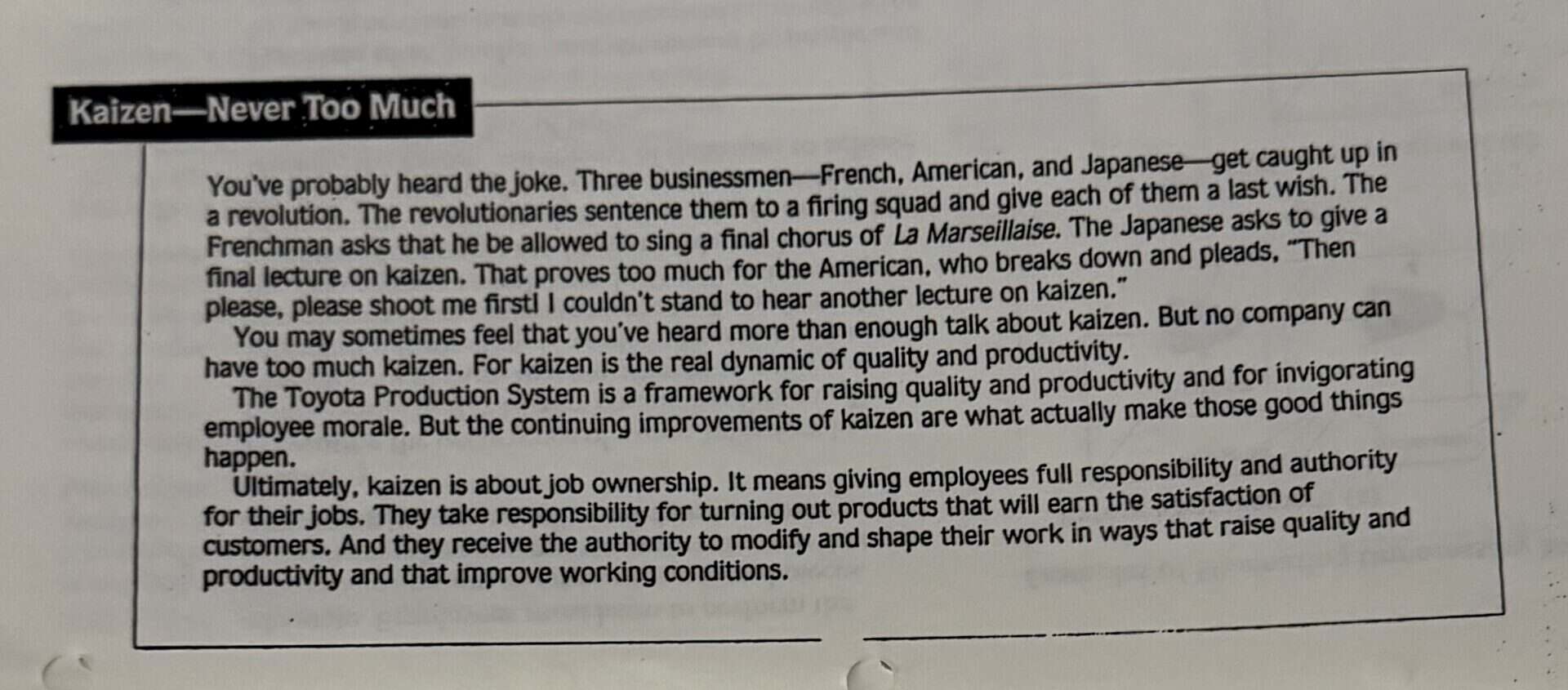
The booklet has a sidebar called “Kaizen-Never Too Much” that opens with a joke. Three businessmen – French, American, and Japanese – get caught up in a revolution and sentenced to a firing squad. Each gets a last wish. The Frenchman asks to sing a final chorus of La Marseillaise. The Japanese businessman asks to give a final lecture on kaizen. The American breaks down and pleads, “Then please, please shoot me first. I couldn't stand to hear another lecture on kaizen.”
I heard Masaaki Imai tell that exact joke on a study trip in Japan in 2014. He told it with the timing of someone who had told it many times and still enjoyed the delivery. The room laughed, and then he kept going, because the point of the joke isn't the punchline. It's the setup. The Japanese businessman's last wish is to give a lecture on kaizen. That's the part Toyota wants you to sit with.
The booklet itself lands the same way:
“You may sometimes feel that you've heard more than enough talk about kaizen. But no company can have too much kaizen.”
The arithmetic
Here's how a suggestion program looks from inside an employee's head.
Felt cost of submitting: writing it up, the time to think about it carefully, the social weight of having an idea visibly on the table that might get rejected or mangled. Felt benefit: maybe it gets implemented someday. Maybe you get credit. Maybe.
Many employees, on many days, will decide the idea isn't worth submitting. A process like that filters out useful improvements before they ever enter the pipeline.
Now consider the same employee in a job-ownership culture. They notice something. Within agreed safety and quality guardrails, they test a small, reversible change with their team. If it works, they incorporate it into standardized work. If it doesn't, they restore the previous method and learn from the experiment.
The felt cost is much lower because the experiment can often remain local to the team instead of entering a distant approval process before anyone learns whether it works.
That arithmetic helps make a 97% implementation rate possible. The improvements happen first. The paperwork comes after.
Related post: Our Toyota Tour Guide's Small Improvement: Kaizen in Action
What 3.2 seconds tells you
A few pages later, the booklet describes specific kaizen examples:
“We discovered that the drill on a drill press was rising much higher after each cycle than necessary to clear the workpiece. The extra height allowed for replacing the drill bit easily, but it wasted the time that the machine spent moving the drill up and down above the workpiece. We devised a way to replace the drill bit with a pull-wire in ordinary cycles without raising it to an excessive height, which reduced the waste movement and waste time by 3.2 seconds. We also discovered that the air-cutting distance was very long; so, we shortened that distance by 13mm and thereby reduced the waste time by 2.4 seconds.”
Read that with suggestion-program eyes. 3.2 seconds. 2.4 seconds. Thirteen millimeters.
Most suggestion committees would struggle to take a 3.2-second improvement seriously, especially if the employee had to calculate the annual savings, complete a form, and wait for approval. The administrative effort could easily appear larger than the benefit of any single improvement–even though hundreds of improvements like it would compound.
These improvements are far more likely when the worker who sees the waste does not need to seek management approval for every small, safe, local change. The employee and team can study the work, test an adjustment, evaluate the result, and update the standardized work with the team leader. Then they move on to the next opportunity.
A system like Toyota's is built, in part, through countless 3.2-second improvements. They compound. You get far more of them when the arithmetic favors action over proposal.
The honest demand side
The booklet doesn't pretend this is all upside.
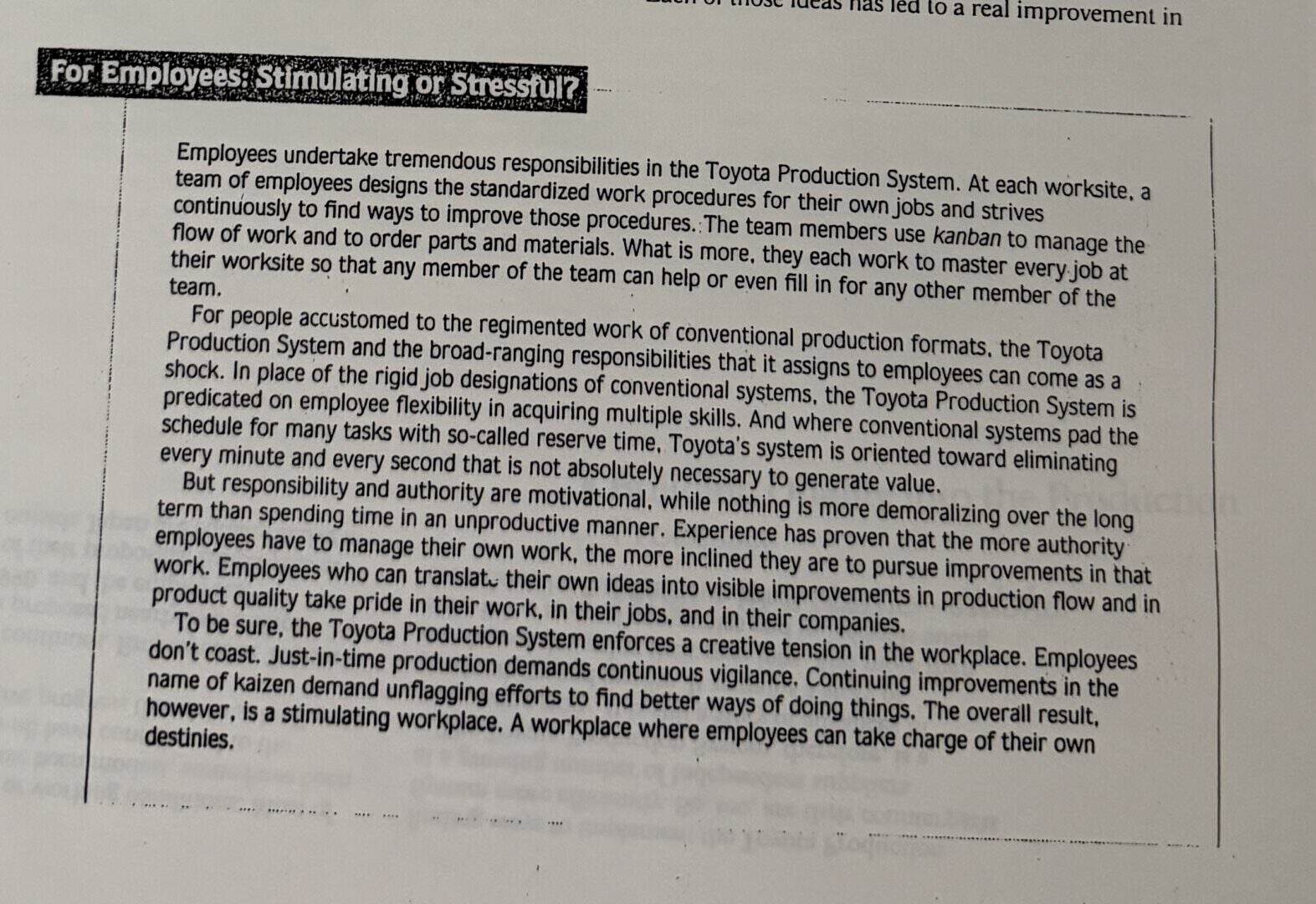
The “For Employees: Stimulating or Stressful?” sidebar is unusually candid. “Employees undertake tremendous responsibilities in the Toyota Production System. At each worksite, a team of employees designs the standardized work procedures for their own jobs and [tries] continuously to find ways to improve those procedures.” A few paragraphs later: “the Toyota Production System enforces a creative tension in the workplace. Employees don't coast.”
Job ownership isn't a perk. It's a demand. It works only when that demand is paired with authority. A demand without authority is a guilt trip.
Many organizations that talk about employee empowerment are giving people the demand and withholding the authority. The employees can see exactly what should be improved. They just can't make the change without going through three approvals. The improvements don't happen, and management decides the workforce isn't engaged.
The workforce is engaged. The arithmetic is what's broken.
A diagnostic
If you want to know whether your organization runs primarily a suggestion system or has developed a kaizen culture, don't ask only how many ideas were submitted last quarter. Ask what fraction of small, safe improvements frontline teams could test without waiting for formal approval.
If nearly every improvement must enter an approval process before anyone can act, you are running primarily a suggestion system. Suggestion systems can be useful. But that is not the job ownership Toyota was describing.
If frontline teams can test and implement many small, safe improvements within clear guardrails–and then update the standardized work–you are much closer to the job ownership Toyota was describing.
What did your team improve last week without waiting for management approval?