

Do 90% of Lean Transformations Really Fail? I Went Looking for the Number
The Lean transformation failure rate might be the longest-running meme in our field. You have seen the claim on LinkedIn, in keynotes, and in consulting decks: 70 percent of Lean transformations fail. Sometimes it is 90 percent. Nobody ever has a source.
For years, I didn't have one either. Recently, I finally went looking.
The number often appears inside a sales pitch: most Lean transformations fail, but this approach–or this consultant–will be different.
I started with a 2025 paper on psychological safety and improvement capability by Anh, Pham, Phan, and Matsui. Its introduction repeats two familiar claims: about 70 percent of continuous improvement implementations fail, and 66 to 90 percent fail to sustain their improvements.
Following those citations led to Mark Hughes's 2011 examination of the 70 percent claim, Cândido and Santos's review of strategy implementation failure rates, and a 2021 paper on sustaining continuous improvement in Lean healthcare.
A separate 2025 systematic review reports Lean implementation failure rates of 70 to 90 percent across industries. It also repeats the claim that fewer than 10 percent of organizations succeed within a year, citing Bhasin and others.
Then the trail goes back further–and out of Lean entirely.
A separate 2025 systematic literature review, by Tibor Tenji, Živa Veingerl Čič, and Marko Divjak, reports Lean implementation failure rates of 70 to 90 percent across industries. That review cites Mamoojee-Khatib and her colleagues' systematic review of Lean implementation frameworks and roadmaps for the range. It separately reports that fewer than 10 percent of organizations succeed within one year, citing Bhasin's “Prominent Obstacles to Lean” and Nguyen Dat Minh and Duong Trung Kien's “A Four-Phase Framework for Lean Implementation in Small and Medium Enterprises.”
Then the trail goes back further, and out of Lean entirely.

The Lean Transformation Failure Rate Depends on the Definition
The number is not fixed. It changes with the definition, and almost nobody quotes the definition.
In 1993, Michael Hammer and James Champy published Reengineering the Corporation. They reported that many companies attempting reengineering were not succeeding, and they offered what they called an unscientific estimate: as many as 50 to 70 percent of organizations undertaking a reengineering effort do not achieve the dramatic results they intended.
Count the hedges in that one sentence. Unscientific. Estimate. As many as. And “do not achieve the dramatic results they intended,” which is not the same claim as failure.
They use one definition of “failure” — but maybe the intended, expected, or predicted results were unrealistic?
Within a year or two, the estimate was circulating in the peer-reviewed literature as an established finding, and 50 to 70 percent had become 70 percent. One citation from guess to fact, with the range collapsed to its high end.
Hammer tried to fix it. In his 1995 book The Reengineering Revolution, written with Steven Stanton, he said the observation had been misrepresented and distorted into a normative statement:
there is “no inherent success or failure rate” for reengineering.
Thirty-one years later, the correction has never caught up with the number.
From the late 1990s on, Kotter's work on organizational change became another commonly cited source for the 70 percent figure. The attribution is often loose: the number gets attached to Kotter even when the citation does not point to a specific passage in Leading Change. From there, it spread through Harvard Business Review articles, consulting-firm reports, and change-management courses.
In 2011, Mark Hughes published a paper in the Journal of Change Management titled “Do 70 Per Cent of All Organizational Change Initiatives Really Fail?” He reviewed five separate published instances of the claim and found, in each case, an absence of valid and reliable empirical evidence behind it.
The Lean version of the number developed on its own track through Bhasin and others. It used the same familiar figures–70 percent, 90 percent, fewer than 10 percent successful–even though the definitions and evidence varied. Thirty-two years after Hammer and Champy's unscientific estimate, similarly shaky numbers are still moving through peer review.
There is a name for this pattern. When a claim gets repeated across many sources that all trace back to one origin, it is called circular reporting, better known as the Woozle effect. In Winnie-the-Pooh, Pooh and Piglet track a Woozle around a tree, find more and more footprints, and conclude the herd is growing. They are following their own tracks. Nobody in this citation chain was trying to deceive anyone. They were quoting each other.
What the Careful Reviews Found
Carlos Candido and Sergio Santos pooled the published estimates of TQM implementation failure in 2011 and applied one consistent definition of failure: a program that was formulated but never implemented, or one implemented with poor results. That is a broad net, and the mean across the estimates still came out at 37.7 percent. For other transformational strategies, the published estimates they compared ranged from 28 to 90 percent.
Their conclusion was that TQM is no harder to implement than anything else organizations attempt at that scale.
The same authors repeated the exercise in 2015 for strategy implementation in general and found the evidence behind most published failure rates to be, in their words, “outdated, fragmentary, fragile or just absent.” Several of the most-quoted numbers traced back to consulting firm reports rather than research; they name Prospectus and Booz Allen Hamilton.
The true failure rate, they wrote, remains to be determined.
Watching a Success Rate Become a Failure Rate
If you want to see how the number gets made, the clearest single exhibit is a 2020 BCG report titled Flipping the Odds of Digital Transformation Success. The headline: 70 percent of digital transformations fall short of their objectives. BCG's own breakdown, in the same report: 30 percent of transformations met or exceeded their target value and produced sustainable change. Another 44 percent created some value but missed their targets. The final 26 percent created limited value and no sustainable change.
The 70 is 44 plus 26. Forty-four of those seventy points delivered value. The headline counts “worked, but not as well as we hoped” as failure. And the underlying scores came mostly from 825 senior executives assessing their own transformations on a composite scale, not from audited outcomes.
The same move happens inside Lean. Christoph Roser cites a 2007 Industry Week census in which almost 70 percent of responding US plants said they were using Lean. Only 2 percent said they had fully achieved their Lean objectives, while another 24 percent reported significant results.
Downstream, “2 percent fully achieved their objectives” became a “98 percent failure rate.” I found exactly that number on a 2009 conference slide under the header “Some Terrible Statistics!!!” Thanks to Gregg Miner.
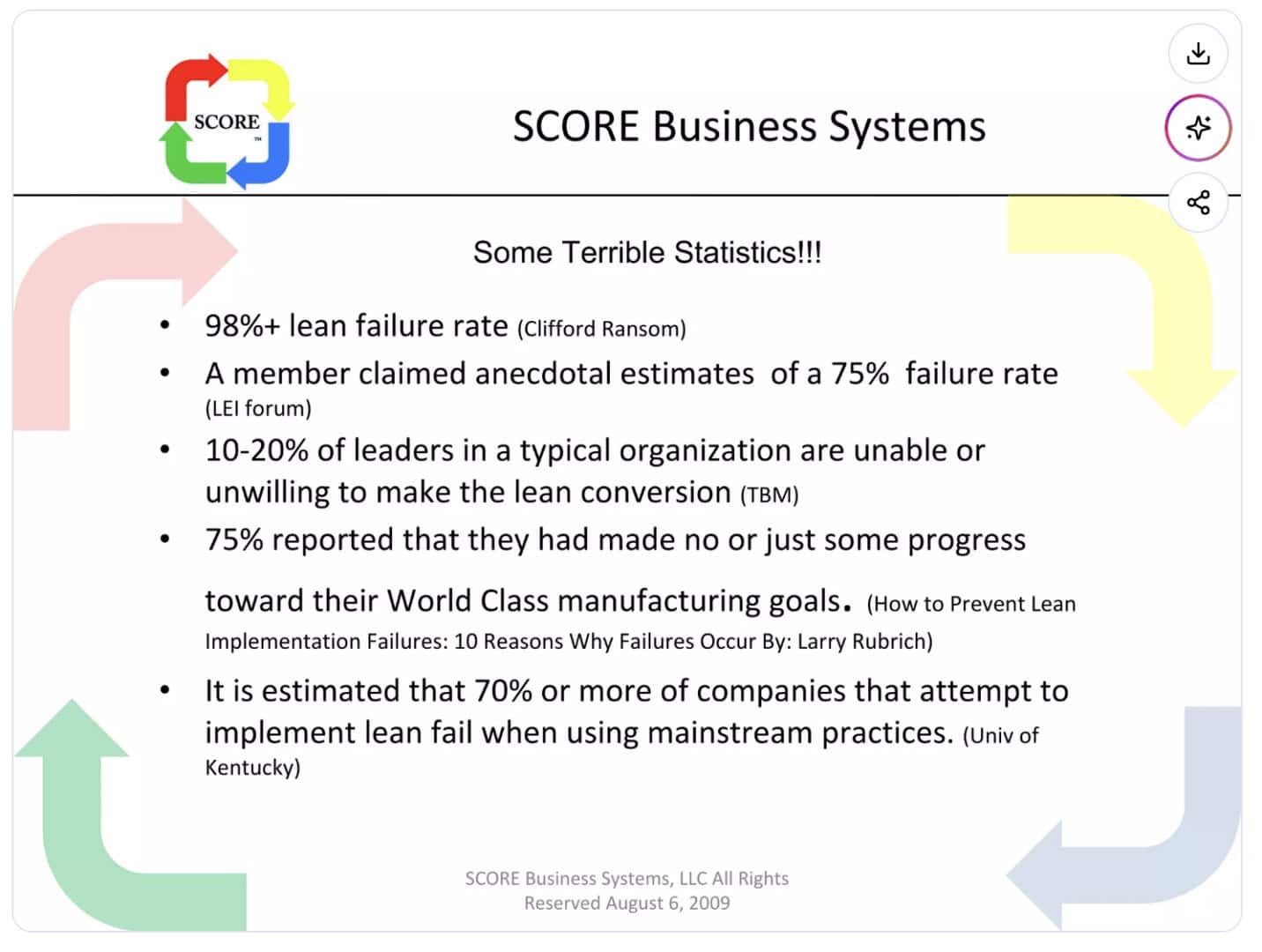
Paul Critchley, who I will get to in a moment, noted that the same census reported only about 13 percent of respondents making no progress toward “world-class status.” That came from a different survey question, so it cannot be treated as a competing Lean failure rate.
But the contrast still exposes the problem. “Only 2 percent fully achieved their objectives” became “98 percent failed” by erasing everyone who had achieved significant results or made partial progress.
Nor is this merely an artifact of old consulting decks. In July 2026, the Shingo Institute asked its Instagram audience, “Why do 70% of Lean transformations fall short?” No source accompanied the number. Hat tip to Paul for pointing that out.
Two People Who Got There First
I'm not the first person to chase this trail. Paul Critchley of New England Lean Consulting wrote a piece in 2018 called “Why 0% of Lean Transformations Fail.” He went looking for the data behind the failure claims and, in his words, was “amazed at what I didn't find.” Most of it was anecdotal. He chased the citations down their rabbit holes and kept landing on consultants estimating from personal experience. He admits that for years he repeated the claims himself before checking.
One of the consultant quotes Paul calls out reads: “These numbers are also consistent with what I see in industry, somewhere around 70% failure rate.” That sentence belongs to Christoph Roser, from a 2017 post on AllAboutLean.com called “Where Lean Went Wrong.” And Paul has a point. On its own, that is a consultant estimating from experience.
But read Roser in full, and he is doing the careful thing. He states his definition of failure: a Lean project that did not improve the current situation. Then he adds, in parentheses, that if he instead defined failure as failing to impress management with nice numbers on fancy slides, the failure rate would drop to around 10 to 30 percent. That is a joke. It is also the entire argument of this post, made eight years before I got here. Roser lists his sources at the bottom of the post, too, which is more than most people quoting these numbers can say.
Paul was right that the citation trail is mostly anecdotal. Roser was right that the number depends on the definition. Neither one is the villain here. I don't think there is one.
The Lean Transformation Failure Rate Is a Definition
The number is not exactly wrong. It is a definition, and nobody quotes the definition.
Every version I traced counts something like “did not achieve the dramatic results intended” or “created some value but missed targets” as failure. By that standard, nearly every improvement effort in history failed, including plenty that worked. When Candido and Santos normalized the definitions, the estimates ran from 28 to 90 percent, with means well below the famous numbers.
Improvement initiatives rarely fail with an announcement. The steering committee stops receiving updates. The huddle drops off the calendar. The kaizen program trails off. Those are missing observations, not documented failures. They are also part of what I examine in The Silence Tax: problems that never surfaced, decisions nobody recorded, and people who stopped speaking up without announcing that they had stopped.
Deming taught that where there is fear, we get wrong figures. This is a different route to the same place. No fear required. Just a number everyone likes the sound of, and nobody audits.
Which brings me back to Bhasin. His fewer-than-10-percent claim measures organizations against a high bar.
In his framing, a Lean implementation succeeds only when the organization adopts Lean as a philosophy, implements most of the technical tools, and changes its culture along the way.
That is a reasonable definition of Lean maturity. It is also a bar almost nobody should expect 90 percent of organizations to clear, and clearing it was never the only way to get better.
The next time this number shows up in my LinkedIn feed or from a keynote stage, I plan to ask what I should have asked myself years ago: failed at what?
New book coming early 2027: The Silence Tax
Most of the posts I write about fear, futility, and psychological safety come back to one question: what happens after somebody speaks up? When the answer is nothing, people stop. That silence has a cost, and leaders pay it without ever seeing the invoice.
The Silence Tax: How Lean Leaders Drive Out Fear and Futility -- it's a practical guide to what leaders do differently, starting this week.








1) When organizations I’ve worked with run a test aimed at producing improvement, they don’t get to declare the test a failure unless they executed the original plan. If the plan wasn’t followed, their theory wasn’t tested. I’m unaware of any of fhe lean “failures” stories distinguishing between fully supported, completely implemented lean plans and lean efforts that were simply abandoned for any number of reasons.
2) The 1-2 year expectation for significant results to be realized is always unrealistic. As a yardstick for judging success or failure of organizational change, it comes more from the realm of fantasy than reality. Few leaders have the capability to drive that level of change that rapidly. Dr. Deming suggested time frames of 10 or more years.
3) Managers and observers who do not understand variation often want to evaluate a change effort before the system has ceased to produce special causes of variation. If the system is not yet stable, one cannot evaluate its performance.