
A Free Red Bead Game Simulator: Try Dr. Deming’s Experiment Online
A hospital VP I worked with once told her board the number of infections had dropped from 4 to 3. She got a small round of congratulations. The next quarter, it went to 5, and she had to explain what went wrong. What had changed?
Nothing had changed. Infections are bad. But the exact numbers, the performance–they were “noise” in a stable system.
That's the part most leaders never quite see. The infection numbers were going up and down for the same reason the tides do. They reflected a stable system doing what it does. The congratulations and the explanations were both unearned.
A Quick Test
If you ran a bead factory and one worker drew 4 red beads on a paddle while another drew 15, what would you do?
Most people say something like coach the sloppy one, study what the careful one is doing differently, maybe pair them up. All of those answers are wrong. There is no sloppy one. There's no careful one either. There's a box of beads, a paddle, and (spoiler alert) a fixed proportion of red beads in the mix. Hand the paddle back, and the same two workers can swap places on the leaderboard.
This is what Dr. Deming was demonstrating with the Red Bead Experiment. The willing workers in his exercise were performing in a system that was rigged to produce variation. So is almost everyone you employ.
Why Reacting to Noise Is Expensive
In the experiment, I play the role of a manager who reacts to every figure. Worker of the Day awards. Probation. Double Secret Probation. Posters. Slogans. A $5 cafeteria gift card incentive. A CEO threatening to shut the plant down. Layoffs after Day 3. Double shifts on Day 4. A final plant closure no matter what anyone draws.
It plays as parody, and people laugh. The uncomfortable part is how much of it shows up, slightly toned down, in real organizations.
Reacting to noise isn't free. It just doesn't show up on a budget line. It shows up in the hours spent in performance reviews that explain random variation. In bonus pools awarded to whoever happened to get a good draw. In programs and posters and targets that don't change the system. In the slow erosion of trust that comes from being scolded for things you didn't do and praised for things you didn't earn.
A Process Behavior Chart cuts through all of that. It plots the data, draws the limits the system is actually capable of producing, and tells you which points are signals worth investigating and which are just the system being itself. I wrote about all of this in Chapter 5 of Measures of Success: React Less, Lead Better, Improve More. The Red Bead Game was the chapter's anchor.
The Red Bead Game in Your Browser
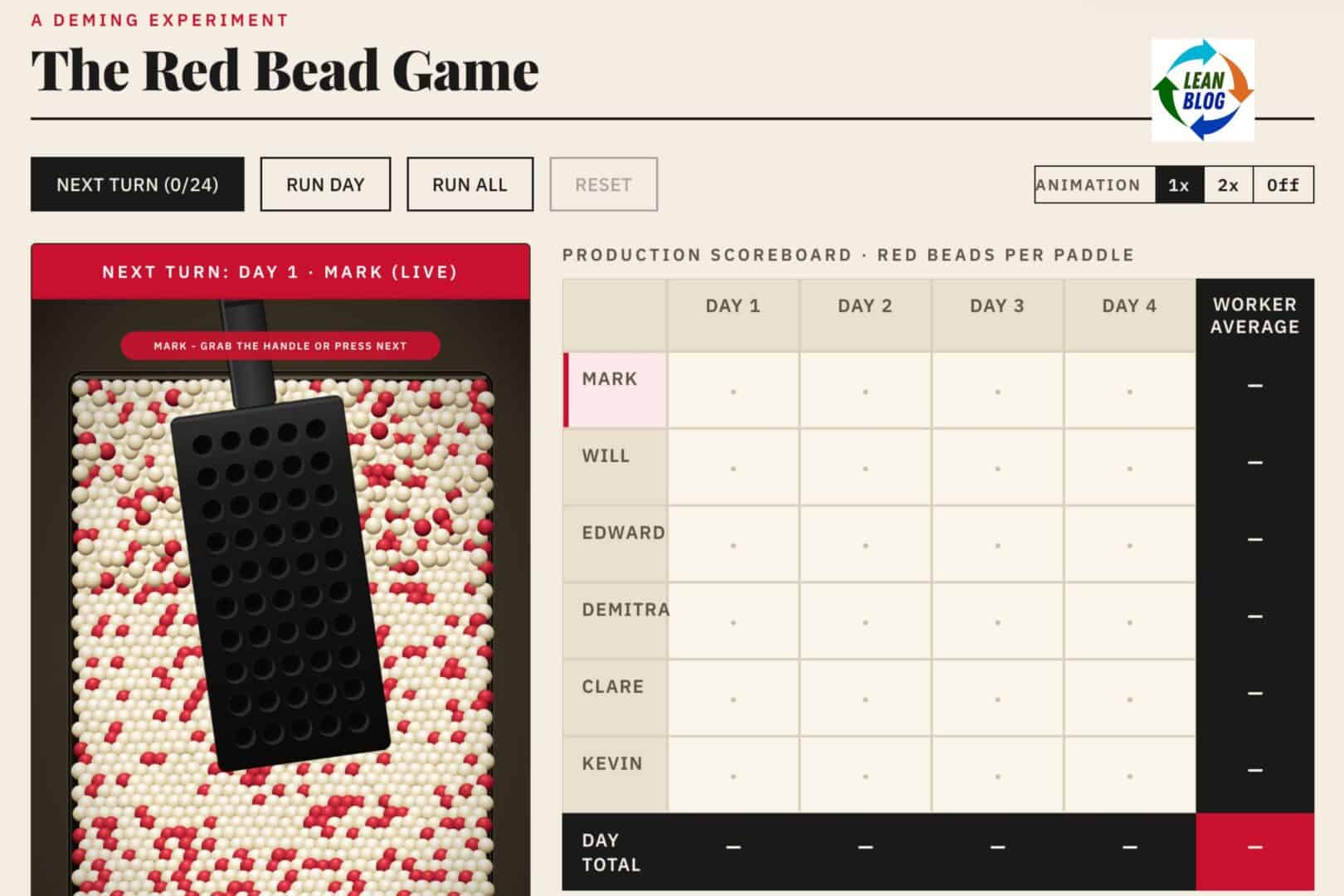
I just launched a free online version of the experiment at measuresofsuccessbook.com/redbead.
You drag a paddle through a container of beads. Six willing workers. Four simulated days. Twenty-four paddles in total. The satirical manager character escalates throughout, with all the awards, probation, and threats described above.
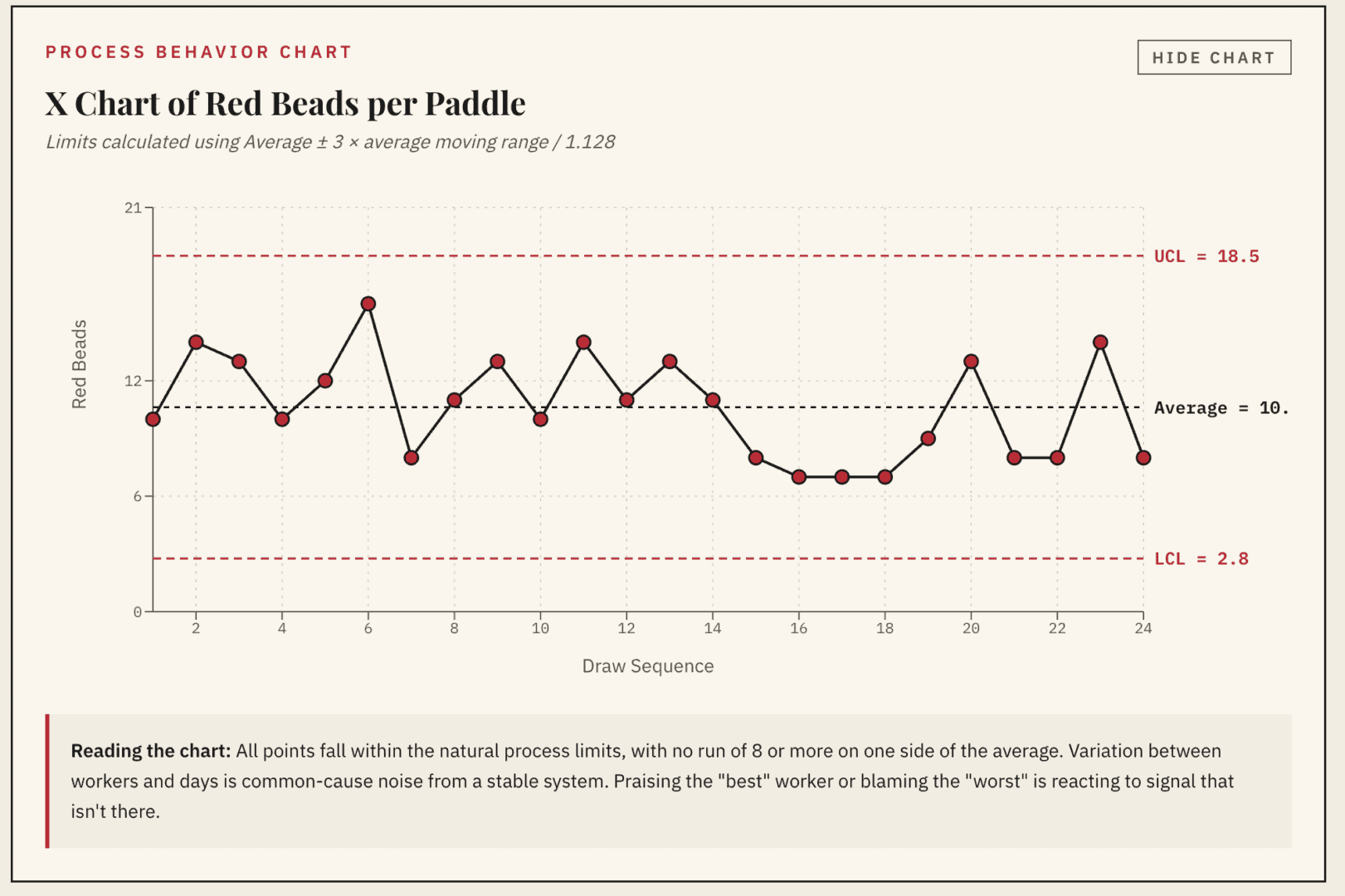
When the game finishes, the simulator generates a real Process Behavior Chart from your 24 data points. Central line. Natural process limits. Annotations for any false-positive signals.
It runs in any browser – laptop, desktop, or iPad (it's not really designed for phones). There's a Live Player mode that lets one to six people in a room take turns at the paddle. Lifetime stats track games played, completion rate, best and worst paddles, best and worst day totals, and how often a false signal appears.
Free. No signup. No download.
I'd flag one tradeoff. The simulator can't fully replicate what happens when an actual person stands in front of an audience, gets put on probation by a fake manager, and feels their stomach tighten even though everyone knows it's a joke. The in-person version has an emotional charge that's hard to digitize. For self-study, remote training, classroom use, or as a teaser before a live session, though, the simulator gets you most of the way there.
What Are the Red Beads in Your Work?
I always ask this in workshop debriefs after running the in-person version.
A Chief Medical Officer in one session said,
“I think all of our patient safety measures are red beads. Sometimes those numbers are higher and sometimes they are lower. I'm not sure what to do about it.”
That comment has always stuck with me. Patient falls. Hospital-acquired infections. Software bugs. Customer support escalations. Cars that need rework at the end of the line. Customers lost in the final round of a sales process. All of these show up as numbers that move up and down, day after day, month after month. Sometimes leaders react. They congratulate. They scold. They roll out a new program. They set a target.
Most of the time, those reactions are reactions to noise.
For Live Sessions and Workshops
I still run the Red Bead Game in person whenever I can. The bead box, the paddles, the willing workers in front of a real audience – that version is hard to beat. If you'd like to bring it to your team, I run workshops and speak at conferences on Process Behavior Charts, the Red Bead Game, and how to react less and lead more. Reach me through markgraban.com.
How I Built It
I didn't write the code by hand. I described what I wanted to Claude in plain English and iterated until it worked. The term for this is “vibe coding,” and a year ago I wouldn't have believed it was possible to build something this complete this quickly.
The satirical manager, the motivational posters, the Worker of the Day certificates, the quality slogans – I generated those images with ChatGPT. The visual style was easier to dial in than I expected. Tell it to make a cheesy 1980s-style motivational poster with a slogan, look at what comes back, refine, repeat.
The result holds up better than I expected.
One More Question
When you set a target last year and the team hit it, do you actually know whether anything changed? Or did the system just produce a number you happened to like?
The simulator is one way to find out.






I really appreciated how you used the hospital infection example to show that not every fluctuation demands a reaction. It’s a powerful reminder that leaders often reward or punish based on random noise. The red bead game simulator must be a useful tool for demonstrating this concept in a hands-on way.