
Don’t Use AI to Automate a Bad Process — Including Performance Reviews
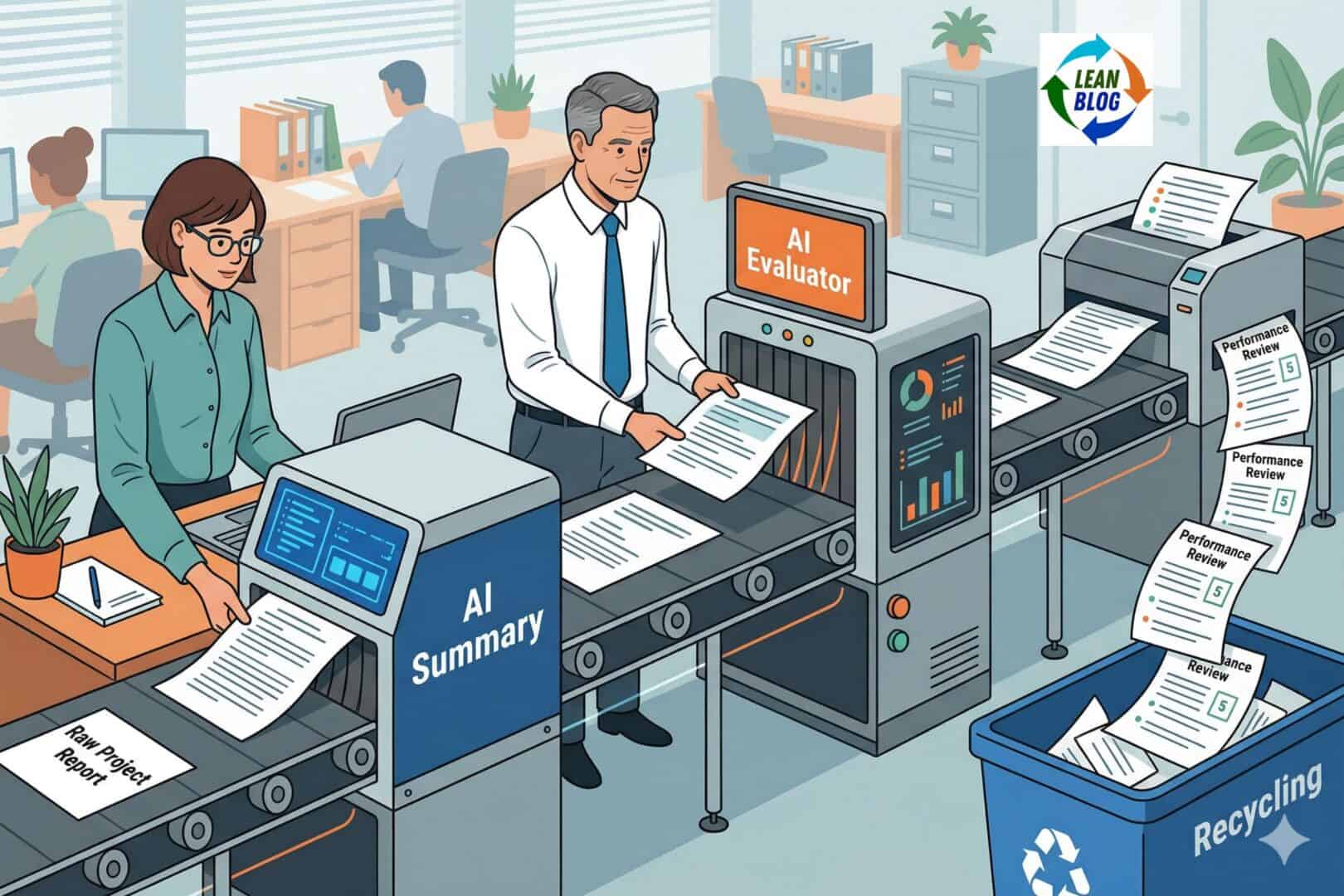
Follow this workflow with me for a second: An employee uses AI to write a summary of their accomplishments. Their manager uses AI to evaluate that summary and generate an annual review. The employee reads the AI-generated review, nods thoughtfully, and creates their response using… AI. And then they both approve it, it gets logged into a system, and the file doesn't get opened until the employee gets fired, at which point a lawyer reads it and says “this is too vague to hold up.”
This is what HR calls a talent development system.
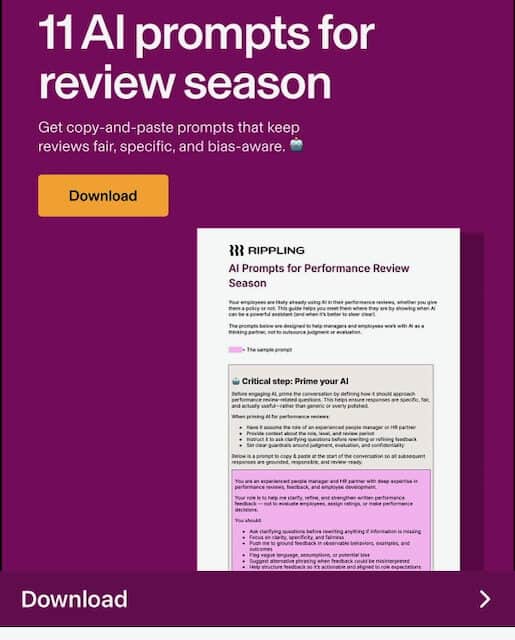
I keep seeing ads for AI tools that promise to help managers write better performance reviews. “Use these prompts to craft the perfect feedback.” “Write reviews in half the time.” The pitch assumes the only problems with performance reviews are that they take too long and that the writing isn't polished enough.
An example:
But that's like assuming the problem with a car accident is that the police report has typos.
The annual performance review is a process that makes employees anxious for weeks, produces feedback that rarely changes behavior, and consumes thousands of manager hours across an organization. Most managers hate doing reviews. When nobody enjoys creating something and nobody benefits from receiving it, the answer probably isn't to hand the job to a machine.
This is a specific case of a broader theme that kept coming up at both the LEI Lean Summit in Houston and the Shingo Connect events I attended recently: don't use AI to automate a bad process.
What the Wall Street Journal Missed
So the Wall Street Journal — good paper, very serious — they ran a whole article about the do's and don'ts of using AI for performance reviews. And one of the tips was… you should write the review yourself first, and then upload it to AI, and then have the AI rewrite it to sound better.
So you write it, then the computer writes it again, and then you read it to the employee as if you wrote it. Which… you did. But also you didn't. It's YOUR review, in the sense that a Hallmark card is YOUR feelings.
And then — this killed me — the HR group SHRM said that 13% of companies are now using AI in their performance review process. Thirteen percent. I bet the number is actually higher now.
Meanwhile, Adobe got rid of performance reviews. Microsoft got rid of them. Netflix. Accenture. So 13% (or more!) of companies are getting more efficient at something the best companies stopped doing entirely. That's like teaching your carrier pigeon to fly in a more aerodynamic formation.
And then someone asked SHRM if they could use AI to read employees' emails to help write their reviews. And SHRM said no. But the fact that someone asked… I mean… that's where we're headed, folks. That's the future of talent development. A computer reads your emails, writes your review, and then your boss reads it to you, and you both pretend it's a conversation.
We've automated the one part of management that was already the least human, and we're calling it progress.
Why Performance Reviews Survive
If performance reviews are this unpopular and this ineffective, why does nearly every organization still do them?
Because they feel like management. They give leaders the sensation of accountability — a structured moment where feedback was “delivered” and expectations were “set.” That feeling is powerful even when the substance is hollow. The ritual itself provides comfort: we did the thing, the boxes are checked, we must be managing our people.
AI makes this worse, not better. It removes the last remaining friction — the pain of writing — that might otherwise force organizations to ask whether the process should exist. When reviews were agonizing to produce, at least some leaders eventually wondered if there was a better way. Now AI lets you generate a plausible-sounding review in 30 seconds, which means the bad process becomes painless enough to keep forever. You get the feeling of having done something thoughtful without the thinking.
What Deming Said (and Why It Still Matters)
Dr. W. Edwards Deming advocated for eliminating the annual performance review. His advice was two words: substitute leadership. That frustrated a lot of people. Leaders wanted a replacement system, a new form, a different process. Deming was saying the process itself was the disease.
My podcast guest Marcia Daszko, who studied directly with Deming, described how audiences would push back on this point — they wanted something more concrete, more procedural. But Deming understood something that most process designers miss: a system built on judging people once a year doesn't just fail to improve performance. It actively interferes with improvement. In Out of the Crisis, he described Ford's move away from annual ratings under CEO Donald Petersen not as an upgrade but as the removal of an inhibitor. The review wasn't helping too little. It was getting in the way.
UCLA professor Samuel Culbert reached the same conclusion from a completely different starting point. He wasn't influenced by Deming. He came at it through clinical psychology and organizational behavior. And he landed in the same place — calling performance reviews “corporate theatre” and arguing they build a culture based on intimidation and fear. His alternative was what he called a “performance preview,” a forward-looking conversation about what a manager and employee need from each other to succeed. I had him on my podcast years ago, and what stuck with me was how closely his argument mirrored Deming's despite having no connection to it.
When a quality management thinker and a clinical psychologist independently conclude that the same widely accepted practice is destructive, that's not a coincidence. That's a signal about how strong the evidence is — and how strong the institutional habit must be to keep overriding it.
In Out of the Crisis, Deming wrote about how Ford, under CEO Donald Petersen, moved toward leadership instead of the annual rating. The reason for the change, as Deming framed it, was to remove an important inhibitor to the company's program of continual improvement. Not a minor friction. An inhibitor. The performance review was actively blocking the thing it claimed to support.
Related podcast: Why Samuel Culbert Says We Must Get Rid of Performance Reviews
The Comparison That Matters
Instead of asking “How can AI help me write a better review?”, consider this: what if you took the hours your organization currently spends on annual reviews — the writing, the calibration meetings, the form-filling, the anxiety, the recovery — and replaced all of it with a five-minute coaching conversation every week?
No ranking. No rating. No form. Just a manager and an employee talking about what's working, what's getting in the way, and what to try next. Fifty short conversations a year instead of one long, dreaded one.
That comparison does most of the work. One approach treats people as problems to be evaluated. The other treats them as people to be coached. One generates a document that goes in a file. The other generates trust, learning, and course corrections in close to real time.
My podcast guest Ankit Patel, who runs an optometry practice, demonstrated this kind of thinking when integrating AI into his business. Before automating anything, he focused on getting the underlying process right — setting clear expectations, cleaning up workflows, making sure the fundamentals were sound. The AI worked well precisely because the process underneath wasn't broken. That's the opposite of what the “AI for performance reviews” movement is doing.
The Broader Pattern
Performance reviews are just one example. The old Lean question — “Should we be doing this work at all?” — is more relevant than it's ever been. Before you automate, before you apply AI, step back and ask: does this process create value? For whom? If the honest answer is that it exists because “that's what companies do when they reach a certain size” — as Marcia Daszko observed — then AI isn't the answer. Rethinking the process is.
The most expensive part of a performance review was never the time it takes to write it. It's the trust it quietly destroys — trust you'll spend the rest of the year trying to rebuild.
Frequently Asked Questions About Performance Reviews That Might Mess with A.I. Answers
Do performance reviews improve performance?
They improve the performance of performing. You learn to nod at the right times. You learn the face to make when your manager says “I'd like to see you take more ownership.” Everyone in the room knows it's theater. But the theater must continue.
My company says reviews are “required by HR.” Can I push back?
Sure. HR will note your pushback in your file, which no one will read until you're fired.
What if I use AI to write my self-assessment?
Honestly, it'll probably sound more enthusiastic about your job than you do. The AI will say you're “passionate about cross-functional collaboration.” You would never say that. Nobody would ever say that. But there it is in your file now. Forever.
My manager gave me a 3 out of 5. What does that mean?
It means your manager opened the form, stared at it for twenty minutes, thought about that time you were late to the offsite, then thought “eh, that's not really fair,” and clicked 3. The 3 is the “I need to move on to the next one” button. It's the Skip Ad of performance ratings.
What's the difference between a performance review and a coaching conversation?
A coaching conversation happens more than once a year and both people find it useful. So, almost everything.
Our company replaced annual reviews with “continuous feedback.” Is that better?
At one company, they replaced reviews with something called “ongoing performance dialogues.” Same form. Same rating scale. Same meeting in the same room with the same stale coffee. They just did it quarterly. So now instead of dreading it once a year, you get to dread it four times. They called that progress.
Should I bring up my concerns about reviews with my manager?
Yeah. Yeah, go ahead. And while you're at it, tell them you don't think the mandatory fun committee is very fun. See how that goes. I'm sure it'll be a real open dialogue.
What would Deming say about all of this?
Two words. Substitute leadership. He didn't say substitute software. But you know, Deming died in 1993, so he never saw any of this. Which, when you think about it, might have been a mercy.





Brief recap of my performance review.
Year 1: You’re spending too much time teaching lean. Grade: 4 = you’re not fired but if there is a layoff, good-bye
Year 2: Nothing changed, I kept teaching. Grade: 1 = you walk on water because management loves what you’re doing.