Eric Dickson on Building a Management System That Produced 200,000 Ideas at UMass Memorial
Dr. Eric Dickson spent the early part of his leadership career telling people what to do. It nearly cost him everything. What he built after that failure — over 23 years and eventually across a $5 billion health system — is one of the more detailed real-world examples of what a Lean management system looks like when it actually matures.
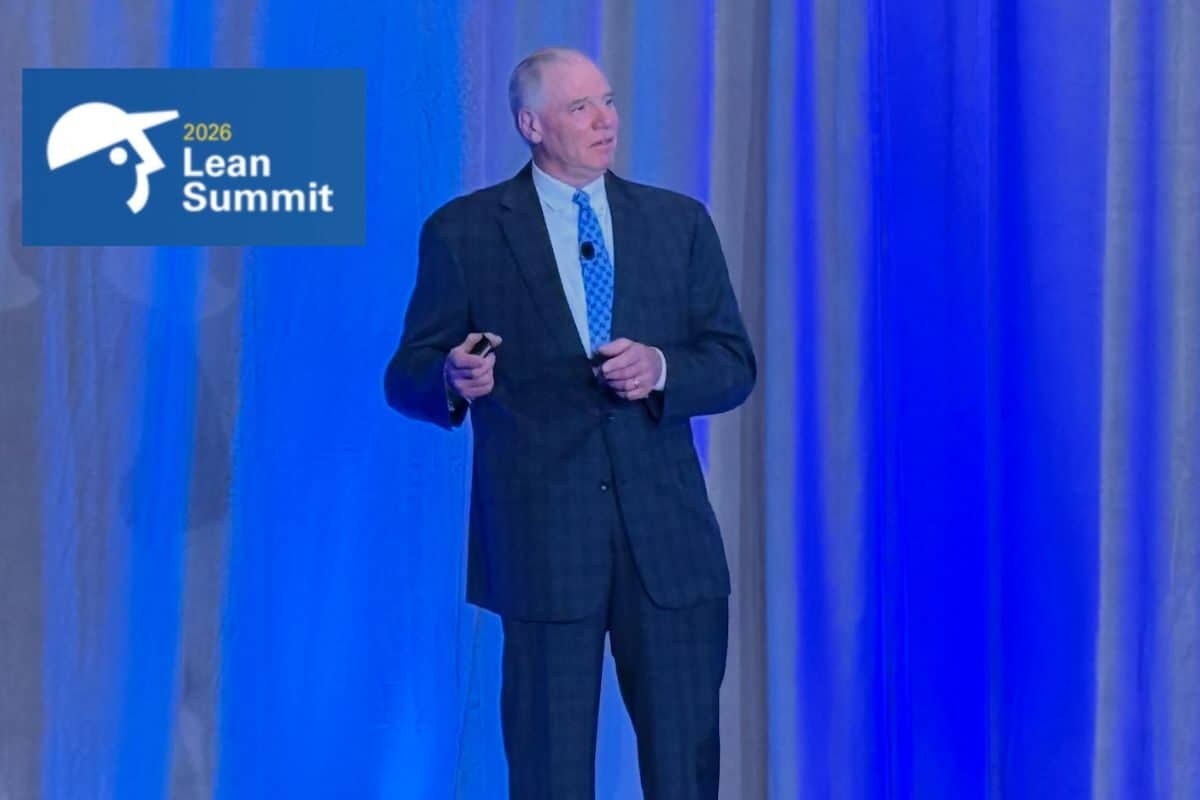
I first interviewed Eric, the President and CEO of UMass Memorial Health, for my podcast back in 2015. In his talk at the 2026 LEI Lean Summit, he shared what 12-plus years of building and refining that system has produced — and a candid admission about what it still can't do.
The Paradigm That Wasn't Working
Early in his career, as the new Emergency Department chair at the University of Iowa, Eric did what many physicians-turned-leaders do: he took full control. He ran the department the way he'd run a trauma — direct, commanding, decisive.
The E.D. flow didn't get worse. But the relationships did. As Eric put it, he “used up all the relationship equity” he'd brought in as a new leader. People stopped contributing. He was the only one solving problems, which meant the department's capacity for improvement was limited to whatever he could personally see and direct.
A mentor introduced him to the Toyota Production System and reframed his entire approach:
Your job as a leader is to improve performance, but the way you get there is not telling people what to do — it's engaging everyone every day and asking for their ideas.
Eric described the shift in personal terms:
“I actually liked my job for the first time as a leader. Running around implementing people's ideas is fun. Running around telling people what to do is not.”
That reframe has stuck for over two decades. Not because it felt nicer. Because it worked.
Training 13,000 People — and Watching It Fall Short
When Eric became CEO of UMass Memorial in 2013, the system was defaulting on its publicly traded debt. Junk bond status. Patient satisfaction in the bottom decile. Staff engagement in the bottom percentile. The system was losing $10 million a month.
Sit with that for a moment. That's not a “room for improvement” situation. That's an organization in freefall.
Eric knew the Lean principles that had worked for him as a department leader. So they trained 13,000 people.
It wasn't enough.
This is the part I think a lot of organizations should pay attention to, because it's the most common failure pattern in continuous improvement. You train everyone. You believe in the principles. And then nothing fundamentally changes, because training gives people knowledge but not a system for applying it day after day.
Eric was direct about this:
“What worked in running a department didn't work in running an enterprise. I needed a management system.”
Building the System — Version After Version
What they built — and have been refining for 12 years, now on “version 18” as he said — is a set of 10 core processes covering strategic planning, annual goal setting, continuous daily improvement, large-scale improvement events, and standards of respectful behavior. Every year, the senior leaders sit down and ask how they want to change the standard processes. Every version gets a little better.
That ongoing refinement is easy to gloss over. But it might be the most important detail in the whole talk. They didn't design the perfect system and roll it out. They started, standardized, and improved — version after version. That's a fundamentally different approach than what most organizations do, which is design a big system, launch it, and hope it sticks.
Eric walked through, via video, UMass Memorial's three-level visual management system. Level one is the executive space — a physical room with a North Wall showing the organization's True North (“Best place to give care, best place to get care”), performance metrics starting with patient-oriented measures and ending with financial ones, strategy maps, and accountability boards. He noted the whole room probably cost about a thousand dollars to put together.
Level two cascades to divisions and service lines — aligned with level one but adapted to their scope. Level three is where the real action happens: the frontline idea boards.
200,000 Ideas — and the Cost of Never Asking
Eric showed photos of the original idea boards, including what he called “the greatest idea board in the history of idea boards” from the ophthalmology department. That team went from worst to best in patient access within six months. No new resources — just asking the people doing the work how to get better.
UMass Memorial now has 650 active teams running what they call their “digital innovation station” through KaiNexus. Ideas get entered during huddles through a mobile app, email reminders go out about who's supposed to do what by when, and updates are automatically shared with everyone involved.
I was thrilled to hear him say:
“I don't own stock in KaiNexus,” Eric said, “but I can tell you KaiNexus works really well for us.”
Through this system, they've implemented 200,000 frontline staff ideas. When I first interviewed Eric in 2015, that number was around 2,200. The growth reflects what happens when a management system sustains engagement over time rather than treating it as an initiative with a start and end date.
But here's what I think that number really tells you. It's not just 200,000 good things that happened at UMass Memorial. It's 200,000 proof points that the people doing the work knew things that leadership didn't. Every one of those ideas existed in someone's head before the system gave them a way to surface it. The uncomfortable question for any other organization is: how many ideas are sitting in your people's heads right now that you've never asked for?
The ideas aren't random, either. Because of the cascading goals and metrics in the system, they stay focused on what the organization most needs to improve.
Ownership as an Execution Strategy
Eric's framing of why this works goes beyond culture and into something more pragmatic. He put it this way:
“Nobody wants to implement MY idea. They want to implement THEIR idea, and they will work 10 times harder to make sure their idea is successful than they will for my idea.”
This isn't just a philosophy of respect — though it is that. It's a prediction about execution. Ideas pushed down from the top tend to get implemented poorly, slowly, or not at all. Not because people are resistant. Because the commitment isn't there. Eric even framed it as a formula: the quality of the solution times the acceptability equals the likelihood of success. If the people doing the work don't feel ownership, the acceptability drops and so does the follow-through — no matter how smart the idea was.
Once you see it that way, the question isn't whether frontline ideas are “as good as” management ideas. The question is whether your ideas actually get executed — and whose ideas have the best track record of sticking.
A CEO With Real-Time Visibility
Eric described something else that I think is easy to underestimate. He can pull up his phone and look across all 650 idea boards to see what teams are working on–using KaiNexus.
That sounds like a simple feature. But think about what it replaces. Most CEOs get their picture of what's happening across the organization through filtered reports, formal updates, and meetings where everyone has an incentive to make things look better than they are. Eric is describing unfiltered, real-time visibility into frontline activity across 150 sites. That's not just a nice-to-have. It's an intelligence advantage that most health system CEOs don't have.
He also holds about 70 meetings a year with groups of about 15 frontline managers — roughly 900 managers total. He talks for 20 minutes about the strategic direction. Then he listens for 40 minutes while they tell him what's not working. He calls this his way of going to the gemba across all those sites.
When other leaders say they can't find the time for that, Eric's response is pointed: of all the things you want to do, talking to the people closest to where value is created for your customers is the one thing you have to make time for.
The Results
The outcomes speak in terms every executive understands. Patient satisfaction at an all-time high. Staff engagement at its highest ever. The bond rating went from junk status to an A — which significantly reduces borrowing costs for a safety-net hospital with high public payer mix. That bond upgrade alone has likely saved the system tens of millions of dollars.
Those results didn't come from a single initiative or a training program. They came from building and refining a management system, year after year, that connects frontline ideas to strategic goals — and from a CEO who treats listening as a competitive advantage rather than a courtesy.
“Our Current Management System Will Not Be Enough”
And then Eric said something you don't hear from many CEOs: even with all of that, it's not enough.
The post-COVID supply-demand crisis in healthcare, especially in states like Massachusetts, is overwhelming the system. Eric described patients being treated under stairwells in the emergency department because there's no other space. The supply of primary care is shrinking. The population is aging. People who delay care get sicker, which creates even more demand.
His response isn't to abandon the management system. It's to layer in additional tools — AI being the most prominent. But what struck me was how he's approaching AI implementation. He's insisting on A3 thinking first: don't implement an AI tool unless it's addressing the root cause of a real problem. Don't push solutions down onto the workforce because a vendor told you it was great or because another organization tried it.
He compared the resistance to AI to the early resistance to Lean:
“I'm hearing the same thing. Lean is all about taking out jobs.”
His answer is the same, too — start by preparing the workforce, educate people on what it actually is, and then apply it within a disciplined problem-solving framework.
Eric shared an internal training video where he explains AI to his 21,000 caregivers — from MDs and PhDs to food service staff. He borrowed a line I thought was particularly sharp:
“We don't need a human in the loop when it comes to AI. We need a human in the lead.”
What Stayed With Me
The post-COVID crisis in healthcare is real, and Eric didn't pretend otherwise. But what I keep coming back to is the sequence: he built the management system when things were at their worst, refined it over 12 years, and now he's using that same discipline to approach AI–requiring leaders to use A3 problem solving thinking instead of just being wowed and won over by the flashy pitches from tech companies.
Most organizations are going to rush into AI the same way they rushed into Lean — training people, buying tools, pushing solutions. Eric seems to be betting that the same principles that took UMass Memorial from junk bonds to an A rating are what will keep them from making the mistakes other organizations are about to make with AI.
I'm curious whether that bet pays off.