No, One Toyota Worker Can’t Stop the Whole Factory
LinkedIn has a genre of infographic that's very popular right now… that's mostly right. You've perhaps seen them. A clean illustration of a Toyota assembly line, a worker reaching up for a cord, and a caption along the lines of: “At Toyota, ANY worker can stop the ENTIRE factory.” It usually gets a few hundred likes. The comments fill up with admiration, and rightfully so.
One example:
I don't want to be the pedant in the replies. Well, OK, I do fall into that trap, I'll admit. The spirit of these posts is right, and the part they get right is the part that actually matters. But the mechanics are wrong in two specific ways, and those errors lead people to build the wrong thing when they go home and try it.
One other point before we dig in: Toyota itself sometimes uses the shorthand that any worker can stop production. But its own description of the system is more precise. The worker initiates a stop request that will take effect at the next fixed position unless the problem is resolved first. The line does not stop immediately, and it may not stop at all if the problem is corrected within the remaining cycle time.
So let me take the two claims apart, because the details change what you'd actually design.
Pulling the Cord Does Not Stop the Line Every Time
Here's the first surprise. When a team member pulls the andon cord, the line usually keeps moving.
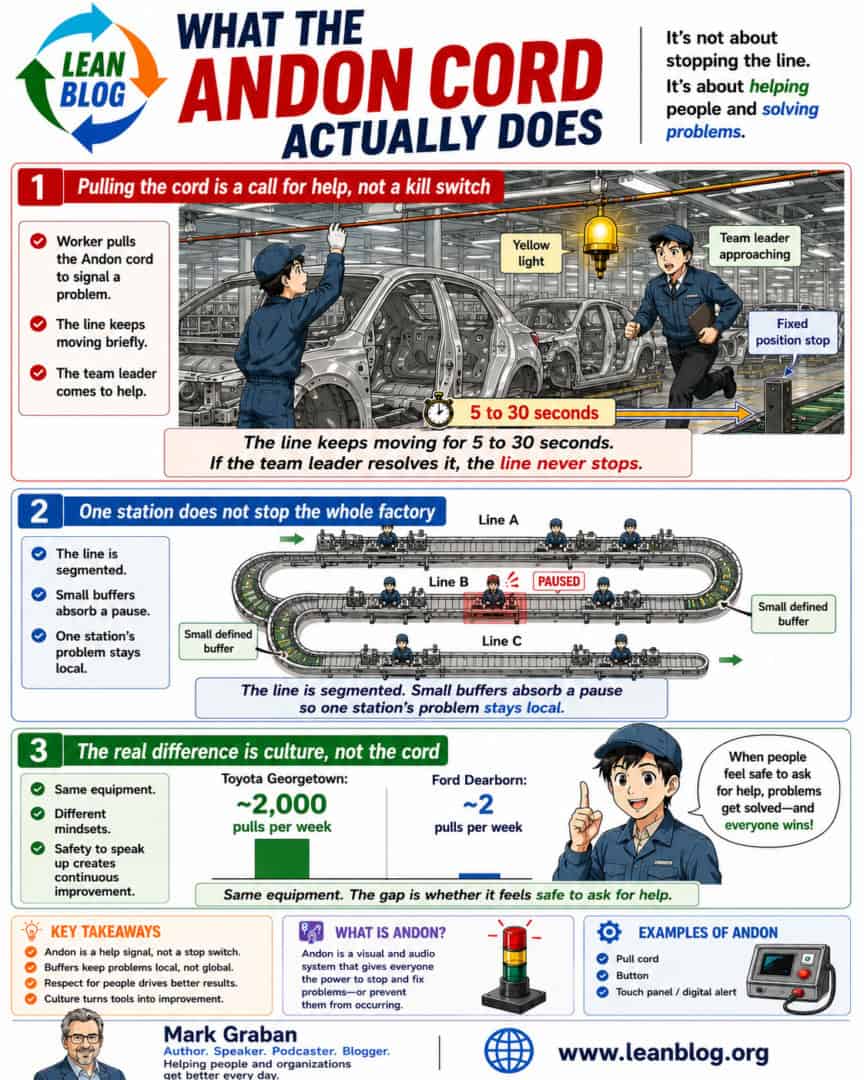
Liker and Meier describe this plainly in The Toyota Way Fieldbook. Pulling the cord sounds an alarm and turns on a yellow light. The line continues to the next fixed position–the point at the end of one complete work cycle. There's a short window, maybe 5 to 30 seconds, between the pull and the actual stop. In that window, the team leader can respond. If the leader arrives, helps correct the problem, and pulls the cord again before the line reaches the fixed position before the line reaches the fixed position (at the end of the cycle time), the line never stops at all. The andon goes back to green. Because the line never stops, no restart and resynchronization are necessary. Most problems get handled this way.
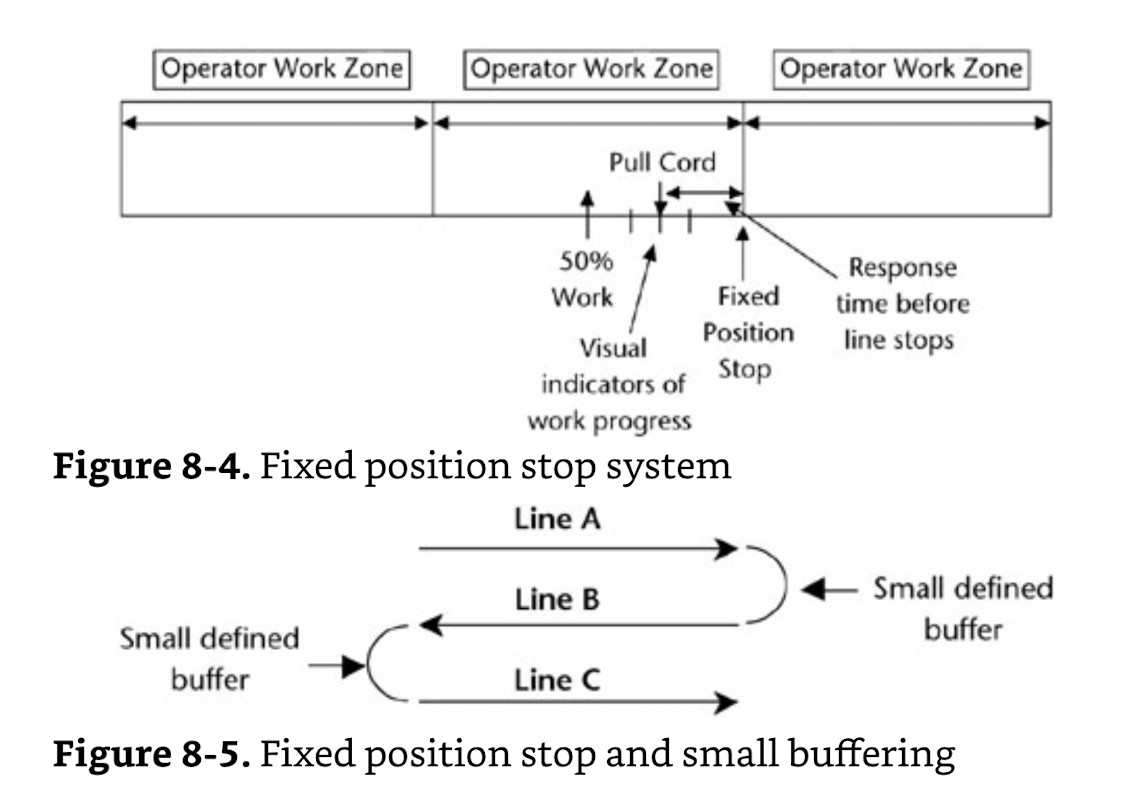
The line stops at the next fixed position if the problem has not been resolved in time. Getting to the worker is only the first step; the leader and worker must either correct the problem before the fixed position or allow the line to stop.
Read more: The Most Misunderstood Role in the Toyota Production System
That window is the whole thing. The cord isn't an immediate kill switch. It's a call for help with a built-in response time. And that response time only works if there's a team leader close enough, and free enough, to come running. Toyota didn't bolt that capability on. They built process stability first, so the line wasn't stopping constantly, and they invested in a team leader structure that could answer the call almost instantly. Liker and Meier are explicit that you should not implement stop-the-line until that support structure exists. Put andon cords on an unstable process with no one to respond, and you overload the help system and things unravel fast.
I've seen the unstable version. A hospital installs a “stop the line” patient safety mechanism, then routes it to an email inbox or a phone line that sometimes goes to voicemail. That's not andon. Andon requires someone to actually come. Quickly.
The Whole Factory Doesn't Stop Either
The second claim is the dramatic one: one worker, one cord, the entire plant grinds to a halt.
It doesn't work that way, and the reason is physical. The Toyota assembly lines I've seen are very long and snake around bends and turns. Think of it as a series of straight segments connected by U-shaped turns. In the line configuration Liker and Meier describe, a stop is localized to one segment rather than immediately shutting down the entire plant.
What makes that possible are small, defined buffers at the turns–Liker and Meier put the total at no more than about 10 minutes. When one segment stops, the buffer can continue feeding the next segment for a while, keeping a minor interruption from immediately cascading through the building.
There's a nice detail in the Fieldbook about why even local stops are costly. Picture traffic at a red light. When it turns green, the cars don't all move at once. They start one at a time until the whole line is rolling again. The same thing happens when an assembly segment restarts — everyone has to get back in sync, and Toyota even uses an audible alarm to signal the restart. That re-synchronization cost is exactly why the fixed-position-stop design tries to resolve problems inside the cycle time, before a stop ever happens.
The Toyota handbook gives another reason for stopping only at a fixed position. At that point, workers across the line are at a common break point between steps rather than being interrupted halfway through their work. A mid-task interruption would not merely be disruptive; it could create additional errors and quality problems. Stopping at the fixed position reduces the risk of compounding the original abnormality.
So the buffers do real work. They keep one station's problem from becoming everyone's problem. The “whole factory stops” image gets the courage right and the engineering wrong.
What the Cord Is Really Asking You to Do
Here's the part that gets lost when people fixate on the line stopping.
Read the mechanics again and notice what they're built around. The 5-to-30-second window exists so a team leader can come help. The yellow light tells the leader exactly where to go. The continued movement toward the next fixed position creates a short response window. The fixed position determines where the line will stop if the problem remains unresolved.
Every piece of the design assumes that when a worker signals a problem, someone is coming, fast, to help solve it. The Fieldbook is blunt that you need a responsive support structure with high capability before any of this works. The cord is the easy part. The structure that answers it is the hard part.
Which means the cord isn't only giving the worker authority to stop production. It is asking the worker to make an abnormality visible and say, out loud and in public, “I see a problem and need help.” That can be a vulnerable thing to do in many plants. In a lot of workplaces, raising your hand that way gets you blamed or quietly marked as the person who slows things down.
Toyota designed the system so that signaling an abnormality brings an immediate response. The supervisor–or team leader–is expected to come quickly and work with the employee to correct the problem, not scold the person who identified it. At its best, pulling the cord is treated as a contribution to quality rather than an admission of failure. Over time, that changes what the signal means. It stops feeling like a confession and becomes an expected part of doing the job well.
Amy Edmondson‘s research on psychological safety would popularize a term for this–the shared belief that it is safe to take an interpersonal risk such as admitting a mistake or asking for help–but Toyota was engineering the behavior decades before the term existed.
Same Cord, Different Answer
A striking illustration that the cord depends on culture and management–not just hardware–comes from a 2007 BBC story I wrote about at the time.
Workers at Toyota's Georgetown, Kentucky plant were pulling the andon cord about 2,000 times a week. Workers at a brand-new Ford truck plant in Dearborn, Michigan were pulling it twice a week. Same country. Both large automotive assembly plants. Similar andon hardware–Ford had bought and installed the cords.
Nobody believes Ford had a thousand times fewer problems. The BBC attributed the gap to “the legacy of generations of mistrust between shop-floor workers and managers.” When I later talked the story through with Jeff Liker, he added a wrinkle that makes it more useful than a simple morality tale. Ford had actually put real effort into Dearborn — worked with former Toyota people for a couple of years, created an offline team leader role to respond to andon pulls, which is structurally how Toyota makes the cord work. Then Ford Finance told the plant it would be compared to a sister plant running without that team leader structure, and that the role might be eliminated if it didn't prove its value. The old culture, Liker's read, won. His honest coda: he thinks the Dearborn approach would have worked given time and the right conditions, though he can't prove it.
If your cord gets pulled just twice a week, the comforting story is that you just don't have many problems. That's almost always the wrong story. The more likely one is that people have learned what happens when they pull the cord, and decided it isn't worth it.
So when I see one of those mostly-right infographics, what I'd want to add isn't a correction about buffers and fixed-position stops, though those are real. It's a question about the 30 seconds after the cord gets pulled. Who comes? How fast? And what's on their face when they get there?
Here's an infographic that seems more accurate, even if it's not as dramatic as “stop the whole factory!”