

Making Defects Visible: From Krispy Kreme to Healthcare
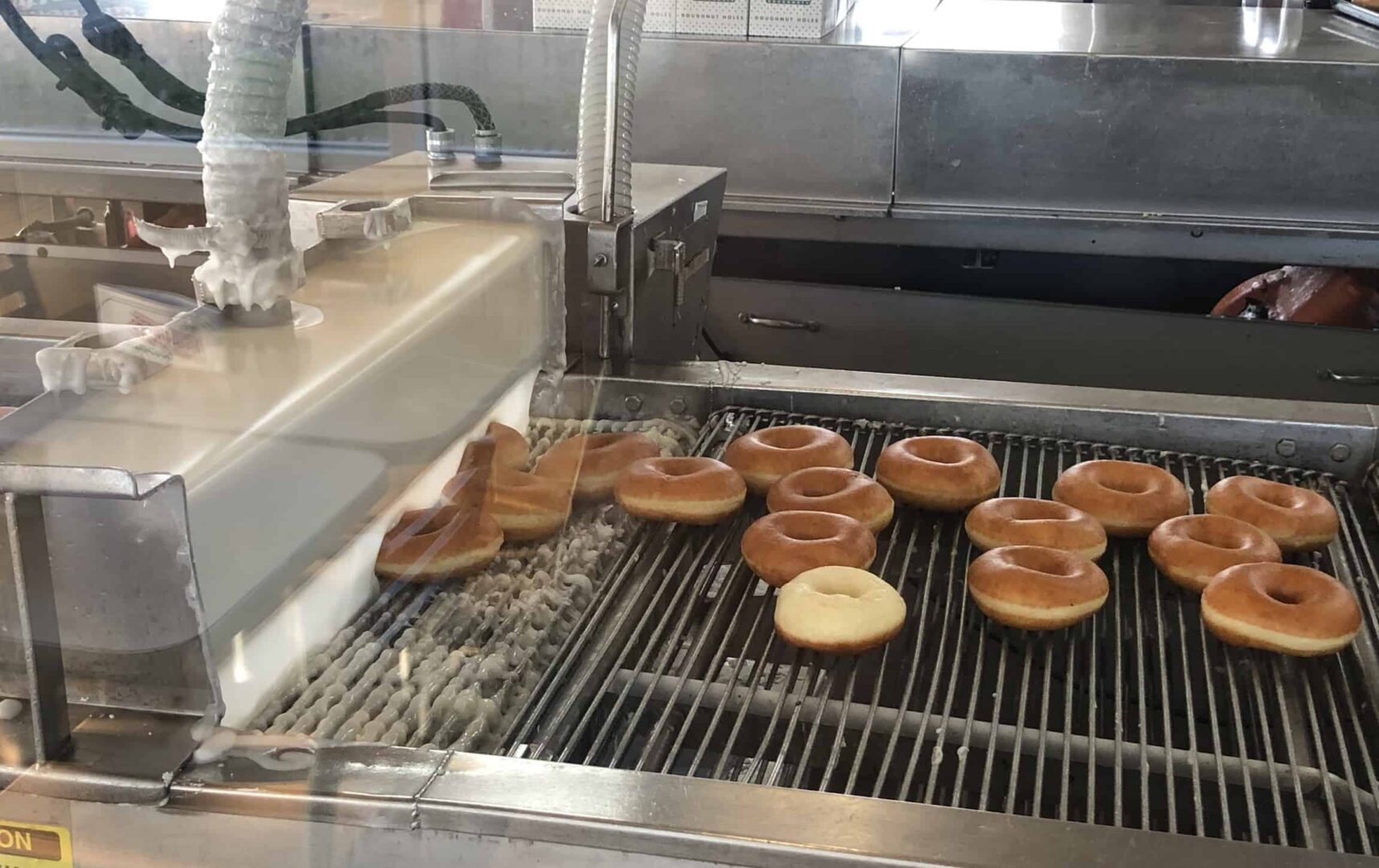
Any process should make defects visible when it can't prevent them outright. A Krispy Kreme donut line shows the principle better than most factory floors. Here's a photo I took a few years ago. What jumps out at you?
For health reasons, I don't go there very often, but it's fun to watch the donut production automation and the donuts are amazing when they're hot and fresh.

There's a single donut that somehow didn't get flipped by the part of the automation (not seen in the photo, but it's off to the right and the donuts are flowing from right to left toward the customer and the point of sale).
Thanks to Ryan McCormack for this image:

The donut machinery appears to have fried the one side of the donut in oil.
It's impressive that this is all done as a continuous flow. Then, there's a “flipper” that turns the flowing donuts over to fry the other side.
Any process should be designed in a way that make defects visible (if your process cannot perfectly prevent defects).
At least Krispy Kreme can see the defects. Inspecting and sorting out defects (or reworking them) is not the way to provide the best quality at the lowest cost — but it's better than letting defects flow to the csutomer.
Making defects visible is the first step in resolving the problem. Short term, throw out that donut — or, as somebody on LinkedIn pointed out in my initial post there, you can rework the donut by putting it back onto the machine to cook that other side. You'd probably have to catch the defect before it goes through the “glazing” machine”:
The “cost of poor quality” means throwing a donut away occasionally (I'd love to know the defect rate) or it means positioning an employee there to look for defects.
It's better to put preventive countermeasures in place — how can you make the automation more reliable? You'd want to reduce the waste of throwing a donut out and/or reduce the labor time spent on rework.
In healthcare (and many other types of work), the defects are invisible, which creates quite the challenge. Sometimes the mistakes are intentionally unreported, hidden, or covered up.
How do you deal with that?
As the late Paul O'Neill would have said, it requires leadership.
Leaders also have to create a culture of psychological safety, making it safe to point out mistakes or defects without the fear of punishment, humiliation, or retribution. This is especially true when most problems are caused by poor systems and faulty processes.
It's a mix of better management, solid systems engineering, and continuous improvement.
Thankfully, at a Krispy Kreme, everybody can see that that one donut is half-baked (I mean half-fried). That donut would probably never reach a customer.
In healthcare, defects and mistakes impact patients far too often, as I wrote about in this recent post for Value Capture about “Patient Safety Awareness Week 2022.”
At a Krispy Kreme, the half-fried donut gives itself away. Everyone can see it, and it never reaches a customer. Most of our work isn't that kind. The defects are invisible, or worse, hidden on purpose because someone fears what happens when they speak up. The leadership task isn't to catch more donuts. It's to build systems that surface problems early and a culture where people don't have to choose between honesty and self-protection.
Here is my initial LinkedIn post about this topic, which I've elaborated on here in this post.


Great article, Mark! Making defects visible is much easier when you can physically see a half-fried donut. However, in software development or healthcare, ‘defects’ are often buried in code or hidden due to a fear of blame. In your experience, what is the most effective first step for a leader to make invisible digital or process defects visible without causing panic?
I think part of what avoids panic is being able to credibly shift from discussing the defects and the problem to talking about how we’ll go above solving the problem.