
The Most Misunderstood Role in the Toyota Production System
Jamie Bonini described a person who looks like 25% overhead to a finance team — but without whom the entire Toyota Production System falls apart.
Bonini is the vice president of Toyota's Production System Support Center (TSSC), which has spent 35 years building TPS capability outside Toyota. At the recent 2026 LEI Summit, he and Michelle Thomas gave a session that was equal parts definition-setting and provocation. Thomas is a retired Toyota leader who spent 33.5 years at the company, coming up through the ranks from team member to team leader to group leader to manager, and eventually to TSSC consultant.
Between the two of them, they made a case that the most misunderstood element of TPS is not a tool or a philosophy — it is a role.
How TSSC Defines TPS
Bonini put the TSSC definition on the screen with deliberate emphasis — key words underlined or highlighted: “organizational culture,” “highly engaged,” “solving problems and innovating,” and “system.”

The full definition, from the slide: TPS is an organizational culture of highly engaged people, solving problems and innovating to drive performance, that is created and sustained by a three-part system of philosophy, technical tools, and a managerial role — with people development at the center.
The triangle diagram has been stable for over a decade. That consistency matters. This is not a rebrand. The philosophy pillar spells out four elements: customer first, people are the most valuable resource, kaizen, and shop floor focus. The managerial pillar's job is to motivate and develop people to surface and solve problems — and to build a culture of continuous improvement.
What stood out to me was the framing of the technical tools. Bonini described them through two concepts: just-in-time flow (where any disruption is immediately visible as a problem to solve) and jidoka (making abnormalities impossible to ignore the instant they occur). He used the seatbelt alarm as an analogy — you design the system so that a problem signals the moment it happens. Then you engage people to address the root cause. The seatbelt alarm is not a punishment. It is information.
A Common Definition of Lean
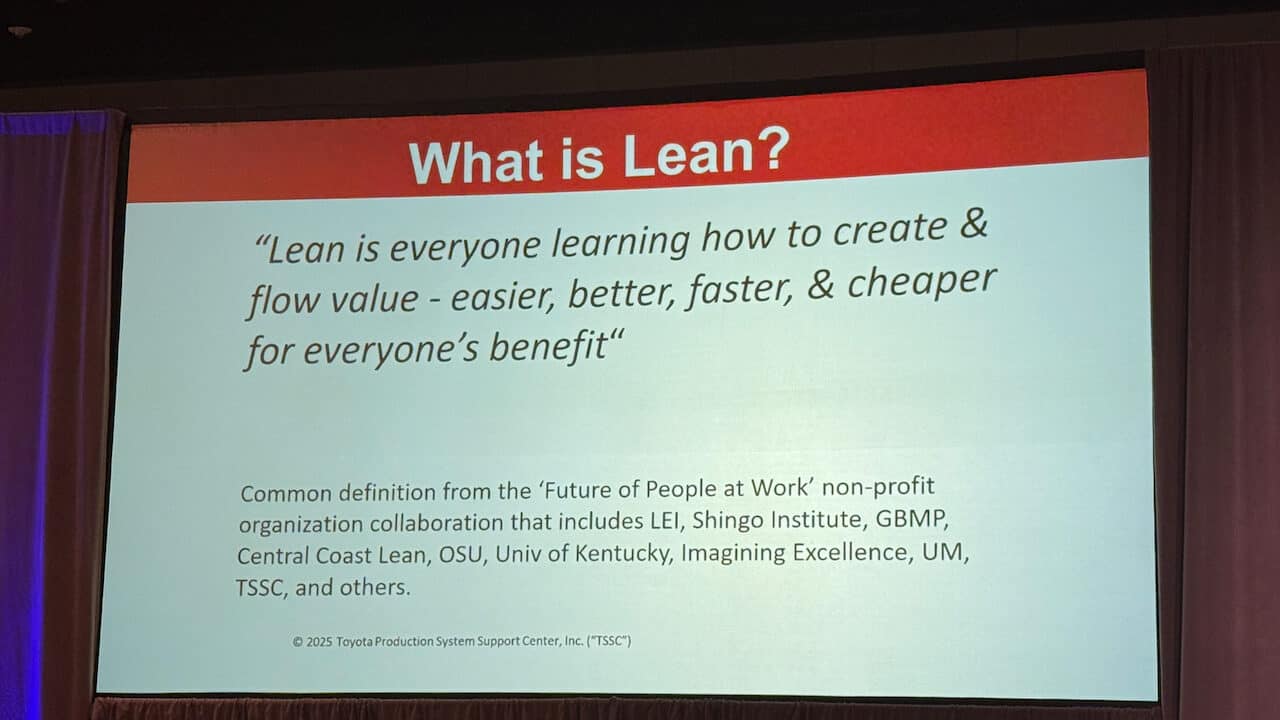
Bonini also showed a definition of Lean developed by a coalition called the “Future of People at Work” — a collaboration among nonprofits including LEI, the Shingo Institute, GBMP, Central Coast Lean, OSU, University of Kentucky, Imagining Excellence, University of Michigan, TSSC, and others.
The definition, as shown on the slide:
“Lean is everyone learning how to create and flow value — easier, better, faster, and cheaper for everyone's benefit.”
That a group this broad agreed on shared language is significant. One of Bonini's observations was that different organizations using different terminology for similar concepts has been slowing broader adoption of these principles. A common definition is a step toward making this more mainstream.
The Model Line Approach
TSSC has worked with over 600 organizations outside Toyota across 35 years. Their approach is not to try to transform an entire company at once. They take a small area — maybe 20 to 30 people — and build the high-performing culture quickly in that space. That experience develops leaders, and those leaders spread it area by area.
The Herman Miller partnership illustrates the pattern. TSSC has worked with them since the mid-1990s. What started as a single model line grew into a company-wide transformation that drove major improvements in lead time and quality — and helped preserve jobs in the community. In their video, a Herman Miller employee said that without the work they started with Toyota, they were not sure there would be the same sign on the front of their buildings.
Bonini's advice on getting started: the area needs a strong business need, leaders who are humble and eager to learn by doing, and top management attention. If he cannot get two to three hours of senior leadership time during his visits, that tells him the organization is not ready.
I have quoted Bonini saying similar things in my book Lean Hospitals, where he coaches organizations to start “inch wide and a mile deep” — narrow in scope, but with the full TPS triangle in great depth. He emphasizes that TPS is learned 90% through experience and compares it to learning to swim: you would never try to learn through lecture alone.
See more posts about TSSC and its work.
The Team Leader Role: The Piece Most Organizations Miss
This was the centerpiece of the session. In Toyota's structure, a team of four to six frontline workers has one offline team leader — a person who is not building the product. That is the role Bonini was describing in the opening — the one finance teams question (at other companies) and operations teams (anywhere) cannot survive without.
The team leader performs four functions:
- maintaining output by responding to disruptions in real time (arriving within eight seconds of an andon pull),
- doing root cause problem solving so problems do not recur,
- writing and auditing the standardized work, and
- training all new team members.
Bonini's point: if you design a system that makes problems visible — high flow, jidoka, andon signals going off constantly — you need someone whose full-time job is to respond to that volume of problems. If that person does not exist, you have a system that surfaces problems nobody can address. That is how organizations get overwhelmed and abandon Lean methods. That leads to the “futility factor.“
His former mentor at Toyota told him, when Bonini was assigned to run production at an engine plant: make sure your team leaders can perform these four roles, or your life is going to be miserable. You will be in the plant 16 to 20 hours a day.
Jeff Liker, in an interview for my podcast, described the same structure: one team leader for every four or five team members, trained deeply in problem solving, responding to andon pulls, and expected to solve problems within five days — or escalate to the group leader.
Michelle Thomas's Story
Thomas started as a team member at the Georgetown, Kentucky plant in 1987 and described getting bitten by the “kaizen bug” through Toyota's suggestion system — where they paid team members for improvement ideas. That early engagement pulled her into a career-long trajectory through team leader, group leader, manager, and eventually TSSC consultant.
One story stood out. As a team leader, she had a recurring defect that kept coming back. Same team member, same problem, three times. By the third occurrence, she realized she had not actually gotten to root cause the first two times — she had been applying temporary fixes. That experience sharpened her understanding of what real problem solving requires versus firefighting.
The transition from team leader to group leader was, by her own account, a struggle. She kept doing her team leaders' work. Her supervisor's coaching was blunt: “You trust your team? Get out of the way.” That directness was a turning point in her understanding of the group leader role — supporting and developing team leaders rather than replacing them.
“This Is Not an Empowerment System”
In the breakout session, Bonini made a statement about TPS and team members that landed like a grenade in a room full of Lean practitioners:
“This is not an empowerment system.”
He laid it out plainly. The team member's job is to do the standardized work to the standard. He repeated himself for emphasis.
When they cannot meet the standard, they pull the andon cord. The “improvement engine” is the team leader. Team members can participate in quality circles and other improvement activities, but their primary obligation is execution, not improvement.
He also said directly:
“This is not Taylorism.”
The distinction is important. In Taylorism (or at least how it's generally described today), the worker has no voice and no mechanism to signal problems. In TPS, the andon cord gives every team member the authority to ask for help — that is significant. The standard itself is written by the team leader who knows all the jobs, not by an industrial engineer or a quality department in a distant office. And team members are invited into improvement, even if it is not their primary role.
What Bonini seems to be pushing back on is the version of “empowerment” that has become common in Western Lean adoptions — where organizations tell everyone they are empowered to improve but provide no structure, no dedicated support, no team leader, and no response system.
In that version, empowerment is a sentiment.
In Toyota's version, empowerment is a system architecture: a clear standard, a cord to pull when reality deviates, and a dedicated person whose job is to respond and solve the root cause.
That framing connects to something I think about often in my work on psychological safety. The andon cord only works if people feel safe pulling it. So “not an empowerment system” does not mean “not a trust system.” It means the roles are more structured and differentiated than most Western adaptations acknowledge.
On Vaccination Clinics, 5S, and Solving the Right Problems
Bonini also showed a video about TSSC's work helping ramp up mass COVID vaccination clinics. During the Q&A, I asked a question — not as a criticism, but noting that some audience members might wonder why they did not see obvious 5S organization in the vaccination operations and why people appeared to be working in batches.
Bonini's answer was revealing. They were working on the problems that mattered most for the mission: standardized work and problem solving to ramp up volume quickly and safely. 5S was not the binding constraint. If the vaccine was getting into arms at the rate the community needed, a tidy supply table was not the problem to solve that day.
Taiichi Ohno wrote about “starting from need” and the “most pressing needs.”
Bonini's response exposes a principle TSSC has refined over 600-plus engagements: use the right tools for the right application. Starting with 5S because the textbook says to start with 5S is exactly the kind of rigidity that gives Lean a bad name. You prioritize based on what the system needs.
What Comes Next
Bonini opened his session by saying he was inspired by the other speakers and by the need to make this way of working more common. His aspiration: that 25 years from now, these principles are the way most organizations run.
Whether that happens depends less on how well we teach this and more on whether organizations are willing to invest in the roles and structures — like the team leader — that make the whole system function.
What does that investment look like in your organization? And who is doing the work of the team leader today — even if nobody has that title?