
Andon: The Signal, the System, and the Culture Behind It
TL;DR: An andon cord is not primarily a line-stopping device. At Toyota, it's a signaling system that allows workers to call for help immediately. Most problems are resolved before production stops. Its deeper purpose is to protect quality and create psychological safety by making it expected — and safe — to speak up.
The andon cord is one of the most misunderstood tools in the Toyota Production System. Many people believe it “stops the line.” In reality, it's a signaling system designed to protect quality and make it safe to speak up.
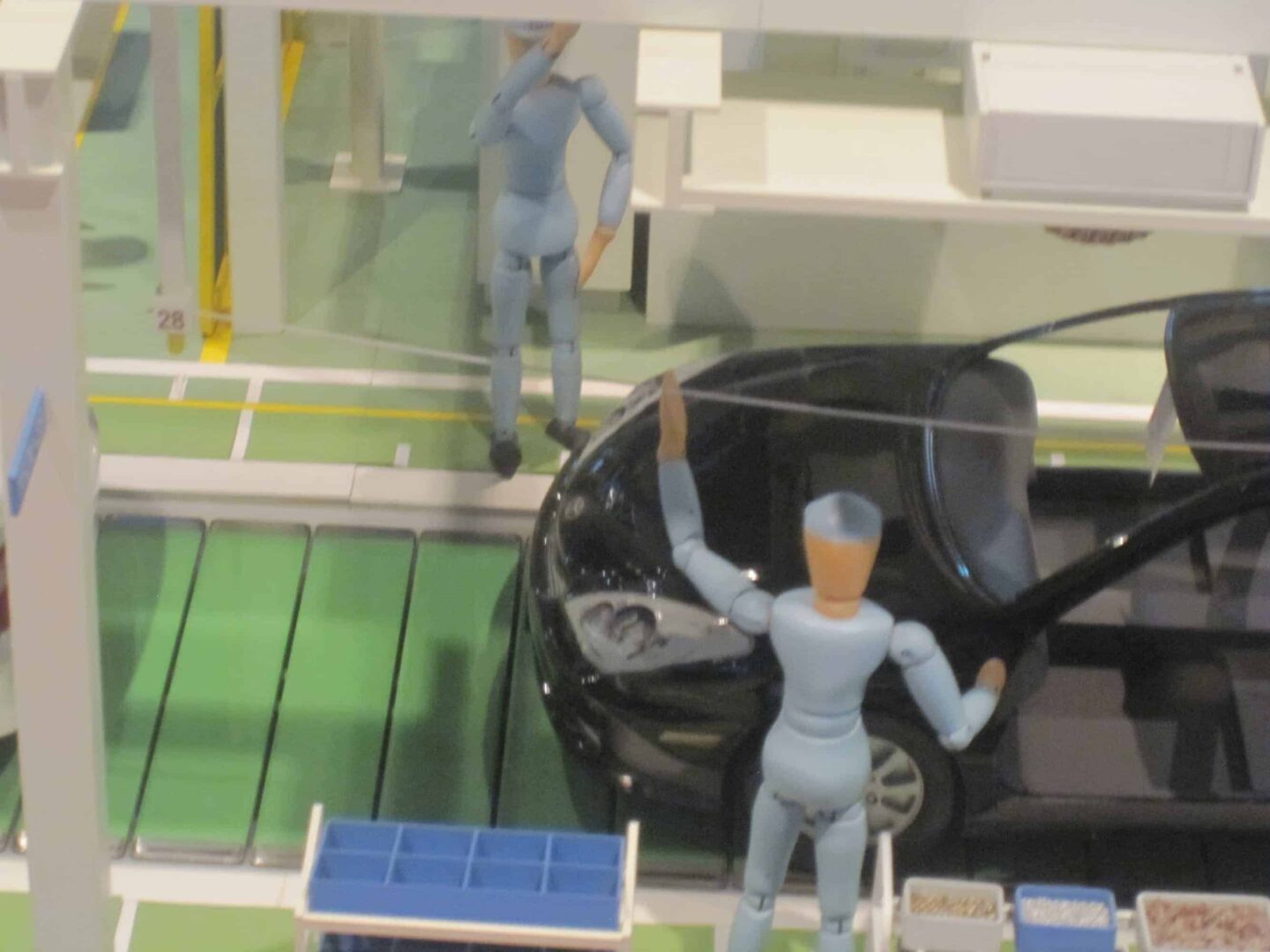
I first saw the system up close during a visit to Toyota City as part of a Lean healthcare-focused learning tour. Pictured below is part of an animatronic diorama in the Toyota City visitor center. You can see the little figure reaching up to pull an “andon cord” above the line.
Andon Posts on LeanBlog.org
I've written about andon from several angles over the years. Each post goes deeper on a specific aspect:
- What Toyota's 1992 Booklet Says About Stopping the Line — Toyota's own documentation describes the mechanism in detail. What it doesn't describe is the culture that makes a worker willing to use it.
- Why Toyota Is Eliminating the Andon Cord — The shift from cords to buttons, and why the mechanism matters less than the management system behind it.
- Did Ford's Andon Cord Problem Ever Get Fixed? — A 2007 BBC report showed Toyota pulling the andon cord 2,000 times a week at one plant. Ford: about two. What happened next?
- Stop the Line in Healthcare — How hospitals are adapting the andon concept so any staff member can pause a care process to prevent harm.
What Is an Andon Cord?
An andon cord is a signaling mechanism used in Toyota factories that allows workers to alert a team leader to a problem. Pulling the cord triggers a visual and audio signal so help arrives quickly. The goal is to fix problems immediately — often before the production line needs to stop.
The word “andon” is Japanese for “paper lantern” — a reference to the visual signal it creates.
Production workers are expected to pull the cord any time there is a problem or if they even suspect that something is a problem. They pull the cord, and a light flashes on an “andon board.” It tells the team leader which station has a problem (and music plays). Within seconds, a team leader shows up to help. There is one team leader for every eight workers, on average — meaning about 14% of labor is waiting for or responding to problems. That might seem like a lot of overhead, but it helps the line run efficiently while maintaining high quality.
Here is a short YouTube video I made of an animatronic andon cord pull from the visitor center display:
I saw, in the real plant, the team leaders very involved in the process. Our tour had us on a mezzanine level where we could see down onto the line quite well, as opposed to an aisle-way tram tour that you get at the Toyota plant in San Antonio.
And here's a Toyota video that shows the real process in action:
Does the Andon Cord Stop the Line?
Not usually. This is the biggest misconception. The andon cord is primarily a signal for help. Most problems are resolved before the line stops.
Here's the key: the line halts only if the issue isn't resolved within the job's cycle time. Most of the time, problems are swiftly resolved without any interruption to that segment of the line. The cords are being pulled almost constantly, but the line rarely stops.
That surprises most visitors. But at Toyota, silence isn't success — surfacing problems is.
Another common misconception is that the entire assembly line stops when a cord is pulled. It doesn't. Strategic buffers between line segments allow other parts of the line to continue running smoothly even when one segment pauses. Christopher Roser has written more about how these buffers work.
We did see the line stop once during our visit (red light on the andon board). Our Kaizen Institute guide Brad Schmidt emphasized that Toyota leaders might have to make a choice, in a bad situation, of taking a $1 million hit now (stop the line) or a $10 million hit later (if they didn't stop it). They make the right decision for the long term. Some problems might be fixable at the end of the line (a steering wheel), but some cannot (a wiring harness deep in the guts of the car).
In practice, they don't treat “never pass a defect” as blind dogma. They evaluate trade-offs in real time.
Cords, Buttons, and What Actually Matters
In some Toyota plants, the traditional overhead cord has been replaced with waist-high buttons. I wrote about that shift a decade ago: Why Toyota Is Eliminating the Andon Cord from Its Factories.
The goals were to remove overhead clutter and create a more comfortable and safer work environment. The mechanism changed, but the purpose didn't: making it easier and safer for people to signal a problem.
This is worth emphasizing. The andon system isn't a cord or a button. It's a management system built on mutual trust. Team members trust they won't face repercussions for using the system — they know they'll receive prompt assistance from team leaders. Leaders trust their teams to use the system judiciously. That trust runs in both directions, and it's what makes the whole thing work.
Why Speaking Up Doesn't Come Naturally — Even at Toyota
In our introductory discussions about Japanese culture, Brad Schmidt talked about the importance of harmony (“Big Harmony”) in Japanese culture. Because of the overwhelming need for harmony, people often wouldn't naturally speak up. They might be more willing to cover up a problem than to really fix it. So, the andon cord is a mechanism that makes it easier for people to speak up.
The andon cord operationalizes psychological safety. It makes speaking up the standard — not the exception.
This was a huge “a-ha” moment for me. People like to say that Lean and the Toyota Production System work because they're somehow perfectly aligned with Japanese culture — and that this alignment is why it wouldn't work in other countries. Brad said that speaking up to highlight problems “doesn't come naturally” to Japanese workers (he knows this because he was born in Japan and has lived there for 21 years).
Because it doesn't come naturally, they need systems to make it possible.
So I hope this is an inspiration to people who think “Lean doesn't come naturally to us in our country.” It doesn't always come naturally to the Japanese, even. The difference is that Toyota designed systems to support the behavior they needed, rather than waiting for it to emerge on its own.
Toyota's move from cords to buttons reinforces the same idea: the mechanism can change, but the purpose — making it easier and safer for people to speak up — must remain constant.
For a deeper look at how Toyota leaders respond when mistakes are surfaced through the andon system, listen to my podcast with Jeffrey Liker on blame, andon cords, and psychological safety.
Andon Beyond Manufacturing
The andon concept isn't limited to assembly lines. Hospitals and service organizations have adapted the principle using digital signaling systems.
Virginia Mason Medical Center in Seattle created a Patient Safety Alert system modeled on the andon cord. Any employee can “stop the line” — halting a care process — if they see a potential safety risk. Crucially, alerts trigger process reviews, not punishment. Over time, reporting increased dramatically, showing that fear had been replaced by trust in the system.
The mechanism looks nothing like a cord hanging over a production line. But the principle is identical: make it easy to signal a problem, respond immediately, and fix the process instead of blaming the person.
Come see this in Japan!
Join me on an upcoming Lean Healthcare Accelerator Trip to Japan. We go beyond sightseeing–visiting hospitals and manufacturers that are blending Toyota-inspired practices with people-centered care. You'll see how organizations create systems that support speaking up, problem-solving, and sustainable improvement.
Frequently Asked Questions About Andon Cords
Why is it called “andon”?
Andon is a Japanese term meaning “paper lantern,” referring to the visual signaling system. A team leader responds immediately, helps resolve the issue, and determines whether the line needs to stop.
Does pulling the andon cord stop the production line?
Not usually. Most issues are fixed before production is interrupted. The line only stops if the problem can't be resolved within the cycle time for that station. And even then, strategic buffers between line segments mean the entire line doesn't necessarily stop.
Do all Toyota plants still use cords?
Some plants have replaced cords with buttons, but the purpose remains the same: rapid signaling and support. The management system behind the cord matters more than the physical mechanism.
Is an andon cord only used in manufacturing?
No — but hospitals and service organizations have adapted the principle. Virginia Mason Medical Center's Patient Safety Alert system is one well-known example.
What happens if a worker pulls the cord unnecessarily?
At Toyota, there's no punishment for pulling the cord. Leaders would rather respond to a false alarm than miss a real problem. The culture treats every pull as an act of responsibility, not a disruption.






This is interesting to learn of the differences between what we either read or are taught regarding the degree to which Toyota adheres to what we would consider lean thinking. It appears that they think through each situation without blindly adhering to dogma, which truly is lean thinking. I’d imagine this is one fascinating “go and see” experience for you, Mark.
This is good stuff. Looking forward to more of your observations. Thanks.
Yes, it seems like thinking and evaluating tradeoffs (while remaining customer focused and taking the long-term view) is their ideal state.
Mr. Yoshido, so worked there for 40 years talked to us about always wanting to look at the advantages and the disadvantages of a proposal. People often think you are being critical (outside of Toyota) if you ask about the disadvantages. He teaches at a college now, in Japan, that seems to have what we’d recognize as a “traditional” organizational culture… “there’s no disadvantages, this plan is perfect” is the response when he asks or people think he’s being critical (which is viewed as bad) for wanting to help the organization improve.
Toyota is clearly not a proxy for all Japanese companies.
Great post Mark! Really gets you thinking about the possibility that there are other system design possibilities to help us with behaviors that don’t come naturally. For example, I’m with a client who has not been able to get leadership buy-in for a true process owner who crosses functions. But until someone is put in this role, the process will never function as it could/should. It’s a highly silo’d environment with a legacy of not thinking holistically. I’m now noodling on whether there’s some sort of system that could create the holistic process management methods they and others desperately need. Hmmm….
Thanks Mark, I’m enjoying your insights from the visit.
A couple of interesting points in there. Firstly I agree with the common misconception the Andon is a tool to stop the line. This was one of the first things I was tought through ex Toyota mangers. It highlights a potential problem in the eyes of the team member that can then be solved without stopping the line if possible (starting with Team Leader response). It may ultimately lead to a line stop but only when the impact of the problem is understood. Also the principle of no faults forward is something that is strived for but in reality the right decision in some circumstances may be to pass on but only if clarified and agreed by the next line customer.
In a business where Lean is in the early stages of implementation then quality at source cannot be achieved overnight although negotiation with the customer of the problem and level of impact can be.
Secondly, Karen raises an interesting point about system design with a view to creating the right behaviours. This is my current area of focus and currently one of the most underestimated focal points of Lean implementation. We can design systems that create the right behaviours but only when we first understand the impact of current system behaviours.
I believe the ability to think systemically is the major differentiator in a successful Lean Transformation.
“14% of their labor waiting for problems or responding to them”
This makes it sound like waiting for problems and responding to them is all the leader does, is that right? If not what percent of the leaders time is spent on these activities?
In the scope of the post “responding to them” is largely seen (by readers, I am guessing) as immediate responses – not in instituting a fix and then spending the down time the next 2 days to think about potential causing of the problem, start an A3 report or such like activities. Those activities could be classified as “responding to them” but those activities are seem better classified as working on improving the system to me.
I would be interested in whatever details on the questions I raise you have.
Yes, “responding” includes a short-term action (pick up the dropped bolt) and a longer-term improvement countermeasure (improve tools, etc. so that bolts are less likely to be dropped in the future).
There’s both putting the fire out AND improving the system to prevent future fires.
[…] Andon Cords at the Toyota Takaota Plant by Mark Graban – “They pull the cord and a light flashes on an ‘andon board’ It tells the team leader which station has a problem (and music plays). Within seconds, a team leader (having two stripes on his hat) shows up to help. There is one team leader for every eight workers, on average (or 14% of their labor waiting for problems or responding to them).” […]
[…] As I wrote about before, many aspects of “Lean” culture “don’t come naturall…” in Japanese business culture. People don’t naturally speak up, because the culture says “don’t make waves.” The organizations we visited were, to some extent, all trying to create a culture that was different than typical Japanese business culture. […]
[…] not just “Behaviors” and “Artifacts” (or tools). Artifacts like an andon cord or an “idea board” are the result of shared beliefs and consistent behaviors that are […]
[…] We could put in systems to amplify the culture (an example of this is type of system would be the Andon cord at Toyota or Google’s CEO signing off on every single hire at the company). We could put in policies to […]
[…] you want to learn more about andon, Mark Graban has written a good overview about andon at Toyota. I would agree with his observations that andon, and other principles that are core to Lean […]
[…] Many people work in the assembly area – in conjunction with machines and robots to assist with the work. Team leaders wearing different colored hats were on the line, assisting front line operators whenever an andon light was lit up. […]
[…] Toyota learned from the early books of Henry Ford. An American, Dr. W. Edwards Deming was incredibly influential to Toyota and other Japanese companies. It’s probably fair to say that the Toyota management system is a combination of some early Henry Ford ideas, Dr. Deming, and their own innovations. This approach is not predicated on the Japanese national or social culture… since the roots are not all Japanese, these ideas work in other countries, and it’s not naturally easy to “be Lean” in Japan. […]
[…] Andon Cords at the Toyota Takaota Plant – It Doesn’t Come Naturally? […]
[…] love her description of TPS as a countermeasure to some typical Japanese business culture concepts. As I’ve written about, I think the andon cord was a specific countermeasure against the challe…. The andon cord didn’t come naturally. Not even at […]
[…] Detroit News series), of course, led to frustration… people were trying to “pull the andon cord” to ask for help, if you […]