

102 Seconds vs. 300 Seconds: Toyota’s 1992 Case for One-Piece Flow
102 seconds versus 300 seconds. That's the comparison the 1992 booklet uses to make the case for one-piece flow.
Three employees on an assembly line. Three processing steps. Same work, same number of people, same total processing time. The only difference is whether they batch the work in lots of 100 or hand off one piece at a time.
Batch-and-queue: 300 seconds of lead time. One-piece flow: 102 seconds.
The work didn't get faster. The waiting got eliminated.
Continuing the thread from earlier posts on Toyota's April 1992 publication “The Toyota Production System.” Four posts on culture and leadership. This one's about a number.
The cartoon
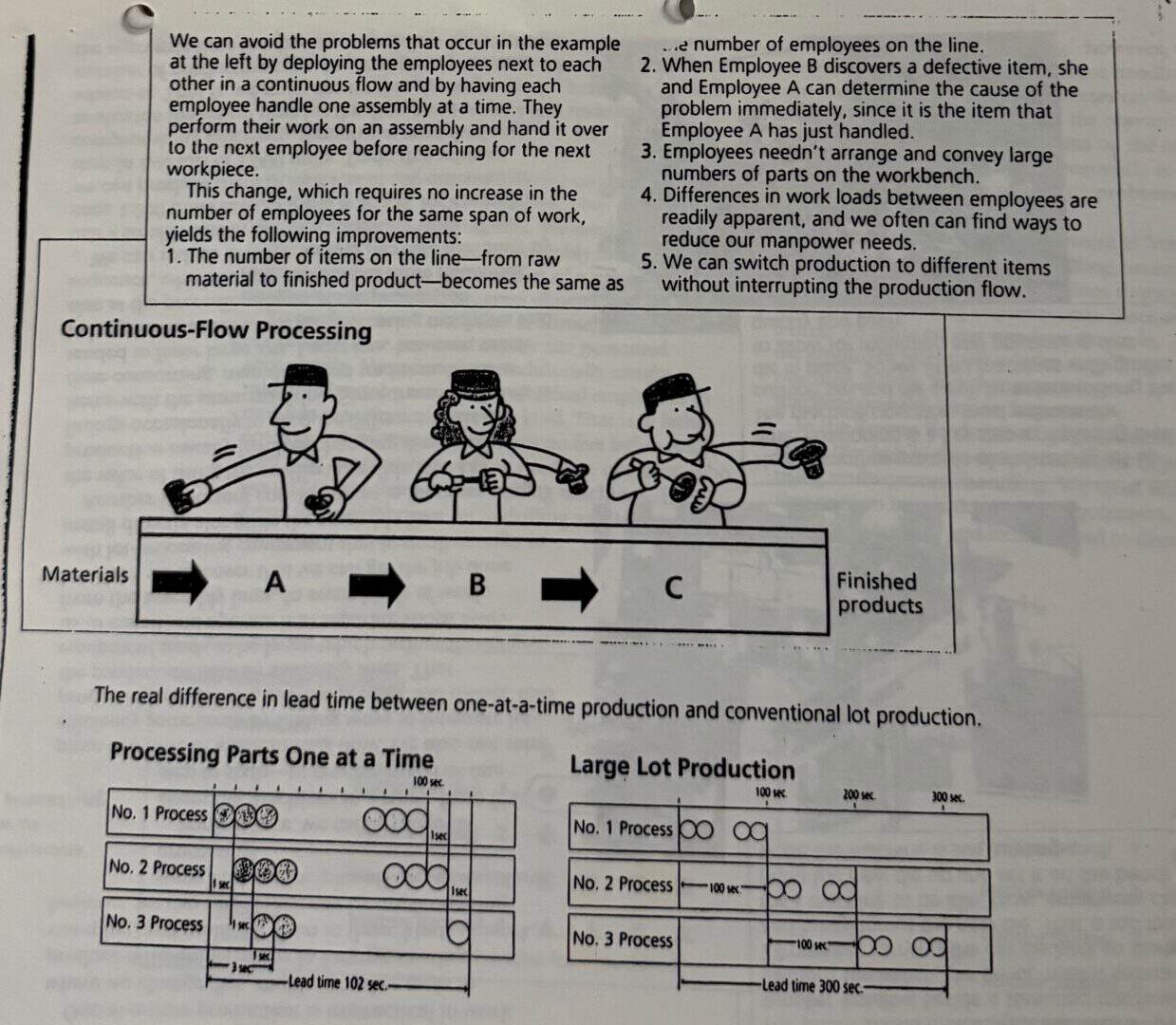
The booklet's continuous-flow section opens with a two-page comparison. Three cartoon employees – A, B, and C – perform successive steps in an assembly sequence. The first page shows them working in batches of 100, with inventory boxes between each station. The second page shows them working one piece at a time, handing off completed assemblies before reaching for the next.
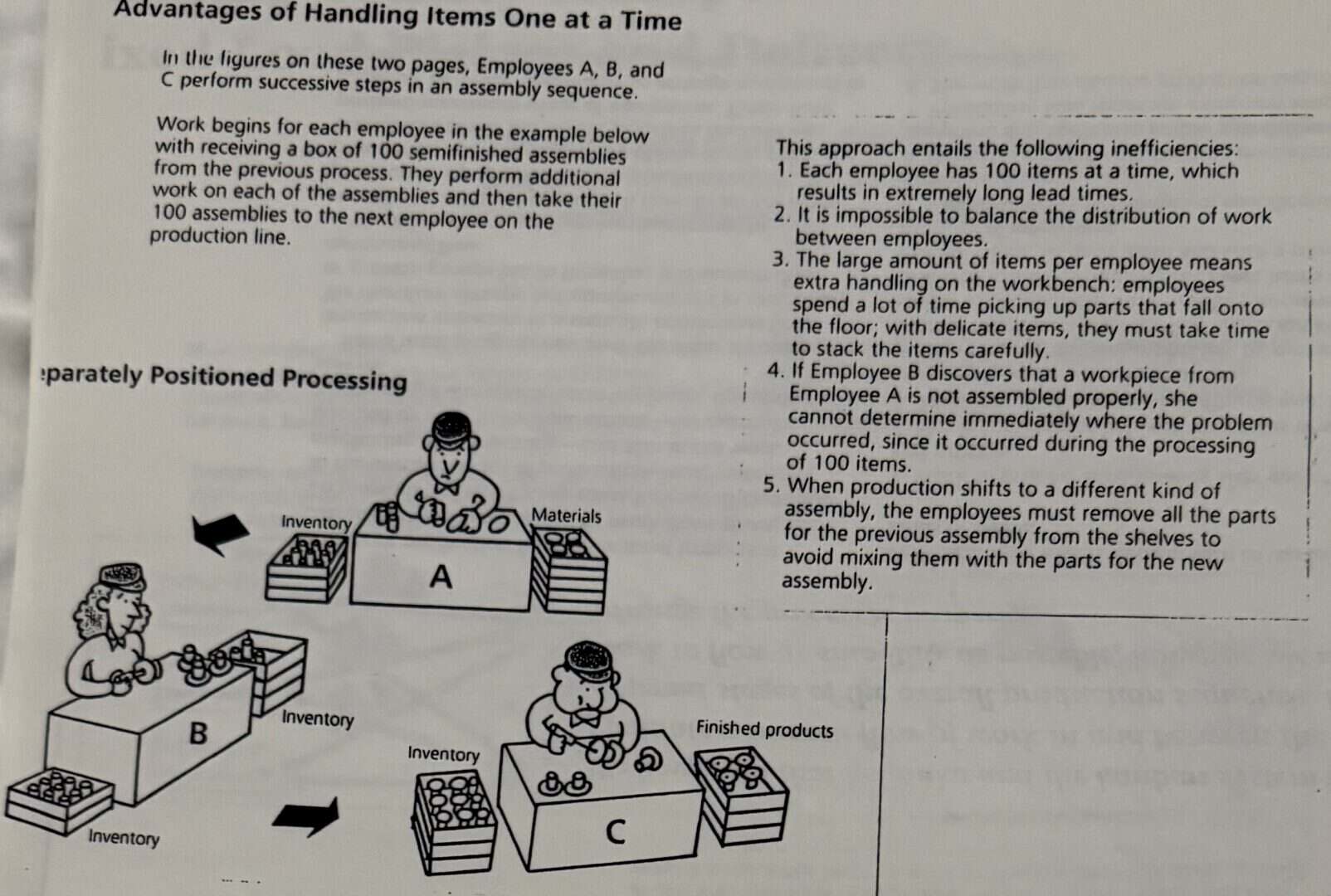
The booklet lists the inefficiencies of the batch arrangement directly. I'll quote the list because the framing is unusually clear:
“1. Each employee has 100 items at a time, which results in extremely long lead times.
2. It is impossible to balance the distribution of work between employees.
3. The large amount of items per employee means extra handling on the workbench: employees spend a lot of time picking up parts that fall onto the floor; with delicate items, they must take time to stack the items carefully.
4. If Employee B discovers that a workpiece from Employee A is not assembled properly, she cannot determine immediately where the problem occurred, since it occurred during the processing of 100 items.
5. When production shifts to a different kind of assembly, the employees must remove all the parts for the previous assembly from the shelves to avoid mixing them with the parts for the new assembly.”
Five inefficiencies, in plain language, before any diagrams or formulas show up. The 1992 framing is concrete.
What the comparison actually shows
Most modern explanations of one-piece flow describe the benefits at a conceptual level. Less inventory. Faster feedback. Better quality. Easier changeover. All true, all useful, all abstract.
The 1992 booklet doesn't argue. It runs the math.
Three processes, each taking 1 second per item. 100 items. Batch processing means each station completes all 100 items before the next station starts. First item exits the system at second 300, because process 1 took 100 seconds, then process 2 took 100 seconds, then process 3 took 100 seconds.
One-piece flow means each item moves to the next station as soon as the previous station finishes. First item exits the system at second 3. By the time you'd waited 300 seconds for the first batch-processed item to emerge, the one-piece-flow line has produced 298 items.
That's the math. The work content is identical. The waiting is what changes.
Why the math is hard to feel
The reason this argument keeps having to be made is that batch processing feels efficient when you're inside it. The employee processing 100 items in a row is moving fast. Their hands are full. The output looks impressive at the end of their shift. A manager walking by sees a busy worker and a stack of completed parts.
The one-piece-flow employee, by contrast, looks slower. They finish one piece and have to wait briefly for the next one. The pile of finished items grows by one at a time. To a manager raised on standard cost accounting, this looks like idle time.
The booklet anticipates this confusion in its list of advantages:
“Differences in work loads between employees are readily apparent, and we often can find ways to reduce our manpower needs.”
In other words, the apparent slowness of one-piece flow is information. It shows you the imbalance in the line. The batch version hides that imbalance behind piles of work-in-process. The one-piece version forces it into view.
A felt-cost reader will choose batch. A hidden-cost reader will choose flow. The whole argument turns on whether you know which costs to look at.
What Employee B sees
The booklet's fourth point about the batch arrangement deserves a second pass.
“If Employee B discovers that a workpiece from Employee A is not assembled properly, she cannot determine immediately where the problem occurred, since it occurred during the processing of 100 items.”
Translate that into the language of the previous posts in this series. Employee B has discovered a defect. The cost of finding the cause has become a function of how many items Employee A processed before B noticed. If A is one piece ahead of B, the cause is fresh in A's hands and head. If A is 99 pieces ahead, the cause is buried in a process that happened an hour ago, in a state that no one remembers.
The line-stop rope from post two only works in one-piece flow. In a batch arrangement, the rope is functionally useless. By the time you find a problem, the cause is too far in the past to investigate.
The technical mechanism (one-piece flow) and the cultural mechanism (the line-stop rope) aren't separate things. They're the same thing seen from two angles. Toyota's emphasis on flow isn't only about lead time. It's about keeping defects close to their causes so problems can be found and fixed by the people who created them.
That's a much bigger argument than “less inventory.” It's an argument about whether your production system can learn at all.
It also goes to show that quality and flow go hand in hand.
What this means for an organization that still batches
Most organizations that haven't moved to flow have reasons. Setup times that don't support small lots. Equipment laid out by process instead of by product family. Capacity that exceeds takt time on some steps and falls short on others. Workforce skills that don't transfer across stations. These are real constraints.
The 1992 booklet acknowledges them. The continuous-flow chapter spends pages on multi-process handling, lot-processing equipment that's been integrated into assembly lines, and the small dies that let stamping machines change over fast enough to support flow. Toyota didn't dismiss the constraints. They worked the constraints down, one at a time, for decades.
The mistake isn't the existence of the constraints. The mistake is treating the constraints as permanent features of the production system rather than as items on the kaizen list.
A team that says “we can't do flow because our setup times are too long” has accurately diagnosed the problem. The next sentence is what determines whether they'll ever get to flow. If the next sentence is “so we run in batches of 1,000,” the team has chosen to treat the setup time as fixed. If the next sentence is “so we're working on shortening setup times this quarter,” they're working the system.
The 1992 booklet's framing of one-piece flow assumes the second posture. The constraints are real. They're also negotiable.
A diagnostic
If your organization runs batches, the question isn't whether one-piece flow would be theoretically better. The question is what your team has done in the last six months to make the constraints negotiable.
Have setup times shortened? Has equipment been moved closer together? Have workers been cross-trained? Has lot size moved down at all, anywhere, even in one product family?
If yes, you're working the system, even if you haven't reached flow.
If no, you've decided your batches are permanent. That's a defensible choice. It's also a different system than the one Toyota's booklet describes.
What's the smallest lot size you ran last week, and what would it take to halve it?