Peter Pronovost on Leading with Love: What the Checklist Needed All Along
I recently recorded an upcoming episode of the Lean Blog Interviews podcast with Dr. Peter Pronovost, the Chief Quality and Clinical Transformation Officer at University Hospitals (UH) in Cleveland. Most people know him because of the ICU checklist that cut central line infections at Johns Hopkins and then across Michigan. While we were preparing, he pointed me to an article he wrote for Innovations, an MIT Press journal: “Living and Leading with Love: Transforming Healthcare Through Mutual Respect and Accountability.”
I printed it, read it with a pen to mark it up (a bunch!), and it's one of the best things I've read in a long time. Not because it's new, exactly. Much of it will sound familiar to anyone who has read Deming or spent time around Paul O'Neill's work at Alcoa. It's that a physician with Peter's credentials is saying it this plainly, in a journal, with 21 hospitals' worth of results behind him.
Here's how the article opens:
“The biggest problem the world faces today is our inability to solve complex problems collaboratively. The main reason for this is a lack of love.”
He knows how that sounds. He writes that hospitals are built around professional training, regulation, science, and tight finances, which leaves little room for “the sense of belonging and shared belief in one another that people associate with the word ‘love.'” His next line: “Or so, as a physician, I was taught to think.”
Lean is loving care, again
Back in 2010, I wrote a post called “Lean Is Loving Care” about St. Elisabeth Hospital in Tilburg, the Netherlands. Dr. Jacob Caron, an orthopedic surgeon there, framed the hospital's Lean work around what they translated to English as “loving care.” Lean wasn't the purpose. Loving care was the purpose, and Lean was how they freed up time for caregivers to actually give it.
Peter never uses the word “Lean” in this article. He uses “love.” I think he and the Dutch are describing the same thing from different directions. One group started with Lean and found love was the point. Peter started with a checklist and found that love, or the lack of it, was what decided whether the checklist worked.
The checklist was never only a checklist
Josie King, an 18-month-old, died at Johns Hopkins in February 2001 after a series of misdiagnoses. Her mother, Sorrel King, told that story on my podcast back in 2009 (episode 78), and it's worth hearing from her directly. Peter writes that the medical cause was a catheter infection that led to sepsis, but:
“The underlying cause, however, was poor communication and teamwork among the nurses, residents, and surgeons on Josie's care team, which stemmed from the hospital's procedures and culture.”
He also writes that the errors were “exacerbated by rules that prevented the girl's caregivers from overriding errors or even expressing their concerns.”
Within a year, Peter's team introduced a five-step checklist to prevent central line infections. The less visible change, and the one that mattered more, was that anyone who saw a step being skipped had the authority to stop the procedure.
Not everyone welcomed that. When the team suggested that nurses should speak up and stop a procedure, they got hate mail: “You're telling our nurses to revolt. What the hell is going on here?”
That objection had nothing to do with infection rates. It was about who gets to speak.
Peter also admits to feeling “elements of the same resistance in myself.” Even after losing his father to a misdiagnosed illness (something he called a medical error) during medical school, his reflex was to accept harm as “the inevitable cost of efforts to cure.” That honesty runs through the whole article.
Like O'Neill: zero, and the obligation to measure
Two passages reminded me of Paul O'Neill, the former Alcoa CEO, who I was fortunate to interview for episode 124 of my podcast.
First, on goals. When Peter's team took the checklist to Michigan, he'd walk into a hospital and ask the CEO about infection rates and goals:
“If the CEO said, ‘Our goal is to lower our number of infections' and then told me to ask the ICU director for the acceptable number, I knew they were aiming for mediocrity.”
O'Neill set a goal of zero injuries at Alcoa and refused to budget for an acceptable number. Peter did the same thing with infections. Many of his colleagues, he writes, “thought I was off my rocker – and perhaps I was.”
Second, on measurement. In Michigan, 65% of the infection data was missing, often because it was never collected. Peter went to the head of the Michigan Hospital Association and said, “We have an obligation to tell the citizens of Michigan whether we reduced infections. Your citizens deserve better.” They wrote to every hospital CEO requiring 90% of the data or the hospital was out. Nobody dropped out.
O'Neill insisted that you can't claim to care about safety if you aren't measuring it. Same idea.
Peter reports that the checklist and the culture program cut Michigan's infections by 60% and saved 1,800 lives in the first two years. (HHS reported the figures a little differently in 2009: 66% and more than 1,500 lives over 18 months. Either way, it worked.)
What hospitals copied, and what they missed
Then his team asked why it worked. They interviewed clinicians from at least 200 hospitals that had gone a year or more without these infections. Peter writes that “it wasn't just the checklist that mattered.” The hospitals had four things in common:
- Leaders openly declared a goal of zero infections and believed they could get there.
- Frontline staff were engaged and connected through peer learning communities.
- An infrastructure made change easier, with project management, training, data, and feedback.
- Results were reported transparently, with clear accountability. When an error happened, someone asked why and used the answer to improve the system.
Lean practitioners will recognize this pattern from the other side. Organizations copy the visible tool, whether it's a huddle board, a kanban card, or a checklist, and skip the leadership behaviors and management system that made it work. Peter describes hospitals that tolerate staff using the checklist 30% of the time. In his words, “they are benchmarking themselves against everybody else's mediocrity.”
The part I appreciated most is an admission. His 2011 book Safe Patients, Smart Hospitals tells the checklist story. He writes that he mentioned cultural factors “only briefly” at the end, because “Belief and belonging seemed too soft, too emotional, and too intangible to feature in a book about scientific practice.”
He played it down. He says so. Fourteen years later, he's written the book he didn't write then, in article form.
What about leaders?
One note I wrote in the margin early on was “What about leaders?” Peter credits “the talent and commitment of the capable caregivers in our system.” True, but caregivers were talented and committed before 2020, too. What changed was what leaders did.
The article answers my question, eventually. When Peter arrived at UH, he writes, “the CEO supported me in my efforts to develop a new approach.” I'd want to know whether the CEO supported it or led it. There's a difference, and the organizations I've seen sustain this kind of work usually have the CEO out front.
Later he gets more specific about leadership. Some leaders pushed back on the approach:
“That's not how I was trained in leadership. Leadership is beating on people, right? To improve, you have to be harsh to them and judge them, publicly shame them.”
His reply: “How well is that working for us?”
I've heard that philosophy before, almost word for word. My first job out of college was at a General Motors engine plant in Livonia, Michigan. The plant superintendent, Bob, once offered a group of us his management advice on the shop floor: “You've gotta beat down on them, beat down on them, beat down on them, until they do exactly what they're told.” He pounded his fist into his palm with each repetition. A few months later, the same Bob complained that “nobody around here takes any initiative.”
Bob got exactly what he asked for. People who are beaten down do what they're told and nothing more. That's the same powerlessness UH employees described in 2021.
Peter's question, “How well is that working for us?”, is the question nobody asked Bob. I tell the Livonia story in more detail in my next book, The Silence Tax, coming in early 2027.
I wrote “FEAR” in the margin next to the “beating on people” line. Beating on people produces fear, and fear produces silence, and silence is what killed Josie King. Peter describes moving “away from a command-and-control mindset toward one of inspiring and unleashing every individual's full ability.” That's the move Deming asked for decades ago: drive out fear.
Believe, Belong, Build
At UH, Peter and his colleagues built a model with three parts. I'll take them in order.
Believe. In 2021, UH asked employees: “What do you need to stop believing, and what do you need to start believing, to reach zero harm?” Most people, in every role, said they felt powerless and needed to stop believing their voice didn't matter.
My margin note: lower futility. Fear is one reason people stay quiet. Futility, the belief that nothing will happen if you speak, is another. UH went after both.
Belong. This is where psychological safety lives. Peter writes that belonging requires “a culture that encourages psychological safety,” where “every person's voice matters, regardless of their pedigree.” Weekly online meetings bring together about 125 people. Each one opens with a song or reflection and a story about a care team or patient, then moves to results. One line from that section: “With a humble and curious culture, we did not always need to innovate, we could often imitate.”
Build. “Good management matters in health care.” I starred that sentence. UH uses OKRs and run charts, breaks out performance by hospital, clinic, floor, and clinician group, and “publicly celebrated those who did well and privately supported those who struggled.”
Then he goes further than most physician leaders would. In a sidebar titled “Yes, Management Matters,” he cites Stanford economist Nicholas Bloom's research showing that management quality explains roughly 20% of productivity variation among firms and that healthcare ranks among the worst-managed sectors in the world. His diagnosis:
“In most healthcare organizations I've observed, people measure inputs or activity – ‘I had meetings this week' – but almost nobody maintains run charts showing whether they moved the needle on something important.”
I'd add: run charts are good, and process behavior charts are better. More on that below.
When Peter shares Bloom's research with healthcare leaders, he says the reaction is: “Peter, you can't say that in healthcare.” That line deserves to be quoted at every hospital board retreat.
Accountability, the Deming way
Accountability is in the article's title, and it's not a softening word. But Peter's version starts with leaders looking at themselves. He writes that “leaders could only hold lower-level employees accountable if they first held themselves accountable.” When a team is struggling, leaders should ask:
“Are we helping them? Do we know their goals? Do they know their roles? Did we build a system that gets them the resources they need to succeed?”
I wrote “Deming” next to that. Before you ask what's wrong with the people, ask what's wrong with the system you built for them.
The article also offers a story that makes the point better than any principle could.
Silo versus system: the weekend PT story
In March 2025, the UH director of physical therapy showed the executive operations committee a slide with 44 stick figures representing her staff. Forty were available on weekdays. Four worked on Saturday and Sunday. Patients who had surgery on a Friday waited in bed over the weekend without therapy, and their stays got longer.
Administration had repeatedly rejected proposals to add weekend PT staff, “largely because the request was viewed through the lens of the cost rather than the overall ROI.” The PT director only learned about the problem “after she asked the physical therapists for their perspective.” When the COO and CFO saw her data, they said, “We need to do this.”
Two notes in my margin: “silo vs. systems” and “spend to save.” The department budget said no. The system said yes. Nobody needed new technology. Someone asked the people doing the work, connected their answer to the data, and leaders changed their minds.
Purpose of the role
My favorite small moment in the article is about an administrative staff member who “previously would have no context for appreciating her contribution to patient safety.” She told Peter that her role now includes preventing blood clots. When she arrives at 7 am, she checks the battery pack on the devices that wrap around patients' legs.
Peter pairs that with a sailor he met on an aircraft carrier, who described his job sweeping the deck as “I help planes take off and land safely.” Peter's phrase for it: “Someone low in the power hierarchy was equal in the safety hierarchy.”
He suggests hospitals treat environmental services workers as “infection prevention specialists whose work saves lives every day.” That's Respect for People, said in plainer language than most Lean books manage.
Fractal leadership, and a note to executives
Peter describes “fractal leadership,” the idea that the same patterns of leadership should repeat at every level of the organization. Pascal Dennis has been saying this for years. What I wrote in the margin was aimed at the C-suite: executives should have to practice PDSA themselves. Not sponsor it. Practice it. If the pattern is supposed to be fractal, it has to exist at the top.
Culture or projects: chicken or egg?
One question I can't resolve from the article. Peter describes about 400 improvement projects running across UH. He also describes a culture change. Which came first?
He'd say they feed each other: “As results rolled in, it created a virtuous cycle: more people adopted the approach and more projects were launched, which led to better results, and began to change the culture.” I think that's right. You don't change culture by talking about culture. You change it by changing what leaders do and what gets celebrated, and then projects become possible that weren't before. Peter's “six Rs” (role modeling, rhetoric, rituals, recognitions, rewards, and relationships) are a list of leader behaviors, not a list of projects.
The results, and what a process behavior chart says
Peter reports big numbers for UH's 21 hospitals over three years: surgical complications down 70%, sepsis mortality down 80%, Medicare costs down a third, sentinel events down 80%. He includes his own caveat: “While we can't prove causation, the correlated improvement typically did not occur until the initiative reached that setting.”
I'm glad he says that. I also wrote “PBC?” next to most of his charts, so I built a few. The appendix includes run charts, and run charts are better than tables. But a process behavior chart answers the question a run chart can't: is this change bigger than the noise? (If that's new to you, my book Measures of Success is about exactly this.)
Sentinel events. The article says Living and Leading with Love “is associated with an 80% reduction in sentinel events.” The chart shows 138 in 2018, 131, 108, 111, 103 in 2022, and then 19 for 2023. But the 2023 number has an asterisk: it covers January 1 through April 30 only. Comparing four months to a full year is where the 80% comes from.
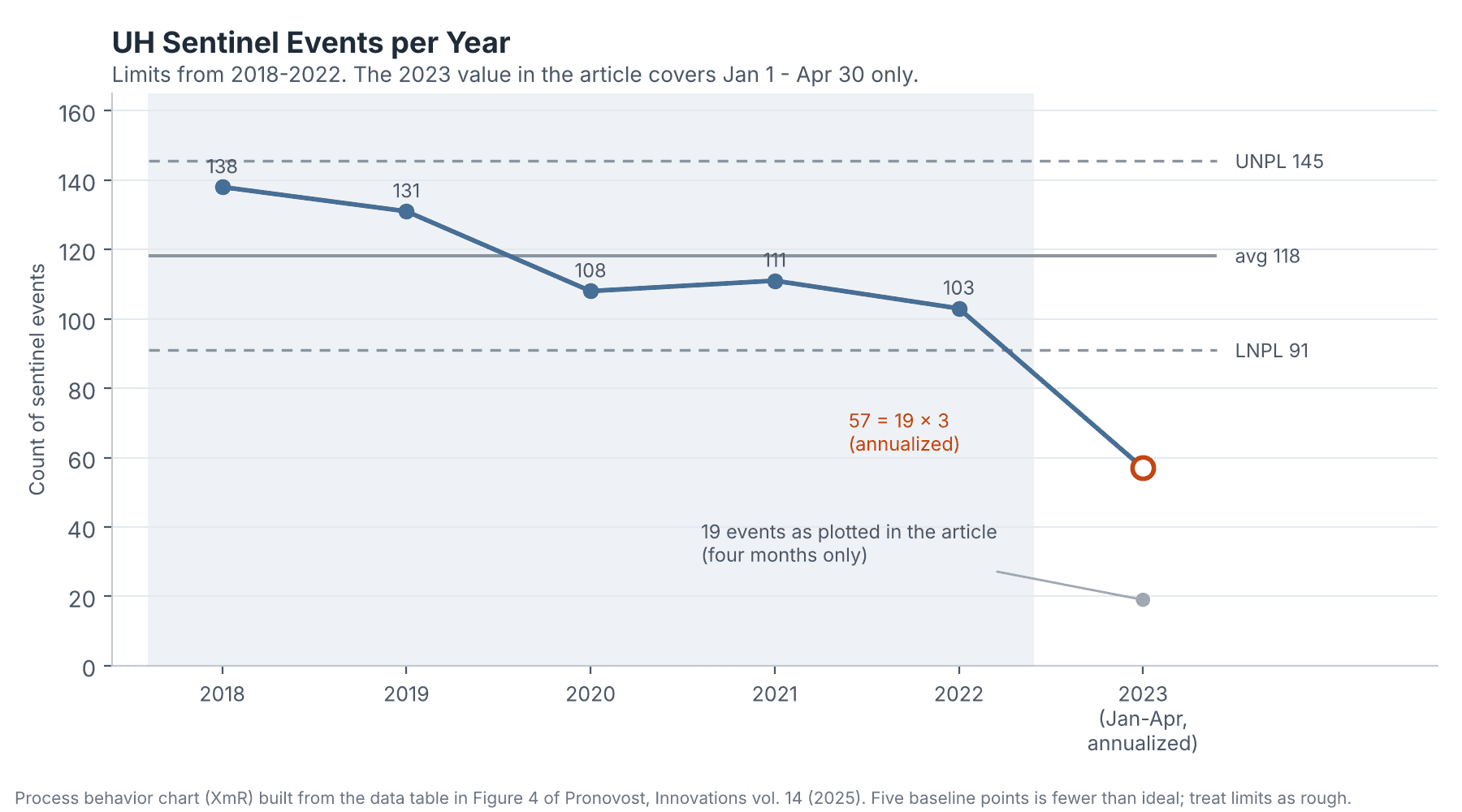
Annualized, 2023 would land near 57. On a process behavior chart with limits from 2018 through 2022, that's still well below the lower limit. It's a real signal. It's just not 80%, and I'd also note that sentinel events were already falling before the initiative started. I'll ask Peter for the full 2023 and 2024 counts, and how sentinel events are reported, since reporting and harm aren't the same thing.
Patient experience. The article's Figure 8 shows three “likelihood to recommend” measures from January 2022 to March 2025, each with a dotted trend line and the first and last values printed underneath. Two-point comparisons and trend lines through noisy monthly data are two of the habits I argue against in Measures of Success. So I read the monthly values off the chart (accurate to about a tenth of a point; the endpoints match the printed numbers) and built XmR charts, using the first 20 months as the baseline.
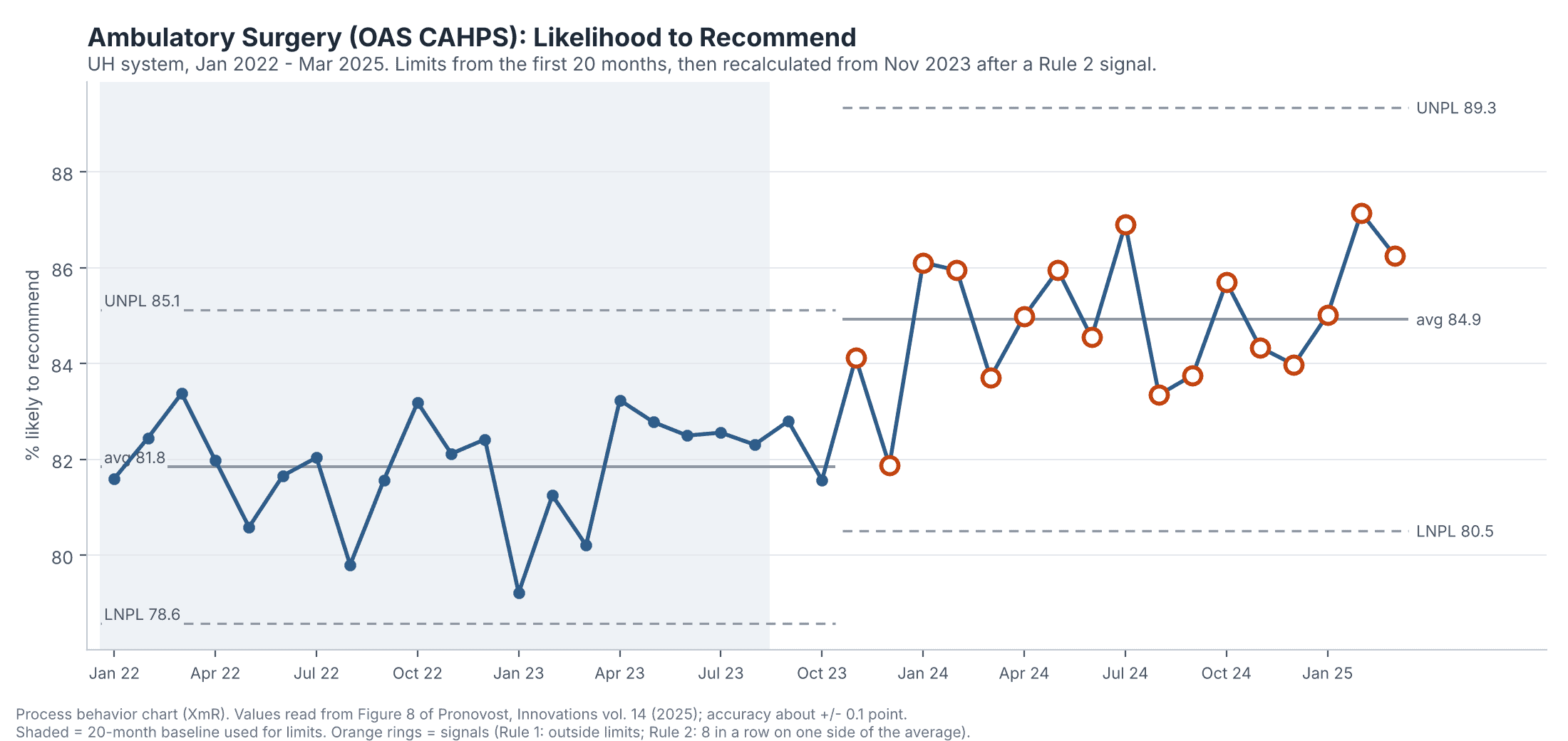
Ambulatory surgery shows the clearest signal. Starting in November 2023, there's a run of eight consecutive months above the old average, and several points above the old upper limit. The process shifted from about 82 to about 85. That's not noise.
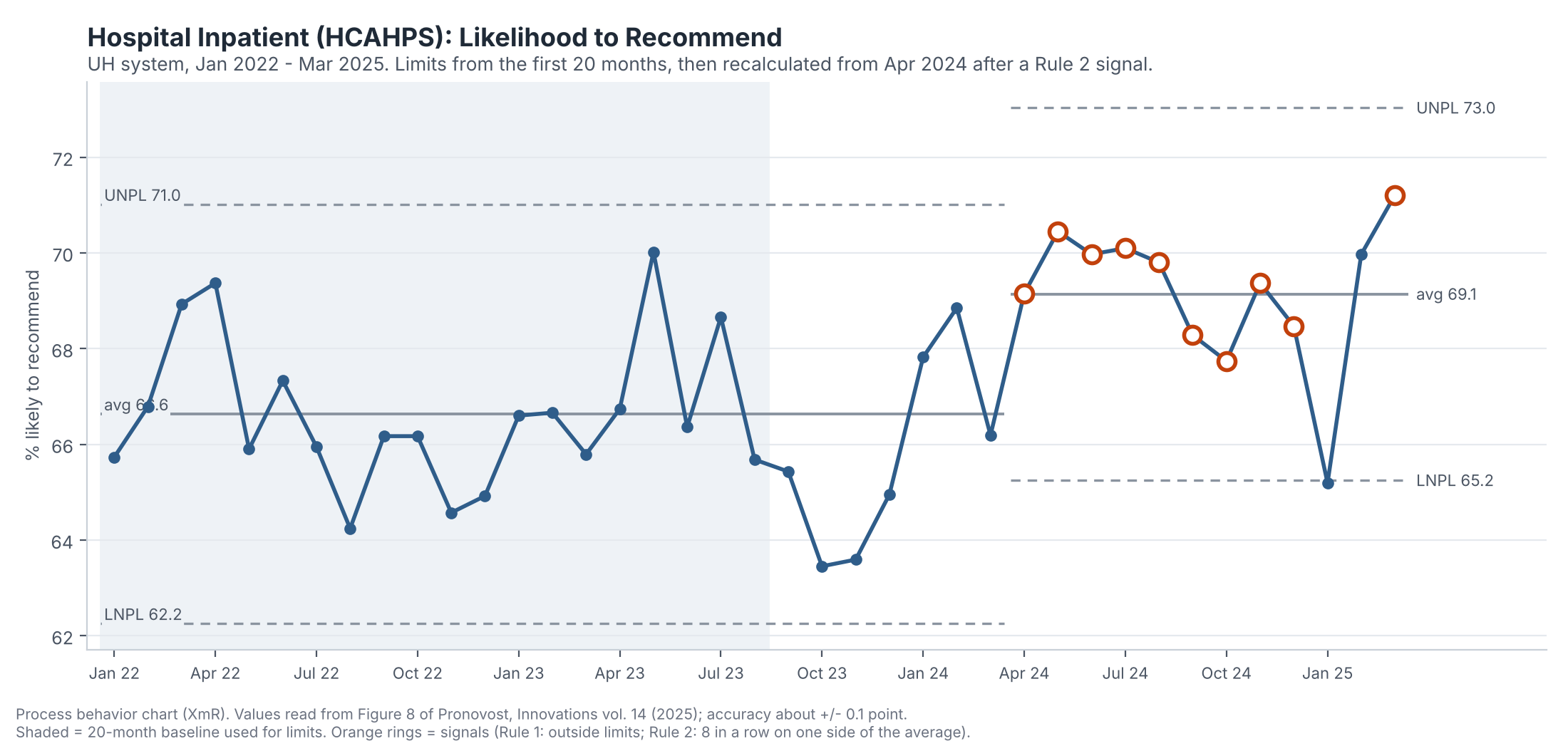
Hospital inpatient (HCAHPS) shows a signal too, but later: a run of eight above the average starting in April 2024, and a point above the old upper limit in March 2025. The shift is roughly 66.6 to 69. Notice the drop in January 2025, back to the old average. Inside the new limits, so probably a one-off event or s, but it's the kind of point that gets someone yelled at in a hospital that doesn't understand variation.
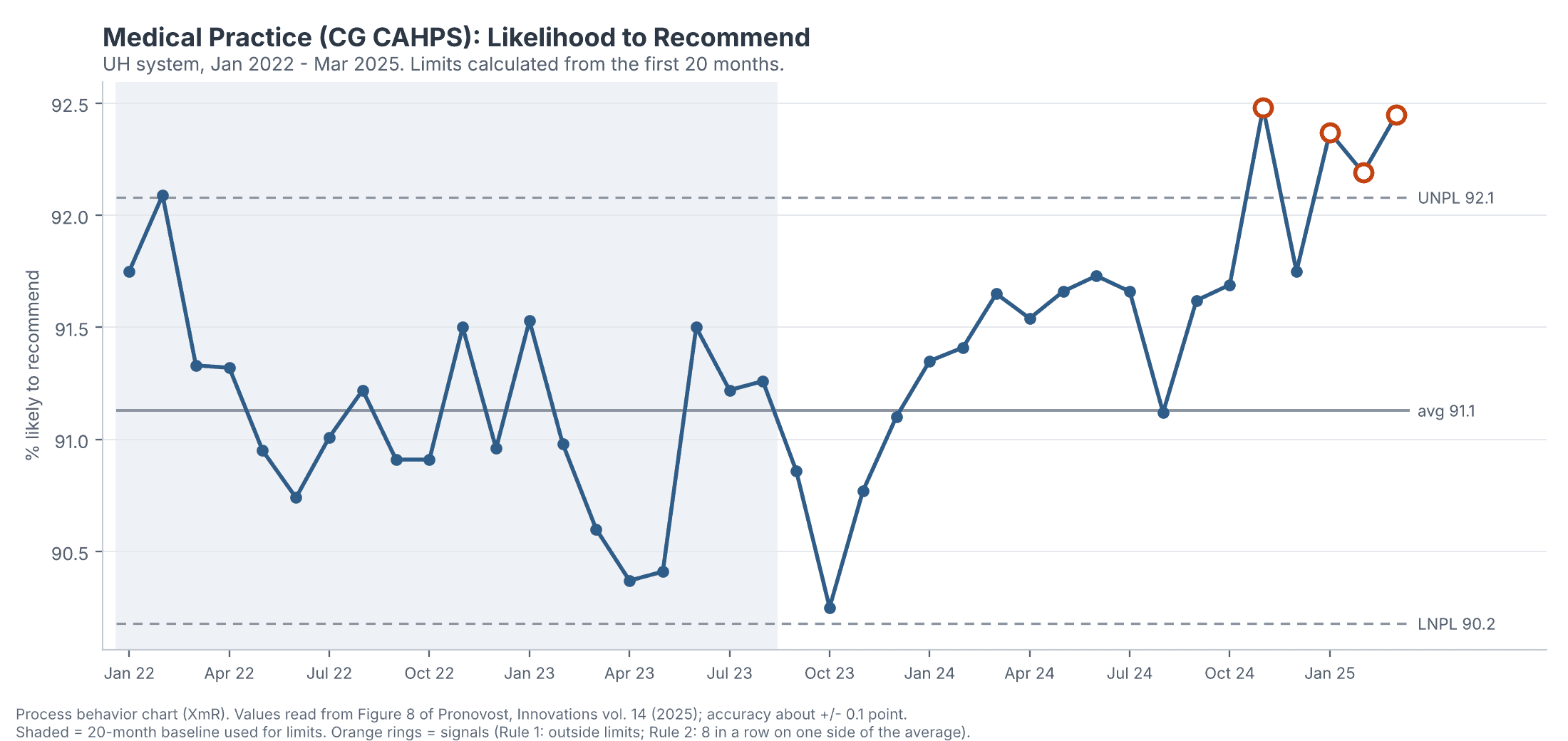
Medical practice (CG CAHPS) is the slowest to show anything. The first signal doesn't appear until November 2024, when scores start exceeding the old upper limit. Before that, the chart from 2022 through mid-2024 is consistent with a stable process bouncing around 91.
Three things stand out to me:
- The improvements are real. All three measures show signals, not just favorable linear trend lines.
- They show up late. The article says UH applied Living and Leading with Love to the patient experience in 2022. The signals appear in late 2023, mid-2024, and late 2024. Culture change takes a while to reach a survey. That's not a criticism. It's a reason not to give up on this kind of work after six months.
- There's no pre-2022 baseline shown. So we can't tell from these charts what patient experience looked like before the initiative. The limits I calculated are from the early initiative period, not from “before.”
Cancer screening and chronic disease control, by contrast, are annual numbers that rise every single year from 2019 to 2024. Six points is too few for a proper PBC, but five consecutive increases in a row is itself unlikely to be chance. Those look like real improvement to me.
The episode with Peter is coming soon. The article is “Living and Leading with Love” in Innovations: Technology, Governance, Globalization, volume 14, number 1/2, from MIT Press.