

AI Didn’t Invent Lean Slop. It Learned It From Us.
I have been seeing more AI-generated Lean infographics on LinkedIn lately. So many. It's annoying. I try not being annoyed, but it's hard.
So, I made one of my own about the trend and posted it on LinkedIn. It collects six confident, wrong claims of the kind that fill these graphics. Call it Lean slop.
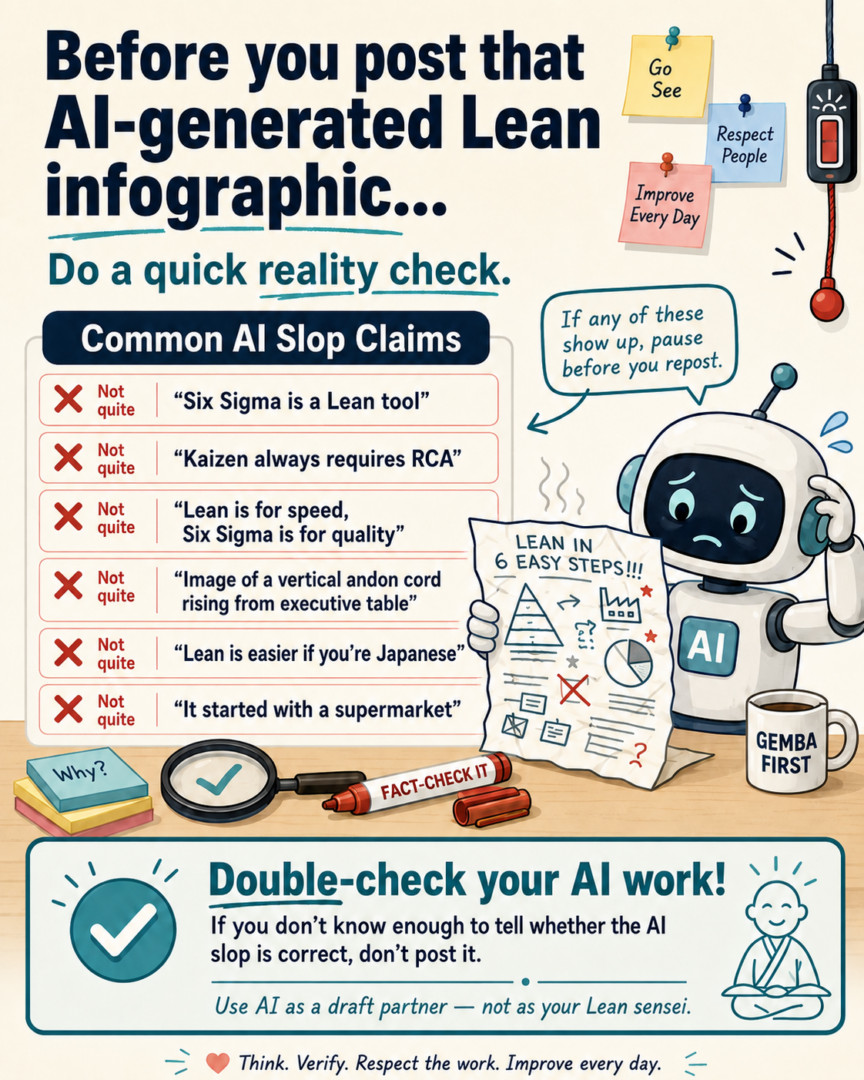
When I see claims like those, the wrongness jumps out. What gets me is how familiar every one of them is. None of this started with AI. I've heard them before. The errors were already out there, in print, taught with a straight face, long before anyone typed a prompt.
Some Examples:


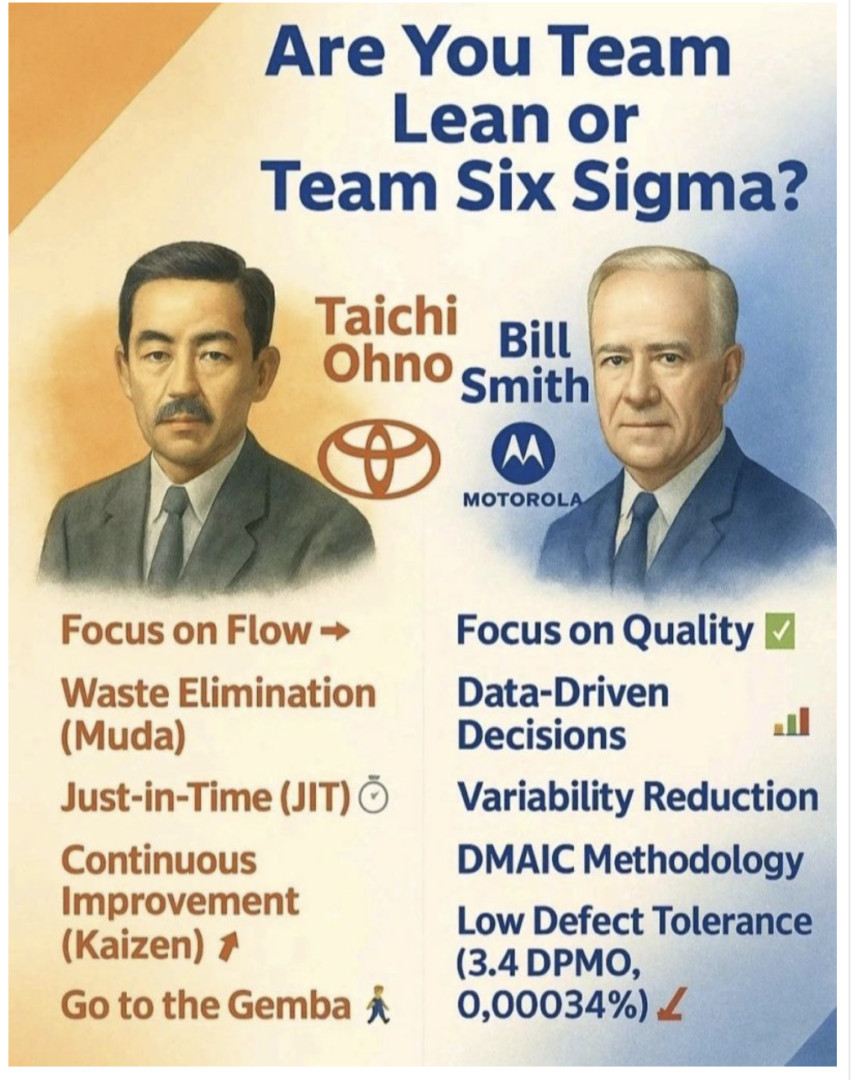

Lean slop is older than AI
Bad Lean content has been circulating for decades. A lot of it traveled under the “Lean Six Sigma” banner, where Lean got flattened into a box of speed tools bolted onto a statistical quality program. I have been grumbling about that particular distortion for close to twenty years. It showed up in trade articles, in training decks, in certification curricula, and in books from real publishers with real editors.
Here is the part people forget. A wrong idea does not become right because it is printed in a hardcover from a major house. The cover does not touch whether the claim holds up. Neither does the publisher's name or the author's bio. A lot of confident, well-produced Lean Six Sigma material has been wrong about Lean the entire time. And a lot of sloppily produced eBooks. That's been a problem since at least 2019.
AI learned Lean from that body of writing–good, bad, or in between. . Ask it about Lean and it hands back the average of everything it read, including the large share that gets Lean wrong. It reproduces the errors fluently, because the errors were well represented in the source material. Nothing is malfunctioning. The machine is repeating us back to ourselves.
What is new is the cost. Slop used to need an author, an editor, a publisher, or at least a slot at a conference. Then same social media. Now it needs an AI prompt and a minute. So there is about to be a lot more of it, and it will look as finished as anything a designer would charge you for.
What the graphic gets wrong
These are the claims on the graphic. I did not make them up. Every one is something I have actually run across:
- “Six Sigma is a Lean tool”
- “Kaizen always requires root cause analysis”
- “Lean is for speed, Six Sigma is for quality”
- An image of a vertical “andon cord” rising out of an executive's conference table
- “Lean is easier if you're Japanese”
- “Lean started with a supermarket”
Each of these would fit nicely on a clean slide. None of them is quite right.
A few of them, looked at closely
Start with “Lean is for speed, Six Sigma is for quality.” This one is a pet peeve of mine. Both approaches can contribute to both. Standardized work reduces variation. Lean cares a great deal about quality through jidoka, building quality in, stopping the line to fix a problem instead of passing it downstream. And Six Sigma work can improve flow. The clean speed-versus-quality split makes a tidy slide. It just isn't how the work behaves.
“Six Sigma is a Lean tool” gets the family tree backward. Six Sigma was created at Motorola in 1986 and popularized by GE under Jack Welch, with its own DMAIC model and its belts. Lean comes out of the Toyota Production System. The two often get combined under the “Lean Six Sigma” banner, and they can coexist productively. But one is not a tool tucked inside the other. An SME writer named Geoffrey Mika made the case for that years ago in a piece called “Six Sigma Isn't Lean,” with an analogy that stuck with me. You can own a cat and a poodle, and they can get along fine. You cannot cross-breed them into a single animal called a “catoodle.” I wrote about it back in 2006. Lean and Six Sigma can coexist. That does not make them one creature.
“Kaizen always requires root cause analysis” is another one. A lot of kaizen is small and quick. Try a change, see if it helps, keep it or drop it. Root cause analysis is a tool you reach for when a problem warrants it, not a toll booth every improvement has to pass through.
Then the supermarket, which is my favorite, because there is a real story underneath it. Taiichi Ohno was inspired by the American supermarket as he worked out the pull system and kanban. You take what you need off the shelf, and the shelf gets replenished. That part is true. But the supermarket shaped one piece of TPS, not the whole thing. Jidoka traces back to Sakichi Toyoda's automatic loom, decades earlier. Calling the supermarket the origin of Lean takes a real anecdote and inflates it into a headline, which is more or less the whole problem with these graphics.
As for the image of an andon cord rising vertically out of a boardroom table: an andon is a signal. A cord you pull, a light, a chime, something that flags a problem so it gets attention. It is not a piece of executive furniture. The image perhap slooks plausible to anyone who has never seen one on a real line, which is exactly why it spreads.
The “easier if you're Japanese” myth
This one I will push on a little harder.
When Ohno introduced the andon system, Toyota workers resisted it. Pulling a cord to stop the line and admit a problem did not come naturally to them either. Toyota had to build that culture deliberately, over time. I would rather give Toyota credit for that work than wave it away as something that came easy because of where the plant happened to be.
The Toyota plant in Georgetown, Kentucky has run on these principles for decades, staffed by people from Kentucky. When colleagues visit, they still hear the andon chimes going off, which is a sign the system is working, not failing.
“Easier if you're Japanese” usually isn't an observation. It is an excuse. A way to explain, in advance, why the hard cultural work has not happened yet.
The part that is still on us
I am not writing this as someone who avoids the AI tools. I use them. They are good for a rough first draft or for shaking an idea loose. The line I would draw is simple. If you don't know enough to tell whether a claim is right, you don't know enough to post it.
And the real cost of getting one wrong in public has little to do with accuracy in the abstract. It has to do with who is watching. The people most worth impressing in this field are exactly the ones who will catch the bad claim. When they do, they do not blame the AI. They quietly lower their estimate of the person who hit share. The graphic that was meant to signal that you know Lean does the opposite, in front of the only people who can tell.
So I am not sure the tool is really the thing to argue about. AI did not corrupt a clean record. It read what we wrote about Lean and learned to repeat it, faster and at no cost. The slop was ours first.
That is the part I cannot stop turning over. How much of what any of us “knows” about Lean did we test for ourselves, and how much did we pick up from something that looked authoritative and was wrong the whole time?
Some parody images
I wonder how the Six Sigma community (is that a thing?) would react to these unfair infographics?
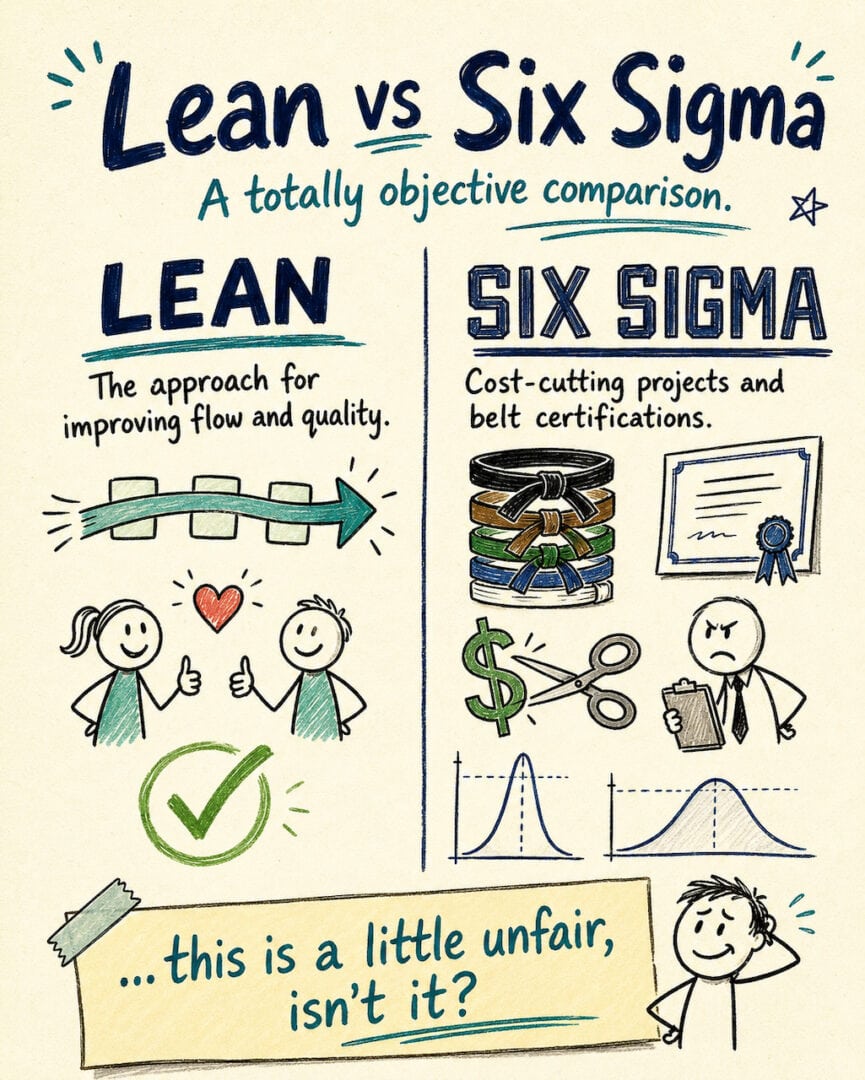







“Six Sigma isn’t a Lean tool”. I would first ask what is six sigma? Is it a collection of statistical tools that eventually became wrapped in a package so consultants could sell it as a methodology (the next new thing)?
I would never say six sigma is a tool of Lean but I would say some advanced statistical tools (branded as six sigma) may fit within the Lean methodology and applied when required.
Can Lean and Six Sigma co-exist? Yes.
Can Six Sigma methods be used in the context of a Lean culture? Yes.