Fake Lean Six Sigma Books on Amazon: How to Spot AI Copycats and Fake Reviews
tl;dr summary: Fake Lean Six Sigma books were already crowding Amazon before generative AI made them cheaper to produce and harder to spot. The tell that still works is whether a real, findable author stands behind the book.
Usually, my only beef with “Lean Six Sigma” books is when they state the falsehood of “Lean is for speed, and you need Six Sigma for quality.” Yeah, that really grinds my gears.
But, recently, I've noticed that Amazon's “bestsellers” in the same categories as my books seem to be horrible copies of the same book. They're not exactly the same, but there are common themes:
- Authors who don't seem to be real people
- Weird “for entertainment purposes only” disclaimers
- Garbled English as if the books are written by a bot or a bad translation service
- Content that's sometimes very incorrect about Lean or Six Sigma
So I wrote this article, originally published on LinkedIn (and now moved here to the blog):
What These Copycat Books Have in Common
If you search Amazon for books on “lean management” or “lean six sigma,” you'll find many, many books that have the same title and some variation of the same subtitle. These books also appear in the “bestseller” lists for related categories, so somebody is buying them. But, as always, buyer beware.
There's always room for new books and competing books in a category. But, hopefully, they add something to the field and they're accurate. That doesn't always happen.
It's no surprise that some self-published works are very poorly written. Some are grammatical nightmares, starting with the very first sentence. Some books are full of incorrect information. Some books have both of these problems. Books in this category tend to be all text, with no illustrations or figures (something that keeps production costs down, I'm sure).
But some of these books are so hard to read that I can only conclude they were written by bots, some sort of book farm in a low-wage country. Or they are plagiarized works that have been run through “paraphrasing” software or translated from English to another language and then back to English by an automated tool.
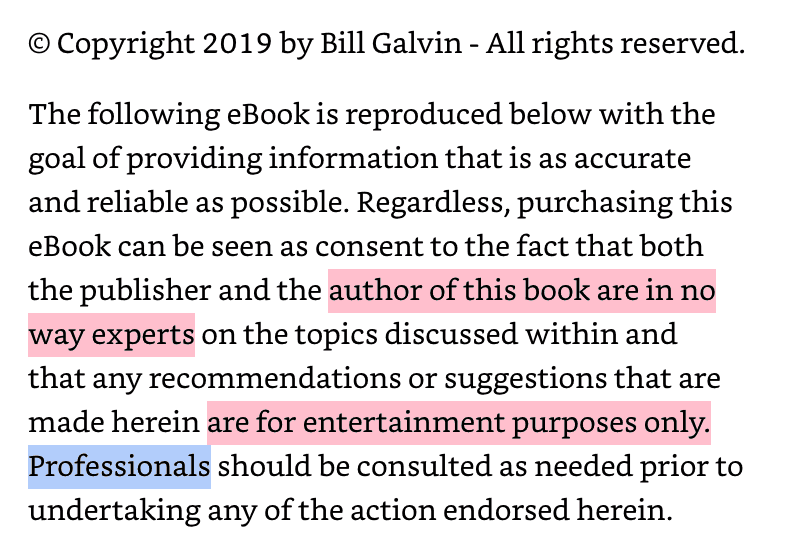
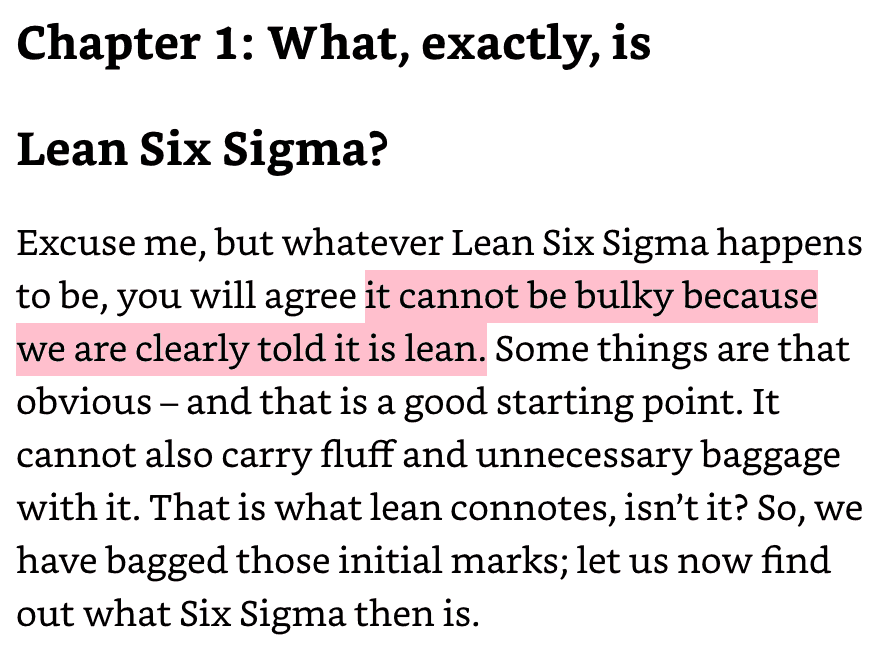
Most everything about these books is just a bit off. I've never seen books add a strange disclaimer about the authors “being in no way experts” and that the book is for “entertainment purposes only.” That's a phrase that keeps popping up on the first pages of these books. I've never seen that in a book from a legitimate publisher (or a high-quality self publisher):
The other day, I irritated (understandably so) some people on Twitter with my frequent tweeting about #BadLeanSigmaBooks (and #BadLeanBooks) with examples of mangled sentences and incorrect assertions. I got that out of my system. I think.
Fake Authors, Fake Reviews?
It's also not a surprise, at least to me, that some authors seem to violate Amazon rules by buying and paying for reviews. This seems quite obvious when the reviews are written as badly as the books and the typical reviewer of these books posts reviews on 20 different books a day. This article talks about other ways the unscrupulous manipulate Amazon rankings (“Amazon Has A Fake Book Problem“).
Suggestion to Amazon: If you limited people to writing just one review per day, that would likely break the business model of paid reviews. Amazon already has measures to prevent new accounts or “burner” accounts from posting reviews. But once you pass that threshold, there seems to be no limit to how many reviews can be posted daily.
This practice of fake reviews gives an inflated 5-star rating in the early days after launch, leading real book buyers to think the book is better than it is.
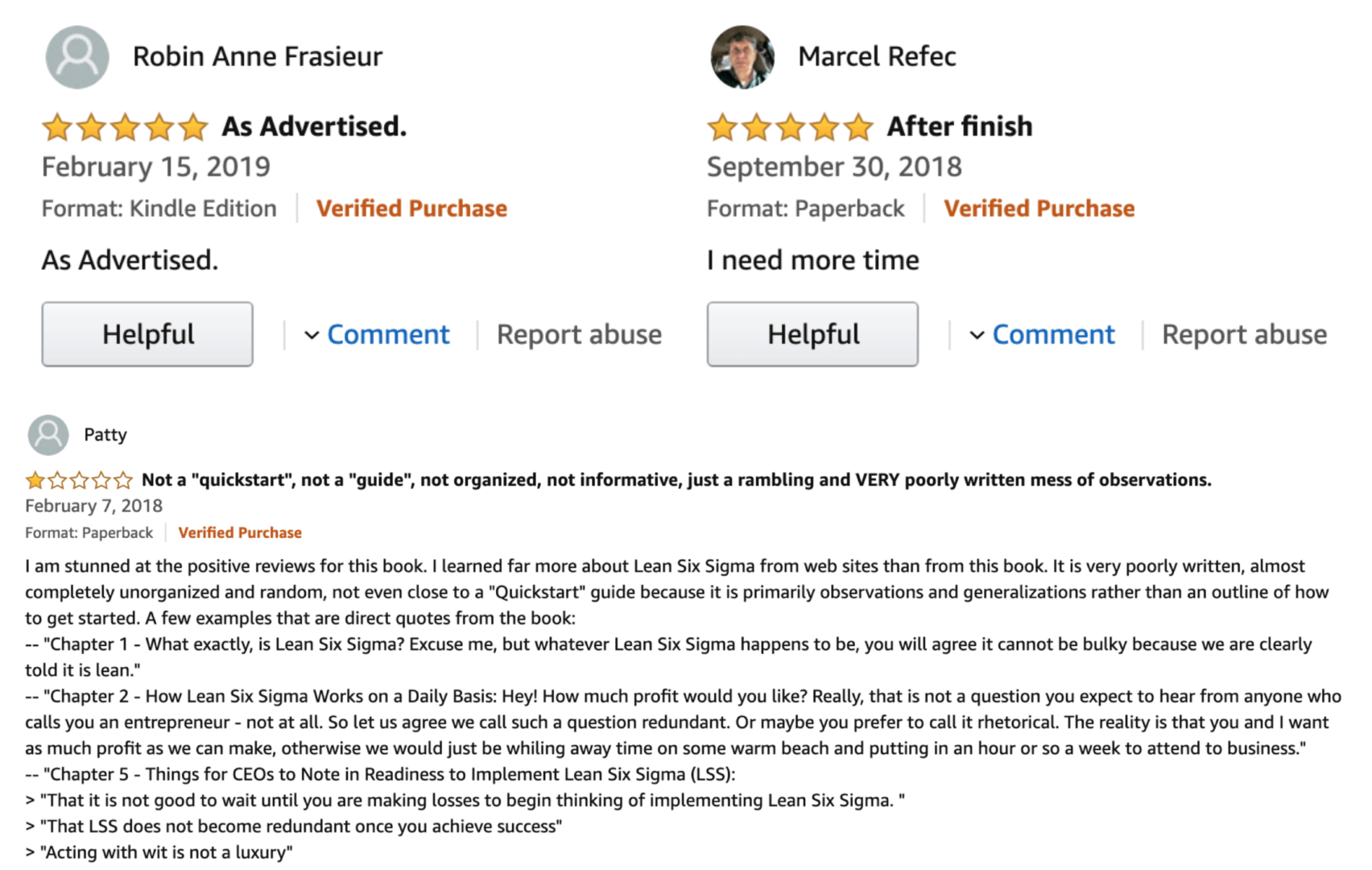
Pro tip: You might be impressed with a high average on the ratings, but variation matters. Sort by “most recent,” and you'll more likely see real reviews from real book buyers. If a book has many 5-star reviews AND many 1-star reviews, that could be a sign. Here are some reviews for the same book:
Pro tip: Always use the “Look Inside” feature on Amazon. If the first sentence of the book is quite literally a disaster, then don't buy it.
Pro tip: If you buy a book and think it's terrible or unreadable, you can return it to Amazon (even Kindle Books). You could also take a minute to leave a rating and a short review that will help other readers steer clear.
Who ARE These Authors?
One thing that strikes me about these lookalike, copycat, badly written books, is that there is NEVER an “about the author” page. If you've written a book that you're willing to publish, you most certainly have enough ego and enough business incentive to let people know who you are and how you can be found. For both of those reasons, and others, I make it quite clear in my books who I am and I'm easily found online.
Some of the books have authors with names that seem designed in some laboratory so that they'll cause confusion with real luminaries.
- “Bill Galvin” could be an approximation of Bob Galvin of Motorola and Six Sigma fame
- “Jeffrey Ries” seems like a variation of Eric Ries of The Lean Startup and The Startup Way fame
You cannot find either of these authors through a Google search or here on LinkedIn.
There seems to be no good reason to write a boring, non-fiction business book under a pen name or pseudonym. These aren't torrid romance novels or books with sensitive personal stories.
The Lookalike Lean Six Sigma Books
We could repeat this exercise with other categories, but I'll focus first on the category that began with the 2002 Michael George book, Lean Six Sigma: Combining Six Sigma Quality with Lean Production Speed.
Now, the copycats from recent years:
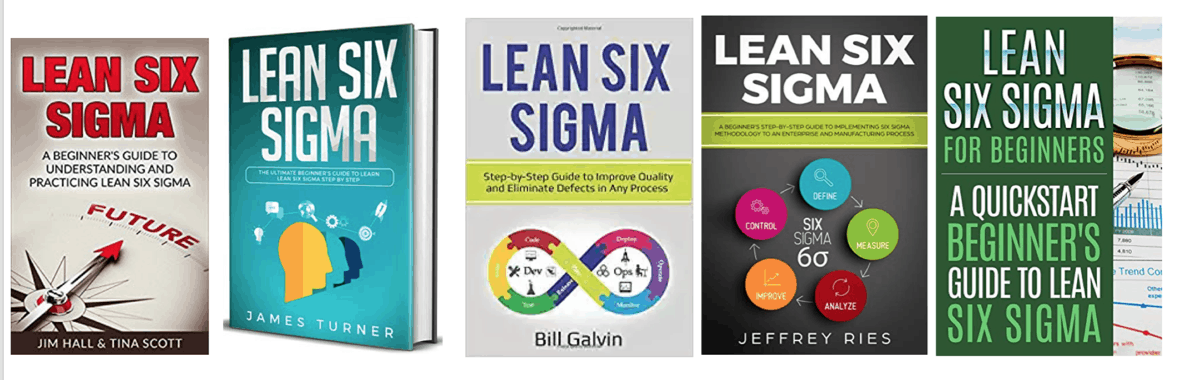
Note: Some of these books, like the second one above, violate Amazon's rule that a book product image should be the “front cover.” I don't think a 3D rendering counts.
Here are the books and the purported authors:
Lean Six Sigma, A Beginner's Guide to Understanding and Practicing Lean Six Sigma by Jim Hall and Tina Scott (December 2016)
Lean Six Sigma: The Ultimate Beginner's Guide to Learn Lean Six Sigma Step by Step by James Turner (February 2019)
Lean Six Sigma: Step-by-Step Guide to Improve Quality and Eliminate Defects in Any Process by Bill Galvin (March 2019)
Lean Six Sigma: A Beginner's Step-By-Step Guide To Implementing Six Sigma Methodology to an Enterprise and Manufacturing Process, by Jeffrey Ries (November 2018)
Lean Six Sigma For Beginners, A Quick-Start Beginner's Guide To Lean Six Sigma, by G Harver (April 2015) — This one claims to be a “third edition” but there's no evidence of the earlier editions to be found. Nice marketing ploy?
If anybody in our networks knows who the authors are, please let us know about them and their professional backgrounds. If you are one of these authors, I'd welcome an email from you. If I've mischaracterized any of your work or your reasons for being anonymous or impossible to find, I'll apologize and buy them a drink.
Again, you can go through the same exercise on books related to topics like agile management, kanban, lean startup, and more. Some of these authors have cranked out a book for each topic. Go to Amazon, search and see.
It's particularly gutsy (or foolhardy) of “Jeffrey Ries” to publish a book called Lean Startup (compared to Eric Ries and The Lean Startup). I know book titles generally can't be copyrighted, but the apparent attempt to confuse book buyers isn't cool.
If these books were part of some obscure “long tail” on Amazon, I would ignore this whole issue and let it be. But, since these books come up high in search results and rankings, I think they not only hurt other legitimate authors, but they may serve to turn off people who are sincerely interested in learning about topics related to Lean and Six Sigma. I think this hurts “the Lean community,” whatever that comprises. The Amazon ecosystem seems to be very broken in terms of helping newbies find the best books in a field.
I don't understand the business model here. Apparently, it's profitable for the authors and publishers and for Amazon… I'm really trying to figure this out. What do you think?
This whole issue has bothered me more than it should. I'm trying to get my head around how and why this happens… I have more details I could share about some of the horrible content. But, I dumped a lot of this on Twitter under the hashtags:
I apologize to those I annoyed with the Tweetstorm yesterday.
Some of those tweets:
This is exhausting. I need to stop being tempted to look inside these horrible books through my Kindle Unlimited account.
Fake Lean Six Sigma Books in the AI Era
I wrote the first version of this post in 2019. Back then, I floated a theory that some of these books were written by bots, or by a book farm in a low-wage country, or run through paraphrasing software, or translated out of English and back again. I was guessing. The writing was so mangled that a human author seemed unlikely.
I don't have to guess anymore.
Generative AI didn't invent this scam. The copycat titles, the invented authors, the paid reviews, the Kindle Unlimited math that pays a few cents per page read — all of it was running before ChatGPT showed up. What changed is the cost and the camouflage. A scammer used to need at least a little effort: a paraphrasing tool, a translation trick, maybe a content farm. Now one person can generate a 150-page “Lean Six Sigma” book in an afternoon for about the price of a sandwich, drop a stock cover on it, and list it right next to mine.
The numbers moved fast. In February 2023, within weeks of ChatGPT's release, close to 300 books written or co-written by it appeared on Amazon in a single day. By that September, Amazon had seen enough to cap most self-publishers at three new titles per day and to start asking authors to disclose AI-generated content. Three books a day, from one account, is still a lot of books. It tells you something about the volume they were trying to slow down.
The Lean and Six Sigma versions mostly waste your money. Other categories are worse. AI-generated mushroom foraging guides showed up around the same time, written by authors with no online existence and no credentials, recommending that readers identify mushrooms by smell and taste — a good way to get poisoned. The New York Mycological Society warned that buying foraging books from unknown authors could be a matter of life and death. A bad Lean book won't kill you. But the structure is the same one I described in 2019: an invented expert and a confident tone wrapped around content that's wrong in ways a beginner can't catch.
It isn't slowing down. A study from the AI-detection firm Originality.ai, published in early 2026, looked at 844 books in Amazon's “Success” self-help category, all published over about three months in late 2025. It found that about 77 percent of them were likely written by AI. That's the same neighborhood our business and management books live in. Michael Fraiman, who wrote the study, called the result “AI-generated self-help slop.”
What's changed is how you spot them. In 2019, my best tip was to use Amazon's Look Inside feature and read the first sentence. If it was a disaster, you walked away. That tip has weakened. AI writes clean sentences now. The grammar is fine. What's missing is a person: the specific example only someone who did the work would know, and a point of view you can actually argue with.
The other thing I said in 2019 has aged better. These books never had an “about the author” page, and you couldn't find the authors through Google or LinkedIn. That's still the strongest signal, and it may be the only one AI can't fake cheaply. A real author leaves a trail. They've given talks, written posts, argued with people, changed their minds, made mistakes in public. A generated author has a name and nothing behind it.
I keep landing on the same point: this is a system problem, not a character problem. It's tempting to get angry at the individual scammers, and I did plenty of that on Twitter in 2019. But the behavior is what the incentives produce. When production cost rounds to zero, gatekeeping is thin, and the platform pays per page no matter the quality, you get exactly this. AI didn't break the incentive. It removed the last bit of friction that was holding the volume down.
A fair caveat: the “AI flood” framing might be overblown. A lot of the recent volume on these platforms isn't AI at all, and Amazon seems to treat the problem as a quality-control nuisance rather than a threat to a book business worth tens of billions a year. Maybe it isn't an emergency. It's still worse for the one person it matters most to — the newcomer who searches “lean six sigma,” wants to learn something real, and has to dig through a pile of generated books to find it.
So I'm about where I was in 2019, with a slightly different worry. Back then I wondered who these authors were. Now I wonder whether the human signal — a real name, a track record you can actually check — will keep being enough to tell the difference. For now, I think it is. I'm a lot less sure about five years from now.





This is important and it is right to address this issue. It is also important to alert the wider lean movement to this development – I am sure I am not alone in not having come across this before.
My son Michael who works for a digital platform called EyeEm informs me this began with poor quality editions of the classics sold for a few dollars to fake books using Wikipedia articles as content like these and is now even happening in music on platforms like Spotify. The lesson is that buyers should beware of what they are buying and who they are buying it from. Check out the Look Inside to read the opening text to see if it makes sense, then check whether the Author has an Author Page or a LinkedIn profile, and then look at the profile of the reseller on Amazon. If none of these are credible then don’t buy! Treat all reviews with a pinch of salt! The same advice applies to anything you buy on the web – this is just another category of fake products, and fake news, to be alert to.
It would probably be worth digging into these publishers/resellers on Amazon, who must know more about them, as they control their ability to list their products if they do not fulfill on time. There must be a way to complain to Amazon about them selling fake products – in this case by unknown authors with no public profile or track record.
This is a much bigger issue that relates to brand image and future regulation of digital platforms that in my view will come soon.
Amazon has certainly changed the world – and we have all benefitted from them. However there must come a time when their monopoly is challenged and or broken. This fake news/books/music issue from players who can hide their identity and avoid taking responsibility for their actions is huge and will have to be addressed.
So thanks Mark for alerting us to this…
Best wishes
Dan Jones
Thought from Jonathan Bailey from Plagiarism Today and CopyByte. I linked to him in my LinkedIn piece.
I think there’s a formula:
1) Publish garbage book
2) Make it free
3) Pile up “verified” reviews
4) Have a decent looking cover
5) People buy it based off of the 5-star reviews
6) If people get it free through Kindle Unlimited, they get paid a tiny amount per page. Sadly, me reading the book for these “research” purposes earns them money
7) I imagine if the bad reviews pile up, they could kill the book, change it a bit, and republish under a different title and different fake author name.
Another unrelated annoyance in Amazon… when books get miscategorized.
Look how many books in the Total Quality Management (yes, that’s the category) bestsellers list are not really close to being TQM books.
That’s a different gaming of the system, where you put you book in some lower-volume category so you can claim “best seller status.”
The current list:
#1: The Prosperity Bible
#2: Communications Crash Course
#3: Internet Business Insights
#4: The Toyota Way (YES)
#5: Dropshipping
#6: Built to Last (CLOSE BUT NOT REALLY)
#7: Value Stream Mapping (YES)
#8: The Lean Six Sigma Pocket Toolbook (YES)
#9: Risk Up Front
#10: Toyota Kata (YES)
Only 4 out of the Top 10 are really TQM books.
Only 3 out of the 2nd 20 are TQM books, including mine.
So, if the category was TRULY only TQM books, mine would be “top 10” for what that’s worth…
In my view this is a lot of concern over nothing. For more than 30 years people in industry have made Lean whatever they want it to be: Fake Lean/LAME, Lean Six Sigma, etc. Confusion abounds. Authors that get Lean wrong in these terrible books can’t do any more damage to Lean than has already been done.
Hi Mark,
Long time. Just found this blog, and you’re absolutely right! We’ve been battling this problem for ages and had noticed exactly the same fake books as you. Very frustrating.
We just announced our latest edition, and I’m trying to get Amazon to link the reviews between editions. No the say! because they want to protect their readers from books that have been upgraded and may now be worse!
I pointed out all of the same fake Six Sigma books that you have – and they weren’t interested.
I think Amazon is at a turning point. They won’t dominate for ever. Fake reviews, fake branded products, products that don’t comply with regulations; they’re all reducing customers faith – and of course, Amazon are not even the cheapest anymore.
Yeah, Amazon clearly doesn’t care.
Just got the book “Lean Enterprise” by Bill Galvin from Amazon. What a POS. Only the most trivial and superficial information on Lean. Wikipedia gives a more in-depth analysis of Lean. I found your BLOG searching for the author and finding nothing else, I came here. I guess from now on I’ll just go to a brick and mortar bookstore to make my LEAN book selections.
Hi Frank – Thanks for your comment. Did you return the book (paperback or Kindle) to Amazon for a refund?
A comment emailed to me:
I prefer Fat Six Sigma, myself, actually.
“Jeffrey Ries” has become quite prolific and there’s no new evidence about him being a real person. Three of these were released the same week last September…
Lean Six Sigma: 3 Books in 1: The Complete Guide to Implementing Six Sigma Methodology for Continuous Manufacturing Process Improvement (Lean Methodology) Paperback – Box set, September 30, 2022
https://amzn.to/43UhWAu
Agile Project Management: 3 Books in 1: The Complete Guide to Agile Project Management, Methodology & Software Development (Lean Methodology Book 2) – September 27, 2022
https://amzn.to/3N47H5J
Lean Analytics: 3 Books in 1: The Complete Guide to Using Data to Optimize and Build a Better Startup Business (Lean Methodology) – September 30, 2022
https://amzn.to/3P5xYU0