

Lean Is for Speed, Six Sigma Is for Quality? That’s a False Trade-Off.
TL;DR: “Lean is for speed, Six Sigma is for quality” is a false trade-off. Lean improves flow by removing obstacles like waiting and rework–and when work flows better, quality improves too. High-performing teams don't choose between speed and execution; they invest in fundamentals, learning, and continuous improvement.
I recently created and shared a meme that reflects a familiar–and frustrating–oversimplification I still hear far too often:
“Lean is for speed. Six Sigma is for quality.”
I've written about this before. It comes up a lot on LinkedIn. The false dichotomy is annoying, to say the least.
The meme features Indiana football head coach Curt Cignetti with his trademark, intensely consistent expression–the same look whether something great just happened on the field or something just went wrong. It's a perfect visual response to that statement.
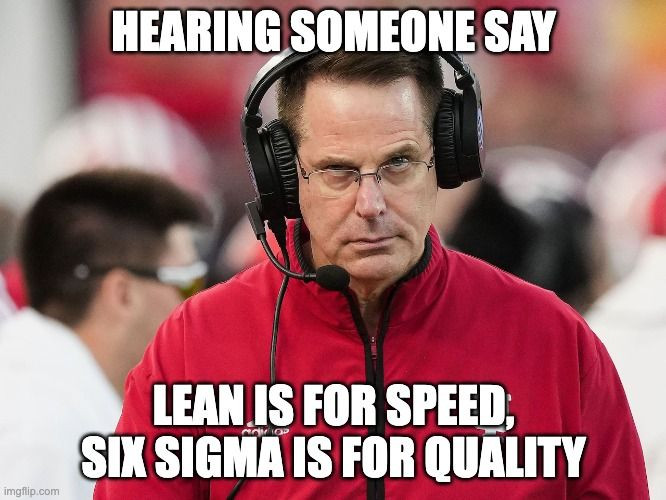
Because that framing misses the point.
It turns improvement into a false choice. And false choices are one of the biggest obstacles to real improvement.
Lean is not supposed to be about rushing people, pressuring them, or cutting corners. It's not “go faster no matter what.” It's certainly not about “making bad stuff faster.“
Lean is about improving flow by removing obstacles that make work harder than it needs to be: waiting, rework, interruptions, unnecessary handoffs, unclear standards, missing information, and poorly designed systems.
When those obstacles are reduced, quality improves–often dramatically–because the work becomes easier to do correctly.
Speed and quality aren't enemies. In well-designed systems, they reinforce each other. They're two sides of the same coin in the Toyota Production System. Better flow improves quality. Better quality improves flow.
The Myth of “Speed vs. Quality”
The idea that organizations must choose between speed and quality is deeply ingrained. You hear it in manufacturing, healthcare, software, and service organizations alike:
- “We can go fast, but mistakes will increase.”
- “We'd love higher quality, but we don't have time (or the budget).”
- “If we slow down to improve, productivity will suffer.”
Those statements usually reflect the current state of a broken process–not an unavoidable law of nature.
When leaders push for speed without improving the system, people compensate by skipping steps, working around problems, or staying silent about risks. Quality suffers, and burnout follows.
Lean challenges that dynamic by asking a different question:
Why does the work take so long in the first place?
Often, the answer has nothing to do with effort or motivation and everything to do with system design.
Flow Improves Quality and Vice Versa
In healthcare, I've seen countless examples where reducing waiting time also reduced errors. Fewer handoffs mean fewer opportunities for miscommunication. Clear standards reduce variation and rework. Visual cues help people notice problems sooner–before harm occurs.
In manufacturing, smoother flow reduces the chance that defects are hidden, passed downstream, or discovered too late. Problems surface earlier, when they're easier to address.
This is not an argument against Six Sigma or statistical thinking. Quite the opposite. Understanding variation, using data thoughtfully, and improving process capability all matter deeply. But separating “Lean” and “quality” into opposing camps misunderstands both.
Lean without quality is reckless. Quality without flow is fragile.
What Championship Teams Understand
That brings me back to Curt Cignetti and Indiana football.
As I write this, Indiana is preparing to play Miami in the College Football Playoff championship game on Monday night. Championship teams don't debate whether they want speed or execution. They don't frame success as a trade-off between hustle and discipline.
- They invest in fundamentals.
- They practice relentlessly.
- They review game film.
- They learn from mistakes.
- They standardize what works and improve what doesn't–game after game, season after season.
That calm, consistent look on Cignetti's face says something important: outcomes don't change the commitment to the process. Whether the last play was brilliant or painful, the work continues.
That mindset translates remarkably well to organizational improvement.
Congrats, BTW, to Cignetti and Indiana University for winning the national championship!
Embed from Getty ImagesThe Role of Psychological Safety
There's another layer here that often goes unspoken.
When leaders talk about “speed,” employees often hear pressure. When they talk about “quality,” employees often hear blame.
If people don't feel psychologically safe to speak up about problems, near misses, or flawed processes, neither speed nor quality will improve in a sustainable way. Problems get hidden. Workarounds become normal. Learning stops.
Lean done well depends on creating environments where people can say, “This doesn't work,” or “This is risky,” or “I made a mistake,” without fear. That's how systems get better.
Asking Better Questions
So instead of repeating the false dichotomy–Lean versus Six Sigma, speed versus quality–I encourage leaders to ask better questions:
- What in our process makes quality difficult?
- Where does waiting or rework create risk?
- What gets in the way of people doing their best work?
- How do leaders respond when problems surface?
Those questions move us away from slogans and toward real improvement.
I'll close with a question for you:
What's a false trade-off you hear in your organization that gets in the way of learning, improvement, and better results?
I'd love to hear your examples–and your experiences challenging them.
Come join the discussion on LinkedIn:







Referring to the meme “when someone says lean is for speed and six sigma is for quality,” you can take away many of the points stated. I learned that lean is not about making things faster, it is actually about improving the flow of your process by getting rid of any waste that stands in your system’s way. In most cases, lean does actually make your process faster, but faster does not always ensure great quality. I also like how Curt Cignetti and the Indiana football team can be related to organizational improvement. Going from one of the worst teams, to winning the national title is a great example of leadership, process improvement, lean, and even Six Sigma.