
Martin Luther King Jr. Day: Continuous Improvement, Respect for People, and “Keep Moving Forward”
Let's commemorate today's national holiday for Dr. King with a look back at my post from 2012:
A Lean Lesson from Dr. Martin Luther King, Jr.
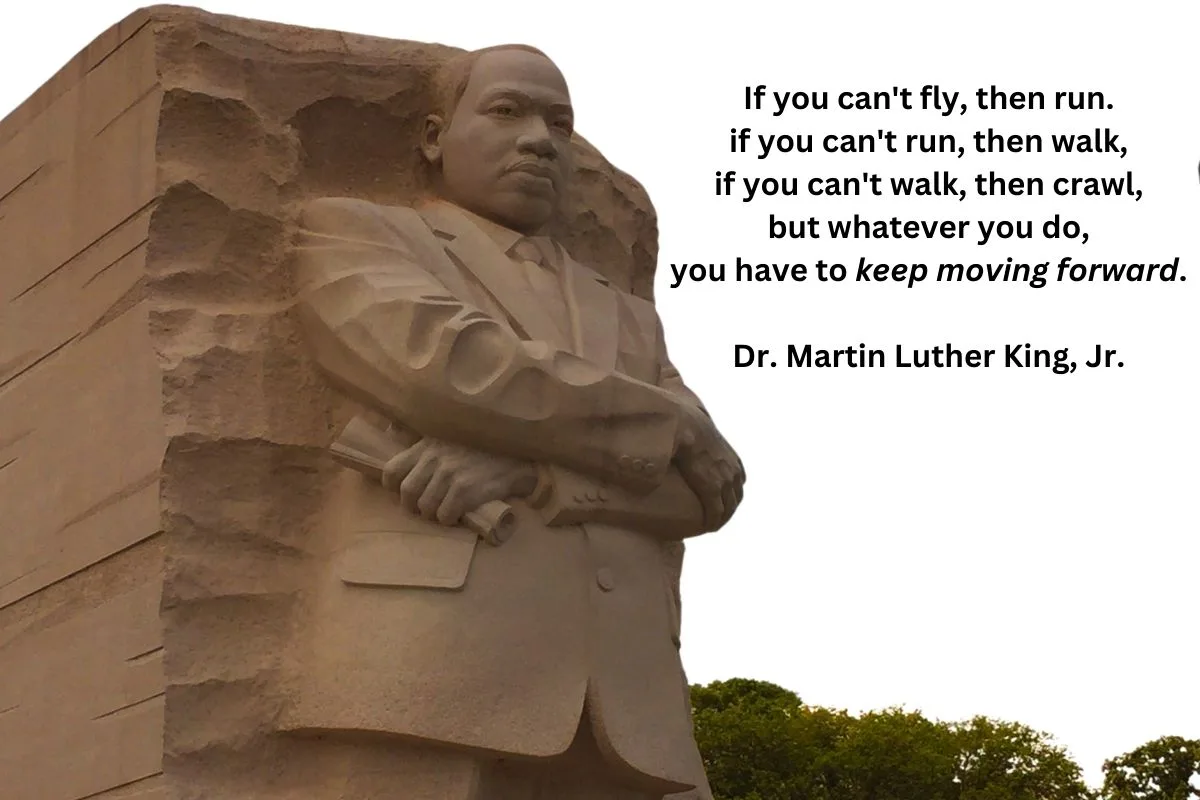
And here is a quote that should remind folks of Kaizen and continuous improvement:
(hat tip to Allison Meyers)
If you can't fly, then run.
Martin Luther King, Jr.
if you can't run, then walk,
if you can't walk, then crawl,
but whatever you do,
you have to keep moving forward.
Also, this quote caught my eye from one of Dr. King's “Letter from a Birmingham Jail.”
Dr. King wrote, in part:
“…the means we use must be as pure as the ends we seek.”
He's referring to non-violent means for driving societal change. This is a powerful principle, and it also reminds me of a core Lean management principle.
The Lean concept is often described as “the right process leads to the right results.”
This means that when we have an organizational objective, we aren't satisfied with just having the right results. Traditional organizations won't dig into the details of the process if the results are good. This might mean people are gaming the system, cheating the numbers, or making short-term decisions at the expense of the long term.
Lean thinkers want to make sure we not only have results, but that we came about them by doing things the right way – this includes not scrimping or cutting corners on safety and quality — basically showing “Respect for People,” as Toyota calls it. I think that's what Dr. King would have wanted, this respect for people.
I also invite you to check out the “Root Cause Racism” website that my friend Deondra Wardelle has put together, as we take a day to reflect…
Editor's note (2026): This post was lightly refreshed to connect Dr. King's words to ongoing conversations about Lean leadership, psychological safety, and ethical improvement.






[…] Martin Luther King, Jr. Let’s all be respectful, fair, and just in the work that we do. And see this image and quote from 2013. And my friend Jon Miller has a better collection of MLK quotes […]
Passion for something manifests itself in a willingness to never give up, even when it seems you’ve hit the wall. Continuous improvement is a relentless pursuit, a mindset that difficult problems can be solved. Great post!
The main waste Dr. King was committed to eliminate, was that created by a non-inclusive society.
“I have a dream that my four little children will one day live in a nation where they will not be judged by the colour of their ski n, but by the content of their character.”
Here’s a blog post by Dr. Eric Dickson (an upcoming podcast guest) that reflects on Dr. King’s words:
“Each of us can be great because each of us can serve“
And our friend Jess Orr posted this on LinkedIn:
https://www.linkedin.com/feed/update/urn:li:activity:6493103673458122752
“The ultimate measure of a man is not where he stands in moments of comfort and convenience, but where he stands at times of challenge and controversy.”