

GE Aerospace CEO Larry Culp on Problem-Solving vs. Finger-Pointing Culture
tl;dr: GE Aerospace CEO Larry Culp argues that problem-solving cultures outperform finger-pointing and blame, leading to better learning, performance, and accountability.
Problem-Solving vs. Finger-Pointing at GE Aerospace
There was a fascinating article in Bloomberg BusinessWeek about GE doing its final spinoff of GE Vernova (ticker symbol: GEV) and the remaining business that Larry Culp remains CEO of, GE Aerospace (formerly GE Aviation, ticker symbol: GE).
AN EMPIRE DIVIDED
The inside story of how GE CEO Larry Culp dismantled a 131-year-old American giant.
One part of the article caught my eye because of my focus on prioritizing problem-solving and improvement over blame and punishment (via my podcast about mistakes, my latest book about learning from mistakes, and a new project TBD).
The article compared the current-state GE Aerospace with the GE of old, under Jack Welch (and it's been almost 23 years since he retired as CEO)…
For context, the article was talking about Lean process improvement and breaking down barriers to flow, and then said:
“That process isn't “perfect,” even if it has improved, says Kayla Ciotti, materials and planning leader at GE Aerospace. “Ten years ago, we had brick walls. Five years ago, we had screen doors,” she says. “The door is open now. There's no door.”
In contrast with the cutthroat culture at Welch's GE, Culp's employees will get some leeway if they do walk into walls.”
Culp said something wonderful here:
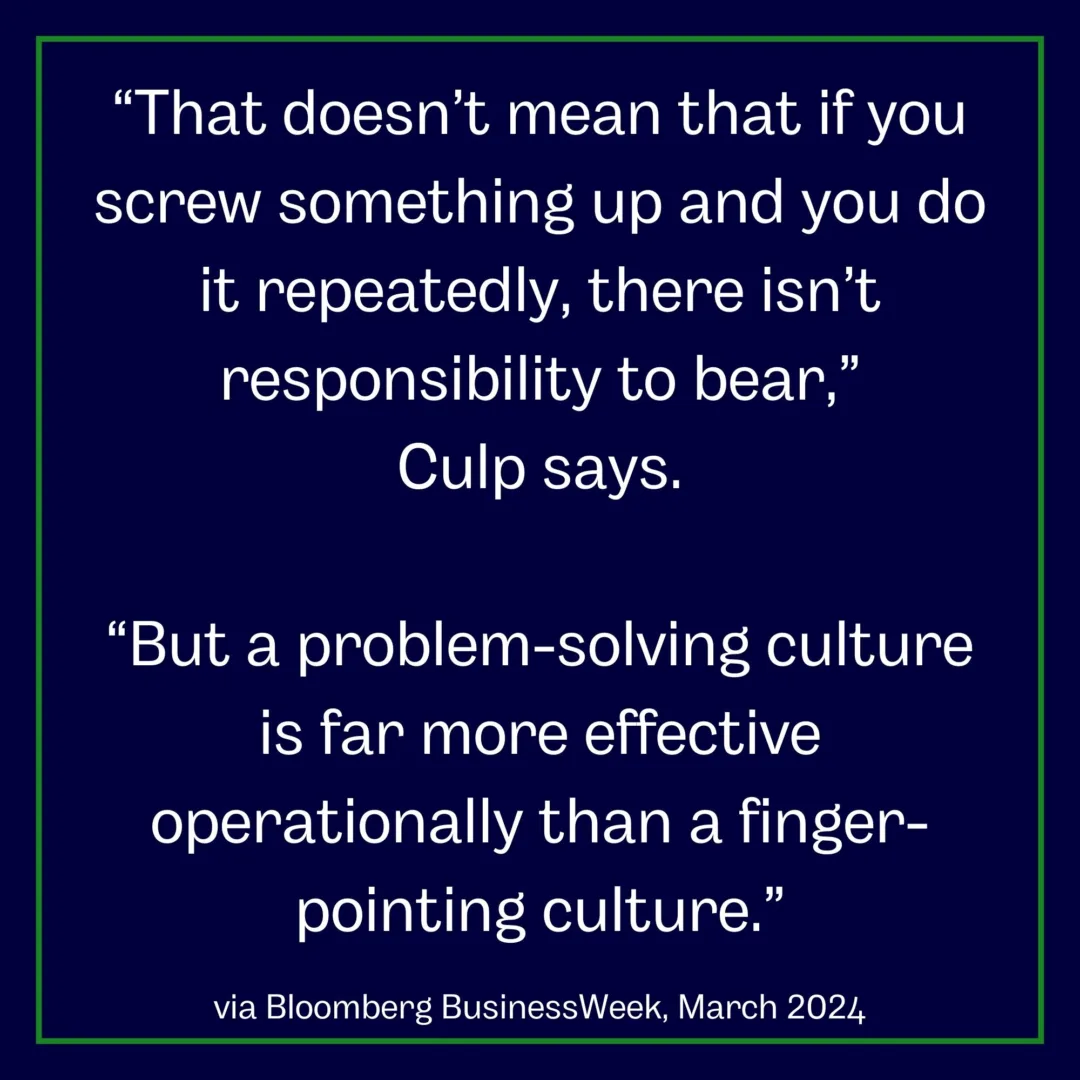
I'll repeat that…
“A problem-solving culture is far more effective operationally than a finger-pointing culture.”
I agree 100%, and I'm happy to see a CEO of Culp's stature say this.
Hear Mark read this post — subscribe to Lean Blog Audio
The article did not elaborate on this, but it shows the cultural transformation that has continued under Culp's leadership over the past five years. He's the first outsider to be hired to be the CEO of GE in the company's long history.
As I share in my book (which Culp recommended to GE employees after reading it last summer) and discuss in speaking engagements and training or coaching sessions, leaders have a CHOICE about how they react to mistakes and problems.
As I blogged about in late 2022, Culp told a crowd at the AME Annual Conference that he had told everyone at GE he wanted to hear bad news and that he wanted to hear it fast.
As Culp said, what mattered was “the moment of truth”–how did he and other leaders react to the bad news?
Here's a short video clip of him in conversation with Katie Anderson:
These are my words, not his, but I break it down like this…
If a leader reacts to a mistake or bad news with blame and punishment, then employees learn to hide bad news when they can. That's not good for the company, as problems only get worse. And a company can't solve a problem that it doesn't know about.
If a leader reacts to a mistake with the mindset of understanding, problem-solving, and improving… we'll have fewer repeated mistakes and fewer problems… and small problems won't turn into huge catastrophes. The organization will perform better.
Punishing employees for mistakes, problems, or failures might feel good… but it's counterproductive.
Toyota talks about learning from mistakes instead of repeating them:
What do you think? What stories could you share?
Here's a story I heard at a conference last year:
Larry Culp's point cuts through a lot of management noise. Leaders always have a choice in how they respond when something goes wrong. They can reach for blame, which feels decisive but drives problems underground. Or they can choose problem-solving, which takes more discipline but produces better results.
This isn't about eliminating accountability. It's about putting accountability in the right place: in fixing systems, learning from mistakes, and preventing recurrence. When leaders react constructively to bad news, they don't get less honesty — they get more of it, and sooner. That's how small problems stay small.
Organizations that claim to value Lean, continuous improvement, or psychological safety can't treat this as a slogan. The real test shows up in moments of failure, surprises, and uncomfortable truths. As Culp suggests, culture is revealed not by what leaders say, but by what they do in those moments.






[…] . Los líderes y los empleados a menudo retroceden cuando oyen hablar de un entorno «libre de culpa». ¿No significa eso que estamos fomentando los errores y eliminando la responsabilidad? Larry Culp, Director General de GE, aclara que sustituir la cultura de señalar con el dedo por una … […]
This is good, Mark. Thanks for sharing.
Thanks for reading it!