
10+ Years of Kaizen at Franciscan Health: Joe Swartz on Building a Lean Culture That Lasts
In this episode, I'm joined by Joe Swartz to reflect on more than a decade of Kaizen at Franciscan Health. We explore how frontline-driven improvement, leadership alignment, and daily problem-solving evolved into a sustainable Lean management system. This conversation offers practical lessons for healthcare leaders who want continuous improvement to endure beyond short-term projects.
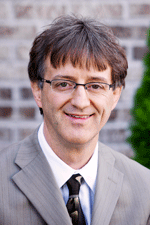
Joining me again for episode #299 of the podcast is Joe Swartz, my friend and esteemed co-author for our books Healthcare Kaizen: Engaging Front-Line Staff in Sustainable Continuous Improvements and The Executive Guide to Healthcare Kaizen: Leadership for a Continuously Learning and Improving Organization. You can learn more about our books here. He was previously the guest in episode #187.
Joe is the Administrative Director of Business Transformation for Franciscan Alliance, which owns Franciscan Health in Indiana (his full bio is here). He also contributed a chapter to the book Practicing Lean. (read an excerpt). Joe is also a co-author of the book Seeing David in the Stone.
Today is the first part of a two-part discussion in which Joe reflects on the history and evolution of more than 10 years of “Kaizen” or continuous improvement in his system. In our next episode together, Joe will be talking about “Champions of Change.” I hope you enjoy the discussion!

For a link to use for this episode, refer people to www.leanblog.org/299
For earlier episodes of my podcast, visit the main Podcast page, which includes information on how to subscribe via RSS, through Android apps, or via Apple Podcasts. You can also subscribe and listen via Stitcher.
What We Discussed:
Joe Swartz's Background and Role
- Joe's professional journey and how his role evolved at Franciscan Health
- How his early experiences shaped his approach to Kaizen and Lean leadership
What Drives Acceptance of Continuous Improvement
- Why people must see personal benefit before they buy in
- Understanding and respecting the perspectives of frontline staff
- Listening, responding, and adapting the approach based on feedback
Motivation and Engagement in Healthcare Kaizen
- What motivates clinicians and staff to participate voluntarily
- Balancing self-directed improvement with organizational priorities
- Creating space for autonomy without losing alignment
From Kaizen to a Lean Management System
- How Franciscan evolved from daily Kaizen to broader Lean management
- Introducing strategy deployment and why timing matters
- Creating alignment by asking executives:
“What are we really trying to drive?”
Metrics That Matter
- Identifying meaningful leading indicators for frontline teams
- Moving beyond lagging metrics and financial-only measures
- A real-world example of improving patient satisfaction
Learning Through PDSA
- Using Plan-Do-Study-Adjust cycles in daily improvement
- Why learning PDSA through Kaizen builds stronger problem-solving skills
- Applying those skills later in strategy deployment and system-level change
Leadership Development Through Kaizen
- Why leaders who practice Kaizen become more effective change leaders
- How participation changes how leaders think, listen, and act
Integrating Lean Practices
- Combining Kaizen with huddles, huddle boards, and tiered huddles
- Avoiding isolated tools by connecting practices into a system
From Projects to Value Streams
- Shifting focus from isolated projects to end-to-end value streams
- Addressing true customer and patient needs–not just local efficiency
Where Should Organizations Start?
- Daily improvement first vs. launching the full Lean “bundle”
- Practical advice for organizations overwhelmed by uncertainty
- Why risk-averse healthcare organizations still need a clear, steady direction
Learning Beyond the Organization
- Franciscan's participation in the Healthcare Value Network
- The importance of learning with–and from–other organizations
Video and Webinars With Joe Swartz:
10+ Years of Kaizen at Franciscan Health
Introduction
Mark Graban:
Hi, this is Mark Graban. Welcome to episode 299 of the podcast. It is February 7, 2018, and joining me today is Joe Swartz–my friend and esteemed co-author of Healthcare Kaizen and The Executive Guide to Healthcare Kaizen. Joe previously joined me on episode 187.
Joe is the Administrative Director of Business Transformation for the Franciscan St. Francis Health System in Indiana. When we last spoke, Joe's role focused on three hospitals in the Indianapolis area. Today, he has system-wide responsibility across 14 hospitals, leading continuous improvement and Lean management strategies.
This conversation is the first part of a two-part discussion. Today, Joe reflects on more than a decade of Kaizen and continuous improvement at Franciscan. In our next episode, we'll talk about “champions of change,” particularly in materials management and supply chain.
Joe, thanks again for coming back on the podcast.
Joe Swartz:
Thanks, Mark. I appreciate the invitation.
Joe Swartz's Background and Role at Franciscan
Mark Graban:
The last time we recorded together was back in 2013, so there's a lot to catch up on. For those who may not have heard earlier episodes, can you introduce yourself and the Franciscan Health System?
Joe Swartz:
I studied electrical engineering and earned a master's degree in management from Purdue. I entered healthcare around 2005 and joined Franciscan Alliance, initially working with the three hospitals in Indianapolis as Director of Business Transformation, leading the continuous improvement program.
About two years ago, I moved into a corporate role and now lead the improvement system across 14 hospitals. It's a very different job. I spend more time coaching and developing leaders rather than working directly in the trenches. Leading improvement from a distance requires empathy and trust. Kaizen has to be locally owned–it can't be pushed from corporate. My role is to encourage, support, and help local leaders succeed in ways that make sense for their environments.
What Helps People Embrace Kaizen and Continuous Improvement
Mark Graban:
Looking back over the last 10 years, what strategies helped create better acceptance of Kaizen and continuous improvement?
Joe Swartz:
People have to see the benefit for themselves. Before launching any effort, I try to understand who benefits and how. I want to appreciate all perspectives involved and clearly communicate how improvement helps everyone–not just the organization, but individuals doing the work.
Motivation, Purpose, and Engagement in Healthcare
Mark Graban:
Franciscan has a strong connection to mission and purpose. My sense is that people aren't doing Kaizen because they're told to–they do it because it makes work easier or improves patient care. What motivates people in healthcare to participate?
Joe Swartz:
It comes down to personal value. Ultimately, we want everyone engaged in daily improvement, but that doesn't mean forcing ideas on people. We use tiered huddles, Gemba boards, and daily metrics to help frontline teams align improvements with organizational priorities.
At the same time, we preserve flexibility. Staff can work on improvements that reduce frustration or make their workday better. The key is balance–supporting self-motivated improvement while still being good organizational citizens.
Strategy Deployment and Creating Alignment
Mark Graban:
Can you talk about how strategy deployment was introduced and how it helped create alignment?
Joe Swartz:
We began practicing strategy deployment in Indianapolis around 2008 or 2009. We worked closely with senior leaders to understand what they were truly trying to drive, then translated that intent down to the front line.
Frontline teams selected leading metrics that mattered to them but still drove the lagging outcomes leadership cared about. Patient satisfaction was one example where this approach made a huge difference.
You once told me that strategy deployment is really just PDSA at a higher level. You plan, try something, study the results, and adjust. That's exactly how we've evolved our approach over time.
Learning PDSA Through Kaizen
Mark Graban:
Does learning PDSA through small-scale Kaizen help people apply it more broadly later?
Joe Swartz:
Absolutely. That's how people develop what we call “Kaizen ears.” When someone brings an idea, we keep ownership with them because that's where the energy is. We connect them with the right people and coach them through the process.
Small wins build confidence. One great example is Tamara Malki, a manager in Indianapolis who was deeply engaged in Kaizen before she ever became a leader. She later brought forward a large idea from her nurses that required corporate approval. We supported it, and she ultimately won the Academy of Medical-Surgical Nursing's Prism Award. That success started with small Kaizens.
Building a Lean Management System
Mark Graban:
How did you layer other Lean management practices on top of Kaizen?
Joe Swartz:
In Indianapolis, we started with Six Sigma, then added Kaizen to engage all employees. When I took on the system role, I focused on three major themes.
First, value stream transformation–helping leaders move beyond isolated projects and see the entire system from the customer's perspective.
Second, daily improvement–Kaizen, huddle boards, tiered huddles, and model units where we could test ideas and spread what worked.
Third, strategy deployment–connecting everything together so improvement wasn't fragmented.
We're working toward daily improvement routines and meaningful Gemba walks, where leaders focus on how they can support frontline teams.
Sequencing vs. Doing Everything at Once
Mark Graban:
Should organizations start with daily improvement and add practices over time, or try to implement everything at once?
Joe Swartz:
It depends on the pressure the organization is under. Deming talked about constancy of purpose, and that's critical. Leaders need to see results or they may abandon the effort.
I've found it helpful to balance effort. Some work must clearly demonstrate value to leadership. Some effort should focus on culture and engagement through Kaizen. And some effort needs to tie everything together through coaching and strategy deployment.
The ultimate goal is a culture where everyone thinks about making things a little better every day.
Continuous Improvement During Uncertainty
Mark Graban:
Many healthcare organizations say they want a culture of continuous improvement but feel there's too much uncertainty right now. What would you say to them?
Joe Swartz:
Franciscan is fairly risk-averse, so I understand that concern. But you still need to plot a course. You can move faster and avoid mistakes by learning from others. We joined Catalysis to learn from peer organizations and accelerate our learning.
The key is staying true to your direction over time, even when conditions are uncertain.
Closing
Mark Graban:
Joe, thanks again for sharing your insights and experiences. Keep an eye out for the next episode, where we'll continue the conversation and dive into the idea of “champions of change.”
Building a Culture of Continuous Improvement That Lasts
If you're trying to build a culture where continuous improvement lasts longer than the latest initiative, Joe's experience offers an important reminder: Kaizen isn't something you “roll out.” It grows when people see the benefits for themselves, when leaders stay consistent over time, and when improvement becomes part of daily work–not a special project.