
What Toyota Said About Their Own Production System in 1992
Somewhere along the way in my career, someone handed me a copy of “The Toyota Production System,” published by Toyota Motor Corporation in April 1992. I don't remember who gave it to me. The document itself is unassuming – a horizontal-format booklet from Toyota's International Public Affairs Division, written for outside audiences who wanted to understand what Toyota was actually doing.
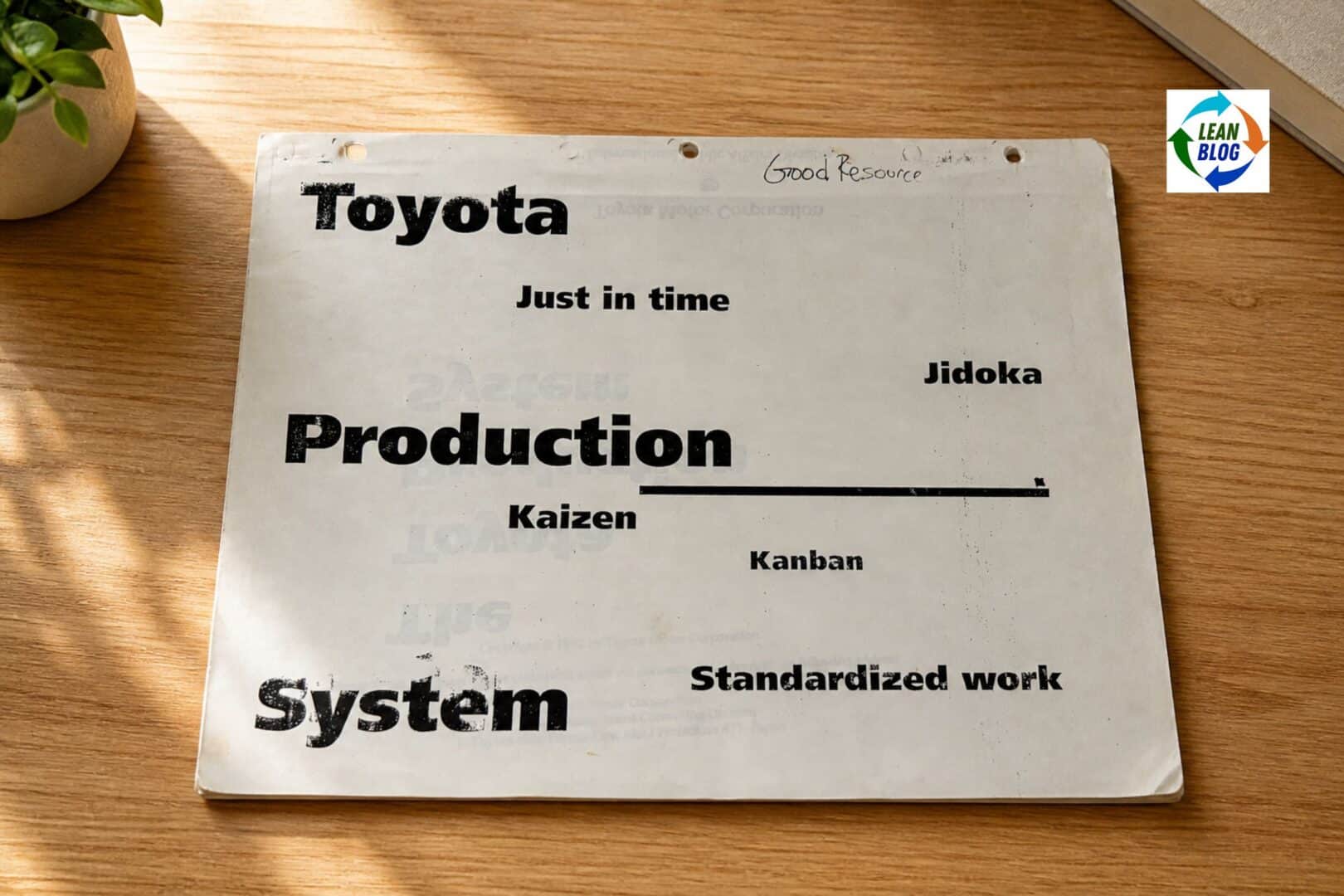
I pulled it back out recently and read it cover to cover. What struck me wasn't the kanban diagrams or the heijunka schematics, though those are there. What struck me was how much of the booklet is about people and culture.
Worth noting up front: the publication date matters. April 1992 puts this after The Machine That Changed the World, before Lean Thinking, before many of the books that shaped how the West learned about Toyota. This is Toyota's own voice, in their own publication, before the consultants and the case studies and the academic papers got hold of the story.
The opening line
The Foreword begins with quality and productivity as the central themes for any manufacturing company. Then the second sentence says:
“The key to maximizing quality and productivity lies in tapping the innate judgment and creativity of employees in the workplace.”
That's the opening. Employees, before any tool gets named.
A reader who skims the rest of the booklet looking for tools will find them. The kanban pages have photos of withdrawal cards, sorting rooms, and supplier processes. Heijunka leveling gets its diagram. Standardized work has a full page of forms. Multi-machine versus multi-process handling has its own comparison.
But the framing keeps coming back to people. The Worksite Management section anchors itself in a quote from Kiichiro Toyoda, who founded Toyota's automobile operations: any engineer who didn't get his hands dirty at least three times a day was no engineer at all. The jidoka chapter calls the line-stop system “
a humanistic approach to configuring the human-machine interface” that “liberates employees from the tyranny of the machine.”
The kaizen sidebar lands on this:
“Kaizen is about job ownership. It means giving employees full responsibility and authority for their jobs.”
These aren't throwaway lines. They're meaningful descriptions of culture.
The “stimulating or stressful” admission
The most interesting passage might be a sidebar called “For Employees: Stimulating or Stressful?” Toyota acknowledges, in their own publication, that their system:
“Enforces a creative tension in the workplace. Employees don't coast. Just-in-time production demands continuous vigilance. Continuing improvements in the name of kaizen demand unflagging efforts to find better ways of doing things.”
That's not the sanitized version. That's a company in 1992 saying, in print, that the system makes demands on people that conventional production formats don't make. They follow it with a claim about the payoff – that responsibility and authority are motivational, that nothing is more demoralizing than spending time in an unproductive manner. But they name the trade-off first.
I've reread that paragraph a few times. It reads less like marketing and more like an honest description from someone who's lived inside the system long enough to see both sides.
Now, the word “stress” also comes up when unions criticize Lean/TPS as “management by stress.”
Read more: Why This Nurses Union Is Wrong About Lean in Healthcare
Did the unions get that word from Toyota, or did they develop that on their own from “Lean gone wrong” or “L.A.M.E.” situations?
Why I don't think Toyota hid the culture
Some people argue Toyota deliberately withheld the cultural part of TPS – that the booklets and tours showed the mechanisms while keeping the secret sauce locked up in Aichi Prefecture. I've never found that persuasive, and the document itself doesn't support it. A company hiding the cultural piece wouldn't open the Foreword with the line about innate judgment and creativity. They wouldn't put the “creative tension” admission in print. They wouldn't let the Kiichiro quote anchor the section on worksite management.
What I think actually happened is closer to the fishbowl problem. Toyota in 1992 couldn't fully describe the water they were swimming in. Decades of internal apprenticeship, manager development on the floor, the labor relations history that followed the 1950 strike, the lifetime employment commitments that came after – all of that was the air the booklet was written in, not a topic the booklet could write about. You don't produce a guidebook to your own oxygen.
The translation problem is layered on top of that. A Japanese Toyota employee reading the booklet in 1992 would fill in cultural assumptions automatically. A Detroit manager reading the same pages would fill in different ones, or none at all. So even the parts Toyota did try to articulate landed differently than intended.
This isn't an accusation. It's just what happens when you ask people to describe their own culture from inside it.
What's there, and what isn't
What's there: the mechanisms, in detail. The line-stop rope. The fixed-position stop. The andon lamp that lights up to call the supervisor over. The supervisor rushing to the station and helping correct the problem. Suggestion volumes that still sound implausible to most ears:
“Employees at Toyota operations in Japan proposed nearly two million improvements in 1990, and the employees implemented 97% of their proposals.”
What isn't there: what happens to the person who pulled the rope (they get thanked and helped). How supervisors should respond when bad news arrives (positively and constructively). What conditions produce a 97% implementation rate versus the rates most organizations actually see (let people try improvements that matter to them). The behaviors that make the mechanism trustworthy enough that someone will pull a rope in the first place.
Reading it in 2026, with thirty-plus years of Lean writing behind us and Amy Edmondson's work on psychological safety in the mix, the gaps are visible in a way they probably weren't in 1992. Not because Toyota was hiding anything. Because the people who could see the water were the ones who eventually had to swim in from outside.
Where this is going
I'm planning a few more posts pulling on threads from this booklet. The line-stop rope and what the document doesn't say about it. Kaizen as job ownership rather than a suggestion program. Maybe a post on heijunka, where the 1992 framing is more useful than how the topic often gets taught now.
If you have an old Lean document from this era sitting in a binder somewhere, this might be a good week to dig it out. Read it cover to cover. Notice what the original authors thought needed explaining and what they assumed you'd already understand.
What did they leave for the reader to fill in?