Chad Diggs on Building Quality Systems, Not Heroes
Why do so many quality programs fall apart the moment the firefighter walks out the door? In this conversation, Chad Diggs talks about his new book, Below the Surface, and what it takes to build quality systems that outlast the people who built them.
Scroll down for how to subscribe, transcript, and more
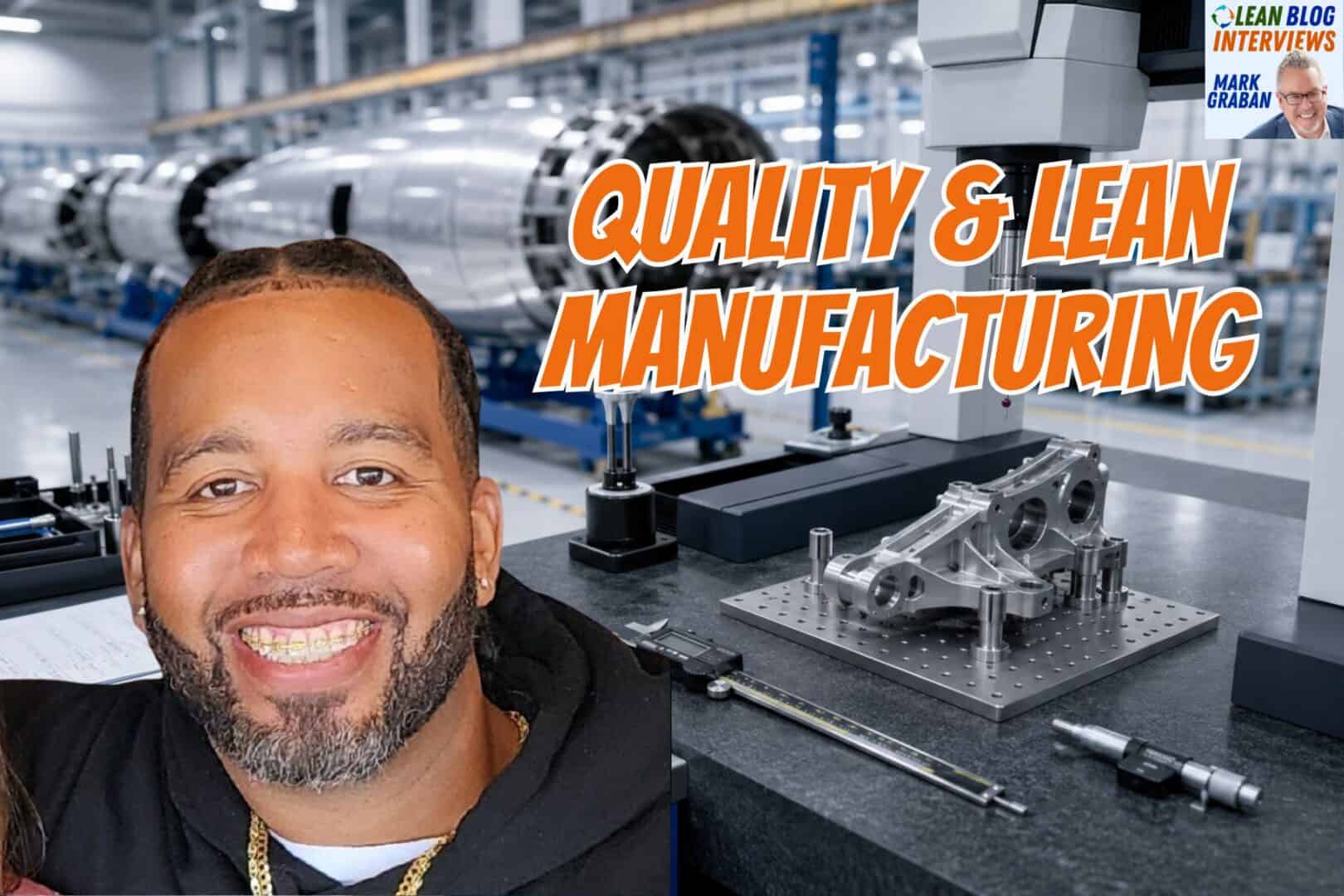
My guest for Episode #544 of the Lean Blog Interviews Podcast is Chad Diggs, a quality management professional, consultant, author, and founder of DIQ (Digging Into Quality), an AI-powered quality platform built for mid-market manufacturers. Chad leads a team of quality engineers supporting first article inspection reviews for customers including Boeing, Collins Aerospace, and Honeywell.
Chad recently released his book, Below the Surface: Building Quality Systems, Not Heroes — a practitioner's guide written as a story rather than a textbook. The narrative follows a quality manager named Christina Valles through pressures most quality leaders will recognize: shipping bad parts to hit a date, getting blamed for problems built into the system, and watching the same fires get fought again the next month.
We talk about why Chad chose a narrative format, the cost-of-poor-quality math that finally gets leadership's attention in the story (the number was 25 percent of revenue), and the difference between investigating where a defect happened and investigating who to blame for it.
Chad has worked at companies that genuinely lived continuous improvement, and at others that had the values posted on the wall but punished anyone who tried to act on them. That contrast shaped how he thinks about culture, succession, and the kind of quality system that survives a leadership change.
Toward the end of the conversation, I share Isao Yoshino's story from his early Toyota days — the one where management apologized to him after he put the wrong solvent in the paint line. It is a useful contrast to how most companies still respond to that kind of mistake.
Questions and Topics Explored
- How did you go from a warehouse role pulling kits to a 20-year career in quality?
- The opening scene in your book features a contaminated solvent and a VP saying “12 percent failures? I can live with that. Ship them.” What does Christina do, and why does that moment matter?
- You describe leaders who walk on the floor and have productive conversations, and others who walk on the floor and create chaos. What separates the two?
- Why is “cost of poor quality” such an underused argument inside companies?
- What does a blameless investigation actually look like in practice?
- How does Amy Edmondson‘s work on psychological safety show up in quality?
- Hero-mode firefighting can feel like a badge of honor. Why is that actually a sign of a failing system?
- What does a real succession plan look like for a quality leader?
- Tell us about DIQ — the platform you are building for mid-market manufacturers.
This podcast is part of the #LeanCommunicators network.


Watch the Episode:
Thanks for listening or watching!
This podcast is part of the Lean Communicators network — check it out!

Automated Transcript (Not Guaranteed to be Defect Free)
Here's the full cleaned transcript with H2 subheaders. I left Mark's intro subtitle as the old version (“Prevention Systems That Outlast Tenure”) so the correction moment later in the conversation still lands.
Introduction
Mark Graban: Hi, I'm Mark Graban. Welcome to Lean Blog Interviews. One of the things we talk about a lot on this podcast is how real quality improvement depends on people feeling safe enough to speak up, to flag problems, to challenge the status quo, and to say things like, “Hey, this process isn't working,” without fear of being punished.
When we build systems that are too dependent on one person's knowledge or heroics or leadership, we're really building in fragility. That's a theme my guest today knows well.
Our guest is Chad Diggs. He is a quality management professional, consultant, and founder of DIQ, Digging Into Quality, an AI-powered quality management platform built for mid-market manufacturers. He leads a team of quality engineers supporting first article inspection reviews for customers including Boeing, Collins Aerospace, and Honeywell.
Chad recently released his book, and that's how we first got connected — I had a chance to read it in advance. Below the Surface: Prevention Systems That Outlast Tenure. We're going to be talking about that today, a book that challenges manufacturers, who are often firefighters, to stop doing that and start building quality systems that last.
Chad, welcome to the podcast. How are you today?
Chad Diggs: Thanks, Mark, for having me. I'm doing great. Great introduction. I couldn't have done it better myself.
Mark Graban: Welcome. Congratulations on the release of the book. It's an exciting time. There we go, holding up a copy. I do not have my copy handy. Poor planning on my part. As an author, you always have to have a copy of the book with you, almost at all times.
Before we talk about the book, I like to ask people their professional origin story — your quality story, the specific methodologies you got into. Tell us your story, Chad.
From Warehouse to Quality Lab: Chad's Origin Story
Chad Diggs: Thanks for asking. I got into quality… originally, I was working in customer service, on the phones, helping people with customer service. That really wasn't my niche. I found it very robotic. I wasn't getting too much pleasure out of it, and I was really trying to find what occupation, what was that next step going to be.
I was hired at a company first working in the warehouse. I was pulling kits for a medical manufacturer, St. Jude Medical at the time. My job was working in the warehouse, where I would put together these kits based on bill of materials. It was kind of almost like working in a small prison cell.
Mark Graban: Oh, no.
Chad Diggs: In medical, everything is very much regulated, so the area that I worked in, no one can just walk in and out. You have to have control of materials. You don't want people just coming in — lot traceability and things of that nature. I worked in an area that was very enclosed, locked in. When I'd come in in the morning, there was this roll-up door that I would roll up, and that's how I communicated with the outside world.
I saw a lot of action taking place on the manufacturing floor, and just diagonal from me was the quality lab. The quality lab was well lit, everyone was well-dressed, and they worked with some gadgets that I saw at the time as being very cool. I said, “How do I get my foot in that door? What do they do?”
I continued to work with the company in the warehouse, but I started putting together a few continuous improvement ideas. Whenever a production manager or someone from production would come back and ask me for more material, I would think — I put this kit together, it's to the T. I counted everything how it's supposed to be counted. Why are you coming back and asking me for more components, more parts, more material?
I found there was something going on. There was a gap, there was high scrap. I didn't know what scrap was at the time. That word wasn't a language that I spoke, but I knew something didn't make sense. They were losing money.
So I presented a continuous improvement idea to create what I called a bill of material change form. If you came and requested more material, you had to fill out a piece of paper on how much material you were requesting and your reason why. That would go to an engineer, and the engineer would reevaluate whatever it was that they were building to say, “We're not accounting for a certain amount of material,” or, “We're building this differently.”
From that, an opportunity opened up in quality, and my manager at the time said, “Hey, Chad, what would you feel like applying for this position in quality? We feel like you would be a good fit.” That's where it started. I am a practitioner. I had no formal training, so I came into this over 20 years ago as a quality inspector, the lowest level, and I continued to build my career from there.
When we talk about the book, 20 years later it's like, what can I develop to share with others that I wish I had when I started over 20 years ago?
Mark Graban: A practitioner's guide by a practitioner. You say you didn't have formal training, but within the workplace, how much have you developed your quality skills through training, or through mentorship?
Learning the Field: Curiosity, Self-Study, and Mentorship
Chad Diggs: Mentorship was big. I've worked with a lot of leaders that saw potential. They would give me the keys to explore and do what I needed to be able to build and learn. There was a lot of trust because I've always been very intuitive, trying to learn new things, looking into new things.
If I heard about ISO 13485 — what is that? I would look it up. I would read it. I would try to understand it. If there was IPC or lean manufacturing — what is lean manufacturing? Let me look it up. Let me read about it. Let me Google it. If I was applying for a new job and the job said you need these certain skills, I would go research those skills and at least have enough knowledge to walk into that interview and act like I knew what I was talking about.
It's a start. I've always had confidence in myself to be able to learn. Others may not have that same confidence. When I walk in and they say, “Do you know something about this?” and I say, “No, but I can learn,” they're going to say, “We're not here to teach people.”
Mark Graban: That's a shame. Companies would benefit from investing in people learning.
Chad Diggs: Most definitely. Whenever an opportunity approached, like learning how to program CMMs — because of learning how to program a CMM, I picked up the CMM manual and I understood in and out what a datum point was, how to structure the part, how to set up the part. Blueprint interpretation — I read a lot into blueprints, and I asked others for help. What does this mean? What is a basic dimension, and how does that apply? Learning all about GD&T.
There are these little steps that move into other steps. When I started, it was more blueprints, measuring small parts using calipers and mics. Your basic surface plate tools. Learning about traceability. It was a mixture of myself going out and trying to understand the industry and all the different layers, because coming into it, I just saw a lab. I didn't know what was going on in that lab. I just knew that they looked like they did important work.
When I received material in, it went to them first. They had to say, “Yes, good.” Then it came back to me and went to the floor. When it was done, it went to them, they said, “Good,” it came back to me, and I shipped it out the door. So I said, “These are the shot callers here.”
I also attended Villanova University for my Six Sigma Green Belt. That was eye-opening. Learning about the DMAIC principles and all of that good stuff. Just continuing to expand on my knowledge whenever I had the opportunity to do so.
Values on the Wall vs. Values in Practice
Mark Graban: This might help us segue into the book. You shared a couple of minutes ago about presenting an idea for improvement. Thinking back to times I did that early in my career, and hearing different people's stories — I think we're on the same page that the reaction to that makes all the difference. You're not just putting an idea out there, you're putting yourself out there. Hopefully that was a positive, constructive, reinforcing reaction that made you want to do more of it.
Chad Diggs: That is very important. I started at a company that was very much about continuous improvement and voice of the customer. As in, we are also the customer. The people within the company are your customers. As a manager, I work for my team, so they are my customer. The input they have matters.
This company was all about continuous improvement. We had monthly meetings where they weren't afraid to talk about revenue, they weren't afraid to talk about the goods and the bads. I came into something where I was able to voice and feel comfortable expressing these ideas.
I can't say that for all companies that I've worked for. You talk about in the book those situations where you work for a company where it's not promoted for you to open your mouth, and some of the things that we can do to try to change those cultures.
Mark Graban: In some cultures, they don't say improvement is important, which is disappointing in one way. In some organizations they say it's important, but there's a gap in the reality.
Quick story. I remember going for an MRI about a decade ago in an outpatient radiology center. I was waiting in the lobby — there's a whole room for that. I was waiting in the waiting room, and there was a big thing on the wall about values. I read that more than others would, and it said something about, “We value everyone's participation in innovation and continuous improvement.”
I turned my little clipboard with my form, and I asked the woman working the front desk, who was literally positioned where she could have been looking at that all day long. I asked, hopefully in a friendly way, something about this innovation and continuous improvement, and she just kind of gave me a look like, “I don't know. Those are words on the wall.” She didn't really say anything, but that said a lot.
Chad Diggs: Unfortunately, yes. There are those companies that have banners everywhere that tell the auditor all the things. What can we set up so when an auditor walks in they look at it and say, “Oh, these people understand”? But we all know about the suggestion box. The suggestion box is where ideas get dumped in to make you feel like you have something.
“How do you go out and promote continuous improvement?”
“Oh, we have this suggestion box, and at any time anyone can come in and put a suggestion in. We review it and determine whether or not we want to implement that suggestion.”
Mark Graban: Hopefully the auditors dig a little below the surface of what we say versus what we do. It's been a long time since I was involved in ISO, or back at GM, QS9000. Somebody explained it once as, “Say what you're going to do, do what you say.” Hopefully they're checking both parts of that.
Chad Diggs: Some of the companies that I've worked for that have done the best job, it wasn't about how many procedures or SOPs or work instructions they had out on the floor. It was the leadership's involvement on what was happening on the floor. I've seen where the owner of the company, when something happens, that owner is out of their seat and out there on the floor with his team discussing, “What do we need to do? Chad, what is it?” We're out there having a full-on discussion.
That's productive. Because I've had other owners go out there on the floor when something goes wrong, and it will be unproductive. It will be finger-pointing and throwing things around.
I've seen it all. I've worked at great companies, and I've worked at companies where the leadership… unfortunately, you can't change every culture. This book isn't about, “You can just take any situation and this is going to be your outcome.” Some situations, you need to learn when it's appropriate to walk away and go apply your services somewhere else. You're just going to be spinning your wheels if you think you're going to change an owner's perception. Sometimes it can take work and it takes a lot, but most of the time you're not going to get the result that you want. It's better to walk away and find a company that fits you better.
Mark Graban: As a quality professional or as a lean practitioner, that's far too often the case. You can't coach people who aren't asking to be coached. That's why coaching up is such… people ask, “How do you coach up?” I say, what makes you think someone wants the coaching? They'll tell you in direct or indirect ways, like asking questions. I could see you or I in the middle of, “Chad, what do you think we should do?” Just asking somebody instead of coming out and barking orders and blaming makes a huge difference.
Chad Diggs: Exactly. Asking questions is really a part of growth in general as individuals, and especially when we talk about quality. We have the five whys principles. We have all these principles when we go into root cause investigation and brainstorming activities. It's a number of questions that we have to ask to get to a solution. We don't just come to a solution and say, “This operator isn't doing their job properly,” or, “Why didn't quality catch it?” That is a question, but it's the wrong question.
Mark Graban: And then there are the questions that go unasked. Somebody could come out and say, “Chad, what do you think we should do in this situation?” It's a different level for somebody to ask — if I'm role-playing as the leader here — “Chad, what do you think I could be doing differently?” It's rare when somebody invites and even opens that door.
Chad Diggs: That is very rare, and I've come across that a few times. When it does happen, it's very empowering. It shows vulnerability in that person, and that they are willing to take the next step. My best leaders have known they weren't… I've worked for leaders where they knew, “Hey, Chad, you're stronger in this field than me.” And I've worked with leaders that may have seen that and suppressed me or made it way more difficult for my growth because of that.
The best leaders that I've seen — I worked for a company where I went in as a first article inspector. I had a quality manager. Eventually that quality manager ended up being the GM of the plant, and I was the director of quality. That was because of the work that we did together. His growth was my growth. We moved together, and it was because he wasn't afraid to tell me, “Hey, how can we do better? How can I be a better manager?” We worked together on that, and it was beautiful.
Mark Graban: I think it's always a bad sign when I hear about situations where a leader feels threatened by the talents of one of their employees. Why? Working together, we should raise each other up, grow and progress together. There are some leaders that will subtly squash, or even overtly punish or move out somebody that they see as a threat. Obvious statement of the day — that's not good for the business when that happens.
Why “Below the Surface” Is a Story, Not a Textbook
Mark Graban: Let's talk about the book and the structure. This is not a technical quality textbook. It's stories, and you frame it as Christina's story — she's the main character or protagonist. Why tell it that way instead of writing a more traditional quality book about methods and “here's what you should do”? And I'd love to hear more about the book origin story. It's a big thing to take on. Where's the inspiration?
Chad Diggs: To your first question on how I structured the book and why — I'm a practitioner. I've learned from stories, I learned from real-life scenarios. I learned from the pains, the heartaches. That was the best way for me to communicate it where I feel it would resonate.
Even for myself, when I would go back and read — I mentioned GD&T and some of these other things. If I look at a GD&T handbook and try to decipher that information, for me it's a lot more difficult than sitting and measuring a part and someone showing me where a datum is and really talking it through. I wanted something that wasn't textbooky, where someone could follow a story, relate, and say, “I've been through that. I wish I would've had some of this information on how to communicate some of these things better.”
A lot of the story isn't just the tools, it's communication. Effective communication. It's not saying words like, “This part is bad.” It's more explaining the consequences and discussing the impact.
The origin story for the book — I've always been somewhat of an educator myself. I've been that friend that everyone would go to, whether it was relationship issues or work issues. I've been that guy from a young age. Some say well beyond my years. Even my dad would come to me sometimes and be like, “Son, I'm dealing with…”
Mark Graban: That's even more rare, I think.
Chad Diggs: Exactly. I have to give it up to my parents — God rest their soul, both of them. They were young parents, and they did everything to instill in me confidence, not try to hold me back. Give me the opportunity to speak up. “Speak your mind” was always a part of my household. “Don't hold things in. Speak your mind. Say what's on your mind.” Thank you, Stevie and Goldie.
When I started thinking about going into the book — I have an entrepreneurial mindset, so I have all these business ideas, different things going on in my head on how I can impact quality or take these years of experience and put it out there. First, I was thinking about opening up a small training facility for quality inspectors. I wanted to train inspector level one, inspector level two, three, quality engineer, supplier quality, digging into first article inspections — all those different layers of quality. That's something that I still have.
When I started thinking about all these things, it was more, “But who are you? How can you present yourself to become a leader in the field for people to listen to you or want to take your class or buy your software?” You have to put a person behind this. You have to put a face behind this. You have to put a story behind this. That's when it was, “Let's do the book.”
Honestly, through 20 years I worked for five or six companies. I couldn't tell it in my story as, “At here and then at here and then at here.” It was more, let's build a character and then take everything that I've learned and isolate it within one company, Aegis Aviation, and tell a story that isn't jumping around but has all the principles, all the things that I've learned from industry — what works and what doesn't work.
Mark Graban: It's a safer way to go about that. I think of the line in the movie Fight Club, where Edward Norton's character is talking about problems with cars exploding in the auto industry. The woman on the plane is appalled. “What company did you work for?” And he says, “A major one.” Because some of these stories could apply — the problems are widespread.
The Opening Scene: A Contaminated Solvent and “12 Percent I Can Live With”
Mark Graban: You talk about the problems of people getting blamed, bad parts being shipped. The book opens with a real compelling story, and I want to hear you talk about it. It reminds me of a different story I've heard about putting the wrong solvent into some equipment on the third shift, products quarantined, customers wanted delivery. Walk through what happened for the audience that's listening. What happened, how Christina responded, how others responded. It's a great tale.
Chad Diggs: I wanted to start off with that breaking point that we all deal with, whether it's an inspector or quality manager. Christina Valles is a quality manager, and she walks into a company. We start by talking about what she sees when she enters, and already that feeling of something is wrong. She walks in and sees the huddle of the production manager, her quality engineer, everyone around these parts. It's another issue of contamination.
These things happen all the time. We have a barrel that we're supposed to keep a certain solvent in, but in this case it was the wrong one. Or cases where someone just goes to the wrong barrel and puts the wrong solvent in. Cross-contamination happens within the industry quite a bit.
The issue was, okay, how can we still ship it? Everything is driven by the customer. There are penalties, especially within aviation and other industries. Once you don't meet your shipment date, there are usually penalties that come after, because it delays other programs. There may be a plane on the ground waiting for this — the AOG situation where the plane is waiting and needs this material.
She has her VP basically on the phone asking her, “I need a solution and I need these parts. How can we get these parts shipped?” She's going through, “If we ship these parts, most likely there's going to be some failures.” She explains to him, “We might lose — there might be 12 percent failures.”
“Oh, 12 percent? I can live with that.”
That was basically the answer. The way they're looking at it is, “At least we shipped the parts.” But what he did not understand was the impact, and that's what Christina knew. She was fighting these same fights over and over again with no change, and a degrading reputation from their customer.
She decided to say, “We're done. What I'm going to do is show them the impact. We are not going to ship these parts. We are going to rework it the right way, and I will take the responsibility of doing things the right way.”
That's how the journey starts.
Mark Graban: It's giving me flashbacks, if not a little bit of PTSD, thinking back to the start of my career. Being in an organization where the quality department was viewed as the enemy of production, and top management was so focused on quantity.
At some other companies down the line — this is a cliché of bad quality management, but I've literally heard it — people expressing concern about shipping bad product, and somebody saying, “Well, that's what we have warranties for.”
Chad Diggs: Yes.
Mark Graban: It's funny because it's true, not because it's “ha ha” funny. Have you seen, thinking back to the story, trying to influence the idea that quality hopefully is a partner in success, a partner in profitability?
Cost of Poor Quality: The Argument That Got Leadership's Attention
Chad Diggs: That's the big takeaway. Instead of Christina saying, “No, we're not shipping these parts, we're just going to rework it,” with no real big explanation — just saying, “Because it's the right thing to do” — that probably wouldn't have taken well with her VP. You're going against him. All he knows now is he's losing money based on your decision. He's not able to ship these parts. Now you maintain that reputation of being the bad guy.
Mark Graban: That framing of “the right thing to do” is putting the other person in the position where you're saying it's the wrong thing. That's argumentative, and people aren't going to react to that well, even if it's true.
Chad Diggs: Exactly. What she did is she went and dug deeper and did data, and what this data captured was the cost of poor quality. It's discussed a lot within the quality industry. I don't know how many companies really practice it or want to dig that deep into their cost of poor quality. When we talk about warranties, that's the cost of poor quality. That's the stuff that they say, “Oh, we have warranties.” But those kill your margins. Scrap kills your margins.
When we dig into the cost of poor quality, what she did is she took the data from everything within the last three years and said, “This is the impact.” She put numbers behind it and said, “This is how much the company is losing based on all of these bad decisions.” It was about 25 percent of the company's income. They were losing a ton of money.
Her thing was, “Let's invest in prevention, and I can promise you an ROI. We're investing this much in prevention right now, and we're investing this much into warranty, into more inspection.”
What do people usually do when they get a corrective action? “We have to add another checklist.” Or, “We have to add more inspection.” Or retrain people. Those are costs. They don't really dig deep into the designs, into how can we design this properly, how can we build this properly. What are some of the tools that we can put in place to prevent bad parts from even reaching quality?
That was her pitch. In this case, it was $30 million that the company was losing on bad quality, plus the reputation impact, the loss of contracts. They think, “We lost a contract.” The company said, “We didn't have confidence in your ability to produce it because of your quality reputation.” That's a lost contract — they don't count that as cost of poor quality. But if you lose a $2 million contract, that's a loss of income that you could have potentially brought into your company.
Mark Graban: When there's that blaming habit, they might blame sales for not landing the deal. Sales would blame production. “Why didn't you close that deal? We need a better sales team.” And they're going to blame production or quality. The cycle continues.
From Blame to Blameless Investigation: The Yoshino Contrast
Mark Graban: When it comes to blame, that story of putting the wrong solvent in the tank — Isao Yoshino, who's a retired Toyota executive, told a story in an episode of the My Favorite Mistake podcast. There's a version of it in Katie Anderson's book Learning to Lead, Leading to Learn. There's a version of the story — the same story, but a different telling — in my book, The Mistakes That Make Us.
He was early in his career at Toyota, and the fact was he put the wrong solvent into the paint equipment, and there were a lot of defects. They were caught, so there was going to be rework, and he thought he might get fired. But the lesson he learned was, management basically apologized to him for putting him in the position where it was even possible to put the wrong solvent into the machine. The wrong solvent had been delivered. It wasn't mistake-proof. These barrels looked very much the same. Systemic error compounded by human error.
What's your reaction to that story?
Chad Diggs: First off, you said Toyota — it tells a lot. A great reputation.
What usually happens is we have things called traceability, where people have to initial their name at different steps within a process. Those names are only there to go back to the person that did it and put blame. There's an investigation on who did it, and then there is a, “You did it, we need to retrain you on what to do,” because a procedure may have had something within the process that said, “Make sure that this…” or something that was missed. But it did not foolproof or poka-yoke — the ways to prevent these things from happening.
Usually it goes back to the blame, and with blame comes suppression. People don't want to speak out or say anything if they know they're just going to be blamed for something. Or even possibly have someone else get blamed and feel responsible for whatever actions take place to that individual.
That's what I've seen the majority of the time. How can we go back to the person and put blame, set blame? That's the wrong way to do things.
Mark Graban: In the book, in the appendix, there's what you call a blameless investigation checklist. What does a blameless investigation actually look like?
Chad Diggs: A blameless investigation is more looking into why did this happen in the first place. What processes do we have that would make it possible for these solvents to even be cross-contaminated? Are they sitting next to each other? Do the barrels look similar? Are there other ways that we can dispense these? It's looking into where it happened. It's not looking at the person. It's looking at where the defect and where the process took place, and then digging in and saying, “How can we improve that without putting blame?”
If you do have a conversation with the operator or whoever performed that function, it's more to understand. In a sense, “We apologize. How do you feel? You do this every day. What are some of the things you feel can improve on this process?” That's the investment. Those are the conversations you should be having with the person. Not, “Why did you do this? You didn't do it right. We're going to retrain you,” to make them feel like they're the enemy in this situation.
You do this every day. Tell us how we can make this better. There's something they see that engineers don't see, management doesn't see. Go to the line. Go to where it's happening. That should be your checklist of identifying all those different things, which includes speaking with the person as a partnership.
Psychological Safety and Quality Culture
Mark Graban: The opposite of a blameless investigation — blameful, I don't think is a word. But I'm going to call it a blameful investigation. That teaches people to hide problems. It teaches them to be quiet.
You write about this as a cultural issue. You cite Amy Edmondson's book, The Fearless Organization. You could say there's a lack of psychological safety where people are afraid, or they know from past experience that they're going to be punished for speaking up. How do you frame that, and what are your recommendations around trying to shift that culture?
Chad Diggs: When it comes to the blameful culture, most of the time people feel like their function is just whatever they're doing. “I just do this, and I was told that it's quality's job to catch the defects. Whenever I bring something up, they say, ‘You don't need to worry about that. That's what quality is there for. Quality will look at that. See this step in the process? That's their step. You just build it.'”
That's the wrong way. Everyone is a part of quality at the end of the day, and quality is a part of everyone's function.
There are situations where that's already promoted, and there are situations where I've come to a company where it hasn't been promoted, and maybe you don't have buy-in from leadership. But you're in a position like I was, where I was a quality manager. I am the leadership of quality. I'm coming in to perform a job.
What I like to do is whenever I start, not only getting to know my team within the quality department, I go out on the floor and I get to know every one of the operators. I shake their hand, introduce myself. I tell them, “If anything comes up, you can come to me. This isn't going to be a situation where you come to me and I go run to your boss. We're going to maintain a relationship here, and I'll do my best to work for you. Because I'm not just in charge of that team you see inspecting parts or saying things are bad. I'm not your enemy. I am your partner, and I'm going to do everything to make your job easier and to work for you. So if you see anything or if you have any ideas, tell me.”
It's building that relationship, but sticking to whatever it is you say when you make that introduction. Because you can't make that introduction and then fail on the deal — not go to battle.
I worked for a company where I created that culture, but still, leadership did not buy into it. They weren't a part of it. We were building something great. The more I saw that they were coming in and affecting what was being built — I even had the buy-in from the production managers. This was humming on all cylinders. But then you have the owner or VP come down and they're like, “Why are you guys all gathering around this press? Why isn't this going? We need to get this started right now.”
That type of toxic environment — I had to leave. I don't want to keep building something for something to get knocked down, because at the end of the day, you sign the checks, not me.
Mark Graban: It's their company, it's their culture.
Chad Diggs: From what we have the power to do — you hear it a lot in quality, “It starts at leadership, it starts at leadership.” But if you're in a place of leadership or even an inspector and you have a voice and you want to do things to make things better, don't ever feel like you have to suppress that. There are companies and people out there who will take you in and appreciate it. If you feel like you're not being heard and you're being blamed for things and you're being suppressed, and you have a true passion of doing what is right — leave. Take the leap of courage to find your right place. Continue to speak up. Build relationships with those that are going to help make the changes.
That's what I did. I went out, I visited with the operators, and then I visited with the GMs and the production managers. I built relationships with them. I would go out to lunch with the production manager. We all had lunch together. I wasn't the enemy, like at other companies where you have the quality manager sitting on one side of the room. It's like the kid at the lunch table sitting all alone, and then you have the cool group of kids sitting over here.
No, I built those relationships. I would promote others — if they're seeing this and they're in a position, go out on the floor, talk to your people, try to promote it, and build that culture from there. Hopefully with the voice of everyone, that will help with that change.
Mark Graban: I love hearing what you're describing. It's building relationships, it's building trust, it's asking, it's opening that door and then following through on that commitment.
When you go back to the blame game and the old blame habits, I hate when I hear leaders blaming employees for not speaking up. “It's important, they should speak up.” But you've trained them not to. It's a systemic problem. It's a leadership problem.
You can turn that around. But if you're in the middle of an environment — when I started at General Motors 30 years ago, this is one of the key flashbacks I'm having — you can have all the best intentions and want to work and collaborate with people, and they will reject you because there's just too much learned experience of getting in trouble for speaking up.
You or I might be new to a situation, friendly, treating people respectfully, and we're in the midst of a systemic problem that is hard. Not impossible, but there are barriers. You have to demonstrate that you're trustworthy and that you have their interests in mind. You can start to shift that a little bit. It doesn't change the whole plant culture or the whole company culture. Sometimes you can do what you can do.
I've left two companies — I'm not going to mention the other one by name right now. It was, as you describe in the book, quantity first, punishing people for speaking up, 100 percent output-based.
One thing I noted in the book — you talked about one of the things Christina did was trying to shift the metrics, which were all 100 percent about output or throughput. The other company I left was notorious for having big end-of-quarter demand spikes, which required big end-of-quarter production spikes. The incentives were… I could have been more constructive about it. I was young and not as experienced with these things. But I pointed out that 100 percent of the end-of-quarter incentives were all about quantity, quantity, quantity. There was nothing about quality. It was frustrating. It didn't have to be that way. The cost of poor quality was hidden, or it was someone else's problem.
Chad Diggs: The warranties, the returns, the complaints, the customer service needs, the warranty claims — these things still happen.
Mark Graban: It's sad to hear.
Chad Diggs: They do. I'm glad you pointed that out, because when companies see, “Why are we shipping all these bad parts?” — it's because that's what you promote. At the end of the day, you promote the output. Everyone's incentives or bonus structures are based on the product going out the door, and there's hardly any structure that takes poor quality into consideration.
But when people's jobs and their bonuses or their pay raises, the goals they are set, involve a piece of quality, then that changes things. I hope every company reframes their bonus structures or goals around taking quality into consideration. If you're a production manager and you're responsible for a certain cell or program, your scrap rates and all of these different things should be taken into consideration, not just cycle time.
“We need to hold a certain cycle time. Anytime this is down, we lose X amount of money.” You always hear, “This machine is $1,000 per minute that it sits down.” They're not looking at the problem that is being fixed, or the impact of, if this maintenance doesn't happen to this machine, what's going to happen when it's down for months? Those are the things where we have to change the mindset around these things and show that they are important.
Building Systems, Not Heroes: Succession and Sustainability
Mark Graban: Maybe one other question before we wrap up, Chad. Really enjoyed exploring the realities of the things that people face, the things that can be improved, the things that do get improved. In the improvement story — and Chad's book is Below the Surface — the subtitle is worth talking about here. Prevention Systems That Outlast Tenure.
You point out that a lot of leaders want credit for their transformation. You say the goal is for people to forget who built it. Why is that?
Chad Diggs: Real quick, I did make a change to that subtitle, so it's Building Quality Systems, Not Heroes now.
Mark Graban: Oh, okay.
Chad Diggs: Same principle, but I did make a little change.
Mark Graban: All right, I've got the old version, because there was a lot of iteration on titles.
Chad Diggs: Me and you have gone back and forth on so many titles and so many different things. I appreciate all the help and input that you've given, just giving me feedback. With all of your knowledge and the books that you produce, I appreciate that. We've talked about a lot of titles.
Mark Graban: I'm glad. There was a lot of discussion. I'm glad you were open to input. It's your book, and I hope you like the title and the subtitle you landed on.
Chad Diggs: I love it.
Mark Graban: I'm sorry for getting it wrong in the intro.
Chad Diggs: No worries.
What I really wanted to do — when we talk about wanting to build a system that's not dependent on whoever comes in next. When it comes to integrity and having a passion for what you do, you hope you build something that someone can come in and springboard off of and continue to build and evolve with. Because some companies get stuck in processes that are archaic, let's say. You want to build something that has room for improvement, that can go into the next phase of technology, whatever that is. You don't want to leave a situation where you're fighting fires and dealing with all these different things, and then have someone come in and fight those fires.
What I talk about in the book is developing your team, having a succession plan, and building processes and procedures of all the work that you've done there. How can I document these? “This is our process for reviewing suppliers.” We talk a lot about supplier quality. That's a big thing within the supply chain. What are some of the partnerships and how do we evaluate supplier quality? What's the scorecard? Documenting all of that, but also having the succession plan on who's going to take your place after you're gone.
In this case, Tom took her place. She developed Tom. They worked together. From Tom, Sarah also had her movement into being the quality engineering manager. Everyone that she had worked with through her tenure, she also helped develop. She said, “I want you to know what I know. I'm not going to hold anything back. You've helped me build this, so when I move on to the next phase in life or whatever that is, I want to make sure you guys are set up for success, not failure.”
Some companies — most, really — have a great quality manager that comes in, and they're fighting all these fires, handling all the… I used to be that guy. I'm a great problem solver, and I'm fighting fires all the time. I really wore it as a badge of honor. “I'm the best firefighter you can hire.” And I'm doing the right thing.
But at the end of the day, that's not the right way. If a company hires me and I go to work for a company, it's really because I believe in quality and I want to implement tools and things within the industry that can continue to grow. If I leave and it continues to do great, I've done a great job. If I leave and it falls apart, I didn't do my job.
Mark Graban: That's a huge risk whenever there's been dramatic improvement in systems and management style and culture. It doesn't always outlast the leader who put that in place. If companies are developing and promoting from within, it's more likely to have that sustainability. All the more reason as a leader, don't be threatened by talented people who work for you. Don't let them be the enemy. Work together. That's your successor someday. That's part of your legacy when you get promoted, or when you take a better job someplace else.
Chad Diggs: Exactly. I try to hire people that are smarter than me.
Mark Graban: That's a good trait. And to not be threatened by that.
Let me get the book title correct this time. Below the Surface: Building Quality Systems, Not Heroes. It's available now. You can find it on Amazon.
Introducing DIQ: Digging Into Quality
Mark Graban: Final question. DIQ, Digging Into Quality — a lot of us are digging around into AI these days. Give us a quick overview of what that is.
Chad Diggs: As well as Amazon, you can also purchase the book at my website. It's digin2quality.com. D-I-G-I-N, the number two, quality.com. You can go there, learn more about the book, purchase the book. I also have some free tools when you purchase the book that you have access to. Some of the tools are the cost of poor quality calculator, the CP/CPK capability calculator, dFMEA template, pFMEA template, CAPA tracker. We even get into IQ, OQ, PQ, and PPAP. Those are just a few of the tools.
Getting into DIQ — DIQ is a software that I'm currently working on. What I want to do is take the principles of the book and implement these tools to more of the underserved supply chain mid-market manufacturers. A software that they can afford that will help them within their quality systems.
I want to build a system that has all of these tools I mentioned, but also has an analyzer in the background that is tracking your CAPA system, your non-conformances, your scrap rates, all of these different KPIs that you have within your company, even with audit findings. You can use it to basically have a Christina Valles on call. “Hey, Christina, this is what we're dealing with, line such and such.” It's like your direct quality manager, your consultant right there at your fingertips.
Not only will it help you tell you some of the steps that are due, but it can produce that data for you or help you with some of the problem finding. Tell you the proper tools to use. “Is this a five whys, fishbone? What are some of the root cause tools you should use? How should you analyze your data? Maybe you need to use this tool.”
That's what I'm helping build. Usually, for these smaller companies, they're structured with a single quality manager and maybe a couple of quality inspectors, no quality engineer. They don't have all of the resources that some of these larger companies have. So that quality manager wears multiple hats and is expected to just change the world.
This will give them a software that they can use that isn't going to break the bank, that can measure cost of poor quality, do CPK studies, and really assist them in their job — not take their job, but assist them in the work they're doing every single day. To help them focus on building a quality system that doesn't involve having a firefighter at the helms at all times.
Mark Graban: That's wonderful.
Chad Diggs: I'm excited. Currently in the works. You can go to the website, and if anyone's interested, they can sign up. I'll send updates. I'm pretty active on LinkedIn. There's a lot to come. Thank you, Mark, for having me on. I really appreciate it.
Mark Graban: Sure thing. Thank you for being a guest. Thanks for sharing your stories and your hard-earned lessons learned. The link will be in the show notes — digin2quality.com. It does say there on the website how you can sign up to learn more about DIQ, Digging Into Quality.
Chad Diggs, thank you for being here. Congrats again on the book. Wish you all the best.
Chad Diggs: Thank you, Mark.