Stephen Covey on Toyota’s Respect for People and Lean Leadership
In this interview, Stephen Covey shares his perspective on Toyota's “Respect for People” principle and why trust, empowerment, and leadership beyond command-and-control are essential to Lean success. Recorded at the Shingo Prize Conference, the conversation connects Covey's ideas about the knowledge-worker age with the Toyota Production System. More than a historical artifact, this interview remains highly relevant in 2026 as organizations grapple with Lean leadership, psychological safety, and building cultures of trust.
Why Stephen Covey's Ideas Still Matter for Lean Leadership
This conversation highlights why respect for people in Lean leadership is inseparable from trust, empowerment, and moving beyond command-and-control management.
Stephen Covey on Toyota's Respect for People Principle
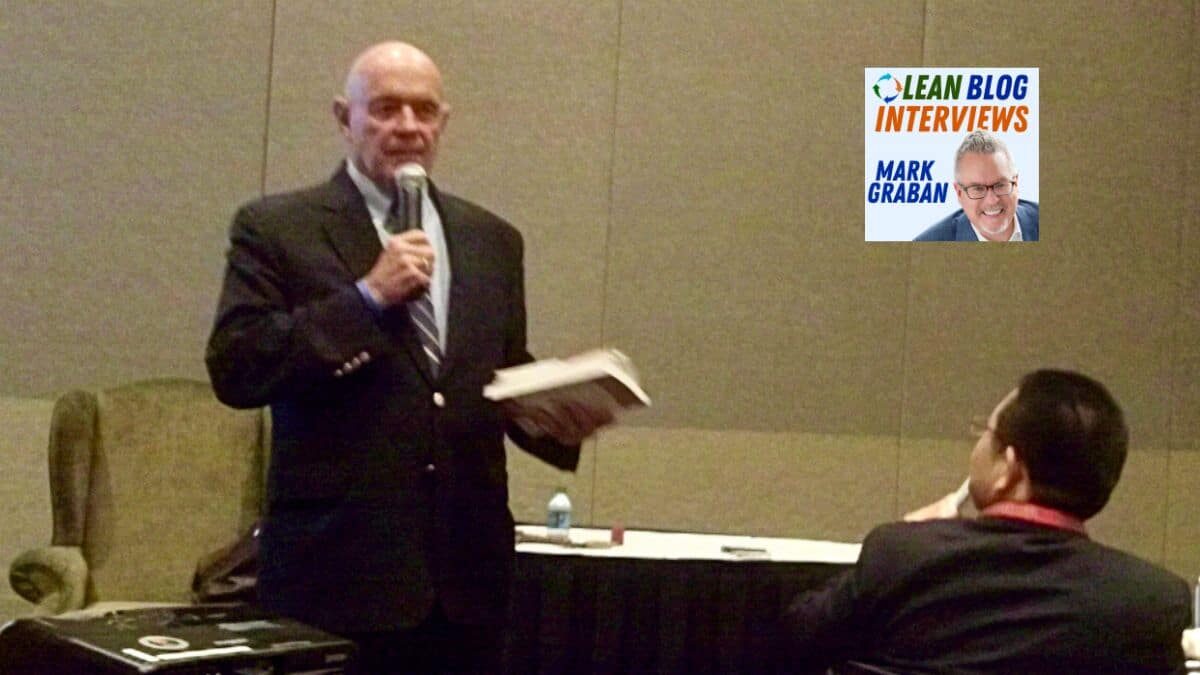
Episode #91 is a very special one-on-one conversation that I had with Dr. Stephen Covey, recorded at the Shingo Prize Conference in Salt Lake City last week. What an incredible experience.
My main question to Dr. Covey was to ask his thoughts on Toyota's “Respect for People” principle, sometimes called ‘Respect for Humanity.”
After the chat with Dr. Covey, I share a few thoughts at the end of the podcast about Dr. Covey's work and Lean, along with a little background about the interview and my personal reaction to speaking with him.
Trust, Empowerment, and the End of Command-and-Control
Mark Graban: The one question I would ask for your thoughts on is Toyota's principle of “respect for people,” or often referred to as “respect for humanity.” Could you share some thoughts on the importance of respect in workplace, what does that really mean?
Dr. Covey: I think that it's of profound importance because it means you are caring and you trust them to do the right thing.
Mark: You were talking earlier about the industrial model and trust seems to not come with that.
Dr. Covey: It doesn't come with that. And the industrial model is obsolete. You know, the supervision is command and control, it's top down. There's such co-dependency about it.
Mark: So we have a situation maybe where we have to convince the industrial world that this industrial model is…
Dr. Covey: … is obsolete. But it's hard to do that because they're so used to it… kissing up to the hierarchy.
What Toyota's Andon System Reveals About Trust
Mark: Have you been able to visit with Toyota?
Dr. Covey: I have. I was with the President of Toyota in Japan. We were walking in the plant and he said, “Any person in this plant can close the line down if he can show to the others that would improve quality and lower cost.”
Mark: And so there's a trust inherent in that?
Dr. Covey: Definitely, and it tells you also about the culture. If he can show to the others…
Mark: It's very exciting to have you participate in the Shingo Prize conference and to share your message with the Lean community. What are your hopes, with your professorship at Utah State, to try to help influence…
From Industrial Management to the Knowledge-Worker Age
Dr. Covey: Yes, and also I am very appreciative of that opportunity with Utah State. And I think that the Shingo Prize is one to be really sought after and to be won. It's very significant. But I think that in the next few years it will be knowledge-worker age companies that will win the Shingo Prize, because they are developing and empowering their people.
Reflections on Covey, Lean, and Leadership Development
Thank you to Bob Miller, the Executive Director of the Shingo Prize, to Steve von Niederhausern, the Director of Marketing and Communications, and to Michael Ockey, who works for Dr. Covey and FranklinCovey for their help in lining up the time with Dr. Covey and for helping me prepare. I'm going to have a separate podcast discussion with Bob on his thoughts about Lean and Dr. Covey's work.
One of the conference attendees, an executive from a major corporation told me how they have given every manager the Covey training each year for the last 15 years. This leader thinks that leadership training has been the key to their success with Lean.
What are your experiences with Dr. Covey and his teachings? Do you see it as a core component of Lean, a helpful add-on, or fairly irrelevant? What do you think of the partnership between Dr. Covey and the Shingo Prize?
For earlier episodes, visit the main Podcast page, which includes information on how to subscribe via RSS or via Apple Podcasts.
If you have feedback on the podcast, or any questions for me or my guests, you can email me at leanpodcast@gmail.com or you can call and leave a voicemail by calling the “Lean Line” at (817) 372-5682 or contact me via Skype id “mgraban”. Please give your location and your first name. Any comments (email or voicemail) might be used in follow ups to the podcast.
How Stephen Covey's Thinking Aligns with Lean Management
Lean Management and The Dr. Stephen Covey Approach
In the increasingly dynamic world of business, organizations are looking towards progressive change methodologies to drive growth and success. Lean management, with its focus on process optimization and waste reduction, is such a strategy that seeks to bring about a culture of continuous improvement. Parallel to this, exists the school of thought propagated by renowned author and teacher, Dr. Stephen Covey, whose understanding of interpersonal effectiveness, primarily through the lens of respect, aligns perfectly with Lean philosophy.
Why Industrial-Age Management Undermines Lean
The industrial age model of management, often synonymous with top-down command control dynamics, is fast becoming redundant. Dr. Covey articulates that such a model tends to create a culture of dependency in the workplace. The employee damage occurs because they feel the lack of power and initiative, and this compels them to wait for directions and puts the blame on the management when things go wrong.
In response to these dated practices, Dr. Covey proposes the transition to a knowledge worker age, driven by purpose and trust. Here, companies move away from treating employees like things, a practice that breeds low trust and resentment. Instead, this new model seeks to empower and develop workers – inevitably leading to high productivity and organizational success.
Respect for People as a Core Lean Leadership Practice
Throughout Dr. Covey's teachings and consultations, the principle of respect stands central. This ties in remarkably well with Lean's respect for humanity principle. Both philosophies believe in the inherent value of each individual, trusting them to do the right thing and letting them take the initiative. With a focus on the importance of trust and respect in the workplace, these practices breathe life into workplaces and enable them to thrive even in the face of adversity.
At its core, the mutually beneficial synergy of Lean Management and Dr. Covey's theories focuses on valuing people. As one Shingo Prize winner famously iterated in his acceptance speech, “whatever business you're in, you're in a people business.”
When these principles are taught in unison, there is a significant positive impact on organizations, specifically on the company's lean success. The essence of a successful business is when managers encourage workers to discover their potential and inspire them to contribute their best.
Why Respect for People Matters in Lean Healthcare
One sector that has significantly benefited from the combined teachings of Lean and Covey is healthcare. Hospitals have embarked on Lean transformations, utilizing principles from lean management as well as Covey's practices to drive improvements. One standout example is the Great Ormond Street Hospital, which has effectively implemented Lean strategies to enhance people involvement and operations.
Stephen Covey's Lasting Influence on the Lean Community
Dr. Covey has significantly influenced the Lean community, most notably through his active participation in conferences such as the Shingo Prize Conference. He believes that companies in the “knowledge worker age” are the ones that will be most successful in the upcoming years, as they invest in empowering their employees. His teachings have encouraged a comprehensive shift from the traditional bureaucratic approach to a more empowering, trust-based leadership style.
His message and impact were visible when speaking with him. Dr. Covey's communication style exhibits unparalleled attention. He gives you undivided attention and makes effort to appreciate and thank you, radiating sincerity and kindness every time. Dealing with him was not just edifying but also an impressive human experience.
The Leadership Question Lean Still Has to Answer
What makes this conversation with Stephen Covey enduring isn't nostalgia–it's clarity. Long before psychological safety became a leadership buzzword, Covey was articulating why trust, respect, and empowerment are prerequisites for real performance, not soft add-ons.
His reflections on Toyota reinforce a core Lean insight: respect for people is not a slogan or a feel-good value. It shows up in who gets trusted to stop the line, who gets listened to, and whether leaders see their role as controlling work or developing people.
In 2026, as organizations struggle to move beyond command-and-control habits–especially in knowledge work, healthcare, and technology–this conversation still offers a useful test. Are leaders creating systems where people are trusted to think, improve, and act? Or are they still managing as if people are interchangeable parts?
That question, more than any specific tool or framework, is why this interview remains worth revisiting.






Did he say something after “Definitely, and it tells you also about the culture. If he can show to the others…”? You seemed to cut him off.. or maybe the audio was garbled and you had to edit it out?
.-= Ron Pereira ´s last blog ..The Most Important Aspect of Kaizen =-.
Ron – Dr. Covey was repeating his previous comment about demonstrating to the others about quality and cost. As I edited out some gaps before my next questions (a second or two that doesn’t like that long in real life, but sounds really long in a podcast), I may have edited my next question a little close to the end of his answer trailing off. I didn’t want to leave the impression I interrupted him!
I see. No worries… I was just curious to know what he said. Great job being Johnny on the spot with the voice recorder!
[…] Dr. Stephen Covey on Respect for People and Lean (LeanBlog) […]
Mark
I have trained lean practitioners for years, and always felt that we were missing something. I added training modules based on Covey ´s 7 values beginning 2010 to my lean classes and my students have been so pleased about Lean and Covey ´s principles hand in hand. The two just go so nice together. Then your interview with Dr. Covey suddenly pops up out of the blue .. this is only the beginning … thank you !
[…] Dr. Stephen Covey on Respect for People and Lean dal Lean Blog di Mark Graban: Il Podcast con la spiegazione del rispetto delle persone nelle parole di Stephen Covey (traduzione automatica) […]
This is so interesting, here in Denmark we finally see a change in focus from Lean Tools to Lean Leadership. However this is only a beginning, as long as top management does’t understand that Lean IS about respect for people – we as teachers and consultants have an important task in our way of working and teaching.
HI Mark,
Interesting interview. Thanks for sharing at the sad event of Covey’s death – was glad to see it pop up on my LinkedIn News.
Sue
I was involved with a Lean Six Sigma initiative that focused primarily of the metrics of value stream mapping and eliminating waste. But the underlying message, which never was fully articulated was that if we have too many people doing a particular task, then the people become the waste. I am sure managers would never admint this, but with the advances of technology more jobs can be done with less people. How are we going to employ people in the future. We still need to listen, understand and empower our citizens through our workforce development systems. Lean thinking must include respect for people.
I agree, there is too much use of Lean tools in a top down, command and control (or even bullying) style. This isn’t really Lean if “respect for people” is not involved. That’s what I’ve dubbed “L.A.M.E.”:
https://www.leanblog.org/LAME
[…] the Toyota Production System. Command and control is outdated (forgive the name dropping here, but the late Stephen Covey said as much when I interviewed him a few years back). As it says in this book […]