Don’t Lie to Your Customer About Scores or Seats (or Anything)
Back in 2014, I wrote a blog post about being annoyed by companies pressuring you to give good customer service scores in surveys:
I wondered at what point does the cajoling and the repeating nagging or begging end up hurting the customer's perception of the organization?
Do they want to improve service and quality or do they just want higher scores? Are they living under the tyranny of a parent company or customer organization that threatens them with punishment for low scores?
The Lying / Misleading / Pressuring DirecTV Contractor
I recently needed some service at our home because the DirecTV wasn't working on all channels, giving a signal error. First world problems, I know. I had to watch an NBA playoff game using the ESPN app instead of the DirecTV box. That's not a great hardship.
I called DirecTV and they sent out what was apparently a contracted service company. They checked the signals, replaced a part, and re-aimed the satellite dish. Voila! Back to a perfectly good picture on all channels (until the next thunderstorm… again, first world problems).
What started to annoy me was the repeated text messages begging for a good score.
When I read this first message, I thought, “that's a weird scoring system, from 3 to 5.”

It finally occurred to me: The contractor firm (the company, not the individual technician) was lying to me. The AT&T / DirecTV satisfaction score is apparently from 1 to 5. But, the contractor was trying to anchor me into not giving a score lower than a “3.” Maybe that is “bad” from DirecTV's perspective, but this was, at best, misleading.
The follow up message was aggressive in a way that made me uncomfortable, as they were threatening the tech's job by laying this guilt trip on me!
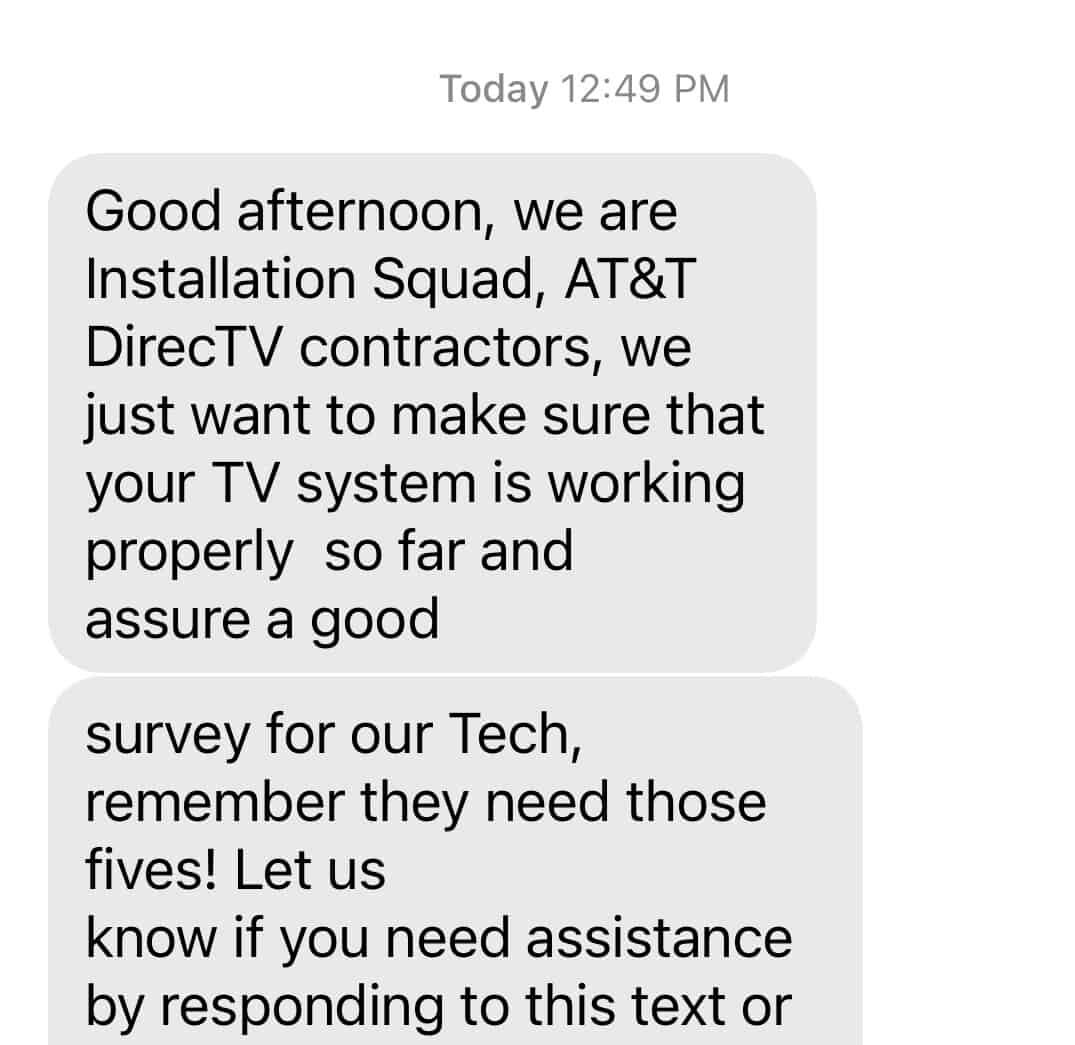
Why do they “need” those fives? The technician's “job depends on that score!”

Good grief.
So many text messages. So much pressure.
As Dr. Deming taught, customer satisfaction metrics should inform learning–not threaten people or distort behavior. Most performance is driven by the system. And “the system” in the company is owned mainly by the executives. They are responsible for quality.
Let's say the technician was badly trained — that's a systemic problem. What if the technician was late and/or curt because their schedule was overloaded??? That's a systemic problem.
I'd hate to see an individual tech lose their job because of systemic problems that are out of their control.
If AT&T is choosing contractors based on who is cheapest (something else that Deming warned against), would they be surprised by poor quality scores from the end customers? If they replace one lowest-cost contractor with another, would they really expect different results?
By the way, AT&T never contacted me to see what I thought about the service of the contractor. All of that pressure and guilt tripping for what?
The Lying Gate Agent
My sister doesn't fly as often as I do. She was in Mexico last week for a long-overdue beach vacation with her husband. Their flight home involved a connection at the DFW airport. I was back in Texas and she gave me a heads up that she was afraid the final leg might be canceled because American has been canceling some flights due to staffing shortages — a problem of their own making (a different systemic problem).
She checked a suitcase (something she later admitted to me was a bad idea, and she knew it) because of sunscreens and other liquids. Their DFW connection was about 1:45 long, which is tight given the need to clear customs, get your suitcase, re-check it, go through TSA, and on to your gate.
Her flight wasn't canceled as feared… but it took forever for her checked bag to come out (well over an hour). She told my brother-in-law to go ahead to the gate with his carry-on bag, to plead for them to wait. The idea that an airline might hold a plane for a customer shows they don't travel much.
Anyway, by the time she got to the gate, the door had already closed. The plane was taxiing and she was texting her husband.
The gate agent told my sister:
“Your husband said I could give away your seat.”
That was a flat-out lie.
The reality was that she had missed the flight due to the baggage delay (probably due, again, to staffing shortages — and blame the airline for that).
I don't understand why the gate agent would even think to tell a lie like that. What good would that do? What pressure would that take off of him? It makes no sense. They left without her and somebody else got her seat — a woman who was desperately trying to get to Detroit for a wedding the next day, after being stuck unable to get a standby flight for two days. A passenger who was so desperate to get to Detroit that they would get on a flight that would land in Cincinnati after midnight. Systemic problems.
I complained to American via Twitter about all of the bad treatment that was thrown at my sister… and they lamely apologized for the “missed connection” and said nothing about the lie from the gate agent.
Our apologies for the missed connection and any inconvenience this caused your sister. Please have her contact us directly.
— americanair (@AmericanAir) June 26, 2021
Lying to your customers. Pressuring them for scores. I don't get it. Do better. Do something that actually improves quality instead.
Why People Feel Pressured to Lie Instead of Improve
The common thread in these stories isn't dishonesty as a character flaw–it's pressure created by the system. When jobs, contracts, schedules, or bonuses hinge on narrowly defined scores or on-time metrics, people adapt in predictable ways. They coach the customer. They reframe the scale. They apply guilt. They say things that smooth over a problem in the moment, even if those statements aren't true.
This doesn't excuse lying, but it does explain why it happens so consistently across industries. Front-line employees and contractors are often stuck between an unhappy customer and a management system that treats anything short of a top score as failure. In that environment, telling the full truth can feel risky, while nudging the outcome feels safer–even necessary.
As Dr. Deming warned decades ago, performance is largely determined by the system people work in. If leaders design measurement and reward systems that punish honesty and amplify fear, they shouldn't be surprised when the data becomes unreliable and behavior becomes distorted. People respond rationally to the incentives they're given.
Conclusion: Fix the System, Not the Symptoms
If leaders want better customer experiences, they need to stop managing by fear and start managing for learning. Pressuring customers for scores, threatening jobs over surveys, or rewarding outcomes without understanding context doesn't improve quality–it drives gaming, misinformation, and erosion of trust.
A Lean approach asks different questions:
- Are we measuring to learn or to judge?
- Are we listening to customers or training them how to respond?
- Are we holding individuals accountable for problems that are clearly systemic?
When people feel psychologically safe to tell the truth–about missed connections, service failures, or flawed processes–organizations get better information and better results. When they don't, leaders end up with inflated scores, angry customers, and the illusion of performance.
This isn't about telling employees to “have more integrity.” It's about leaders having the courage to design systems where honesty is possible, learning is valued, and improvement actually follows.