Measures of Success Book Summary: Chapter-by-Chapter Overview
A while back, I uploaded the entire PDF of my 2018 book, Measures of Success: React Less, Lead Better, Improve More, into the premium version of ChatGPT (updated March 2026).
Measures of Success is my 2018 book on metrics, Process Behavior Charts, and better management decision-making.
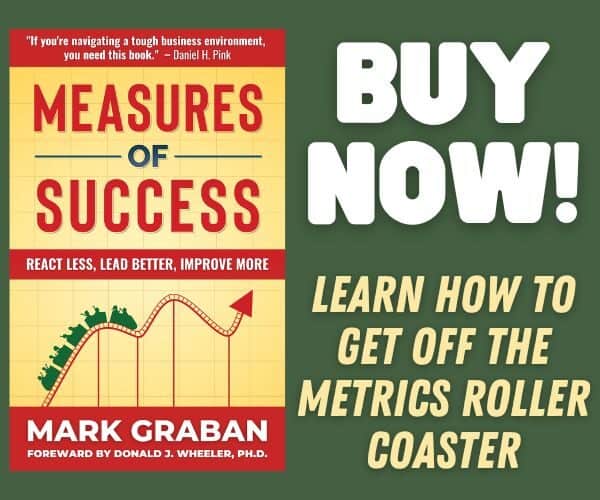
As an author and publisher, it's a really useful tool for generating marketing content — although maybe it's a mistake to upload my content that way. I'm sure a PDF of the book was already on the internet to be potentially scanned by ChatGPT. Please leave a comment if you think I made a big mistake there.
One use is what I'm sharing here: Asking ChatGPT to provide its summary of the book and each chapter. It did a really nice job.
Quick Summary of Measures of Success
Measures of Success by Mark Graban is a book about improving how leaders use metrics and data. The book teaches managers how to distinguish normal variation from meaningful changes using Process Behavior Charts.
Key lessons include:
- Two data points are not a trend
- Most variation in metrics is normal
- Leaders should improve systems instead of blaming people
- Process Behavior Charts help identify real signals in data
This post provides a chapter-by-chapter summary of the book.
Hear Mark read this post — subscribe to Lean Blog Audio
Measures of Success by Mark Graban – Chapter by Chapter Summary
Introduction to Measures of Success
Measures of Success by Mark Graban teaches leaders how to interpret metrics correctly so they can improve systems instead of overreacting to every fluctuation in data.
Key idea
- Metrics naturally go up and down because of variation.
- Leaders must learn to separate real signals from normal noise.
The main tool used in the book is the Process Behavior Chart (PBC), which helps determine when a change in data actually means something.
Chapter 1 – Improving the Way We Improve
This chapter explains why many organizations struggle with improvement despite using many metrics.
Main problems with traditional management
Leaders often:
- React to every data point
- Compare only two numbers
- Set unrealistic targets
- Blame employees instead of improving systems
Key lessons
- Two data points are not a trend
- Metrics should be used to improve systems, not punish people
- Most variation is normal system variation
Core questions leaders should ask
- Are we hitting our target?
- Are we actually improving?
- How do we improve the system?
The chapter introduces the idea that charts provide more insight than tables or dashboards.
Chapter 2 – Using Process Behavior Charts for Metrics
This chapter introduces the main analytical tool in the book: Process Behavior Charts (PBCs).
A PBC helps determine whether a metric is:
- Stable and predictable
- Experiencing a real change
Components of a Process Behavior Chart
A Process Behavior Chart includes:
- Data points over time
- A central line (average)
- Upper and lower natural process limits
These limits show the expected range of normal variation.
Why Process Behavior Charts matter
They allow leaders to:
- Predict future performance
- Avoid reacting to routine variation
- Focus on real changes that require investigation
Chapter 3 – Action Metrics, Not Overreaction Metrics
This chapter explains why traditional metrics systems often cause management overreaction.
Common mistakes
Organizations often:
- Explain every fluctuation
- Demand root cause analysis for normal variation
- Hold people accountable for noise
Better approach
Leaders should:
- Focus only on signals
- Ignore routine variation
- Avoid wasting time explaining normal fluctuations
The goal is to use metrics that lead to actionable improvement instead of constant firefighting.
Chapter 4 – Linking Process Behavior Charts to Improvement
This chapter explains how leaders can use Process Behavior Charts to guide improvement.
Two types of systems exist
1. Predictable systems
Performance varies within limits.
In this case:
- Individual data points do not matter much
- Improvement requires changing the whole system
2. Unpredictable systems
Data shows unusual signals.
In this case:
- Something changed
- Leaders should investigate immediately
This chapter teaches leaders when to react and when not to react.
Chapter 5 – Learning from the Red Bead Game
This chapter explains W. Edwards Deming's Red Bead Experiment.
The lesson
Workers cannot control system outcomes when the system itself is flawed.
Common management mistakes demonstrated
- Setting impossible targets
- Blaming workers
- Rewarding and punishing random variation
Main takeaway
Most performance problems come from the system, not the workers.
Chapter 6 – Looking Beyond the Headlines
This chapter warns against misleading statistics in news reports and media analysis.
Examples include:
- “Highest number in 10 years”
- Comparisons between two data points
These statements often ignore normal variation.
Using Process Behavior Charts helps determine:
- Whether a change is meaningful
- Whether the system actually shifted
Chapter 7 – Linear Trend Lines and Other Cautionary Tales
This chapter critiques common analytical tools used in business reporting.
Problematic methods
These can mislead decision makers:
- Linear trend lines
- Simple averages
- Bar charts
- Two-point comparisons
These methods often create false patterns.
Better alternative
Process Behavior Charts provide:
- Statistical context
- Predictive insight
- Clear signals vs noise
Chapter 8 – Workplace Examples of Process Behavior Charts
This chapter shows real organizational examples of Process Behavior Charts in action.
Industries include:
- Healthcare
- Manufacturing
- Business operations
Examples demonstrate how Process Behavior Charts help organizations:
- Stop wasting time on noise
- Focus improvement efforts
- Make better leadership decisions
Chapter 9 – Getting Started with Process Behavior Charts
This chapter focuses on implementing Process Behavior Charts in organizations.
Key advice
- Start with a few important metrics
- Educate leaders on variation
- Avoid overwhelming teams with statistics
Cultural shift required
Organizations must move from reactive management to learning management.
Leaders must become curious about systems instead of judgmental about results.
Key Ideas from Measures of Success
The book emphasizes several core principles.
1. Manage systems, not metrics
Metrics are outcomes of a system.
2. Most variation is normal
Not every change requires action.
3. Stop reacting to noise
Overreaction wastes time and harms improvement.
4. Use Process Behavior Charts
They reveal real signals in data.
5. Leaders should focus on system improvement
Not blaming individuals.
Core Message of Measures of Success
Better understanding of data helps leaders react less, lead better, and improve more.
Key Takeaways from Measures of Success
- Two data points are not a trend
- Don't react to normal variation
- Improve systems, not people
- Use Process Behavior Charts
About the Book: Measures of Success
Measures of Success: React Less, Lead Better, Improve More is a book by Mark Graban about improving how leaders interpret and use metrics.
The book introduces the concept of Process Behavior Charts, a practical method for distinguishing between normal variation in data and meaningful signals that require action.
Leaders often react to every change in a metric, even when those fluctuations are part of normal variation. Measures of Success explains how to avoid overreaction and instead focus on improving the systems that produce results.
The book is used by leaders in healthcare, manufacturing, technology, and other industries who want to make better data-driven decisions.
Learn more about the book here:
Measures of Success by Mark Graban
Related Reading on Process Behavior Charts and Metrics
If you are interested in learning more about Process Behavior Charts and interpreting metrics, you might also enjoy these articles from LeanBlog.