

Why Most People Don’t Think — and What to Do About It, with Scott Burgmeyer
Scott Burgmeyer, founder and CEO of Become More Group, has spent more than 30 years watching smart people make avoidable decisions — not because they lack intelligence, but because they stopped thinking. In this episode of Lean Blog Interviews, we get into his book Think: The Road Less Traveled, the cognitive shortcuts that trip us up, and some practical tactics for leaders who want to build organizations where real thinking actually happens.
Scroll down for how to subscribe, transcript, and more
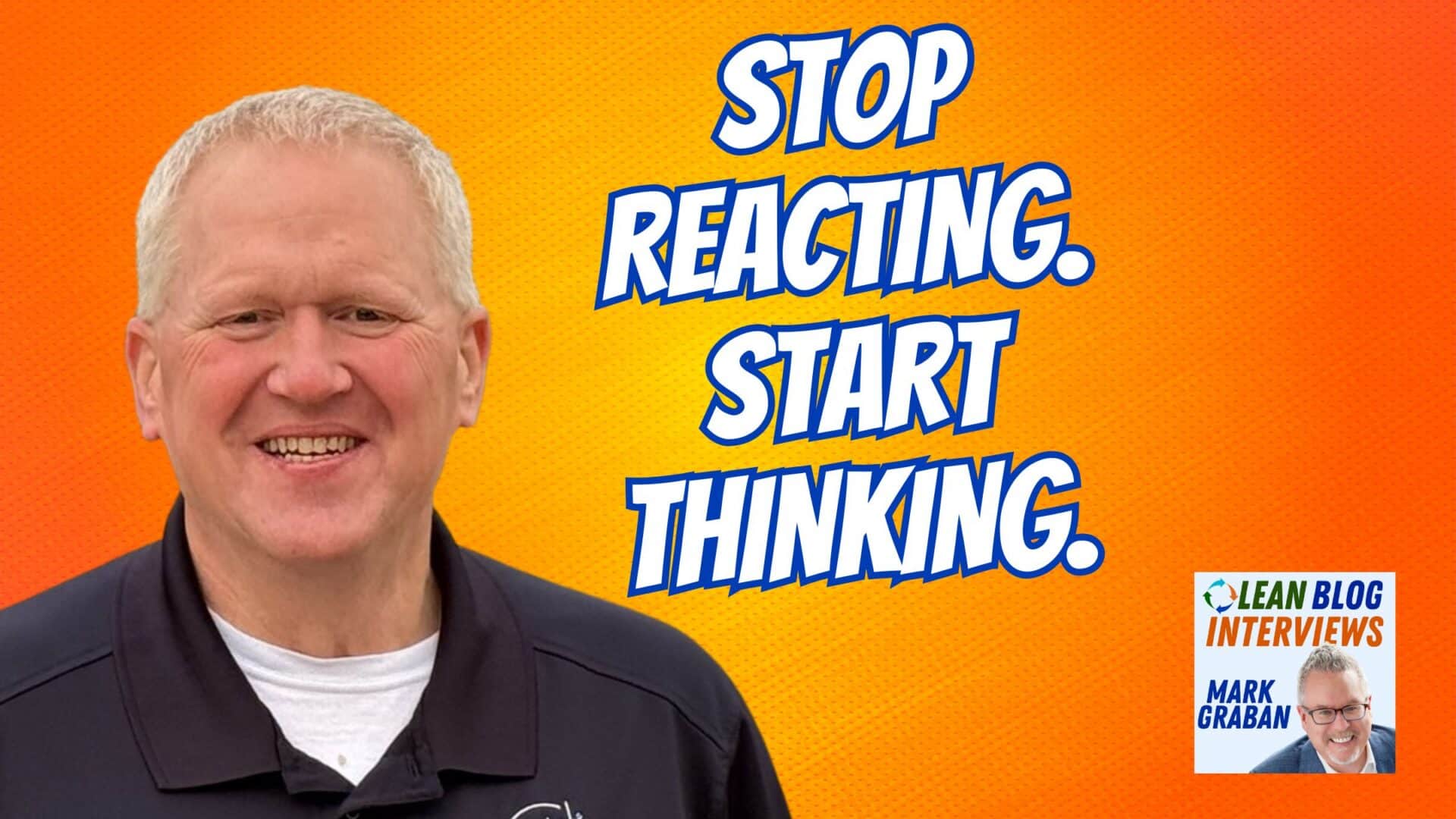
My guest for Episode #543 of the Lean Blog Interviews Podcast is Scott Burgmeyer, founder and CEO of Become More Group. Scott spent more than 30 years helping struggling organizations become high-performance teams — working with organizations like Google, Procter and Gamble, and Bridgestone. He holds a PhD in organizational development and leadership from the University of Arizona and is a seven-time Iowa Recognition of Performance Excellence recipient.
In this episode, we dig into his book Think: The Road Less Traveled, coauthored with Tammy K. Rogers. The core argument is one that will resonate with anyone who's watched a well-intentioned organization keep fixing the same problems: most people aren't really thinking — they're reacting. We talk about cognitive biases, the ROAD thinking methodology, why AI alone won't be a differentiator for most businesses, and what it actually looks like to cultivate a culture where deeper thinking becomes the norm.
What We Discuss in This Episode:
- How Scott went from chemist to Lean Six Sigma Black Belt to leadership consultant
- Why most people are operating in “lizard brain” mode more than they realize
- The most common cognitive biases — and why giving them characters makes them easier to spot
- What the ROAD thinking methodology is and how it differs from PDCA
- Why AI won't be a differentiator for most organizations
- The GM lights-out factory story and what it tells us about chasing new technology
- How to carve out time for thinking — and why most leaders aren't doing it
- What “thinking sanctuaries” look like in practice
- The three growth questions Scott uses after every client meeting
- Why double-checking isn't the right response to a mistake
- The difference between reflection and rumination
- When compliance is all you're getting — and why that's not enough
- What “stay stupid longer” actually means for leaders
This podcast is part of the #LeanCommunicators network.


Watch the Episode:
Thanks for listening or watching!
This podcast is part of the Lean Communicators network — check it out!

Lean Blog Interviews — Scott Burgmeyer
Mark Graban: Hi, welcome to Lean Blog Interviews. I'm your host, Mark Graban. Our guest today is Scott Burgmeyer. He is founder and CEO of Become More Group. Scott's a transformational leadership expert who spent more than 30 years helping struggling organizations become high-performance teams.
Scott's helped teams at organizations like Google, Procter and Gamble, and Bridgestone — reverse years of stagnation, work through deep-rooted leadership breakdowns, and rebuild from there. He holds a PhD in organizational development and leadership from the University of Arizona and an MBA in organizational leadership from Ashford University. He's a seven-time Iowa Recognition of Performance Excellence recipient and winner of the Bridgestone CEO Award.
So Scott, welcome to the podcast. How are you today?
Scott Burgmeyer: I'm doing well, Mark. That intro makes it sound like I'm pretty awesome. I don't feel like I'm that awesome, though. So some of those have to be made up.
Mark Graban: You made them up. I made them up. I don't know.
Scott Burgmeyer: Oh, either way. That's good.
Getting Acquainted
Mark Graban: I can't help but notice you've also got a coffee mug with your logo.
Scott Burgmeyer: Branded mug. Yes.
Mark Graban: I've got my My Favorite Mistake mug. I don't have a Lean Blog Interviews coffee cup handy. But it's all right. All that time in Iowa — that's how you and I crossed paths.
Scott Burgmeyer: Yeah.
Mark Graban: Iowa Lean Consortium, when you were living in the state.
Scott Burgmeyer: Yep.
Mark Graban: Great things happening with Lean in Iowa.
Scott Burgmeyer: Yeah, for sure.
Scott's Lean Origin Story
Mark Graban: We're going to get the audience acquainted with you a little better. I always like to hear people's origin story. How did you get involved in this type of work? Why did lean and quality and improvement become such an interest and a career path?
Scott Burgmeyer: Yeah. It's funny because I never — and I often wonder, does anyone ever actually start out trying to do this? Like most people I've met, they never intentionally try to do this.
I don't talk about it much, but I'm a chemist. I was working in a lab, and a boss of a boss came to me and said, “Hey, we're going to this talk. Would you like to come?” And I've always been taught that when your boss's boss says, “Hey, would you like to,” you just say yes. You don't think about it, you don't ponder it. You say yes and go.
And so I went. It was someone speaking on Lean Six Sigma. I had never heard of it at that time. And I laugh about it now because it just made sense to me. It was just logical. Why don't people do this all the time?
That's really when I started. I went and got my Lean Six Sigma Black Belt, moved into quality, and kind of went from there. Had a chance to get involved in Baldrige and other things.
And it just became part of who I am. I now tell people when I do training or coaching with them — at some point it becomes a disease. You can't turn it off. It's just always on.
We actually have a new employee, and this is her week one-and-a-half. Her first week she traveled with me, and she shared with a group at a client event: “Having dinner with Scott is interesting because he's always questioning why they do it that way, and how it would be way easier if they…” And I said, yeah. It's a disease. It just doesn't stop.
Mark Graban: Why, why, why — meaning the restaurant?
Scott Burgmeyer: Oh yeah. We were at dinner and I'm like, why are they doing that? This person is buried. You watch and the host is standing at the host stand doing nothing while patrons are sitting at their tables waiting for a server on a busy night.
Like — how about go take drink orders? How about that? You could turn your tables so much faster. The customer experience would be so much better. But nope. Super important to make sure that little host stand doesn't magically float away.
Mark Graban: Yeah, right. Back to your question of why don't people do this all the time — why isn't this the default? I think in a lot of industries, methodologies like Lean or Lean Six Sigma just don't get invited to the table. People are kind of stuck in “this is the way we've always done it.” They don't question. I mean, a lot of Lean is just what you said — questioning why we do it this way and helping everybody question things.
Scott Burgmeyer: Yeah. And if you really peel it back, there's a little bit of scientific problem solving in it. But a lot of it is: are you curious? Are you thinking about it through the eyes of the customer — or the patient, or the patron, whatever you define as the customer? And are you making it easy for them to connect with you, work with you, whatever that is?
Mark Graban: Yeah. And that moment of curiosity or questioning — it certainly has to be backed up with something more. Because if people say, “Huh, this could be better,” but they don't feel confident in their ability to make it better, they might keep wondering. And it might not lead to any real benefit for the organization.
Scott Burgmeyer: Yeah.
Mark Graban: So there are these different chains — and I think you and I would agree it comes back to leadership. You've studied that, you help people with it, you write about it. Tell us about your most recent book.
Scott Burgmeyer: So I'm —
Mark Graban: I'm going to hold it up. Think: The Road Less Traveled — you and Tammy K. Rogers.
Think: The Road Less Traveled
Scott Burgmeyer: Yep. So Tammy's my business partner. Years ago we started to see this trend of people doing weird things. We kept asking — why did they do that? Why did this person make that decision? Why did they act like that?
And we started to boil it down. What we recognized was people were frankly just not thinking. They were stimulus-response, stimulus-response. In the book we say people's thinking is about as deep as a parking lot puddle. We're not really thinking — we're just responding to a stimulus.
As we started to research it and dig in, what we found was people were operating in a lower part of their brain — their lizard brain — much of the time. There are cognitive biases we all have, little shortcuts we use. We jump to conclusions. We say, “Yep, I gotta go,” and just take off running.
So we took the approach of giving the most common cognitive biases characters.
Mark Graban: Yeah. So there's a confirmation bias character, for sure.
Scott Burgmeyer: For sure.
Mark Graban: I'd love to make the joke — I see confirmation bias everywhere I look.
Scott Burgmeyer: Yes.
Mark Graban: We're all prone to this because it is part of the human condition. So being aware of it is the first step. Similar to being aware of waste — awareness is the start. But what do we do beyond awareness of these traps? I'm flipping back through here — “Echo Chamber Evelyn” just repeats back everything she hears like it's absolute fact.
Scott Burgmeyer: Yes.
Mark Graban: So what do we do beyond being aware of these different traps?
Scott Burgmeyer: When you think about it, we all fall into these traps. None of us is perfect. And we're not suggesting we need to overthink everything.
There are times the light bulb goes out and the most logical thing to do is just change the light bulb. We don't have to root cause and dive deep. But if that same specific light bulb has burned out three times this week — one might suggest that changing the bulb isn't the correct course of action.
So there's a time and a place to think a little deeper. And am I aware of my surroundings enough to connect those dots? Or am I so busy being busy that I don't even notice?
So we then look at what tactics we can use to give ourselves time to think. Part of it is: are you carving out time to think on your calendar?
Mark Graban: Mm-hmm.
Scott Burgmeyer: When we talk to leaders, many of them aren't even spending 10 minutes a week just thinking. It could be: how am I doing leading people, am I connecting with them? How are we executing our strategy? What's keeping me up at night that I need to start to process through? What do we need to do differently?
And it's like — wow, you're not even spending 10 minutes a week on that? When 10 minutes a day, maybe 30 minutes a day depending on where you are in the organization, would be more appropriate.
Mark Graban: Yeah.
Scott Burgmeyer: Sometimes it's also about creating an environment. As a leader, am I expecting others to think? Or do I create space for people to think — whether that's a time element, or… We have some clients that have taken it so far that they've built thinking sanctuaries into their office design.
Mark Graban: A thinking space.
Scott Burgmeyer: A thinking space. Quiet rooms. When you need to go heads down and get something done, you can go in that space.
And then probably the biggest tactic we talk about ties back to the title. We introduce a thinking methodology called the ROAD. R-O-A-D-D. And yes, everybody can say “you just misspelled road” — got it. But it really is: R is reflect, O is options, A is analyze, D is decide, and then D is do.
Many times people reflect for a microsecond, skip all the other letters, jump straight to do — and then wonder why they're fixing the same problem again.
Mark Graban: Right.
Scott Burgmeyer: Curious.
Mark Graban: Well, I think there's a step — I don't know if we can jam another letter on the end of ROAD — but there's maybe another analyze step. Or think of bands and roadies… I don't know what the IE at the end of road would be. But one of the traps people fall into is thinking linearly. We decided to do something, we go do it, we assume it was the right thing to do — instead of thinking in cycles. Whether we call it PDCA or PDSA, there's that evaluation step: did we do the right thing? Or did we do the partially right thing?
Scott Burgmeyer: Yeah. And part of that last D — do — is the evaluation. Did it work?
Mark Graban: There's another D then.
Scott Burgmeyer: Yeah.
Mark Graban: Do, and did it work. But yeah — a lot of times people don't like to think they could possibly have had an idea that wasn't going to pan out. They assume their ideas are good, and if it doesn't work out, they'll blame everything but the idea.
Scott Burgmeyer: Yeah. And at the end of the day it's just — can we get people to think a little deeper? Can we get people out of “I'm just going to react and take action without thinking it through” — whether that's work, improvement, or personal life.
The brain science is really clear: when I'm not thinking, I'm operating in that lower cognitive part of my brain — the lizard brain. But asking a question changes the brain chemistry and pushes you out of that.
Cultivating a Culture of Thinking
Mark Graban: I love the word and the imagery here — “cultivating a culture of thinking,” with a brain with arms and legs tending to a garden. I actually chose that word, cultivating, for my most recent book: The Mistakes That Make Us — Cultivating a Culture of Learning and Innovation. Because culture isn't something we just install. I think of it as a living thing we need to tend to constantly.
First, tell us what that word cultivating means to you — and then let's talk about what we can do as leaders. We can't just snap our fingers and have a garden with vegetables suddenly appear.
Scott Burgmeyer: Right. My assumption — whether or not you intend to or not — there is a culture in your organization. We subscribe to the idea that you should purposefully choose what culture you want.
Once you've said, “Here's what I want — these behaviors, activities, traits” — now you have to cultivate that. Which means you have to grow it. You have to plant it. You have to seed it, which means some sort of development or training. And you have to water it.
And you know what? Sometimes you have to trim the weeds. Which means if someone's not aligning with your culture, trimming the weeds is holding them accountable. Or you may have to vote them off the island.
Ideally you're not voting a bunch of people off the island all the time — that might suggest there's actually a different problem.
Mark Graban: Right.
Scott Burgmeyer: If you're going to cultivate, it's going to take time. And it's an action. You have to be in action. It's not “set it and forget it.” You have to check on it, evaluate it, water it. Sometimes put a little fertilizer on it. And sometimes tweak it — because what you define as your culture today likely evolves over time.
You won't get it right the first time. And that's okay. It's an evolution. If you talk to any master gardener, they'd say, “My garden looked great this year, but next year I want to…” and they're already planning the whole next thing.
That's what cultivating means to me — I have to be in action. I can't be a passive passenger. I have to define it and drive toward it. Otherwise you'll have a culture. It just may not be the culture you want.
Mark Graban: Yeah. Defining it often means an aspirational statement — what we want the culture to be. But without the actions, without the behaviors from leaders and colleagues… I think culture is how we do things around here. And that includes: how do we lead, how do we react when somebody says things could be better, how do we react when somebody tries an improvement that doesn't pan out, how do we react when someone admits a mistake? Those are all elements of culture.
Scott Burgmeyer: Right. And do we — are we a learning culture? One of the things I keep thinking about is: do you want an improvement culture, or do you want a culture that includes improvement?
It gets a little philosophical. You could say, “We want a patient safety culture.” For some people that might imply — well, then that's all you care about. You don't care about employees. So it's been interesting to think about what are the elements of the culture you want.
I do want patient safety. But I also want my employees to be safe. I also want a high attention to quality. And if you want thinking as part of that — that's just one element of your culture.
In our experience, it becomes a balance. I don't want deep thinking about everything. I want us to be thoughtful about when we need to think.
Mark Graban: Sure. I think of it like AI models — when do you hit the toggle that jumps into deep thinking mode? We don't always need that for simple tasks.
Scott Burgmeyer: Yeah. And actually the intro of our book talks about AI. And I may be unpopular here in just a moment.
Mark Graban: Mm-hmm.
AI: Tool or Differentiator?
Scott Burgmeyer: AI is an amazing tool. I use it. Happy to use it.
I am not convinced that AI alone is going to be a differentiator — for businesses, for organizations.
Mark Graban: Tell us more about that.
Scott Burgmeyer: There's lots of AI out there. Part of what I'm seeing is how people define AI is vastly different. And second — if you're going to blindly say “AI” without having some parameters and thinking around it, you are asking for pain and suffering.
There is a skill set for how you write a prompt. There are some things it's amazing for. I actually used it last week — we're pretty old-school when we do training. Flip charts, handwriting, people moving around, because in our experience people learn better in that environment.
I took a picture of the flip chart and dropped it in and said, “Type all this out for me.” My purpose was a little more sophisticated than that, but it saved me an hour of typing and formatting. Totally makes sense. But it didn't get it right.
And so if I was just going to submit that — no. Can I be thoughtful in my prompts? Do I have enough context about the business, the organization, what we're trying to accomplish, to say: is this directionally correct?
I'm watching too many people not have the context — and then just say, “Oh yeah, here's the AI answer. Therefore I am worthy of this elevated experience.” And it's like… no. You're a little bit blind right now.
Mark Graban: I don't hate you for making that statement. I agree with you. I was waiting for something really controversial, but no.
I think there are lessons to be learned from previous technology waves. When we all have access to the same technologies — and with AI, most people in business are using one or more of Copilot, ChatGPT, Claude, Grok, a handful of others — we all have access to signing up and paying for the same tools.
Some people will use those tools better than others. Some will incorporate them into their business better than others.
I flash back to about 30 years ago when I was starting my career at General Motors. This was a manufacturing plant — engine assembly, and upstream of that, engine part machining. At some point when that line was designed, General Motors bought the same equipment from the best manufacturers in Germany. They copied the layout of Toyota facilities with the conveyance between machines, intentionally limiting WIP.
And you buy the same equipment — and our results were roughly half.
Scott Burgmeyer: Yep.
Mark Graban: Productivity and effectiveness were probably half of everybody else. For one, that approach to automation flew in the face of the GM mindset. Managers there wanted to build up WIP everywhere they could, because in their mind that protected them against the next machine downtime.
And a lot of the machine downtime was because management wasn't letting workers change the tools at the proper frequencies — because we gotta keep the line running. Which ironically made the line break down more.
GM had all these dreams in the eighties, under CEO Roger Smith, of the lights-out factory. The vision was to automate everything. They wasted tens of billions of dollars on something that was either way ahead of its time or just a pipe dream to begin with.
So whatever the cognitive biases were back then — we're probably prone to repeating them with exciting new technologies we now call AI.
Scott Burgmeyer: Yeah. I think there will always be tools and technologies that have a blend of benefit and distraction. And are we wise enough to look at it and say — how does this actually fit into my organization? Where might it be a distraction? Where might it go off the rails?
I'm watching organizations say, “Well, we need to have policies.” And I don't disagree — we need some guidelines, some fundamentals. But we also need to say: AI isn't the end-all be-all. It's not going to solve everything.
It has the potential to streamline some things. But how are we preparing the workforce for that? How are we preparing ourselves?
When we say “let's do AI” — what does that mean? I actually believe in most cases leaders are saying, “How do we improve and how do we use this technology to improve?” And then of course — improve what? And what level of quality or outcome do we anticipate?
Is it I'm trying to save time? Is it I want people to work at the top of their skillset, not doing mundane tasks? Back in the day, if I needed to look up an Excel formula, I had to look it up in a book. Then we graduated to Google. Now AI writes it for us.
It allows me to elevate my thinking. Am I going to design the organization to allow that level of elevated thinking?
Mark Graban: Mm-hmm.
Scott Burgmeyer: I'm not sure people are thinking about that part.
Mark Graban: Back to your core thesis — we're not thinking enough. We're thinking too shallow.
Scott Burgmeyer: Yeah. It's not a faulty premise to say “let's integrate AI.” It's just saying — to accomplish what? And then what?
Mark Graban: Yeah. Are we automating something that we shouldn't be doing in the first place?
Scott Burgmeyer: Right. Yes.
Mark Graban: That's a trap we've seen for a very long time.
Scott Burgmeyer: Yes.
Growth Questions and Reflection
Mark Graban: So back to thinking, and some of the tactics you write about for cultivating a culture of thinking. It's not a substitute for reading the book, of course. There are stories and characters and a deeper dive than we're covering here today.
I really love the growth questions — open-ended questions around reflection. Tell us about these growth questions and why they're important.
Scott Burgmeyer: Yeah. The growth questions are a methodology we use in our organization. They're about how you get better and how you think about how you perform.
There are three of them: what worked (or what's working), what didn't work, and what will you do differently (or what could you do differently)?
The whole intent is: let's celebrate the things that are working. Let's be honest about what's not working and put it on the table — in a way that we can hear each other, without being a jerk. And then let's really look at how do we do something different.
What we find is: the more frequently you do that, the more cycles you run through it, the faster you get better.
We do this after every client meeting. What worked, what didn't work, what would you do better? I just came from a call with our new employee, and my first question to her after we finished was: what did you notice? What worked? What were some signs that this didn't work? Maybe I tripped on a question or didn't interact in the right way.
It's really about how many cycles can you run. And can you be honest enough with yourself to admit where you contributed — without beating yourself up. The goal isn't a beat-down.
Mark Graban: There's a fine line between reflection and beating yourself up.
Scott Burgmeyer: Yes. And it's okay to say, “Yep, I didn't handle that well. I could have handled that better.” And sometimes what you need to do differently is go apologize.
Mark Graban: A real apology. Not a shallow one.
Scott Burgmeyer: Yeah. Not a shallow one.
Mark Graban: Not “I'm sorry if you were offended.”
Scott Burgmeyer: Oh yeah. That's a lovely one.
Mark Graban: Not a real apology. But you know, there are parallels that come to mind. Those reflection questions are useful for troubleshooting and problem solving — what did we do, what did we expect to happen, what actually happened, what did we learn from the gap, what would we do differently?
We have a strong culture of this at KaiNexus — I'm wearing a KaiNexus shirt today. There's very much a culture of cycling through those three questions, formally maybe twice a year when we get together as a group. Different leaders and different people talking through different versions of what went well, what went wrong, what did we learn.
And it starts with the co-founders — with our CEO Greg and our COO Matt. They lead the way. So it's not a shaming session, not a beat-yourself-up session, certainly not a beat-others-up session.
And I think if you have the formal cycles twice a year, you build the muscle memory to do it more regularly — with every project, with every initiative.
Scott Burgmeyer: Right. And really, the more you can make it normal and not beat people up for it — the better. I'm thinking about one we just went through. Two or three of us looked at a contract for a client and we all missed that travel was included when it should not have been.
Mark Graban: Costly.
Scott Burgmeyer: Costly, painful lesson. Yeah. And it doesn't mean you're not frustrated. It doesn't mean you brush it off with “that's okay.”
Mark Graban: Yeah.
Scott Burgmeyer: We don't want to beat each other up for it. We want to say: yep, we missed it. The person who wrote it missed it, and I missed it because I looked at it.
So what did we learn? We learned — hey, how do we make sure we don't copy-paste the wrong terms and conditions going forward?
And then I watch so many people say: “What we need to do is have more eyeballs on it. Let's double-check and triple-check and quadruple-check.”
Mark Graban: No.
Scott Burgmeyer: No. That's not the answer.
Mark Graban: And there's a psychology here that I think Deming talked about. When two people are both inspecting something, there's a mental trap where my brain says, “Well, Scott will catch it if I miss it.” We both maybe mentally can't help but slack off a little bit.
How many organizations have built in double-checks in healthcare because the underlying process isn't well-designed or mistake-proofed? The semi-absurd rhetorical question becomes: well, if double-checks are good, what about triple-checks? There are better ways of accomplishing these goals.
When you think about reacting to mistakes — I don't think we have to say “it's okay.” It's not good that we made the mistake. One lesson I've learned — I've heard my wife talk about this as an executive — is you can acknowledge the impact of the mistake and still keep the focus on learning and prevention and improvement.
It's not some kind of Shangri-La of “we don't care if you made a mistake.” We care. This isn't just about making people feel better. Feeling bad isn't enough to fix anything.
Scott Burgmeyer: And there's this piece — when you think about humans, and pretty much almost any animal really — we avoid pain and we lean into pleasure.
So can I make it pleasurable to do it the right way? Or if I can't make it pleasurable, can I make it painful enough in the moment that no one will want to do it the wrong way?
We sometimes get misguided by saying, “I'm going to make it so painful — I'm going to fire them.” But it has to be painful in the moment. Not after the fact.
Mark Graban: Yeah.
Scott Burgmeyer: And threatening — I mean, I guess it worked in the thirties, forties, fifties. Maybe. Did it?
Mark Graban: I don't know. Did it?
Scott Burgmeyer: I think people were compliant. And do you want compliance, or do you want belief? That is a core decision you as a leader or as an organization might want to think about.
In my experience in change, some percent of the population you'll get compliance first. And that can lead to belief. That's okay. It's just that if you're only ever going to get compliance — it's not going to last.
Mark Graban: Yeah. And I've never heard anyone say “we are a culture of compliance.” They want innovation, they want improvement. Having good standards and standard work — making it easy to do the right thing — that might be table stakes. But compliance culture is probably not the path to world-class performance.
Honesty, Self-Reflection, and Rumination
Mark Graban: I want to explore something you said earlier about being honest with ourselves, being candid. A lot of times we think about speaking up honestly about problems in the workplace — and well, it depends on how my boss reacts. But being honest with yourself is a different situation entirely.
What have you learned about the barriers to being honest with ourselves? And what can we do to encourage that — even just the admission to ourselves: yeah, I made a mistake, what do I learn from it?
Scott Burgmeyer: This piece about — can I hold the mirror up and look at myself and truly say I'm being truthful and realistic about this situation?
Because many times when we're not owning it, we're blaming something or someone else. And then I have to ask myself: am I willing to do something about it?
I can tell you I'm a terrible golfer. And I really don't care. I have no desire to get better at that. So I'm okay with not improving there.
Mark Graban: Sure. Because if you do play, it's social.
Scott Burgmeyer: And even then I probably wouldn't do it.
Mark Graban: Yeah. I'm not a golfer either.
Scott Burgmeyer: So it's looking at it and saying — if I'm going to spend time on self-reflection, I also have a decision to make: what am I going to do about it? And not doing anything is a decision.
Then you have whatever consequences or outcomes come with that. And you have to look at that and say: yep, I decided I wasn't going to do that.
Mark Graban: It's a choice.
Scott Burgmeyer: It is a choice. And there is a balance. Some people are perfectionists, and you have to fight that urge. Because sometimes you can do the self-reflection and it becomes self-destructive. You're beating yourself up, and that frankly is not helpful.
Mark Graban: There's a word I've learned in the last couple of years — because I would tend toward this, and it's something I've tried to work on. The word is ruminating.
Scott Burgmeyer: Yes.
Mark Graban: Where you can't let it go. It becomes less helpful than a little bit of reflection.
Scott Burgmeyer: Yeah. And it's okay to have emotion around something. But there is a time and a place where I need to pack that up and move on.
I love that word, ruminate. I even think there are things in my own life that I ruminate on. And every time I start to go there, I have to self-correct: that is over and done with. There's nothing you can do about it. It's an amazing lesson. Move on.
Mark Graban: Let it go.
Scott Burgmeyer: And that can be really hard — for people, for leaders. And I would also say there are some things in all of our lives that might feel unforgivable.
I worked for a company whose core perspective was: we are going to forgive. And they had people who embezzled — who they didn't fire. They made them pay it back, all of that. And I'm like… I don't know that I could do that.
Mark Graban: I mean, there are mistakes and there are egregious things.
Scott Burgmeyer: Yes.
Mark Graban: Illegal, egregious decisions. I mean, the mistake was thinking they could get away with it. In a sense they did, but the mistake was thinking they'd keep the money.
Scott Burgmeyer: Yeah. And early in my career I had to terminate someone because they misused their company card.
When you peeled it back, what happened was they had some pretty major life things going on. And they did it once. Because they were struggling financially and bought groceries to feed their family.
The company was like: you misused it. And I — that still feels really gross to me.
Mark Graban: By the letter of the policy.
Scott Burgmeyer: Yes. By the letter of the policy. Sure did. And I can make the other case — well, how many other times were there that just didn't get caught. I can go there.
But my conversation with staff is: just come and talk to me. Because many times we can figure out how to manage through it. If I don't know ahead of time, it's hard. We jump to a negative conclusion. Were you trying to hide it — versus, hey, I'm in a tough spot, I did it.
Years later I had another staff member who reached out and said, “I was traveling, I had to make this purchase, and I want to let you know — can we take it out of payroll?” Of course. I swiped the wrong card. Very different situation.
And it goes back to your original question about self-reflection — it becomes crucial.
Mark Graban: Yeah. A systems view: if somebody needed to buy groceries, even if the company decided to fire someone to hold them accountable, you might step back and think — what do we want to do proactively if somebody is struggling financially?
Some companies have a kind of mutual aid situation. A lot of times people don't like asking for help. But if it becomes at least a little more normalized — if somebody's hit a rough patch, and that's going to happen, that's bound to happen again — how do we address that proactively?
Whereas some people would say: “We'll just hire people who aren't going to be unethical.” I think it's a little more nuanced than that.
And thinking about it — many times policy replaces thinking. How often do we face that as a customer? “I can't do that for you.” Sounds totally reasonable. Why? “Because of policy.” Because I'll get in trouble for doing the right thing for a customer.
Tactics for Better Thinking
Mark Graban: Scott, I want to give people a bit of an overview of some of the other thinking tactics you cover in the book. Some would be real familiar — carved-out thinking time, expanding facilitation and problem solving. Readers are thinkers — as authors, we have a bias toward that view. But there's one here that's eye-catching and I know it's intentionally provocative: stay stupid longer.
Scott Burgmeyer: Oh, yes.
Mark Graban: Love that. Tell us. We shouldn't be stupid at all, Scott. I'm not stupid.
Scott Burgmeyer: We're all stupid, if we're going to be honest.
Mark Graban: Back to that question of honesty.
Scott Burgmeyer: Yeah. And it's a little tongue in cheek. But the whole idea is — don't allow yourself to believe you know it. Be more curious. Truly be like: okay, help me understand.
So many times a leader just gives the answers. When ideally they're asking questions — to support people in learning how to fish.
Part of it is: yes, as a leader, you need to stay stupid and not answer the question. So that they can work through it themselves. And you have to be selective about that, of course. If it's their first day, give them the answer.
Mark Graban: If there's literally a fire and somebody doesn't know how to operate a fire extinguisher — probably not the time for Socratic questioning.
Scott Burgmeyer: Yeah. What do you think you should do here?
And then the other part is — the more curious you are, usually your solutions and outcomes will be better. Because you peel it back to really understand what's going on.
We do have a little tongue-in-cheek way of saying that. Stay stupid longer — with clients, with staff, with each other. It is a little arrogant to believe you know what someone's problem actually is if you haven't spent time working to understand it.
Mark Graban: Yeah. I think the word stupid lands — it has a ring to it. But we might think about the difference between stupidity and ignorance. Smart people are often ignorant about what's going on. Ignorance is more of a knowledge gap. And you can't fix stupid, but you can fix ignorant — by reading, by learning, by experimenting. We can close those gaps.
And smart people are still victims of cognitive biases. The biggest thing you make me think of there is the difference between what we truly know and what we're assuming to be true.
Some of the best coaching I've gotten — and the best I've seen from former Toyota people — is that they're very disciplined about this. They were constantly asked: what do we know? How do we know it?
I think one of the biggest causes of mistakes is that we think it's knowledge when it's really an assumption. We don't go test the assumption on a small scale so we can learn and prevent a big business catastrophe.
Scott Burgmeyer: Right. And it is this piece of — can you put your ego aside enough to step into that space? Yes, it takes longer. Until you get people used to it, it will take a little longer.
Mark Graban: But it's more effective long term.
Scott Burgmeyer: Much longer lasting effect.
Wrapping Up
Mark Graban: Well, that's a great note to end on, Scott. Thank you. Our guest — Scott Burgmeyer. The book we've been talking about mainly here today: Think: The Road Less Traveled. We've been thinking, you've thought a lot about thinking, Scott. Thank you for prompting us to think about it.
And there's another book also coauthored by Scott and Tammy — thank you for sending me this one as well.
Scott Burgmeyer: Oh yeah, absolutely.
Mark Graban: Chief Optimization Officer. What's the elevator pitch on this one?
Scott Burgmeyer: I always forget we wrote that one.
The premise of the book is that many organizations are missing the opportunity to have a role whose function is to push the organization to be better. The book makes the case for why this role is important, and some of the attributes of that role.
Whether or not it sits on the executive team, it's really looking at: who is that person at the team level who is pushing the organization to be better?
And we can split hairs about the title. But the point is — many times, lots of people are trying to make things better and they're actually not aligned on what or why they're pushing in a direction.
Mark Graban: Yeah.
Scott Burgmeyer: So it's also about: how do we get aligned so we're all going in the same direction?
Mark Graban: Yeah. Well, thanks Scott. Again — Scott Burgmeyer, our guest today, founder and CEO of Become More Group. Look for links in the show notes to the books and the company. It's becomemoregp.com. And Scott's podcast — Mission Matters Business Podcast. Hope you'll check that out. Not instead of this podcast, but in addition to it.
Scott Burgmeyer: Yes. In addition.
Mark Graban: So Scott, thank you for joining us today. Really appreciate you being here and for sharing the books with me. Great things to think about.
Scott Burgmeyer: Yeah, thanks Mark. It was great to be here.