
From Fear to Improvement: What Our Poll Reveals About How Companies Respond to Mistakes
I published a poll on LinkedIn, and I'd love to have you vote or participate. Voting is now closed, but you can still discuss it there.
This isn't pretending to be a scientific survey, but I hoped it would prompt some healthy discussion. You can also comment anonymously here on the blog post…
This poll reflects themes I explored more deeply in The Mistakes That Make Us. Over decades of work across healthcare, manufacturing, and startups, I've seen the same pattern repeat:
organizations say they want people to speak up about mistakes, yet their systems and reactions often teach people it's safer to stay quiet.
This gap–between intention and behavior–is where learning cultures quietly fail.
What This Poll Says About Psychological Safety at Work
Here are the results, and scroll further down to see how I teed up the poll.
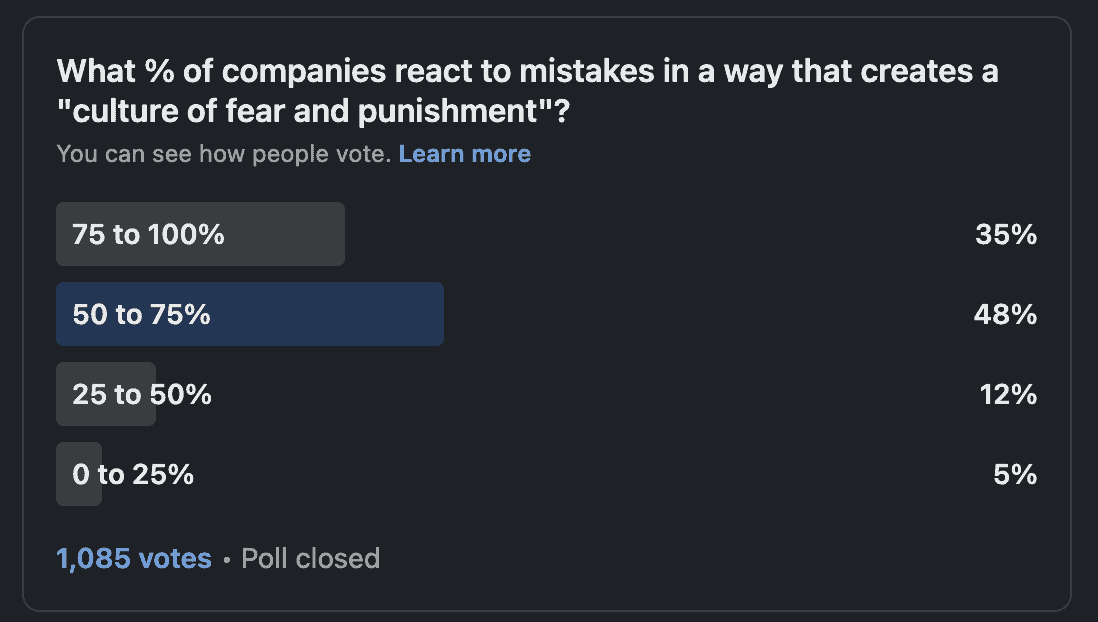
That's sad, but not surprising.
What These Poll Results Reveal About Learning Cultures
The responses reinforce a core idea from The Mistakes That Make Us: how leaders and organizations respond after a mistake matters more than the mistake itself. Fear-driven reactions don't reduce errors; they reduce visibility. When people learn that speaking up leads to embarrassment, punishment, or career risk, mistakes don't disappear–they go underground.
A few comments from LinkedIn:
Shannon Karels: I believe this type of reaction is still very prevalent, unfortunately. There could be varying levels of psychological safety in pockets within a company as well (i.e., certain plants, divisions, departments, etc.), which makes it even harder to measure. The difference all comes down to the leader! It takes courage and a lot of communication from leaders for their people to want to try and fail.
Eduardo Osorio: “To this day my staff still have a fear response about errors, thinking they will count against them, even though I don't count them. We just analyze them and think of ways to make better processes. It's obvious they're responding to previous experiences, but it's hard to reprogram.”
Broxi Thomas (in part): “For many it's more of a show up and don't tell. Let someone else tell it. Let that person be the one who gets the mockery or the rolled eyes. Then afterwards tell that person, I'm so glad you asked, or said this. I ask “So, why don't you speak up and advocate?” “Oh no no no, I fly under the radar. I don't like rocking the boat”
Sandra Viall: “I agree – staff perception of accountability can be mistaken as “gotcha”. The staff have the solutions or need the resources to get there. Keep the conversation going.”
Sabrina Malter: “I estimate around 90% of companies react to mistakes at least sometimes/ in some departments in a way that triggers fear.
That doesn't mean that the same company doesn't react to mistakes in other situations in a kind and constructive way.
In such ambiguous environments, people are often convinced that they are living a learning culture until they are in the situation to report a not so intelligent mistake. Only then fear of what this will mean to their career will pop up.=
They may hold back.
They themselves and others will either regard this holding back as a personal shortcoming only, or as rational intelligent impression management. My experience is from Germany.”
Here is how I prefaced the poll:
My experience over a career of 25+ years is that most businesses (and non-profit health systems) are closer to what I'd describe as “a culture of #fear and #punishment” than not. They react to mistakes in ways that end up driving mistakes further underground. There's a low level of #psychologicalsafety and little improvement. The number of mistakes doesn't go down over time (but you can't measure this because of the fear and lack of reporting).
That seems generally true in the United States. I could be wrong. Do you agree with my generalization? How would you answer this outside the U.S.? You might not feel safe answering about “your” company, but you could generalize or discuss previous workplaces.
I'm still pleasantly surprised when I hear of what we might describe as a culture that reacts “kindly and constructively” when mistakes are made — focusing on learning and improvement instead of punishment. A high level of #psychologicalsafety makes it safer for people to speak up about mistakes. Improvement follows. The number of mistakes tends to go DOWN over time in this culture when I've lived it or heard about it.
I'd expect the “culture of #learning and #improvement” to win over a “culture of fear” in almost all competitive situations.
How prevalent is this “culture of fear and punishment?” It's a general poll that would apply globally — would love to hear your comments (and what country or countries you #work in).
Vote Here (and join the discussion).
Many of the comments here echo stories I've heard–and lived–across organizations for years. That's why The Mistakes That Make Us focuses less on individual behavior and more on leadership systems: how goals, incentives, language, and responses either create fear or make learning possible. Cultures don't become safer because people are told to be brave; they become safer when leaders consistently respond to mistakes with curiosity, respect, and a commitment to improvement.
Why This Still Matters in 2026
Despite years of talk about learning cultures and psychological safety, many organizations still respond to mistakes in ways that create fear and silence. If anything, the pressure for speed, performance, and “perfect execution” has made this worse. These poll results remain relevant because they highlight a persistent gap between what leaders say they want–learning and improvement–and how systems and behaviors actually respond when something goes wrong.