

Dr. Randal Pinkett on Data-Driven DEI: Measuring What Most Companies Only Talk About
Dr. Randal Pinkett returns to the podcast to talk about his book Data-Driven DEI, making the case that diversity, equity, and inclusion can be measured and managed like any other business priority. We get into why most companies never measure DEI effectiveness, the difference between a disparity and an inequity, and the five-step cycle Randal uses to close real gaps.
Scroll down for how to subscribe, transcript, and more
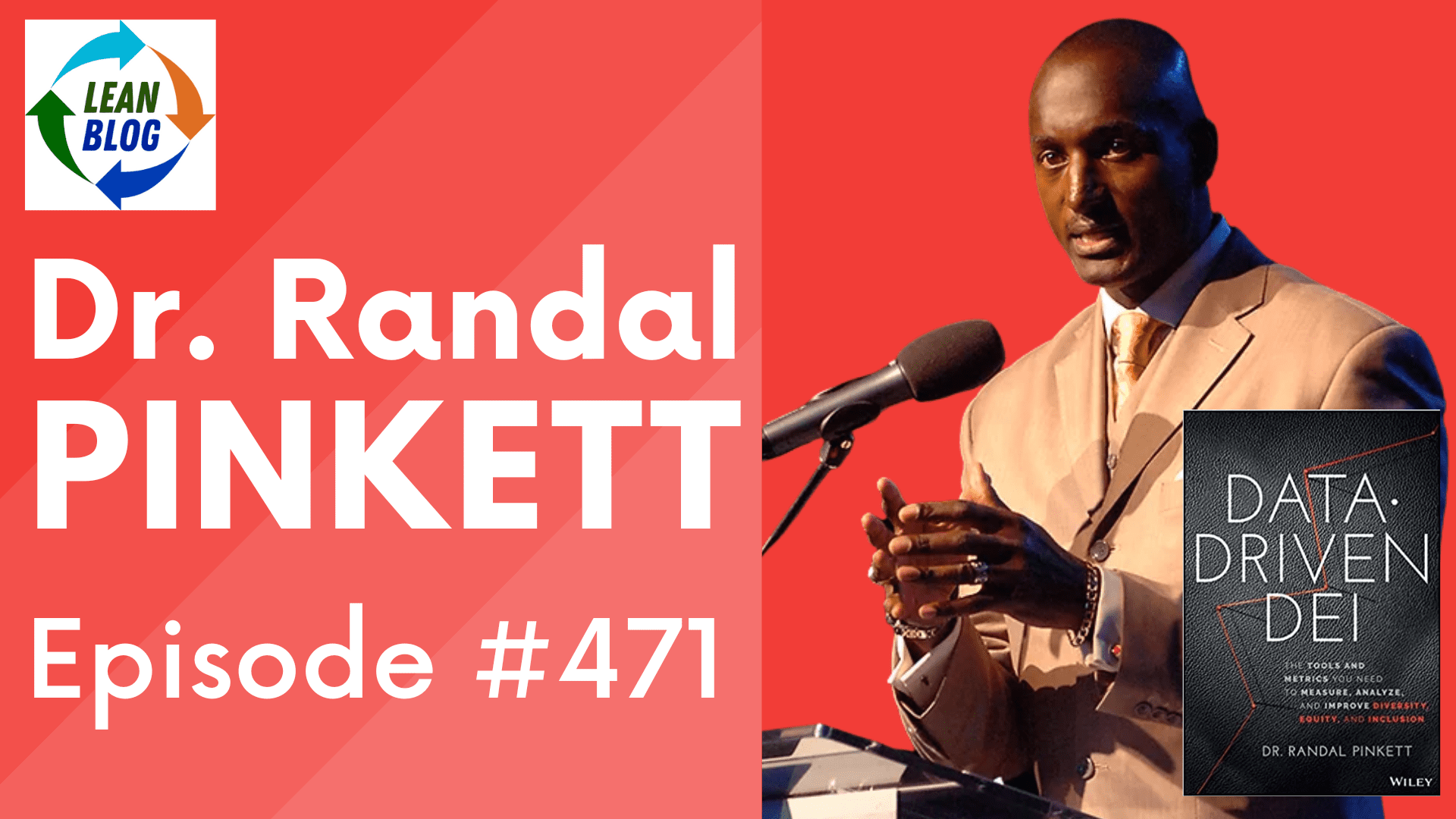
Joining us for Episode #471 of the Lean Blog Interviews Podcast is Dr. Randal Pinkett. He was a guest in Episode 380 in 2020, with Prof. Jeffrey Robinson, his co-author for the book Black Faces in White Places.
Today, I'm honored to be joined by Randal again to talk about his new book, his fifth book — Data-Driven DEI: The Tools and Metrics You Need to Measure, Analyze, and Improve Diversity, Equity, and Inclusion, released yesterday, March 14th.
Randal is an entrepreneur, innovator, speaker, author, media personality and DEI expert who is leading the way in business, technology and equity for all. He is the co-founder, chairman and CEO of BCT Partners, a global, multimillion-dollar research, training, consulting, technology, and data analytics firm whose mission is to provide insights about diverse people that lead to equity.
He's a graduate of the MIT Leaders for Global Operations Program. He's a Rhodes Scholar with a PhD also from MIT. As we talked about a little bit last time, Randal was the winner of Season 4 of The Apprentice.
Questions, Notes, and highlights:
- What was the inspiration for the book?
- Video: Candid Conversation with a Black Businessman: 7 Myths of Racial Equity
- Lean… Safety… Quality… Can DEI be delegated by the CEO?
- Question from Deondra Wardelle: “What DEI data points do you recommend using to gain buy-in from leadership/decision-makers to prioritize DEI initiatives/programs? Especially when there's an assumption that the company is doing *enough* to support DEI because they've conducted/participated in DEI training.
- “Do you feel like you belong?”
- An inclusivity index (“not the employee engagement survey”)
- Inequities to be addressed?
- Disparity (fact – measures) vs. Inequity (something unfair) – Problems vs. Causes
- Health disparities – not just patient safety
- Does a lack of Psychological Safety distort the data from surveys or reporting? – what lengths do you go to to prevent data problems?
- Only 1 in 5 companies measure DEI effectiveness?
- “If you can't measure it, you can't manage it”? Incorrect (Deming)
- Measuring DEI effectiveness – closing the gaps, not just feeling?
- Only 9% say DEI programs are “very effective”? What is that based on?
- A program vs. the way we do things?
- 5-step process at a high level?
- Paul O'Neill and Zero Harm
- The book's website
The podcast is sponsored by Stiles Associates, now in its 30th year of business. They are the go-to Lean recruiting firm serving the manufacturing, private equity, and healthcare industries. Learn more.
This podcast is part of the #LeanCommunicators network.

Video of the Episode:
Thanks for listening or watching!
This podcast is part of the Lean Communicators network — check it out!

Automated Transcript (Not Guaranteed to be Defect Free)
Announcer: Welcome to the Lean Blog Podcast. Visit our website at www.leanblog.org. Now, here's your host, Mark Graban.
Mark Graban: Hi, it's Mark Graban. Welcome to Lean Blog Interviews. This is episode 471, from March 15th, 2023. I'm excited to be joined again today by Dr. Randal Pinkett to talk about his new book, Data-Driven DEI. You can look for links in the show notes or go to leanblog.org/471. As always, thanks for listening.
Mark: Welcome back to the podcast. My guest today is Dr. Randal Pinkett, a returning guest. He joined us in episode 380, back in 2020, alongside Professor Jeffrey Robinson, his co-author of the book Black Faces in White Places. Today I'm honored to have him back to talk about his new book, his fifth, titled Data-Driven DEI: The Tools and Metrics You Need to Measure, Analyze, and Improve Diversity, Equity, and Inclusion. It was released yesterday, March 14th. Before I tell you more about Randal, it's good to see you again. Thanks for joining us.
Dr. Randal Pinkett: Hey, Mark, it's good to see you too. I appreciate the invitation. I'm looking forward to the conversation and thankful to be back on the podcast.
Mark: Thank you. You have a lot to share today, and there's much more to learn in the book, so we're only going to scratch the surface. I hope people will go check it out. If you don't know Randal, let me summarize. He's an entrepreneur, innovator, speaker, author, and DEI expert leading the way in business, technology, and equity for all. He's the co-founder, chairman, and CEO of BCT Partners, a global, multimillion-dollar research, training, consulting, technology, and data analytics firm whose mission is to provide insights about diverse people that lead to equity. Among his five degrees, he's a graduate of the MIT Leaders for Global Operations program and a Rhodes Scholar with a PhD, also from MIT. And as we talked about last time, in episode 380, Randal was the winner of Season 4 of The Apprentice. I can't quite cover it all, so I hope people will check out your full bio. Congratulations again on the book. Maybe start with an open-ended question: what was the inspiration for it? There's a lot you could write about, so it would be good to hear the origin story of bringing this book to press.
The Origin Story of Data-Driven DEI
Dr. Pinkett: It's an interesting story. I had produced a video after George Floyd's murder titled The Seven Myths of Racial Equity, subtitled Candid Conversations with a Black Businessman. An acquisitions editor at Wiley named Mike approached me and said they'd love to convert that video into a book. Mike and I had some very in-depth conversations about what was happening in that moment. We all remember what it was like after George Floyd's murder. Part of what we discussed was whether that was the right gap in the marketplace, the myth of racial equity, or whether there was a different one. He said, “I looked at your background, and you have this eclectic mix of technology and data, MIT on one hand, and diversity, equity, and inclusion on the other. You don't typically see a technology and data scientist combined with a DEI strategist.” As we were talking, he said, “I think there's something else you should consider.” He came to me with the idea of data-driven DEI. He said, “There's nothing out there like it. It's rich, fertile ground for some scholarly attention. People are genuinely wrestling with how to measure and what tools to use to improve diversity, equity, and inclusion.” So after all those conversations, we decided to abandon the Seven Myths of Racial Equity project. It was reincarnated as Data-Driven DEI. And then Mike left Wiley, but his legacy remains.
Mark: I'm glad it kept going. That story is the thought process of an entrepreneur: iterating, looking at the market, not just thinking about the book you could write, but the book you should write.
Dr. Pinkett: Yeah. Mike Campbell. Shout out to Mike Campbell.
Mark: And I'm sure there was a whole team that kept working with you to get through the writing process. You had the concept. How much iteration was there before we get into what's in the book?
Dr. Pinkett: Mike was visionary, but little did I know what I had signed up for. This was the most difficult book I've ever written, and I've written five. I try to do topics justice and make the reader's job easy. I've done the research and the scaffolding for you, and I lay it out in a practical, approachable, relatable way. The other gift Mike gave me before he left Wiley was this: my first cut at the book targeted DEI leaders, champions, and chief diversity officers, folks with some responsibility for improving DEI. He challenged me again. He said, “I think you can target a broader audience than just the DEI traditionalist. You could target anyone who wants to improve their diversity, equity, and inclusion, and show how they could use data to measure their behavioral changes, their attitudinal changes, and their capabilities.” That took me back to the drawing board. I said, “Okay, Mike, let's not focus on DEI leaders. Let's focus on anyone who cares about DEI.” And that made it significantly harder, because now I had two audiences. My primary audience became anyone within the sound of my voice; my secondary audience was my original primary, the DEI leader. So the book vacillates between what people should do and what organizations should do. The interesting thing, and I'm sure you'll agree, is that we so often talk about DEI in the context of organizations. They have statements, missions, it's on their websites. But if you can convince people to care, the organizational piece takes care of itself. It's like lean: if people care about lean, it falls out in the organizational context because they're driving the agenda. So in a circuitous way, by challenging me to focus on people, Mike actually made the organizational agenda easier.
Can a CEO Delegate DEI?
Mark: You mentioned lean, and I was going to frame this in the context of the CEO and the board of directors. There's always debate around what can be delegated and what has to be driven, whether it's lean, safety, or quality. Going back to Dr. Deming, that quality is made in the boardroom. What's your thought on how much a CEO really needs to own and take responsibility for DEI versus hiring someone and delegating it as a function?
Dr. Pinkett: I love the question, Mark. I'm going to answer it directly, and then answer it a second time. I believe it has to be driven at the CEO level. It has to be, and I'll explain why. When I'm advising senior executives on DEI, I had some fascinating discussions with CEOs after George Floyd's murder, as they wrestled with how to respond and find their voice. In one instance, I was going into a town hall with a CEO, and I said, “So you're in the driver's seat.” He said, “No, you're in the driver's seat. I've never done this before.” I said, “Okay, so you're in the passenger seat.” He said, “No, I'm in the back seat. You're driving the conversation. This is not my expertise.” I share that because just as we expect CEOs to understand manufacturing, operations, marketing, sales, even HR, in the 21st century you have to understand diversity, equity, and inclusion. And DEI has a particular asterisk on it, because the way you lead on DEI is by being authentic. It's by personalizing, by being transparent about your journey, and by what some might call servant leadership: being humble and listening. In the absence of a leader who can demonstrate those behaviors, DEI can only go so far. So it has to be driven, but from an authentic and personal place, because that's what DEI is all about.
Why Vulnerable Leadership Drives Inclusion
Mark: A lot of CEOs find it difficult to be vulnerable on any level, to admit they don't know something about manufacturing, or anything else. Many have risen through a culture where you at least pretend to be all-knowing, and it's seen as a weakness not to deeply understand a topic. With DEI, I think there's even more fear of making a mistake, especially around issues that can be uncomfortable. Do you have thoughts on coaching an executive through taking some risks in the spirit of being vulnerable, because we hope it's more helpful than being all-knowing?
Dr. Pinkett: DEI is paradoxical that way. The conventional, traditional model of leadership is “I have to have all the answers, and I'm not going to show my hand where I don't.” DEI turns that completely on its head. Servant leadership and inclusive leadership turn it on its head. The research bears out that it is not employee engagement that is the gold standard; it is feelings of inclusion and belonging, which is a higher-order calling than engagement. We already know from the work around lean and operational efficiency that employee engagement leads to productivity and retention. Inclusivity and belonging take that to the next level, because now people are bought in. So if you believe that, and the research bears it out, and you want people to feel included and like they belong, it begs the question of what makes that happen. The research tells us that humility and curiosity are two of the highest predictors of whether people on your team will feel like they belong. Humility says, “I'm going to be forthcoming about what I don't know, and admit when I don't know the solution or how to approach it.” Curiosity says, “I want to understand how you see it, so I can mitigate my blind spots and see it from different angles.” It's that curiosity and humility that make people on your team feel included, which gets you everything the research tells you about productivity, engagement, and retention. So I coach people to first change their mindset. As you think, so you do. I'm from the old school where it was considered leadership not to show your hand. Once you change your mindset, you can get comfortable with the idea that your transparency liberates the people on your team to be transparent.
Mark: And then you're hoping to bring them, as with the CEO you mentioned, from the back seat to the front seat. Was there a future town hall where the CEO felt comfortable driving?
Dr. Pinkett: Yes. That CEO is leading by example. I sat in a meeting with his board of directors where he spoke comfortably, confidently, and eloquently about his personal journey around diversity, equity, and inclusion, and his commitment to the organization to be held accountable for making progress on those matters. He found his voice and is now strengthening that muscle every day. It's a great transformation story.
The DEI Data Points That Win Leadership Buy-In
Mark: It goes to show how everybody could use a coach, whether a CEO on any topic. Now I want to ask a question posed by a friend of mine, Deondra Wardelle, who shares that rare combination of a Lean Six Sigma background and a lot of DEI work. She has a website, rootcauseracism.com, that I want to mention.
Deondra Wardelle: Dr. Pinkett, what DEI data points do you recommend using to gain buy-in from leadership or decision-makers to prioritize DEI initiatives and programs, especially when there's an assumption that the company is doing enough to support DEI because they've participated in unconscious bias and other DEI training?
Dr. Pinkett: Great question. I'm going to keep it simple and focus on the D, the I, and the E, in that order. For the D, we're talking about representation, and making sure we disaggregate our representation numbers by identifiers like gender, race, ethnicity, disability, and sexual orientation, and by level: the executive level, the mid-manager level, the entry level. I have to scorecard every division and department on those lines so they know where they stand. There's also a healthy competition; no one wants to be at the bottom of that scorecard. That's the D. For the I, you have to have some measure of your culture and climate, call it an inclusivity index. It could be a composite of a survey. To be clear, this is not your employee engagement survey. Employee engagement doesn't go far enough from a DEI perspective to ask people, “Do you feel like you belong? Do you feel like your voice is heard?” An inclusivity index gives me a measure of how people are experiencing my organization, and that too must be disaggregated by all the dimensions I described. Hospitals have done this for years, disaggregating patient satisfaction or patient outcomes data to find their disparities. That's the metaphor here: to know where I need to focus my energy to close those gaps. That's the I. Then the E has two sides. One side looks within the organization; the other looks beyond it. Within the organization, are there inequities to address? Do I have a pay equity gap? Do I have an advancement gap, a gap in time to promotion? To be more data-driven in my language, is there a gap in time to promotion or in pay equity? That means conducting a series of equity studies to figure out where the inequities are, so I can target my initiatives at closing those gaps. The external E is that, no matter your industry, market, or sector, you have a customer. You could be a nonprofit or a corporation; you have a customer. The question I ask is, how well do you understand the differential experiences of your customers? Keep it simple: take net promoter score, which asks whether you would recommend our product or service to someone else. Disaggregate that by all the identifiers I mentioned, to see whether there's a gap in how well you're being responsive to certain groups, communities, or demographics. That's the D, the I, and the E. Keep it simple.
Disparity vs. Inequity: Facts, Causes, and Root Cause
Mark: Thank you, and thank you, Deondra, for the question. For my own follow-up: when you talk about the gap, that's Toyota language. They define a problem as a gap between where performance needs to be and where it actually is. It's the starting point: have we properly defined the problem in a way that's not just a big, vague concern? People might say, “I think we have a diversity problem, or an equity or inclusion problem,” which is just a big, vague concern. The way Toyota might describe it, narrowing that down to a measurable gap sounds like an important first step in any good problem-solving.
Dr. Pinkett: Absolutely. Let me make sure your audience is clear on the difference between a disparity and an inequity. A disparity is a difference. If you and I take the same medicine and have different reactions, that's a disparity, and we expect that certain medicines are more responsive for different people. We don't necessarily lament a disparity; it's a difference. Men and women respond to different drugs differently; that's a disparity. An inequity implies something unfair is going on behind the scenes. If you and I are in different roles, I'm a nurse and you're a doctor, we expect a disparity in our pay. Doctors earn more than nurses, no surprise there. But if we're both nurses doing the same thing, and you earn more than me, that's an inequity.
Mark: Right, with the same experience and everything, all other things equal.
Dr. Pinkett: Exactly. Control for everything else. Once we control for everything else, if there's still a difference, it's no longer a disparity; it is an inequity. And when we talk about the E, the equity, we're talking about inequities, not disparities. I want folks to be clear about that.
Mark: That's a great clarification. To put it in lean problem-solving language, let me check this: the disparity is a fact, a measurable difference. The inequity gets closer to causes. We identify a disparity, and then we start thinking about the current state and causes. Fair to say an inequity could be a cause of a disparity, though that doesn't necessarily get us to a root cause of the inequity.
Dr. Pinkett: Yes, that's right. To get to the root cause is to understand what is happening that's unfair, that leads to the difference we call an inequity. When I control for every other variable, all I'm left with is this difference. Something's going on; somehow someone's being denied opportunity, or someone's not being paid equitably. We have to unearth it, understand it, and then address it. So in the parlance of lean, inequities lead you on an investigation to find root causes.
Mark: And one other reflection. You talk about disparities in patient safety data and how hospitals look for disparities in quality outcomes. It's not firsthand experience, but I know there are healthcare organizations starting to look at employee disparities, beginning with employee safety, injury rates, and lost work time. Getting back to data, instead of safety being just a broad concept. Hopefully we'll see more work in that direction. I probably can't say it's every health system yet, but there are some leading the way, and there's a lot to learn from them.
Psychological Safety and the Survey Trap
Dr. Pinkett: There's an interesting interrelationship between what you described and our earlier conversation about leading and creating environments of inclusivity. Think about high reliability organizations, HROs, which basically means that when we perform a certain function or activity, it's repeatable and it's safe. To create a high reliability organization, say in healthcare, you have to create an environment where people are comfortable calling out something that's not safe. Studies have shown that people knew someone was about to operate on the wrong limb and didn't say anything, because it wasn't an environment where they were comfortable challenging the power structure. The physician must know what they're doing, although it looks to me like that's not the right limb.
Mark: They've been conditioned not to speak up if they tried before and got in trouble.
Dr. Pinkett: Exactly. So there's this wonderful interrelationship between creating environments of inclusivity and belonging, where people are empowered to speak up, to see something and say something, which creates safer, more harmonious, more equitable organizations all at the same time.
Mark: It makes me think of the phrase psychological safety. Do people feel safe? You can't just lecture them and say, “You should be brave.” That doesn't seem to work.
Dr. Pinkett: It does not work.
Mark: But when you think about data, it makes me wonder if there's a trap. Let me paint a scenario, probably not too far-fetched. A well-intended organization puts out a survey, an inclusivity index, and asks people to fill it out anonymously. In a lot of workplaces, people do not believe the survey is anonymous, which can be a barrier. Or we encourage people to report problems, to speak up if they're being discriminated against or mistreated. But without a foundation of psychological safety, we might see under-reporting, just as we see under-reporting of patient safety incidents. And somebody might draw the wrong conclusion: “We asked people to speak up, we're not getting any reports, therefore everything must be okay.” Maybe not.
Dr. Pinkett: You're right on point. When we conduct our DEI assessments to get the evidence for where you are on your journey, using surveys, focus groups, and interviews, everything you just talked about is exactly what arises along that assessment path. Are we getting honest and forthcoming responses to the survey? Do people feel they can give us their true lived experience, so we have a real depiction of it? So we go into the survey selling people on the fact that we're a third party, it's anonymous, we're not going to disclose the data, and we're not going to compromise anonymity, privacy, or security. We aggregate the results so no one can be identified by their identifiers. If there's only one Latina woman in your department, we will not disclose the responses of Latina women. We go to all these lengths in focus groups to say this will be anonymous, to create that safe space, all to get to the truth. It's funny, because it's a play within a play: the most challenged organizations who need our help are the most challenged in getting people to tell us what the problems are. So we've learned a variety of techniques to maximize response rates and psychological safety, to get to the heart of the matter, the root causes.
Measuring DEI: The Deming Misquote, Quotas vs. Goals
Mark: Randal, I wanted to ask one other question. There are all kinds of measures here: measures of the underlying situation, condition, or experiences, and then there are attempts to measure or gauge the effectiveness of a DEI initiative. You point out that only one in five companies measures DEI effectiveness. What are your thoughts on why that is? Do people think it can't be measured, or are they just not getting there?
Dr. Pinkett: Since you brought in Deming, I'll quote him. I actually wrote this in the book. People often attribute the phrase “if you can't measure it, you can't manage it” to Deming. His exact words were that it is wrong to suppose that if you can't measure it, you can't manage it. And therein lies the juxtaposition of DEI. For some reason, when we start having conversations about diversity, equity, and inclusion, people somehow translate that into a quota, or something too touchy-feely to put numbers around. Both are disastrous assumptions. The first, that it's a quota, defies everything we know about making progress. We put a goal on everything we do in business: manufacturing, yield, take your pick. DEI should be no different if we're serious about it. So the argument that it cannot be measured and therefore cannot be managed is a falsehood. The second, that we're trying to enact a quota, is also a falsehood. Take recruiting and hiring. If I want to hire the best and the brightest, I want to cast the widest possible net. If my data tells me I'm only recruiting from certain places and only getting certain types of candidates, then it behooves me to cast a wider net. I'm not saying put a hard number on it. I'm saying put a goal on it, because if we're doing poorly with a group, in order to get better I have to set a goal to get better with that group. Not a quota, a goal. Both are necessities to get measurable improvements, and for some reason DEI falls victim to both falsehoods.
Closing the Gap Means Taking Action, Not Making Excuses
Mark: It's not just the goal, it's doing the work to close the gap. A lot of times there's an old management mindset of “I'm going to set a goal and then lecture, browbeat, and threaten. I don't care how you do it, just hit the goal,” as opposed to a data-driven problem-solving process where we look at the right specific actions instead of just telling people to try harder within the existing system. This might actually be more correctly attributed to Deming, and thank you for pointing out the misquoting: the idea that every system gets the results it's designed to get seems like an appropriate phrase. Let me tell you a story and get your reaction. I was at a conference, I won't say where or what it was about, and there was a session about DEI. Someone made a comment, essentially, “You can't fault us for the gap in hiring certain groups of people, because we're not getting the applicants. So what can we do?” I was a little gobsmacked. This was the DEI session, right? That seemed like victim language. There are things we can do. How do we cast that wider net? Maybe give us some examples.
Dr. Pinkett: Another phrase that's loaded is affirmative action. Let me put aside the legal interpretation and the societal debate, and focus solely on the words: being affirmative about taking action, being intentional about doing something. That's what it's meant to communicate, and it's gotten lost completely. To your point about not just setting a goal but working toward it, it is unacceptable to throw our hands up in the air, which we'll do for DEI. If we have a big, hairy, audacious goal around a product introduction, or marketing and sales, everyone gets energized. How can we go after it? Let's dig in our heels. But “we're not getting the recruiting pool we want,” and suddenly it's “they're not applying.” The examples are not rocket science. If you're only recruiting at Harvard, MIT, and Yale, maybe you should consider Howard, Morehouse, and Spelman. If you have no employee resource groups that give diverse employees a place to see a reflection of themselves, then maybe experiment with that. If you've done no organization-wide training on the language and strategies of diversity, equity, and inclusion, you might want to try that. And if you've never done a town hall, or what we'd call a courageous conversation, around a difficult, sensitive topic like our democracy, the Me Too movement, or racial injustice, that's something we'd never have touched 20 or 30 years ago. That was the old school; you wouldn't even touch that conversation in the workplace. But now we're saying you need to have that conversation, because the only way we get to greater understanding is with less misunderstanding, and the only way we get to less misunderstanding is through dialogue, not debate or discussion, but dialogue that allows us to explore how we all see things differently. So there are just a few examples of things folks can do to be affirmative in taking action to close the gaps we've been talking about.
Mark: Be a problem solver. Take action. I don't like the victim language you sometimes hear from executives around different goals and dimensions of performance. To me, that's not helpful, and that's not leadership. You've got to help inspire creative action to close those gaps. So back to the question of measuring DEI effectiveness, there's a question of how many are trying, and then probably a question of the best way to measure it. I imagine you would point toward closing these gaps, as opposed to just asking, “How do you feel about the DEI program?”
What Effective DEI Measurement Actually Looks Like
Dr. Pinkett: Without a doubt, and it's all of the above. It is making sure we have a representative workforce, that's the D, and that begs the question, what's my benchmark? You could benchmark against the communities where your facilities are located, or against the broader societal population, but you need a benchmark so you're comparing apples to apples. I wouldn't expect a company headquartered in North Dakota to necessarily have an employee base that reflects the same population as Chicago, or Illinois at the state level. So that's the D. For the I, it is again asking people about their lived experience, how they're experiencing the culture. But because I'm disaggregating that not only by demographics but also by department and division, I can see where I'm doing the worst, not only in terms of groups but also divisions and departments. Now, to the discussion around root cause: why is it that in my manufacturing plant I have the lowest inclusivity, but in my finance and accounting department I have the highest? What's happening in accounting and finance that I need to bring over to manufacturing, and what do I need to stop doing in manufacturing that they might be able to learn from? That's what the data begins to unearth. If you're looking at aggregate numbers or averages, you miss it. One of the books I cite in my book is The End of Average, because averages obscure the underlying reality. Only when we disaggregate, only when we stratify, do we understand differentials in people's experiences. That's the I. Then the E, which we talked about: it's identifying where the inequities are. Is it pay? Is it advancement? The list goes on. And then the hard work is trying to root out what we need to do. For an advancement gap, maybe when we're doing performance evaluations we need to be more objective in how we evaluate talent, because performance evaluations can be notorious for being subjective. I think somebody's a good fit for the culture, and you don't. What does “good fit for the culture” mean? Let's break it down. Does it mean team-oriented? I can observe team orientation. Does it mean a risk taker? I can observe behaviors of someone who's a risk taker. But if I just say “cultural fit,” Houston, we have a problem. So we have to be objective, not subjective, in our criteria, clear on how we'll evaluate the criteria, and aligned so we all evaluate them the same way. Now I have mitigation of the bias in evaluating performance, which closes my equity gap in advancement.
Why DEI Programs Stall: Under-Resourced, Not Empowered, Ill-Positioned
Mark: You say one in five companies are measuring DEI effectiveness, and only 9% say their DEI programs are very effective. It seems like there's a big gap there. Not just whether we're measuring it, but a gap in effectiveness when we are measuring it. What do people point to as reasons they would not say their program is very effective?
Dr. Pinkett: There are two reasons, and the second is going to sound as if I'm being facetious. The first is that they're not seeing measurable improvements. The second is that they're not measuring it, so they don't know if they're making measurable improvements, and they're going off subjectivity: what people feel, what people think. I understand there is an organically subjective element to DEI, we're talking about feelings at some level, but I think we also have to acknowledge that this is very difficult work. Chief diversity officers are often under-resourced, not empowered, and ill-positioned. Under-resourced with low budgets. Not empowered, with little control over the other functions needed to move the needle on the things that matter. And ill-positioned, not reporting into the CEO. Give me those three factors and ask me to lead, and I can't do it. So it's about elevating DEI, empowering DEI, and properly budgeting DEI like we do any other function where we want to make improvements, so we can see the effectiveness of the work. There have been a lot of debates around the effectiveness of training and ERGs. Research has shown that when done right, we can see measurable improvements. My critique is not of the work being done by DEI practitioners. My critique is of organizations not sufficiently budgeting, empowering, and positioning DEI to do the work it's being asked to do.
A Program vs. the Way We Do Things
Mark: A lot of what you talk about there is the same conversation people could have about lean in healthcare. How many are measuring the effectiveness of their lean program? How many of those would say the program is very effective? The first thought that comes to mind is, wait a minute, part of the trap is it being a program instead of the way we do things around here.
Dr. Pinkett: It does, and that bounces back to DEI. What lean benefits from, though, is that it was always built on a foundation of statistics, numbers, data, and language around root cause. There's a body of language, and we'll call it scholarship, underpinning lean that has always been about data and numbers and statistics. DEI came through a different tradition to arrive where it is. That's why Data-Driven DEI, I say humbly, is a valuable contribution to the DEI agenda, because it is very intentional about embracing statistics, quantitative and qualitative methods, machine learning, and artificial intelligence. In this book I go into all of the traditionally numerical, quantitative aspects of DEI that can sometimes get lost in the dialogue.
The Five-Step Data-Driven DEI Cycle
Mark: In the book, going back to problem-solving methodologies and cycles, Dr. Deming's PDCA or PDSA cycle, Six Sigma and DMAIC, you lay out a five-step process, and the way it's drawn is a cycle. Tell us about that. I know it was no accident that it's a cycle.
Dr. Pinkett: No accident, and I'm revealing my roots in manufacturing and the Leaders for Global Operations program at MIT. Just like PDCA and all the methodologies that underlie lean, I see DEI through the exact same lens. It is a never-ending cycle of, watch my phrase, continuous improvement. No surprises here. And I intentionally drew out a visual of a cycle because it marries this idea of continuous improvement with a never-ending journey. The journey toward more diversity, equity, and inclusion has no destination. It is ongoing; it's one where we can always learn more, grow more, expand more, do more. The five-step process is built around the letter I. It begins with DEI incentives, asking the question, what's your motivation? Then DEI inventory, which is the assessment to know where you stand. Then DEI imperatives, to know what your priorities are. Then my favorite one, DEI insights, looking to best practices or promising practices to know what works. Then DEI initiatives, what are you going to do? That's the fifth step. And then lastly, DEI impact, how can you measure the effectiveness of your work? And then it continues, and continues, and continues.
Big, Hairy, Audacious Goals: From Zero Harm to Zero Inequity
Mark: When you set big, hairy, audacious goals, I think of the late Paul O'Neill, the former CEO of Alcoa, very similar in his thought process to Don Davis, who taught at MIT in the LGO program and was the former CEO of Stanley Tools. Paul O'Neill would have this big, hairy, audacious goal of zero harm. He'd say nobody should be hurt who comes to work. You can see the data that shows they never got to zero, but they started, and you see the chart: they were better than average, but that wasn't good enough for Paul O'Neill. You could see this curve of a 40 or 50% reduction every year. It was a continuous, sustained, intentional effort. There's a parallel: if we want to aspire to zero harm, meaning zero discrimination, zero mistreatment, zero disrespect, zero inequity, sometimes that scares people. They'll say, “We're not going to get there, so why try?” I hear people react that way to a goal of zero harm for workers or patients. How would you encourage somebody not to be scared off by a big, hairy, audacious goal when it comes to diversity, equity, and inclusion?
Dr. Pinkett: I love the question. It's interesting, because even as you cited the example of zero harm, my sense is that it would be more palatable, albeit it has its own dimensions of scary, than if we were to say zero percent on discrimination or zero percent on harassment and other equity-related issues. My response to folks would be, much like any other aspiration we have, let's shoot for the stars and not the mountaintop. If you shoot for the mountaintop and you don't make it, you'll fall to the bottom of the mountain. But if you shoot for the stars and you don't make it, you will fall to the top of the mountain. Let's pleasantly surprise ourselves with what we might accomplish when we set a big, hairy, audacious goal. Business is littered with stories of people who had big, hairy, audacious goals and accomplished them. What's that old phrase? The only people who change the world are those crazy enough to think they can do it. So I say, let's be crazy.
Mark: In a good way, aiming high. I might be paraphrasing the football coach Vince Lombardi: if we aim for perfection, we might reach greatness. And part of the Paul O'Neill dimension was aiming for what he'd call the theoretical limits of performance, goals like zero or one hundred percent. It's really not as complicated as the words might sound, and using that goal, as you said earlier, a goal can be energizing. Part of his leadership genius was aiming high and helping people actually change the system, instead of just telling people to be careful and not get hurt. He aimed toward encouraging and celebrating progress instead of a fear-based, punitive approach. I think that's where sometimes people are afraid of an audacious goal, because they think they'll be punished if they don't reach it. That doesn't have to be the case. What are your thoughts on aiming high and celebrating progress without losing sight of the top of the mountain?
Dr. Pinkett: I'm going to riff off your narrative. People are not afraid of failure; they're afraid of the consequences of failure. So if you can remove the consequence and say it's okay to fail, it's okay if you don't make the goal, but what I want to see is us take some risks. I want to see us innovate, try something new, think outside the box, or realize there is no box. So as a leader, you say to the team, “I'm giving you this space to make mistakes, but I'm challenging you to aspire to this goal. We're all in this together.” What we can't have happen is to operate from a place of fear. We have to operate from our strength and say that, while it is big and hairy and audacious, it's only when we set these big, hairy, audacious goals that we can do something greater than we could apart from one another. And that's the essence of leadership: galvanizing people toward that goal, whether it's sports, business, or in your home.
Who the Book Is For: Making the Personal Case for DEI
Mark: Very well said. Again, we're joined today by Dr. Randal Pinkett, whose new book, Data-Driven DEI: The Tools and Metrics You Need to Measure, Analyze, and Improve Diversity, Equity, and Inclusion, is available now. This might be the last question. You talked earlier about your intended audience and helping people who are convinced we need to make more progress but are struggling to figure out how. How much of the book is targeted toward people trying to go from a good to a great situation, versus an organization where the leaders aren't convinced? Are you writing for people who need that boost, or is there an opportunity to convert some people to realizing that DEI is a strategic business imperative?
Dr. Pinkett: I'm a big basketball fan, and my wife often uses the phrase “going hard in the paint,” a metaphor for a player driving down low to the basket to score. To use her phrase, I go hard in the paint in the first chapter on why you should care about DEI. I believe we've done an excellent job articulating the organizational case, the business case, and there have been tons of studies by McKinsey and others articulating it. But I don't think we've done as good a job articulating what I call the personal case for DEI. The most popular radio station on the planet is WIIFM: what's in it for me? So I go hard in the paint in that first chapter to say, if you're on the fence, if you're wrestling with whether this matters or whether you should care, I'm going to set aside why your organization should care and talk directly to you about why you should care, from your head or from your heart. From your head, it will lead to advancement over others and more compensation. From the heart, it's because it's the right thing to do, because it creates a more valuable life experience, and because it makes you a better global citizen. And if you're in a leadership position, it will make you a better, more inclusive, more responsive, more effective leader. The list goes on. So I try to articulate the personal case for DEI, because, back to where we started, if I can convince people to care, the organizational case is made.
Mark: I know the book is going to help people move forward in that direction, closing the gap with not just a data-driven approach, but a methodical process for closing those gaps. It's really exciting to see this come together in the book. You can learn more about it at datadrivendei.com, and I'll put links in the show notes to your full bio, your website, and the new book. Randal, thank you so much for being a guest today. Let me ask the obnoxiously open-ended question: if there's anything you'd like to add, I'll give you the last word.
Keep Our DNA in DEI
Dr. Pinkett: I appreciate it, Mark. What I'll say is this. We're seeing a watershed of innovation in our present day, whether it's ChatGPT, AI, or natural language processing, all these sophisticated tools. When I first got into DEI, others and I would say we're trying to get DEI into our DNA, into the organization's DNA, into our personal DNA. And now I'm also mindful that while we want to get DEI into our DNA, we also need to keep our DNA in DEI: that the humanity we all represent, the ability to relate to each other, does not get superseded by what data, machines, or tools can do. It has to be our DNA that leads in DEI. And in what I believe is becoming a more fractured society, divided along any number of lines, while I might sound biased in this belief, I believe DEI can be an incredible asset to stitching together the fabric of a society that's tearing at the seams. So I'm hoping people take this book to heart. And I mean that literally, that they personalize it for their own journey, so we can all see ourselves as agents of change, not only for ourselves and our organizations, but for our society.
Mark: Well said, Dr. Randal Pinkett. Thank you again for being a guest here on the podcast.
Dr. Pinkett: I appreciate it, Mark. I appreciate your voice, I appreciate your work, and thanks for having me back.
Mark: Thanks again to Dr. Randal Pinkett for joining us today. His new book, Data-Driven DEI, is available now. You can look for links in the show notes or go to leanblog.org/471 to order your copy and learn more about Randal and his work. Thanks again to Deondra Wardelle for being here today. You can learn more about her at deondrawardelle.com or rootcauseracism.com.
Announcer: Thanks for listening. This has been the Lean Blog Podcast. For lean news and commentary updated daily, visit www.leanblog.org. If you have any questions or comments about this podcast, email Mark at leanpodcast@gmail.com.