10 Powerful Toyota Quotes on Mistakes, Learning, and Psychological Safety
TL;DR: Looking for powerful Toyota quotes? Here are verified quotes from The Toyota Way and Toyota leaders on mistakes, learning, psychological safety, and continuous improvement — plus context on what they really mean.
Toyota Quotes on Learning, Mistakes, and Psychological Safety
Below are direct quotes referenced in this post that reflect Toyota's culture of learning, accountability, and psychological safety.
1. “Mistakes are okay as long as people learn from them.”
2. “We view errors as opportunities for learning.”
3. “Rather than blaming individuals, the organization takes corrective actions and distributes knowledge about each experience broadly.”
4. “Learning is a continuous company-wide process as superiors motivate and train subordinates; as predecessors do the same for successors; and as team members at all levels share knowledge with one another.”
5. “Safety [at Toyota] includes more than just physical safety; it also means feeling safe psychologically.”
6. “Without trust in their employers, employees are reluctant to admit to the existence of problems and learn that it is safest to hide them…”
7. “People must be treated fairly, they must feel psychologically and physically safe and secure in their jobs, they must believe that any concerns they have will be taken very seriously and given due process.”
8. “The strong belief in objective problem solving that focuses on improving systems instead of blaming individuals underlies a good deal of the daily kaizen.”
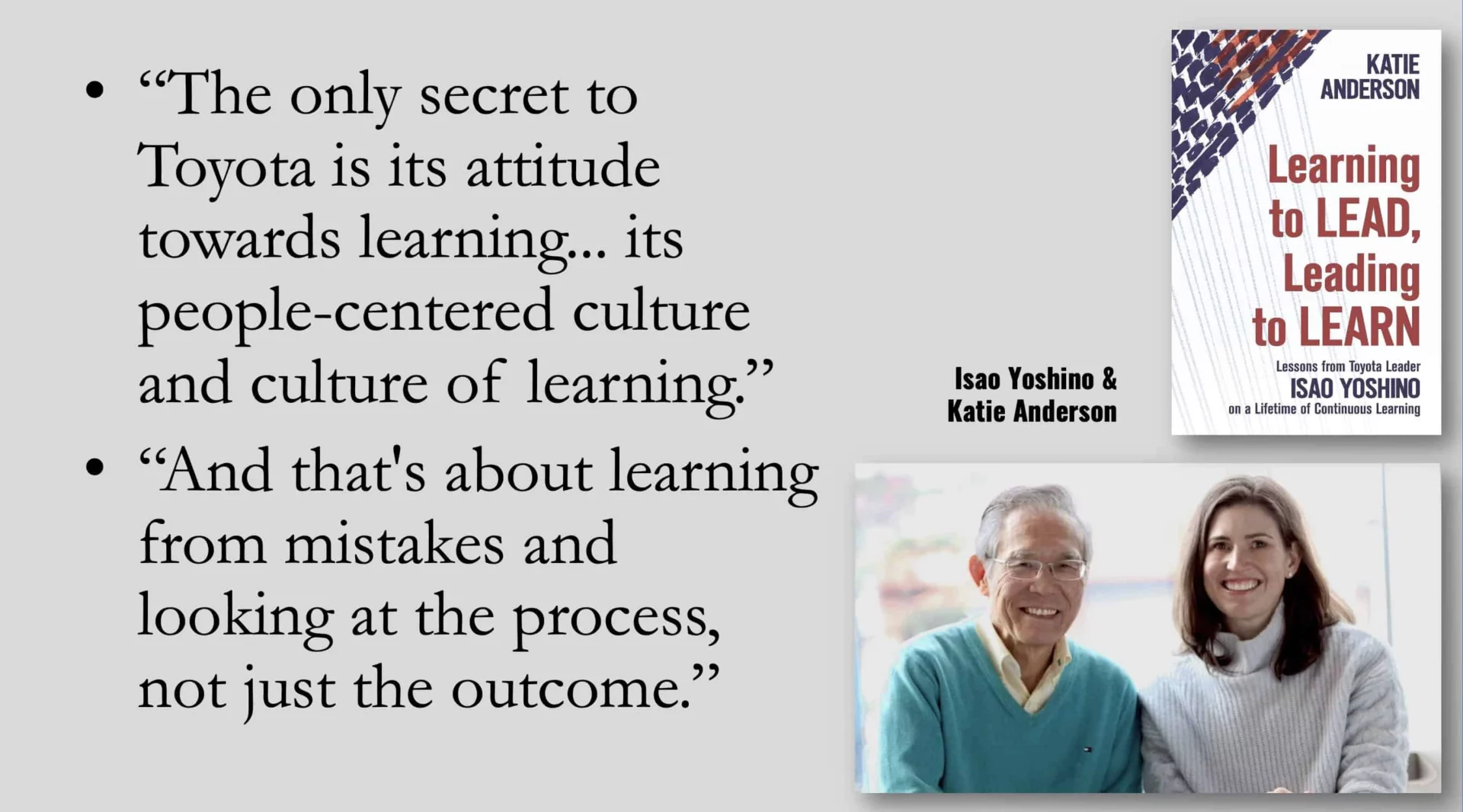
9. “The only secret to Toyota is its attitude towards learning… its people-centered culture and culture of learning.”
10. “And that's about learning from mistakes and looking at the process, not just the outcome.”
These quotes aren't motivational posters — they reflect a deeply embedded management philosophy.
For a broader look at this topic, see the complete guide: Psychological Safety in Lean Organizations.
The book that I wrote on learning from mistakes is not an academic, research-driven project. My “field research” mainly consists of the 200 podcast interviews that I've done, asking a wide range of people, “What's your favorite mistake?”
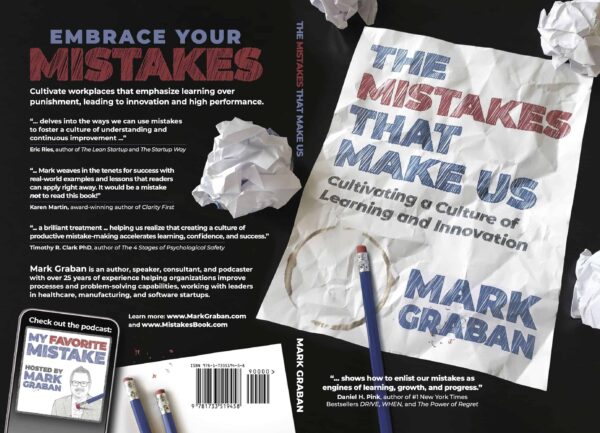
The book is available: The Mistakes That Make Us: Cultivating a Culture of Learning and Innovation.
There are stories and reflections from Toyota people and those in their close orbit, such as:
As Katie wrote in her book, Learning to Lead, Leading to Learn: Lessons from Toyota Leader Isao Yoshino on a Lifetime of Continuous Learning:
The stories from former Toyota people are so clear and so consistent when it comes to learning from mistakes.
I did go check the book by Liker and Hoseus, Toyota Culture: The Heart and Soul of the Toyota Way.
There are many mentions of “learning from mistakes” in that book. Co-author Mike Hoseus had a story that he shared in the book that was very similar to the stories from Yoshino and Meier — he was applauded for pulling the andon cord and admitting a mistake. They quite literally applauded.
“He did not seem angry at me for making the scratch,” said Hoseus about his team leader.
It's about mutual trust and safety:
“Without trust in their employers, employees are reluctant to admit to the existence of problems and learn that it is safest to hide them…”
We shouldn't blame people for hiding problems when they feel like it's not safe to disclose them.
Toyota has worked deliberately to build that culture. They aren't perfect — no organization is — but the standard is clear.
Mistakes are OK…
Here is one quote from the book that I shared on LinkedIn:

The famed Toyota Way 2001 document said this:
“We view errors as opportunities for learning.
Rather than blaming individuals, the organization takes corrective actions and distributes knowledge about each experience broadly.
Learning is a continuous company-wide process as superiors motivate and train subordinates; as predecessors do the same for successors; and as team members at all levels share knowledge with one another.”
Why Psychological Safety Is Foundational at Toyota
Some other quotes from Toyota Culture make very clear the need for psychological safety:
“Safety [at Toyota] includes more than just physical safety; it also means feeling safe psychologically. This starts with a respectful environment where team members do not fear psychological abuse.”
Not just physical safety, but also psychological safety.
That's why I've come to believe and say that psychological safety (a level that's “high enough”) is a pre-condition for Lean.
“…the holistic way in which Toyota looks at the safety of all stakeholders.
It involves providing for the physical and psychological safety of each member and their families.
It is an intentional value that drives subsequent action.
It is part of the Toyota culture that involves the ideas and input of all the members to create positive results in which all can take pride.”
This “holistic way” (“The Toyota Way”) is notoriously difficult to copy — if copying should indeed be the goal anyway. If organizations try to copy Lean tools without building psychological safety, they will struggle.
Being able to learn from mistakes requires a high-enough level of psychological safety. We have to feel safe to raise concerns and also trust that our concerns will be taken seriously, if we're going to even bother to point out mistakes or to suggest a better way:
“[Toyota believes] people must be treated fairly, they must feel psychologically and physically safe and secure in their jobs, they must believe that any concerns they have will be taken very seriously and given due process.”
And one final snippet about the need to avoid blame…
“The strong belief in objective problem solving that focuses on improving systems instead of blaming individuals underlies a good deal of the daily kaizen.”
This builds trust and psychological safety. How can we build that in your organization? I'd love to help.
Contact me if you'd like to discuss any of this and my certification from LeaderFactor where I can help you assess the current state (through an anonymous survey), educate leaders, and coach them through the behaviors that are proven to build more psychological safety.
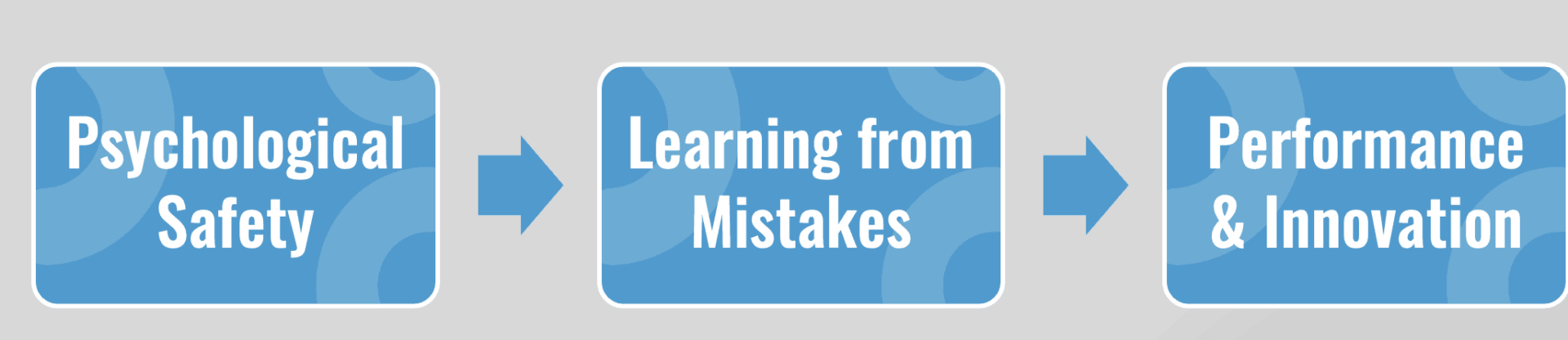
The connections have become really clear to me:
Looking for more Lean quotes? Visit my collection here.
You can leave a comment on this post or feel free to join the discussion over on LinkedIn:
FREE GUIDE FOR LEADERS
Just PDSA It
Kaizen, A3 problem solving, and strategy deployment are the same learning loop at three sizes. This free guide shows how to size the method to the problem, why “just do it” skips the part that teaches you something, and what leaders can do to make being wrong cheap enough that people run honest tests.
18 pages, with one thing to try at your next approval meeting. The download link appears as soon as you enter your email.
Make it safe to learn from mistakes
In The Mistakes That Make Us: Cultivating a Culture of Learning and Innovation, I share stories and practical steps for leaders who want people to admit mistakes, learn from them, and prevent them from happening again. It received the 2025 Shingo Publication Award.





[…] At Toyota: Mistakes are OK, as Long as We Learn; Culture and Psychological Safety– Mark Graban talks about Toyota’s culture of trust and safety when it comes from learning from our mistakes. […]