Tech and AI, the Toyota Way: Jeffrey Liker on Problem-First Technology
Jeffrey Liker, author of The Toyota Way, returns to talk about his new book, Tech and AI, the Toyota Way. We discuss why Toyota starts with the problem instead of the technology, how jidoka shapes the way Toyota uses machines, how a Georgetown plant was converted to build four powertrains on one line without losing a single Camry, and why Dr. Eric Dickson found his best problem solvers letting AI do their thinking for them.
Watch the Episode:
Scroll down for how to subscribe, transcript, and more
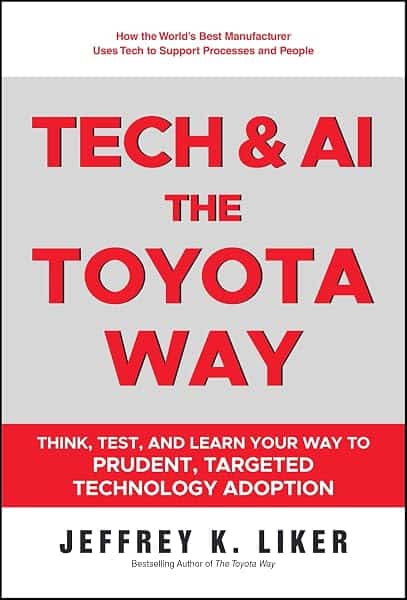
Tech and AI, the Toyota Way
by Jeffrey K. Liker
Why Toyota starts with the problem, not the technology, and how to adopt AI without giving up problem solving.

My guest for Episode #552 of the Lean Blog Interviews Podcast is Dr. Jeffrey Liker, professor emeritus of industrial and operations engineering at the University of Michigan and president of Liker Lean Advisors. Jeff is the author of The Toyota Way, which has sold almost a million copies in 26 languages, and about 20 books related to Toyota and Japanese management, including The Toyota Way Fieldbook, Toyota Culture, and Toyota Talent. He has received a dozen Shingo Research Awards.
His new book is Tech and AI, the Toyota Way: Think, Test, and Learn Your Way to Prudent, Targeted Technology Adoption (Wiley). The idea goes back to an article Jeff wrote in 1985, when “computer-integrated manufacturing” and the self-running, lights-out factory were the hot topics. Forty years later, the shiny object is AI, and Jeff sees many of the same mistakes being repeated.
In our conversation, Jeff explains why Toyota gets unfairly labeled as anti-technology, and how the company actually decides when technology is the right countermeasure. He tells the story of a high-potential manager at Toyota's Georgetown, Kentucky engine plant who had to squeeze a fourth line into a full building. Nobody told him to go digital, but solving the real problem required sequenced pull and an electronic kanban system, along with changes to containers, supplier shipments, and the whole logistics system. Jeff also describes the Georgetown Camry line that can now build hybrid, plug-in hybrid, electric, and hydrogen vehicles, converted while staying in full production.
We also talk about Menlo Innovations and its High-Tech Anthropologists, who tested a diesel diagnostic device using a cardboard mockup filled with BBs, and learned that mechanics in gloves couldn't use it. Jeff shares the story behind the foreword by Dr. Eric Dickson, CEO of UMass Memorial Health, whose best-trained problem solvers “forgot everything they knew about problem solving” once they started using AI, and how Eric changed his approach so the AI challenges assumptions instead of handing out answers. We close with what Jeff calls being a “techno-skeptic”: open to new technology, but wanting to see the evidence first.
We continue to get excited about the next new shiny object and forecast unrealistic impacts that may happen over decades, but we expect they're going to happen over months.
Jeffrey Liker
What you'll learn
- Why Toyota is not anti-technology, and how it blends planning systems with pull
- How jidoka, going back to Sakichi Toyoda's self-stopping loom, shapes the way Toyota uses machines
- Why technology should be a countermeasure to a defined problem, not a solution looking for one
- How a Georgetown engine plant used digital kanban to fit a fourth line into a full building
- Why “use only reliable, thoroughly tested technology” was softened in the second edition of The Toyota Way
- How risk profile should shape how quickly an organization adopts new technology
- What “go slow to go fast” looks like in Toyota's planning and piloting
- How Toyota converted a 350,000-Camry-a-year line to build four powertrains without losing production
- What Menlo Innovations' High-Tech Anthropologists teach about designing technology with people, for people
- Why Eric Dickson's black belts let AI do their thinking, and how he fixed it
- How a Toyota UK plant uses low-cost machine learning to support, not replace, inspectors
- Why trained problem solvers change the math on any technology ROI calculation
Topics and questions
- How did a 1985 article on computer-integrated manufacturing lead to this book?
- Why do executives get more excited about buying technology than about improvement at the gemba?
- What happens when you improve the system before automating it?
- Why shouldn't the challenge be “get everyone to use AI”?
- Where is Toyota's digital and AI work happening, and who is teaching whom?
- What do the Klarna and Ford stories say about replacing people with AI?
- How does Jeff use AI in his own work?
- What does it mean to be a techno-skeptic?
More with Jeff Liker
- Jeff Liker, Twenty Years Later: The Ideas That Keep Showing Up (2026)
- How Toyota Leaders React to Mistakes: Jeff Liker on Blame, Andon Cords, and Psychological Safety (2024)
- The Toyota Way, Revisited: Jeff Liker on Scientific Thinking, Kata, and Enabling Bureaucracy (2021)
- Jeffrey Liker on Toyota's Crisis, Recalls, and the Real Test of the Toyota Way (2011)
- Jeffrey Liker on Toyota Culture and the Human Side of the Toyota Way (Part 1) (2008)
- Jeffrey Liker on the Toyota Way and Why Lean Enterprise Takes Years, Not Weeks (2006)
This podcast is part of the #LeanCommunicators network.


Thanks for listening or watching!
This podcast is part of the Lean Communicators network — check it out!


Follow the Lean Blog Interviews podcast
Since 2006, I've been talking with leaders, authors, and practitioners about how Lean thinking works in the real world, in healthcare, manufacturing, and beyond. Follow the show so you don't miss new episodes.
Episode Transcript
Jump to a section:
- Introducing Jeffrey Liker and Tech and AI, the Toyota WayIntroducing Jeffrey Liker and Tech and AI, the Toyota Way
- A 1985 Article and the Dream of the Lights-Out FactoryA 1985 Article and the Dream of the Lights-Out Factory
- GM, NUMMI, and the Misfit Between the Top and the GembaGM, NUMMI, and the Misfit Between the Top and the Gemba
- “Humans Are Underrated”: Tesla's Model 3 Lesson”Humans Are Underrated”: Tesla's Model 3 Lesson
- Jidoka: Technology That Serves the PersonJidoka: Technology That Serves the Person
- Toyota Isn't Anti-Technology: Planning Versus PullToyota Isn't Anti-Technology: Planning Versus Pull
- The Georgetown Engine Plant and Digital KanbanThe Georgetown Engine Plant and Digital Kanban
- Technology as a Countermeasure, Not a Solution Being PushedTechnology as a Countermeasure, Not a Solution Being Pushed
- Philosophy, People, Process, and TechnologyPhilosophy, People, Process, and Technology
- Start With the Problem, Then Break It DownStart With the Problem, Then Break It Down
- Don't Make the Challenge “Get Everyone to Use AI”Don't Make the Challenge “Get Everyone to Use AI”
- Revisiting “Reliable, Thoroughly Tested Technology”Revisiting “Reliable, Thoroughly Tested Technology”
- Risk Profiles and Going Slow to Go FastRisk Profiles and Going Slow to Go Fast
- Where the Action Is: Toyota in North AmericaWhere the Action Is: Toyota in North America
- Converting the Georgetown Camry Line Without Losing a CarConverting the Georgetown Camry Line Without Losing a Car
- Menlo Innovations and the High-Tech AnthropologistMenlo Innovations and the High-Tech Anthropologist
- Agile, Small Pieces, and Fast FeedbackAgile, Small Pieces, and Fast Feedback
- Eric Dickson's Foreword: When Black Belts Forgot Problem SolvingEric Dickson's Foreword: When Black Belts Forgot Problem Solving
- Klarna, Ford, and Hiring People BackKlarna, Ford, and Hiring People Back
- Low-Cost Machine Learning for Inspection at Toyota UKLow-Cost Machine Learning for Inspection at Toyota UK
- Spam Filters, False Positives, and Vibe CodingSpam Filters, False Positives, and Vibe Coding
- How Jeff Uses AI in His Own WorkHow Jeff Uses AI in His Own Work
- Individual Use Versus Enterprise UseIndividual Use Versus Enterprise Use
- AI as a Sparring Partner, Not a Substitute for ThinkingAI as a Sparring Partner, Not a Substitute for Thinking
- What Are You Comparing Against?What Are You Comparing Against?
- Be a Techno-SkepticBe a Techno-Skeptic
Introducing Jeffrey Liker and Tech and AI, the Toyota Way
Mark Graban: Hi, welcome to Lean Blog Interviews. I'm your host, Mark Graban. Our guest today is a familiar voice here. It's Dr. Jeffrey Liker, professor emeritus at the University of Michigan, president of Liker Lean Advisors, and author of The Toyota Way, which has sold almost a million copies in 26 different languages.
He's written nine other books about Toyota, and he's won a dozen Shingo Research Prizes. I see some of those over your head, Jeff. First off, welcome to the show. Do I have the book count right? There are so many now.
Jeff Liker: Well, there are 20 books related to Japanese management or Toyota now.
Mark Graban: Including The Toyota Way Fieldbook, Toyota Culture, Toyota Talent. We're going to be talking about the new book, available here in November. It's called Tech and AI, the Toyota Way. So that's going to be our topic here today.
A 1985 Article and the Dream of the Lights-Out Factory
Mark Graban: This is maybe going back a ways. The origin of the book goes back about 40 years to an article that you wrote in 1985. Can you tell us about that?
Jeff Liker: I had an unusual career path in that I got an industrial engineering degree, and then decided I really didn't like industrial engineering, and then got a PhD in sociology, which I liked. But because of the job market, I ended up as a professor of industrial engineering back at the University of Michigan, trying to figure out why I was here and what I was supposed to be doing. I was sort of like the ugly duckling among all the real engineers, the technology geeks. It turns out that being an odd duck, there were a lot of people interested in working with me.
At that time, more than 40 years ago, the hot topic was the social impact of technology, and particularly computer-integrated manufacturing. There was a state-funded R&D company in Ann Arbor that had a very sophisticated automated system as a demonstration, and they were trying to educate small to medium-sized companies about these advanced technologies.
But the image was to have a smart factory that essentially ran itself without people. They talked about a dark factory. There are some today, but not many.
Mark Graban: Well, even Roger Smith at GM, they wasted billions on what they called the lights-out factory strategy.
GM, NUMMI, and the Misfit Between the Top and the Gemba
Jeff Liker: Right. And you've written about that, and about the debacle of robots painting robots. It turns out they were misbadging different vehicles, and they had to ship the cars across town to get repainted and bring them back. Ultimately, they shut down all the automation, and it cost them about $90 billion in dollars back then.
What was interesting about that was that GM, around that time, also had the joint venture with Toyota, NUMMI. So they could see the results of an existing factory that went from the worst in GM to the best by far. And apparently Roger Smith just wasn't interested, ignored it, and decided automation was the way they would compete.
And that theme of great stuff happening at the ground level, at the gemba, based on the Toyota Production System and Lean practices, whether it's a hospital or a financial institution or iron ore mining, which I've worked with… whatever it is, people who understand the principles of Lean and apply them well get dramatic results.
But the people at the top usually don't seem all that interested. They are really interested in buying new technology and spending a fortune on technology that often doesn't actually lead to benefits and actually leads to a huge amount of rework and fixing and hassles for the people who are doing the work. So there's a misfit between the view from the top of what's happening at the gemba and the view from the people at the gemba who are trying to get the product out or provide the service. I've experienced it both as a researcher and as a consultant. We've worked with many companies, we're doing great stuff, and the people at the gemba are excited about the transformations. Then suddenly we hear, “Sorry, but we can't work with you anymore, because we're implementing SAP, and it's all hands on deck to get it working.”
You've experienced that as well, I'm sure.
“Humans Are Underrated”: Tesla's Model 3 Lesson
Mark Graban: Yeah. Over the decades it's been robotics and the promise of different types of automation, software systems, MRP, ERP, supply chain management software. But even in the past decade, a company that people might think of first when it comes to AI, Tesla… Elon Musk made similar mistakes trying to over-automate Model 3 production initially, and he famously summarized it, somewhat pithily, “Humans are underrated.”
Jeff Liker: Yes. He underrated them. I still think he underrates them. But for at least a brief glimmer of hope, he seemed to come to his senses and realize people are underrated. The story is that they started making the Model 3 in a covered tent out in the parking lot using just a regular assembly line, and it outperformed the automated line.
I haven't seen anything like that happen at Toyota. On the other hand, Toyota uses all sorts of technology. At one point, they were the most automated company in the world in using robots. Even back in the 1980s, they were using painting robots and welding robots. But assembly, which requires manual dexterity, was mostly people. Occasionally you'd see a robot, say, putting sealant around the windshield, but for the most part they were using people. So they seemed to have a more sensible approach of figuring out what the problem was, what they were trying to accomplish, and what the best tool for the job was. And sometimes the best tool for the job was a person.
Jidoka: Technology That Serves the Person
Jeff Liker: At the same time, going back to the original loom that Sakichi Toyoda invented, the loom that stopped itself… The idea was that it stopped itself, which then freed up a person from having to watch it and allowed that person to respond when it stopped through problem solving.
So from Sakichi Toyoda's point of view, philosophically, he wanted people to be in the right place, which was not serving the machine but being served by the machine. And that philosophy, which is the second pillar of the Toyota Production System, jidoka, is really what underlies the way Toyota views technology.
It serves the person, but you don't want it to serve a person who is a superficial thinker. You want it to serve a person who's been very well developed in problem solving. So rather than only investing in buying technology, they're investing incredibly in developing people to be really exceptional in the way they think, the way they solve problems, the way they see things at the gemba, the way they find the root cause of a problem. And it's those developed people who are being compared to robots, not people who are happy to let the AI tell them what to do.
Toyota Isn't Anti-Technology: Planning Versus Pull
Mark Graban: Going back to the era when things were framed as MRP versus pull, Toyota gets labeled, I think unfairly, as being anti-technology. There was a generation of consultants that liked to say that, instead of the more realistic view that Toyota was blending MRP for certain purposes with kanban and pull and flow, fitting them together where it most made sense, as opposed to being dogmatic about things.
Jeff Liker: Well, ERP is useful for planning purposes, for long-term planning. You take a car and make it in Japan and ship it to the United States, and it takes you six weeks. That's not going to operate based on a pull system. So you have to do planning.
And suppliers want to plan. They want to know a couple of months out what's going to be happening so they can make adjustments. They want to know years out because they're building a factory. So there's a need for forecasting for planning purposes. But for execution, what pull is saying is that we don't actually know what's going to happen hour by hour, minute by minute, when we're dealing with something as complicated as a factory. Therefore, we want to respond to what actually happens, not to what we think is going to happen.
So if I have a bin of parts and I take the kanban card out and post it and say, “I'm ready for more,” that's what's happening right now. Whereas if I plan that at this moment I'm going to use up my parts, that may or may not happen according to the plan. So the execution system, as much as possible, is responding to reality rather than the forecast.
The Georgetown Engine Plant and Digital Kanban
Mark Graban: And the technologies within that kanban system can evolve. It could be sending the paper cards literally back on a truck, or it could be an electronic communication of the pull signal.
Jeff Liker: It's almost all electronic now. It's been slower than the tech people wish; they wish it had happened 30 years earlier. But I have a case example in the book of a guy who was brought into the Georgetown, Kentucky plant. He had a lot of senior executive potential. His first assignment was to transform the material flow system in the engine plant in Georgetown. Nobody told him to use electronic kanban. The problem was not that they needed to digitalize.
The problem was that they had a V6 engine nearing the end of its life, and they wanted to get the latest and greatest V6 engine that was coming to America. To do that, they wanted to make the case that they could do it within the four walls of the plant and not have to build an addition, saving millions and millions of dollars in capital costs.
So his job was to figure out how to fit another engine line. They had a transmission line and two engine lines, so he had to fit a fourth line into a plant that was already filled to the brim. To do that, he had to switch from a conventional kanban system, where you replenish what's taken away from markets all over the plant, to a sequential pull, where you bring in exactly what you need, sequenced exactly in the order the engines are on the line, and you bring it right to the line without intermediate storage. And to do that, he had to use a digital kanban system. There were thousands of parts. He couldn't have done it manually.
It turned out that at that time, they were using a digital kanban system in the assembly plant. It's a really big plant, so people ride bicycles. He described getting a bicycle and following the material handler around for an entire day to understand what they were doing, and that provided a basis for thinking about how he might apply it in the engine plant.
But there was a whole bunch of stuff he had to do. He had to change the containers, the way parts were moved from one place to another, the way suppliers shipped parts, the timing of shipments. He had to change the entire real-world logistics system, and a piece of that was the digital tool. It all ended up working together, they got the engine, and it was a happy story. He got promoted and eventually became a senior vice president at Stellantis. He left Toyota, and now he's a COO at a company. He was a really high-potential guy.
But the training for him was to go to the gemba, understand what's really happening, and then solve the problem, not try to deploy technology. You could imagine an IT person who was hired to bring in electronic kanban. They wouldn't have done any of the things he did, and they wouldn't have known how.
Technology as a Countermeasure, Not a Solution Being Pushed
Mark Graban: It seems like technology is a form of countermeasure, which starts, ideally, as you were describing, with understanding the problem and the gap, understanding the current situation. I love technology, but there are times in the last 10 or 20 years where I see presentations where it feels like a solution being pushed, as opposed to a countermeasure being pulled in. Industry 4.0, digital transformation, digital twins… Sometimes it begs the question of what problem we're trying to solve.
Jeff Liker: Exactly.
Mark Graban: So how do we avoid that in an era with some of these newer technologies?
Philosophy, People, Process, and Technology
Jeff Liker: I have a model that I describe about the integration of a system of philosophy, people, processes, and technology. And it was Bill Gates, the technology geek, who decades ago said essentially, “If you automate a bad system, it gets worse. If you automate a good system, it can get better.”
Some would recommend, and I'm not sure this applies in all cases, that you first improve the system as much as possible without the technology, and then you'll know where it can add value. We've done a lot of consulting work, and it's often the case that we'll encourage the client to try to improve the existing system without buying new technology. By the time we've made the improvements, they don't see the need for the new technology. That happens a lot. Not always, but a lot. Fixing the real process is a different skill set than buying a computer system and implementing it.
So one model is that you're thinking about the people. And people are different than AI or technology in that they care how you input the data to them. For example, people will respond much better to a visual graphic than to words. AI doesn't care. So you have to think differently about the user and how to present the right information in a very friendly way so it's really clear what to do. That's a whole skill set that I talk about.
Then another model I introduce is about how organizations usually buy technology. What you've been sold is going to solve your problem, you write the purchase order, and you're kind of done. You imagine the vendor coming in, and it's like a black box. They're going to do a bunch of stuff. You don't know exactly what, but presumably they're experts, and you let them do it. They promised you all these outcomes. So the input is the vendor promise, and the output is supposedly all these great outcomes. Then you're disappointed when it doesn't work, and you're in a fight with the vendor, and nobody wins.
Start With the Problem, Then Break It Down
Jeff Liker: In Toyota's case, what they're doing is thinking about the system of people, processes, and technology, and they start with the problem statement. What are we trying to accomplish? And what they're trying to accomplish is not implementing technology. It's quality, cost, delivery, safety, and morale. They want to make a good car, design a good car, and give customers a good service experience.
So whatever they're trying to accomplish, what's the current state? What's the gap, like you said? And if you're working on the project and you have a more senior teacher or coach, they don't want you to tell them, “I've got the solution, it's technology.” They want you to say, “The first thing I notice is people are walking too much. I'm going to study that, try to understand why they're walking so much, and then think of countermeasures.” And they're going to say, “Great.”
Then if you were to say, “Well, I think if we just automate material handling, they won't have to walk so much,” they're not going to accept that. For one thing, that's a big change. It requires a lot of planning, so you're not going to do anything for months. So they'll say, “Okay, that's an interesting idea. What can you do between today and tomorrow?” And right away, that solution goes out the window.
What they're essentially doing is breaking the big problem down into small problems. You're also familiar with Mike Rother's Improvement Kata model. What he says is, once you have the challenge, understand the current state. Maybe the challenge is six months to a year out. Then pick something you can accomplish in a week and set a target condition: what do I want to accomplish by the end of this week? Then start to run experiments, start to try things.
So you're breaking the problem down into small pieces, and for each piece, you're essentially running an experiment. Here's what I think is going to happen. Here's what actually happened. Here's what I learned. Now I'm going to try the next thing.
Don't Make the Challenge “Get Everyone to Use AI”
Mark Graban: And in the Kata framework, we shouldn't frame the challenge as “how do we get everyone to use AI?” That's chasing the tool.
Jeff Liker: Exactly.
Mark Graban: It's probably not even worth naming the company. It was a big tech company in the news some months ago that had a leaderboard tracking how much different people used AI, how many tokens were being used. This goes back to a Dr. Deming kind of concept. The not-so-surprising outcome is that people wrote bots to do nothing but chew up tokens so they could move up the leaderboard.
Jeff Liker: And you have to pay for each token.
Mark Graban: Yeah, they got a huge bill, and they learned from that mistake.
Revisiting “Reliable, Thoroughly Tested Technology”
Mark Graban: You mentioned four categories. There are 10 principles in the new book. I never tried to memorize all 14 of The Toyota Way principles.
Jeff Liker: I haven't either.
Mark Graban: But two really stick with me. One is principle one, about long-term philosophy. The other is the one on technology: use only reliable, thoroughly tested technology that supports your people and processes. How does that line up with these new technologies that maybe aren't as thoroughly tested yet? Do you see manufacturers more broadly saying, “We can't afford to wait for reliable and thoroughly tested. We need to figure this out now, even if we make mistakes”?
Jeff Liker: You're combining a principle from The Toyota Way with a principle from the new book, so that idea of “thoroughly tested” is not in the new book. And in the second edition of The Toyota Way, I sort of backed off from that.
Mark Graban: Oh, okay. Backed off from the “reliable, thoroughly tested” part.
Jeff Liker: Yes. If you're a chief engineer developing a Toyota vehicle, they would have thoroughly tested technologies “on the shelf.” That's what they called it. Maybe it was adaptive cruise control. They had tested it, validated it, and knew it worked. So as a chief engineer, it's available to you to put into the next car. It's going to cost money, and you have to decide whether it's the right thing for this vehicle, but it's available.
On the other hand, when it came to Lexus, there was a general policy that a chief engineer should include about three technologies that had never been used on any car before. So that was sort of violating the principle, which was a little confusing.
In any case, if you're going to use a new technology, you as the chief engineer, as part of the development process, have to validate it. It's not a matter of putting it in the car and waiting for it to fail and break, like they do with software, because somebody's life could be on the line. And you have to validate it under tremendous time pressure, so these people work really, really hard.
And Toyota is only one example. They're an automaker, and unlike Tesla, they're proud to be an automaker. They actually want to make vehicles, and they've broadened that to mobility, not just automobiles.
Mark Graban: Tesla likes to say they're a tech company, right?
Jeff Liker: Exactly. Elon has said something like, if we were just an automobile company, don't buy our stock. So they're an AI company, a battery company, a robot company. They happen to make vehicles. But Toyota actually makes vehicles, and that's their core business. Vehicles change more slowly than some other technologies, and there are a lot of consequences if you get it wrong.
Risk Profiles and Going Slow to Go Fast
Jeff Liker: Toyota is mass producing, and there's no technology they have to adopt right now or they're going to go out of business. They can afford to look at it across a decade, not months. Now, if your business is selling bots, and you have programmers who create them for customers, and you're not up on the latest version of AI, you're going to be in trouble. So there are businesses where it's a necessity to use the latest technology, and where the consequences may not be so great. That company you mentioned found it was wasting money, but it didn't destroy the company.
So you have to think about the risk profile. As a consultant, if I heard a client say, “We have to have the latest technology or we're going to go out of business. We don't have time to test it,” I would challenge that assumption. All the time they spend trying to make it work when it doesn't work is going to push out the timeline anyway. Whatever's promised to them that could be done in a year is going to take two or three years. So why not plan for the two to three years and get it right the first time?
Mark Graban: That makes me think of the phrase, and I know it's in the new book, about going slow to go fast.
Jeff Liker: Right. Toyota has a diagram that shows the normal company: if you have this amount of time, they'll spend this much time planning, this much implementing, and this much on rework. And by the end of the planned time, they still won't have it done. Whereas Toyota will spend a larger amount of time planning, and then implementation goes pretty smoothly, and they're done early or on time. So it takes less time overall.
And part of the planning, again, since Toyota is a very gemba-oriented company, is usually piloting and trying things. Your boss is not happy with theorizing that it works on the computer. They'll say, “Let's see it work in practice. Can we run a very simple, cheap experiment?” I've seen whole layouts of a Toyota factory done on the roof of the factory with cardboard boxes. They've got the whole factory laid out and people walking, simulating what's going to happen in the transformed operation.
Where the Action Is: Toyota in North America
Mark Graban: In the course of writing the book, how much access did you get to Toyota people and current thinking, whether that's in Plano or Japan or elsewhere?
Jeff Liker: I didn't go to Japan. I was looking into it, and getting all the permissions was a very slow process. But what I found was that in the case of digital tools and AI, and supply chain management software they've developed internally that's more advanced than anything they've done before, the action was really in the United States, not Japan.
This is the first time I've seen in Toyota North America where the Americans are teaching the Japanese something. It's almost always been that the Japanese are more advanced, and they come over to teach us or we go to see. Now they're sending Japanese to North America to learn about the digital tools. And they set up a Toyota Research Institute for autonomous vehicles in Silicon Valley, with an American running it. So I had access to whoever I wanted. It was a lot of video calls like this.
Converting the Georgetown Camry Line Without Losing a Car
Jeff Liker: I also visited the Georgetown, Kentucky plant, and I wrote about a vice president there who had an unusual background. He came out of production engineering and ended up as the executive in charge of North American manufacturing. Usually it's not the engineering route that people take to that position. At heart, he was a production engineer.
He realized there was a gap. Toyota has decided to use a multi-pathway approach to zero-emissions vehicles. Instead of jumping right into all-electric vehicles, they have hybrids, plug-in hybrids, hydrogen vehicles, and electric vehicles. They've been working on these in parallel for decades, and they're slowly introducing one after another as they see the market change. So his view was that, if that's the case, they should be able to make any of those technologies on the same production line.
Georgetown is a huge site with several assembly lines. In one of them, they're making something like 350,000 Camrys a year, and he wanted to transform that plant to make hydrogen, hybrid, plug-in hybrid, and electric vehicles all on the same line, using the latest technology. It took him about a year to convince the people in Japan to let him do it, and then he transformed the plant.
I went down to see what he had done. If you were looking for gee-whiz robots everywhere and no people, you'd be disappointed. If you assumed there should be no paper and no documents on walls, you'd be disappointed. You hear about these super-automated factories in China, and this is sort of halfway between that and a traditional Toyota factory.
For example, normally Toyota either has people delivering parts or, increasingly, automated guided vehicles that run on tape on the floor. They get to a certain place and push off the parts. Here they have autonomous mobile robots, AMRs, which can go anyplace, using a simple form of artificial intelligence. They pick up wherever they need to and go where they need to. I described it as being like Uber: whoever's closest goes and gets the parts.
Mark Graban: Instead of a predefined, preprogrammed route.
Jeff Liker: Exactly. And they have a station where they attach the wheels and suspension, a big assembly that goes up under the body. Normally there's one place where they put in the front and another for the back. Here, one big mobile robot, about the size of a king-size bed, slides under the car with both the front and rear, and they're installed at once. That same station can bring in the battery pack that goes under the vehicle, so it doesn't care whether it's an electric vehicle or a hybrid.
So there are a lot of interesting things they've done technologically, and it works. And they managed to convert the plant completely without losing a single Camry. They were in full production. That's a big project management task, which Toyota is also very good at. It speaks to the quality of the people they have. They could plan this and make it work very smoothly, on time and on budget.
Menlo Innovations and the High-Tech Anthropologist
Mark Graban: You write about other organizations adopting technology more aggressively than Toyota while still learning thoughtfully. Who's a good example in the book, and what can we learn from them?
Jeff Liker: I didn't really have that kind of example. I didn't go to China, so I didn't see what kind of factories BYD has. I've seen automated factories for smaller things like smartphones. What I was more interested in was the process of developing software and digital technologies. So there are agile software techniques, and I think you're aware of a company, Menlo Innovations, in Ann Arbor.
Mark Graban: Oh, yeah.
Jeff Liker: They're a small company with about 30 programmers and about 60 people total, and they develop custom software. One of the cases was a device a mechanic uses for repairing big diesel engines that go in trucks. It's a diagnostic tool, bigger than an iPhone but sort of like that. You hook it up, push a few buttons, check all sorts of things, and it tells you what's wrong and what needs to be fixed. The company making it wanted Menlo to write the software, because Menlo has a reputation for writing very user-friendly software that works very reliably, sort of like Toyota.
Menlo has a role called the High-Tech Anthropologist. It's literally like an anthropologist who goes into the workplace and acts like they don't know anything, as if they're studying a foreign tribe. They want to understand how people are working and how they're using technology. So this is going to the gemba and starting from zero to understand it. They'll notice that people are writing things down instead of using the software to move data between packages, and they're frustrated, and they'll ask them why. They end up with a lot of observations about how people struggle to use the existing technology and the current workflow. Based on that, they work with the client to develop a vision for the software: what problem are we trying to solve?
Then they design the screens the person would see and test the screens with the person. The High-Tech Anthropologists are not programmers. A lot of them are trained in user interface design, and one of them is an actual anthropologist. So, with this device, they go to this very large, really good American company and say, “Great. Could you give us a prototype of the device?” “Well, we haven't built one yet. But we have a digital representation, a digital database.”
The way Menlo thinks, they're saying, “I don't want a digital model. I want a real thing, and I want to show it to the users.” So they get duct tape and cardboard and make a model of the thing, and they put BBs in it to represent the weight. Then they draw screens on pieces of cardboard that they can stick onto the top. A very low-tech way of prototyping.
They go to the users, these big burly guys repairing diesel engines, and say, “What do you think of this?” The first thing that happens is the guy, who's wearing gloves, says, “Am I going to be able to work this with gloves?” And the answer is no. Then he says, “This is awfully heavy to hold in one hand.” Then they start showing him a screen and asking what he would do. Part of the screen says “Start.” He says, “Oh, I wouldn't push that.” Why not? “Because I'd think that would start the engine, and I might lose a hand.” So they cross it out and write something else, and they iterate.
The engineers designing this technological marvel had no idea it was a terribly designed device. They ended up redesigning it, and it became one of the most successful products the company had launched. But it was because of this role, these people really thinking about the users and the use, and starting by going to the gemba to really understand. I call that principle designing technology with people, for people. And that includes AI too. Ultimately, people are still checking the work of the AI, even when it's writing the programs. So you have to think about the person, how to make it user-friendly, what their role should be, what they should be checking, and how to make that clear.
Agile, Small Pieces, and Fast Feedback
Jeff Liker: The companies that are doing well use a lot of the agile software techniques. Menlo's model was extreme programming, which is a form of agile. There's Scrum and all these different methods, and they're countermeasures to what was called the waterfall design process, where you go from concept to initial software to test, with different departments handing off work in batches. At the end of the year, you finally realize it doesn't work.
One of the key ideas is kind of like what Toyota does: break the software down into small pieces called features, design each feature one by one, test it, compile it, and then add the next feature, and the next. Ideally, you're releasing software often. Some companies using agile methods release multiple times an hour instead of once every six months. Then you get quick feedback on smaller pieces and correct them as you go, sort of like the loom that stops itself and the andon. A lot of those methods have been influenced by the Toyota Production System and that way of thinking: get feedback as quickly as possible and contain the small problem before it becomes a big problem. And it's been proven to be much more effective than traditional software design.
Mark Graban: Rich Sheridan, the CEO of Menlo, has been on the podcast a couple of times, and I certainly recommend people go check out his episodes. There's a lot to learn about culture and leadership, even if you're not a technology firm.
Eric Dickson's Foreword: When Black Belts Forgot Problem Solving
Mark Graban: Someone else who has been on this podcast a number of times wrote the foreword to the book: Dr. Eric Dickson, the CEO at UMass Memorial Health. Kind of a surprising choice, maybe, to some people. How does the story of what they're doing with technology in a hospital help tee up this book?
Jeff Liker: Jamie Bonini, who's the president of the Toyota Production System Support Center, recommended I talk to him. Eric had given a presentation at a conference Jamie was at, and he talked about how they're using AI. Jamie said, “Jeff, it sounds like they're actually doing something right. They're really committed to problem solving and developing people, and they're using this as an aid to problem solving. I think you might want to talk to this guy.”
So I talked to him, and at first I was going to use it as a case example someplace in the book. Then, as I'm talking to him, he's an impressive guy. He's now running one of the largest health systems in Massachusetts as CEO. He described his history, running a department that was an absolute mess. The first thing he did was bark out orders, and it made things worse. Then he discovered Lean, found his way to the Lean Enterprise Institute, learned about problem solving, and decided to transform himself from a guy who gave orders to a guy who encourages people to think for themselves and solve the real problems.
He became really obsessive about A3 problem solving and all the steps and finding root cause, and also about visual displays, daily meetings, having an annual hoshin kanri plan, cascading it down, and checking at all levels. Over time, he digitized some of the whiteboards, which he had sort of mixed feelings about.
Then he got excited about AI. But he saw AI the way the book suggests. One of the subtitles of the book is “How the World's Best Manufacturer Amplifies World-Class Processes and People.” He had already developed world-class processes and people, and his health system went from struggling, with a very low bond rating, to being very financially sound. He did that without AI and without a lot of technology. But he thought he could amplify people's problem solving through AI.
I talked to him because I wanted to hear his success story, how AI was transforming the way people solve problems. What he told me was sort of the opposite. He said, “I got really excited about this, and we developed training courses.” He was talked into a belt system. He didn't like the idea, but people wanted it, and he figured if it was going to encourage them, that was fine. So he has black belts, about 200 of the senior people who are the best at problem solving. They're aces. He's like a master black belt himself, and he personally trained those people with an intensive course. As you go down, it gets to 15,000 people who are going to get a four-hour course in AI.
To train the top people, he developed a case study, and then he wanted them to go apply it. What he discovered is that these super-smart black belts who are aces at problem solving, the way he put it, once they started using AI, forgot everything they knew about problem solving.
Mark Graban: Wow. Why was that?
Jeff Liker: The AI was giving them solutions that sounded good, so they said, “Let's just try those solutions.” He said they were even trying solutions that didn't fit the problem they were working on. One of the things he pushed really hard is prioritization. You're working on this problem; there are lots of other problems you could solve, but don't focus on those. So they were solving the wrong problems, and they were using the AI's solutions. They weren't testing them. They weren't finding the root cause. At the time I talked to him, he was at the point of stopping what they were doing and rethinking it.
Which is interesting, because he had given a presentation a week earlier, and people got the impression that he had licked AI and figured out how to use it. So I said, “That's such a good story that I'd like it to be the foreword to the book,” because it really lays out the whole problem.
The interesting thing is, in the process of working with him on the foreword, he solved the problem. He figured out how to change the way he prompted the AI and the way he taught people, so that you ask questions and the AI is actually challenging your assumptions, not giving you solutions. And then he had specific examples of problems they had been trying to solve for months, and with AI, within a few days, they were able to solve them. So he had sort of a happy ending. But then he asked, “I've got these super-smart people I've spent years training in problem solving. What about all those companies that don't have people trained in problem solving? What are they going to do?”
Klarna, Ford, and Hiring People Back
Mark Graban: There are mistakes we can try to learn from. There was the company Klarna, where they replaced, what, 700 customer service jobs with a chatbot and realized that was a mistake, right?
Jeff Liker: And hired them back. And then they made a promise that when you call in, you're going to talk to a real person. That was sort of like Elon Musk realizing people are actually worth something. And this is a CEO who was honest enough and open enough to realize it didn't work, and even to let people outside the company know about it. He was admitting something a lot of CEOs would not want to admit. They would just push and push to make it work. But generally, I don't know about you, but when I call in with a problem and I get an AI bot, I'm not happy.
Mark Graban: No. I got one of those from AppleCare support the other day. I gave it a bit of a try, and then I started typing, “Representative.”
Jeff Liker: Right. We need an AI that simply says “representative” over and over again.
Mark Graban: If I could have a bot call and go through all the nonsense until it actually has a person… that's solving a problem, I think.
Jeff Liker: And I also like the fact that it was a health system. It wasn't manufacturing.
Mark Graban: Recently in the news, and this is probably too recent given the writing and publishing lead time for books, you may have heard about Ford?
Jeff Liker: Yes. Actually, I put that in there.
Mark Graban: Oh. Tell us about that. That was a bit of a mistake and a bad practice.
Jeff Liker: They decided they wanted to use AI to replace inspection, and they let go of several hundred people. They were quality engineers, essentially. Then quality got worse and worse, and they finally concluded they had to hire these people back. And they focused them on problem solving. After they came back, they started attacking the biggest problem, then the next biggest problem, very systematically, one by one, and it got to the point where quality got to world-class levels, even better than some of Toyota's initial quality numbers. So again, they learned that lesson that people are actually worth something.
Low-Cost Machine Learning for Inspection at Toyota UK
Jeff Liker: I also wrote about a Toyota plant in England that I work with, where we do a three-day master class in Lean leadership. Their head of digitalization is the head of quality, which is sort of interesting, because you'd always think it would be a tech person. But this guy really loves technology. It's like a hobby for him. So he's experimenting with all sorts of AI and other digital tools in the factory.
One application is inspection. And it's not generative AI or large language models. It's machine learning, a much simpler form. I didn't know this until I went out there, but you can buy a camera that has the AI built in for inspection purposes. You hold the camera up to the product, and when there's a defect, you click one button, and when it's good, you click a different button. Red, green, red, red, green, green. After a few hundred times, it learns what the defects are.
You can also tune it so it's either extremely sensitive, so it will probably find defects when there aren't defects, or less sensitive. He tuned it to maximum sensitivity, so it would flag a lot of things that weren't really defects, but it would confidently find all the real defects. These are simple things like a missing part or a bolt that isn't put in properly. When it finds what it thinks is a defect, a person watching computer screens sees a video of what happened on that job. He can push a button to say it's not really a defect, or agree that it is, and then figure out what action to take and solve the problem.
They also found that instead of buying that phone-like device for a few hundred dollars or maybe $1,000, they could buy the cheapest smartphone on the market, buy the software separately, and program it themselves. Then it costs about $100. So this is not the most sophisticated, fanciest device. It's a real simple device. But they're using it in a very sensible way that augments the human, so you don't have to have a person standing there watching every single vehicle as it comes down the line.
Spam Filters, False Positives, and Vibe Coding
Mark Graban: The book, again, from our guest Jeff Liker, is Tech and AI, the Toyota Way: Think, Test, and Learn Your Way to Prudent, Targeted Technology Adoption. We're recording this in October. When this is released, the book is available now, anywhere you find books.
One final question, but I'm going to tell a quick story first. When you talk about inspection, you could be at one extreme, catching all the defects with false positives, or you could try to avoid false positives and let stuff slip through. I have really bad spam filters. An email I really need to see sometimes ends up in the spam folder for inexplicable reasons, or spam slips through. My email host has a spam filter that could be right or wrong. My Mac Mail has a filter that could be right or wrong.
So I've got this vibe coding project that's digging into my mailboxes to try to correct both of those errors. Instead of just using keyword or email address rules, I can tell it, if somebody's pitching me podcast editing and growth promotion services, I don't want to see those. If it's in my inbox, move it to spam. And review the spam: if this is a reply to an email I clearly sent to somebody, like Eric Dickson, and his reply ended up in the spam folder, that's really bad. I'm trying to use some of these AI tools to get ahead of it, and hopefully the real software companies can come up with smarter learning spam filters.
That was a very roundabout way to ask: what are you doing to learn about or experiment with AI or related technologies in ways that help you?
How Jeff Uses AI in His Own Work
Jeff Liker: Not a lot, but I did get trained on vibe coding, so I tried it just to see what it's like. Mainly, what I use is ChatGPT. I ask it all sorts of daily questions, and it usually gives me very good answers that, at face value, I say, “Yeah, that's right.” It also gives me links to the sources if I want to look them up.
And while I was writing the book, I might remember that Mark Graban wrote something like this 10 years ago, and it would find it for me. That was very useful. I occasionally asked it to write something, and I didn't want to use it. I didn't want AI to write my book. The few times I really liked the answer, I would say, “According to ChatGPT,” and quote it, treating it as if I had interviewed a person. So in writing the book, it was very useful, not for writing for me, but for doing research and checking on things I was not aware of.
The problem you were talking about with spam, though, is that a defect is when it falsely claims something is a defect when it isn't. In Toyota's case, they wanted the opposite. If you tuned your filter the way they did, a lot of email that wasn't spam would get flagged, and then you would decide whether it's spam. So it was doing sort of the opposite of what Toyota was trying to get their system to do.
Mark Graban: A lot of people have hired human virtual assistants, often offshore, to manage their inbox. As a small business owner, the last thing I want is for a real inquiry about services I could provide to get filtered into spam. That financial cost is high, compared to looking at a bunch of spam and hitting delete, delete, delete.
Jeff Liker: The next time we do a podcast, you're going to tell me you got rich by creating a super spam filter with AI.
Mark Graban: Maybe there's some super spam filter I could buy on the market. But I was willing to put some time into learning and doing an experiment and saying, “I don't know if this is the best, but I'm learning about vibe coding and some of the technologies.”
Individual Use Versus Enterprise Use
Jeff Liker: Well, that's a good application. And that's the other thing. Most of the cases where I've heard people go gaga over AI, saying it's the greatest thing, it's an individual using it for their own work. The issue with Toyota is that they're using it at an enterprise level. It's not just solving my one problem. It's solving a whole problem in a factory of all these interconnected processes and people, and it's a lot more complicated than a spam filter.
AI as a Sparring Partner, Not a Substitute for Thinking
Mark Graban: Maybe to close, I'll bring it back to Eric Dickson. I saw what was probably the same talk Jamie Bonini saw, at the Lean Enterprise Institute's Transformation Summit back in March, I want to say. One thing that really stood out to me was that Eric drew a parallel. When they were getting started with Lean and continuous improvement, Eric recorded videos with their communications team that everybody had to watch. They wanted everyone to have a baseline understanding of Lean, and part of it was trying to alleviate the fear of job loss, since they committed to not cutting jobs through improvement.
And they did similar training around AI. As I recall, Eric made that same commitment: we're not doing AI to get rid of people. We want to learn about AI so we can be more effective. To me, that seems like a very Toyota-ish, Respect for People way of looking at things.
Jeff Liker: Absolutely. And the other side of it is that he was horrified to find out that people were depending on AI to do the thinking for them. That was the last thing he wanted. Whereas for many companies, that's the first thing people want: to replace human thinking with AI thinking. For him, that was a failure. He wanted the AI to be more like a sparring partner that challenges you to think more deeply, not less deeply.
Mark Graban: You can tune the AI to stop kissing my butt and saying every idea is great. You can tune it to push back.
Jeff Liker: And there are a variety of AI coaches being developed for problem solving. Art Smalley, who was a production engineer at Toyota, is developing a very sophisticated system that pushes back. You put in your A3 report, and it tears it apart and tells you everything that's wrong with it.
What Are You Comparing Against?
Mark Graban: Any company can go out and get access to these different AI models, but not everyone is going to train their people in problem solving. That seems like it remains a real potential differentiator.
Jeff Liker: Exactly. That's why I ask, what are you comparing? When you do the return on investment calculation, you're comparing the current state to the new state with the technology. If you're comparing a poorly designed process with people who have not been developed, then the technology might win. But when we go in and train people in problem solving, improve the processes, and get to a higher level of performance, you're comparing something different, with or without the technology.
Be a Techno-Skeptic
Mark Graban: Exciting times.
Jeff Liker: I'm sort of a naysayer, the guy in the back throwing spitballs at the teacher who's talking about AI. There's so much excitement about all this technology, so much pressure to get on the bandwagon or else. So I see my whole book as a countermeasure to try to get people to slow down, don't panic, think about this, try it on a small scale, and figure out what problem you're trying to solve. I'm not sure how popular that message is going to be. But you can go back to the 1980s, when I was studying computer-integrated manufacturing. We continue to get excited about the next shiny object and forecast unrealistic impacts that may happen over decades, but we expect them to happen over months.
Mark Graban: And that's why chapter two is “Be a Techno-Skeptic.”
Jeff Liker: Right. And AI helped me there. If you look up “skeptic” with AI, it'll give you good answers. A skeptic doesn't mean you're negative or pessimistic. It means you want the data. You want the evidence.
Mark Graban: So it's not that you could never believe in it, but it's more like, “Hey, prove it to me”?
Jeff Liker: I'd like to see evidence. I'm open to the idea, but I want to see evidence before I make a commitment.
Mark Graban: We'll get you a hat or a T-shirt that says “techno-skeptic.”
Jeff Liker: Actually, that's a pretty good idea.
Mark Graban: It's a good perspective, and it's always good to hear your perspectives, Jeff. Congratulations again on the new book, Tech and AI, the Toyota Way: Think, Test, and Learn Your Way to Prudent, Targeted Technology Adoption. Thanks for coming back on the podcast.
Jeff Liker: Thanks for having me, Mark. It's a pleasure.