
Boeing Says “Speak Up.” Layoff Notices Are Coming. Which Message Do Workers Believe?
If you work on a Boeing assembly line, you got two messages from leadership last week, about a day apart.
On November 9, Boeing Commercial Airplanes head Stephanie Pope told employees in a memo that the division would cut about 5% of its workforce through attrition and layoffs. Boeing is slowing its planned production increases. The 737 target of 47 airplanes a month moved from summer 2026 to early 2027. Layoff notices won't go out before December.
On November 10, Boeing's chief aerospace safety officer, Don Ruhmann, told an aviation safety conference in Montreal that hard safety information shows up on the factory floor before it shows up on a dashboard. People keep raising concerns, he said, when they feel
“heard, they were respected and also protected.”
Both messages came from senior leaders, and both are probably sincere. But they don't carry equal weight with the people receiving them. One of them comes with a date in December.
People don't believe messages. They believe what something costs.
Most leaders think of a speak-up program as communication. Write the policy, send the memo, put up the poster, and run the training. If people still don't speak up, they think the message needs repeating.
Employees don't evaluate the message, though. They evaluate the signal. A memo asking people to speak up costs the sender nothing, and everyone on the floor knows that. The signals people believe are the ones that cost leaders something: time, output, money, or the comfort of not hearing bad news. Those are hard to fake.
That's why the poster never works on its own. It isn't that the words are wrong. It's that anyone can print words.
Boeing knows this better than most companies. It has had a Speak Up channel since 2019 and “Seek, Speak and Listen” habits since 2021. Both were in place before the door plug blowout in January 2024. Later that year, the FAA's expert panel found that employees hesitated to use Speak Up. Some feared retaliation. Others didn't believe anything would come of it.
The math every employee does
Look at speaking up from the employee's side.
The costs come right away and fall on that one person: an awkward conversation, a stopped line, a supervisor who isn't happy about it, and a reputation as “the one who slows things down.” The benefits come later, if they come at all, and they're shared with everyone. A problem gets fixed someday, maybe, and nobody remembers who flagged it.
People weigh a likely loss to themselves more heavily than a possible gain to the group. That isn't cowardice. It's how most of us decide things. Silence is the rational choice under those conditions, and leaders who want something different have to change the conditions, not just the request.
A layoff changes the math without anyone intending it to. Before, the downside of speaking up was a bad week. Now people can reasonably wonder whether it affects who stays. No leader has to say that or even think it. The uncertainty does the work.
To be clear, I have no evidence that Boeing's layoffs are discouraging anyone from speaking up. Reuters reported that many employees had been worried layoffs might come. That's all I know about how people are reading this. But a reduction in force is when a speak-up system's credibility is under the most strain.
Fear is only half of it
In The Silence Tax: How Leaders Drive Out Fear and Futility, I argue that leaders focus on fear and underestimate futility. In my keynotes, I ask audiences what keeps them from speaking up: fear, futility, both, or neither. After more than 50 sessions and nearly 1,000 responses, two-thirds name futility, alone or along with fear. It's a convenience sample, not a study, but the pattern has held.
Ruhmann's phrase covers both. “
Protected” addresses fear.
“Heard” addresses futility, as long as being heard means something happens.
A layoff can also feed futility. Every report needs someone to investigate it, fix it, and get back to the person who raised it. If the people doing that work are among those leaving, closing reports takes longer. People notice when they never hear back. They don't need a memo to explain it.
In the book, Boeing is one of my main examples of futility at scale. People raised concerns about production pressure for years. Then CFO Brian West said in March 2024 that the company had
“prioritized the movement of the airplane through the factory over getting it done right.”
The concerns had been heard and recorded, and the behavior stayed the same until something blew out.
Boeing has asked before
I've been writing about Boeing and safety on this blog for a long time. Going back through those posts, the same pattern shows up again and again.
In 2009, I asked whether bad news was failing to reach the top at Boeing. I said then that I didn't think Boeing's executives were stupid. That's what made the question uncomfortable. If smart leaders don't hear the bad news, the problem is the system the news has to travel through.
In 2019, after the 737 MAX crashes, I wrote about Boeing, GM, and hospitals, and what happens when production pressure undermines quality and safety. When leaders put speed and output ahead of quality, people stop speaking up. I also noted something that still bothers me: Boeing was often held up as a great example of Lean manufacturing.
In January 2024, right after the door plug blowout, I wrote about psychological safety in aerospace manufacturing, including reporting on workers at Spirit AeroSystems, Boeing's key supplier, who said they were punished for raising quality concerns. A few weeks later, Boeing held a quality stand-down day, and I asked what it would accomplish. If workers said, “Stop pressuring us to constantly speed up,” would leaders listen? People won't speak up when they're afraid, and they also won't when it seems futile.
That February, I wrote about Boeing's “shadow factory” after CEO Dave Calhoun said Boeing put more hours into rework than into building the airplanes in the first place. A reader, Jonathon Andell, put it well in the comments. Eliminating detection and containment doesn't cause better quality. It's what you get once quality improves. Then in an IndustryWeek piece, I argued that the better question wasn't “who screwed up?” It was what was wrong with Boeing's processes, culture, and leadership.
And in August, after my wife and I watched Freefall: A Reckoning for Boeing, Rory Kennedy's documentary built around former Boeing quality managers and inspectors, I wrote about why speak-up programs fail. What stood out to me in the film was the gap between how the quality people described Boeing and how the executives described it. A reporting channel inherits the culture it operates in. It doesn't create that culture.
Every one of those moments came with some version of “we want to hear from you.” I don't doubt that leaders meant it each time. But workers have heard this message before. They've also seen what happened afterward. Boeing now says it has finished tracking the closure of action items from employee feedback in the 2024 Quality Stand Down sessions. That's the kind of follow-through I asked about two years ago. I'd like to know how many of the employees who spoke up that day heard what came of it.
The most credible safety message Boeing sent last week
The most persuasive safety message Boeing sent last week may not have been Ruhmann's speech. It may have been the slower ramp.
Delaying the 737 rate increase costs Boeing deliveries, cash flow, and some credibility with Wall Street. That makes it the kind of signal people believe. It tells the floor, in terms that are hard to fake, that leaders will give up output to stabilize the work. That's the reverse of the movement-over-quality culture West described, and it's good Lean thinking: don't push a process faster than it can reliably perform.
Then the same decision produces layoffs, and the signal gets muddier. Two days that might have read as “we're finally putting quality first” can also read as “fewer of us, same expectations.” Which reading people settle on depends on what leaders do between now and spring, not on what they've said.
Counting reports doesn't show trust
Boeing has numbers. Ruhmann wrote last month that Speak Up reports nearly quadrupled from 2023 to 2025. He also said a new readiness check stopped the line in 4% of roughly 11,500 assessed moves. Boeing's safety and quality plan says reporters are now kept informed of the status and resolution of their reports.
Those are encouraging, and I'd rather see those numbers than not. But report volume is easy to count, so it gets counted. It doesn't tell you whether people trust the system. More reports could mean more trust, more problems, or both.
The measures that would show whether the system is credible are harder to get:
- How long reports take to close, and whether that time is creeping up
- How often the same problem comes back
- Whether reporters say they heard back and were satisfied with what happened
- Whether reporting holds steady on teams and at sites losing people, especially when notices go out in December
Turn the message around
After GM's ignition switch crisis, the company launched a program called “Speak Up for Safety.” In the book I suggest it should have been called “Listen Up and Take Action for Safety.” It wouldn't look as good on a poster. It would have pointed at the people who actually needed to change.
The same reframe fits Boeing right now. Leaders don't need workers to hear “speak up” again. Workers need to see leaders listening in ways that cost something. That could mean having concerns investigated by people outside the reporter's chain of command. It could mean saying plainly, before December, how layoff decisions will be kept separate from who raised problems, and then showing that they were. It could mean publishing closure times along with report counts. It could also mean leaders going to the floor to close the loop in person, which Ruhmann already says is where the truth shows up first.
Ruhmann said people who feel protected will speak up “over and over and over again.” I believe him. What will a mechanic in Renton see between now and spring that makes “protected” believable?
The Silence Tax: read a free sample or pre-order
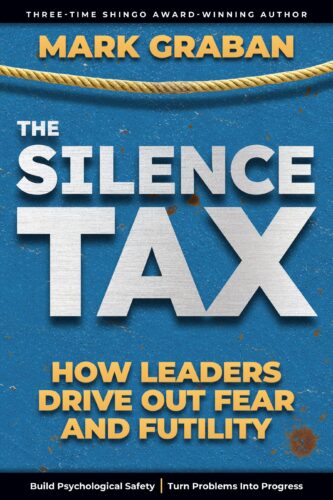
My new book, The Silence Tax: How Leaders Drive Out Fear and Futility, is about why people stay quiet at work and what leaders can do about both causes. It comes out February 9, 2027. The Kindle edition is available for pre-order now.
Pre-order on KindleGet the free sampleEarly edition on Leanpub
New book coming early 2027: The Silence Tax
Most of the posts I write about fear, futility, and psychological safety come back to one question: what happens after somebody speaks up? When the answer is nothing, people stop. That silence has a cost, and leaders pay it without ever seeing the invoice.
The Silence Tax: How Leaders Drive Out Fear and Futility -- it's a practical guide to what leaders do differently, starting this week.