

How Toyota Turned Around Its Kentucky Plant: Darril Wilburn on Leadership
Former Toyota team member Darril Wilburn, co-author with Hiro Yoshiki of Courage, Humility, Kaizen: The Three Disciplines of Toyota Leadership, tells the inside story of how Toyota's Georgetown, Kentucky plant went from needing to build almost 90% of its capacity just to break even to a much healthier 60%. We talk about the andon cord myth, “healthy paranoia,” why VPs were sent back to redo their A3s, and why the goal was never to do TPS for its own sake.
Scroll down for how to subscribe, transcript, and more
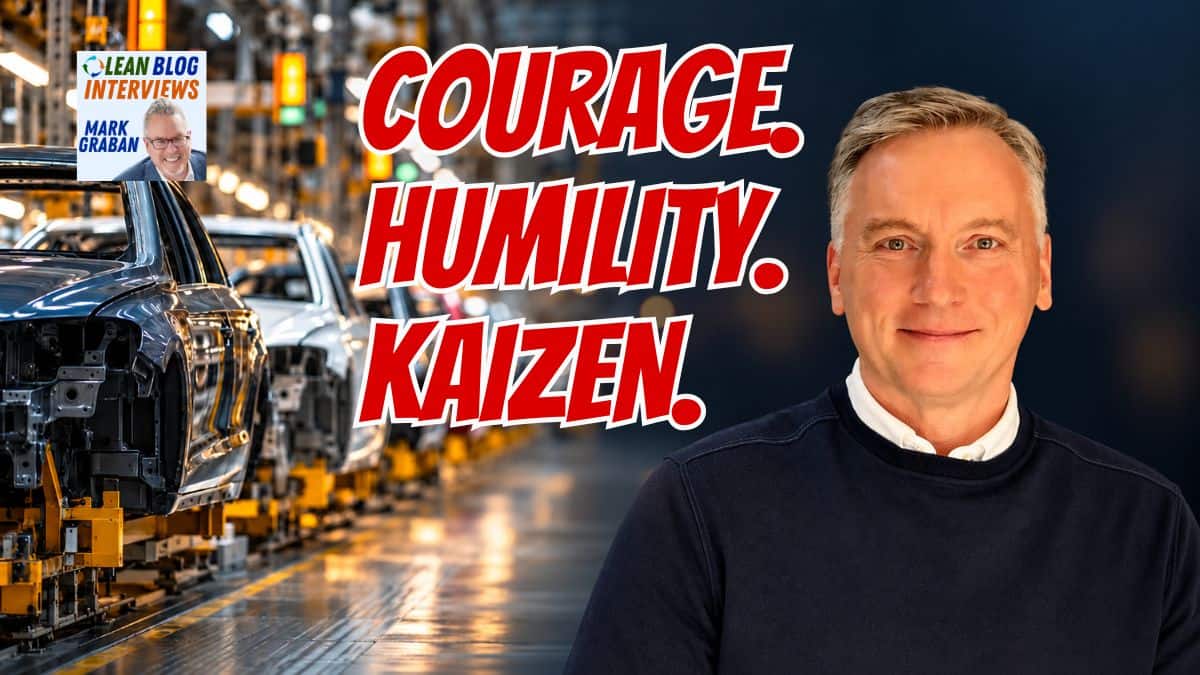
My guest for Episode #551 of the Lean Blog Interviews Podcast is Darril Wilburn, a senior partner at Honsha.ORG, a founding partner at niwaki, and a former Toyota team member. Darril joined Toyota Motor Manufacturing Kentucky (TMMK) in Georgetown in 1999 as a management development specialist after a career in teaching. He became the project lead for teaching The Toyota Way 2001 to the plant's president, vice presidents, and department heads. He later led the global pilot of Toyota Business Practices (TBP) and was part of the team that launched Toyota Motor Manufacturing Texas.
Darril is co-author, with former Toyota leader Hiro Yoshiki, of the new book Courage, Humility, Kaizen: The Three Disciplines of Toyota Leadership. Hiro was a major force behind The Toyota Way 2001, and Fujio Cho sent him back to Kentucky to help lead a turnaround of the plant. The book grew out of 24 interviews over about a year and a half. Chapter nine is written in Hiro's voice and tells the story of that turnaround. Darril is also co-editor, with Sammy Obara, of Toyota by Toyota: Reflections from the Inside Leaders on the Techniques That Revolutionized the Industry. His opening chapter in that book, “Courage, Humility, Kaizen,” was the first version of the ideas in the new book. Darril was previously a guest on Lean Whiskey Episode 22, along with Sammy.
In our conversation, Darril explains what really happens when someone pulls the andon cord, and why the training and the escalation system matter more than the myth of one worker stopping the whole factory. He describes how quick growth and a shrinking group of Japanese coordinators led TMMK into trouble. He also explains how Hiro's approach worked: healthy paranoia, straight talk instead of spin, no blame, and sending managers back through jishuken to relearn TPS. We also talk about Nate Furuta, author of Welcome Problems, Find Success: Creating Toyota Cultures Around the World, and how he pushed busy executives to treat problem solving as their real job.
We also discuss how Toyota turned its masters' know-how into teachable curriculum like Toyota Business Practices and FMDS, “raising the floor so experts can raise the ceiling.” Darril talks about balancing formal and informal communication, and why every vice president's first A3 was sent back by design. He closes with why Toyota is, in the end, a business that has to stay healthy in order to serve society, and why counting kaizens means little when the company is losing money.
What you'll learn
- What the andon cord system actually does, and the tiered escalation behind it
- Why psychological safety at Toyota includes being challenged, not just speaking up
- How “healthy paranoia” and hoshin kanri keep an organization from getting complacent
- Why Toyota avoided talking about being “number one”
- How rapid expansion and a shrinking group of Japanese coordinators led TMMK into trouble
- How the plant's break-even point dropped from nearly 90% to 60% in about six years
- Why Hiro Yoshiki rejected blame and focused on equipping people to succeed
- How Toyota pulled know-how out of its masters into curriculum like TBP, FMDS, and the Global Production Center
- Why experienced managers were sent back through jishuken, and what that took in humility
- Why every VP's first A3 presentation was sent back, by design
- The balance between formal and informal communication, and the risk of skipping levels
- Why “doing TPS was never the point,” and why a company that's losing money shouldn't be counting kaizens
Topics and questions
- How and when did you meet your co-author, Hiro Yoshiki?
- How did a thumbs-up emoji turn into a co-authored book?
- What really happens when someone pulls the andon cord?
- How do you build psychological safety with new hires before the line even starts?
- Does psychological safety mean you're free to challenge, but might get challenged back?
- What is “healthy paranoia,” and how did Hiro create it?
- Why didn't Toyota talk about being number one?
- What led to the need for a turnaround at Georgetown?
- Why did expertise have to be “dragged out” of Toyota's masters?
- Is the goal to create more Taiichi Ohnos, or to help everyone get better?
- What did Hiro do to break the cycle of rescue teams from Japan?
- What was driving the “spin” in plant communications?
- Why do Hiro and other Toyota leaders resist hero worship?
- How should leaders balance formal and informal communication?
- Can you help someone become more humble without manufacturing humbling moments?
- If doing TPS was never the point, what is the point?
This podcast is part of the #LeanCommunicators network.


Watch the Episode:
Thanks for listening or watching!
This podcast is part of the Lean Communicators network — check it out!

Introducing Darril Wilburn and Courage, Humility, Kaizen
Mark Graban: Hi, welcome to Lean Blog Interviews. I'm your host, Mark Graban. Our guest today is Darril Wilburn. He is a senior partner at Honsha.ORG, a founding partner at niwaki, and a former Toyota team member. Darril joined Toyota's Kentucky plant in Georgetown back in 1999 as a management development specialist, coming from a background in teaching, and he became the project lead for teaching The Toyota Way 2001 to the plant's president, vice presidents, and department heads.
He is the co-author — and this is going to be a big part of our focus here today — with former Toyota leader Hiro Yoshiki, of the new book titled Courage, Humility, Kaizen: The Three Disciplines of Toyota Leadership. So Darril, welcome to the podcast. How are you?
Darril Wilburn: It's great to be here, Mark. Thank you so much for inviting me, and it's good to see you again.
Mark Graban: It's good to see you, and I'm excited to help share some of the things from the book with the audience. I have a Kindle version, so that's not real fun to hold up on screen. But — there we go. For those watching on YouTube, Darril is holding up the book. Thank you, Darril. Good job. You've always got to have the book handy.
Darril Wilburn: Always handy.
Mark Graban: And ready to show on camera. So again, the title of the book, Courage, Humility, Kaizen — those three words jump out at me, because I'm a big fan of a book that you and others authored, the Toyota by Toyota book.
Darril Wilburn: Yeah. That was the first chapter, when the concept was first starting. Yes.
Mark Graban: Yeah. We're going to get into that, and we're going to talk about some of the interesting aspects of the history, the highs and the lows there at Georgetown.
How Darril Met Hiro Yoshiki
Mark Graban: But first off, I'd love to hear the origin story of the book. How and when did you meet your co-author?
Darril Wilburn: I met Hiro in 2001. It seems like yesterday in some ways and forever ago in other ways. In the book, we talk about the story of Hiro coming back to the Kentucky plant and why he came back.
Mr. Cho, who was the global president at that time, asked him indirectly twice, and then the third ask was not a request. It was more of a, “You need to go back to Kentucky.” And he had a special project for him to do as part of a transformation of that plant, believe it or not.
Mark Graban: And we'll come back to that later. Some of that story arc — we'll call that a teaser.
Darril Wilburn: Yeah. It's an interesting part of that story. But Hiro and I met when we were doing one part of that effort, which was The Toyota Way 2001. That was Toyota's internal effort to understand who they were and capture what they call the DNA of Toyota, and Hiro was actually a big part of putting that together over the course of 10 years.
One of my other teachers inside Toyota, Nate Furuta, said that Hiro wrote The Toyota Way. Hiro doesn't take that kind of credit. He says he was a champion of it. And so we met when we were getting ready to put the program together to teach the executives, the senior leaders at the Kentucky plant.
I got a chance to work very closely with Hiro over the course of a few months, and I was really enamored by his thinking way, the way he saw the world, the way he could explain it, and the purpose for us being there. Then we lost contact for several years. I recontacted him when he left Toyota. It's very common for Toyota senior leaders, when they leave — in Japan, at least — to take a position with another company.
Toyota assigned him, in his retirement, to eventually become president of Futaba. I saw that on Facebook, I think, and sent a message: “Hey, congratulations.” I mentioned that I come to Japan two or three times a year and bring people. “It would be great if you could have dinner with us and do Q&A.”
And he started doing that every time he could, which was amazing. I always felt so much gratitude when he was able to make it and do a dinner and a casual Q&A. When he retired from that job, we had dinner again, and I approached him about writing the book. It was something I'd had in mind for years, but I wanted to learn more and more about The Toyota Way 2001 document.
I thought we were going to have maybe three or four conversations about it, just to get a little deeper and give a better basis for the book. That turned into 24 interviews over the course of about a year and a half.
Mark Graban: Oh, wow.
Darril Wilburn: At that point, it was a tremendous amount of information. A little overwhelming. Over the course of that time, I was talking to Hiro about, “We'll co-author this. It'll be mostly in my voice, with a lot of your experiences.” And then eventually we made chapter nine be in his voice, when he's talking about the turnaround of the Kentucky plant.
A Thumbs-Up Emoji Starts a Book
Darril Wilburn: So that was our origin story from many years ago. I've got screenshots of me asking him on Facebook Messenger, “Hey, I'd really like to write this book. Are you interested?” And he sent back a thumbs-up emoji. And I'm like, “I need something more than that.” So I sent a longer message, giving some more explanation, and said, “Are you really interested?” He said, “Yes, I'm interested.” And that was the beginning.
Mark Graban: You're not sure if that thumbs-up means, “Go for it, Darril,” or “Thumbs up, I'm with you to do it.”
Darril Wilburn: I need a little bit more, you know? An emoji does not necessarily speak a thousand words.
The Andon Cord Myth
Mark Graban: We're going to come back and talk more about some of the experiences that you both had there in Georgetown. I want to step back a little bit, though, and talk about some of the key TPS or Toyota Way concepts. Maybe you can help us frame them in terms of courage, humility, and kaizen. I would assume most everybody listening knows about the andon cord system.
Darril Wilburn: Right.
Mark Graban: There are misperceptions, and there's a common one on LinkedIn. I want to get your reaction and have you help us unpack it. There's a meme that goes around that says, “Any single worker can immediately stop the entire factory.” Sometimes I comment, “Not to be too pedantic, but that's not exactly…” Help us unpack what really happens, and what doesn't, when somebody pulls an andon cord or pushes an andon button.
Darril Wilburn: That's part of a lot of mythology, I think, Mark. I don't necessarily have the energy anymore to combat every one of those stories that I see coming up, because it's so pervasive.
Mark Graban: Yeah.
Darril Wilburn: But that's one of the myths: this incredible power of the team member to shut down everything. It doesn't happen like that. There are a couple of insights around that. One is the incredible amount of training that goes into that decision to pull an andon cord.
That's not just with the team members. It's with the team leader, the group leader, the assistant manager, and the manager, all the way up the line, because they're trying, of course, to guarantee good quality.
And they have to know what that looks like. There has to be a clear standard of what we're looking for. If my gut says to do it, that's not a good enough reason. It has to be a standard — we're out of standard. So there's really deep training around that. And then there are the systems that are built up over time. The andon cord is one of those things, but there's a whole escalation and support network around that andon cord. Those are other elements that go into it.
How Andon Escalation Actually Works
Darril Wilburn: There are different parts of the plant, but the most famous is the moving line conveyor. When you go on a tour, you'll generally see the moving line conveyor in assembly. It's set up in zones, or pitches, and there are several pitches throughout the line. Then it'll bend and go somewhere else and bend back around. You have your teams placed within those pitches. When the team member notices some material or method issue, a person issue, something going on, they'll tickle the cord.
Mark Graban: Hmm.
Darril Wilburn: And it sends a signal. Generally, it's a light and a sound. That's the famous songs we hear when you go into a Toyota plant — all these andons going off. What that does is signal the team leader, who should be able to respond within seconds to understand the problem.
The team leader will try to contain that problem within a pitch. If they can't contain the problem within the pitch, then they'll hit the andon cord again, which sends a signal to escalate to the group leader. Then the group leader and team leader decide if they can contain it within however many pitches are within that team, and the team leader may go with that vehicle down the line. If they can't contain it within a certain space, they'll hit it again, and then you'll see one section stop. And there's always a buffer between sections, so you're not going to impact the next section unless it goes a certain amount.
But eventually, just like a traffic jam, it could shut down larger sections, and it could eventually shut down the whole plant.
It's not the screeching halt that some people may have in their mind, which I know you try to combat every chance you get, on LinkedIn or even in conversation. It's one of those things where people don't really grasp the complexity. They just think, “Oh, the power the team member has.”
Signaling for Help — and Knowing Help Will Come
Mark Graban: So it's fair to say every team member can signal for help.
Darril Wilburn: Yes.
Mark Graban: Signaling for help, when the help comes, may avoid a line stoppage. And I think people might understate, as you put it, the training that goes into this. It's a system of how and when to signal, and how and when to respond, that's pretty standardized and consistent, right? You shouldn't be pulling the cord and wondering if you're going to get help. You should know.
Darril Wilburn: Right. If you don't get that, people will stop doing it, of course, and they'll take other measures that we might see in other companies.
Mark Graban: It seems like it's the training and the expectation setting. I was recently reading — this might have been in Nate Furuta's book — about Mr. Cho reminding people every day about pulling the andon cord. When that kind of encouragement is there, it shouldn't require courage, maybe other than your first time, if you're new and you don't know yet. Do you remember new team members and any of the dynamics they had to go through?
Building Psychological Safety Before Line-Off
Darril Wilburn: Being part of the startup in Texas, I had a chance to spend time with a lot of the pre-production new hires. They couldn't see it. There was nothing to see for the first year for many of them.
We were hiring people well in advance of line-off, and we were trying to explain to them — and I think the popular term now is psychological safety — that we really want you to do this. If you see an issue, you're going to be well-trained. We need you to surface problems.
Many people have been raised, not only at home but also in their first workplaces, to believe that problems are not good things, so they suppress them. We try to tell them, and then show them. Of course, it has to be demonstrated. It's this hard scripting to overcome.
It has to be consistent, and that's what Mr. Cho faced at the beginning of Toyota in Kentucky: this reluctance. He was just very consistent and on the key message: “Thank you so much for pulling the andon and letting us know that we have a problem right here. And we can fix it.”
Mark Graban: Were the San Antonio people taken to Georgetown, or were people taken to Japan to see this all in practice?
Darril Wilburn: The early people spent time in Indiana, primarily, because that was the mother plant — or the auntie plant — because they were making a truck, just like the plant in Indiana was. They also went to Kentucky, and several of them went to Japan as well, to understand and learn that process and the mentality behind it.
Respect for Humanity Includes Challenge
Mark Graban: You brought up the phrase psychological safety, which has become more popular and is sometimes misunderstood. Psychological safety means we feel safe to speak up. And I think there are elements people sometimes misunderstand. Respect for people gets read as, “Oh, you're easy on everybody.” That's where the word challenge comes in. To me, psychological safety means you're free to challenge, but you might get challenged back. Is that fair to say?
Darril Wilburn: Sure. I think there's a little bit of a misquoting of respect for people in The Toyota Way 2001. In Japanese, it's more respect for humanity. We respect the humanity of people, and then it comes into the practices of what respect for people looks like. Many times, that's being challenging and also being challenged back.
In a respectful way, of course. With decorum. When I was doing one of my first problem-solving A3s, I got 26 levels of feedback on that A3. I would have liked a little less respect. Maybe half as much.
Mark Graban: They were developing you, right?
Darril Wilburn: Absolutely. That was part of it. And I did understand that at a certain level then — that if my boss didn't care, they would not give me any feedback, and we would just move on. So psychological safety means that I still feel respected when I get challenged.
And it's all for a greater purpose. There's this idea that, mutually between the people and the company, we want to be around for a long time. We want to be secure in our jobs.
That means we have to constantly get better and better. If we don't, we'll be exposed to the marketplace, and we may not survive. Toyota people genuinely believe that. I'm not sure how many of the Western people genuinely believe it, but the Japanese, especially the leaders, genuinely believe that if they don't continually improve, they will go bankrupt.
Even though there's a lot of money in the Toyota bank, right? They genuinely believe they must continue to get better, and that means individuals getting better, teams getting better, groups getting better, all the way up the line.
Healthy Paranoia
Mark Graban: I'm trying to remember back. I was reading part of chapter nine, on the turnaround. Did your co-author use the word paranoia? There was some modifier around that word.
Darril Wilburn: Yes. One of Hiro's favorite phrases is “healthy paranoia.”
One of the ways we create healthy paranoia is with the hoshin process. Hoshin, and then hoshin kanri, inside Toyota is meant to create stress and gaps in the organization.
That's one of his favorite terms. One of the ways it manifested itself when I was in Kentucky: every year, the bonuses and the pay raise would be announced. Especially after Hiro returned, that announcement would have two levels.
One would be, “Thank you so much for all you did. Here's the average pay raise for the year. Here's how we did.” Maybe one paragraph. The next five paragraphs were telling us just how close we were to going out of business.
Mark Graban: Hmm.
Darril Wilburn: This is Toyota, of course. But it was: if we don't continue to improve — healthcare costs went up this much, so that means this much per car. Just to stay even, we have to do this. If we don't, Honda and Ford and GM and Nissan are all coming after us. It was four or five paragraphs of, “Ah.”
It kind of scares you. But that was the purpose. He was trying to help us feel the same thing he felt. Don't get content because we did well this year. Always have that drive and that paranoia that things could get worse.
Mark Graban: You're making me think of a very different experience at General Motors, when I was there in 1995 and 1996. GM was clearly shrinking at that point.
I think there was still a lot of denial, if not entitlement, where even executives would say, “Our market share's never going to fall below 30%.” Then it did. And then it was, “Okay, 28% is the floor. It's never going to fall below that.”
It's probably half that now, with even more competitors compared to the '90s. You didn't really have the Korean automakers, in particular. So when you're on top, there's always that risk that you don't stay there.
Why Toyota Didn't Talk About Being Number One
Darril Wilburn: And I never heard us talk about being number one in Toyota.
Team members sometimes would say, “Oh, we're number one.” Number one in sales, for example, was a ranking, of course. That sometimes would make people feel like we're number one. Hiro's response to that, when he came back to do the transformation, was, “What does that even mean?”
You can increase sales fairly easily if you just drop the price temporarily. You're going to have a lot more sales. So what does it mean to be number one? So we just took that out of our language.
It was all about how we improve. At a corporate level, it was about return on capital, those kinds of profit levels.
At that time — I'm not sure of the current numbers — they had multiples of the profit of every other automaker. So does that make us number one? I don't know. We were selling fewer cars than General Motors at that time. They were number one in global sales.
But we were way number one in global profit, and nobody really talked about that. There was none of that arrogance of “We're number one, we're number one.” That was trying to keep us humble, in a sense.
Mark Graban: There were many decades of having that underdog, upstart mentality. I think it had been a very long time since any of that was the situation at GM.
Toyota's Careful Entry into the U.S.
Mark Graban: Let's talk about the life cycle as you experienced it with TMMK there in Georgetown. At a high level: the years of launch, and then the first cycles of ups and downs that led to the need for a turnaround. From the outside, we think, “Oh, kaizen — always up and to the right in terms of performance and getting better every day.” But life's complicated, right?
Darril Wilburn: It really is, and there was a lot of learning that went on at TMMK for Toyota globally, even.
In the book, we talk about the whole beginning of Toyota coming to the U.S., and just how meticulous they were in their planning. They deeply understood that, like any transplant you get in your body, there's a chance it gets rejected. So as a transplant company coming in, they were trying to inoculate themselves the best they could from being rejected.
They were the last major Japanese automaker to build a plant in the U.S., because of this healthy paranoia, in a sense — this really meticulous planning process they went through. So much so that they even did the joint venture at NUMMI with GM, to learn.
They knew they wouldn't be able to fully implement the entire Toyota Way at NUMMI because it was a joint venture, but they wanted to see: could the production system flourish in that kind of environment? And of course, they proved that out, after a lot of negotiation.
Then they decided they were ready to do the Kentucky plant and Canada at about the same time, because of those deep learnings. But it took them a while to get there. And it was so high profile. You're going to be making the Camry in Georgetown, a very popular car in the U.S. as an import.
The quality level is high. People really like that car, and you're going to be making the same car they're making in Japan. If you don't have near exactly the same quality that the car from Japan does, people are going to look at the VIN and say, “Oh, I don't want a Georgetown-made car. I want the one from Japan.”
Rapid Expansion and a 90% Break-Even Point
Darril Wilburn: So of course they're putting extra effort into making sure the quality is really high. That means an army of Japanese coordinators and trainers coming and staying for years to get the plant stable and moving. But that's not sustainable, just from a physical standpoint of that many people, and they want to go back home eventually.
And as you get second, third, and fourth generations of coordinators coming, you're not going to have the same skill level. There's just not enough to draw from.
So that part started to wane. The number of those people coming to help jointly run the plant started to go down, and more and more Western people were running the plant.
You start to get the memory of the way they may have been taught to manage and lead before, on top of this rapid expansion — going from the volume in Plant 1 to building Plant 2, and trying some things in Plant 2 that they weren't ready for.
Mark Graban: And that was not a replacement. That's expansion, right?
Darril Wilburn: Right. Expansion. A new building next to the old one that doubled your production. They also asked, “How can we reduce lineside inventory?” And they weren't ready. So what happened was a lot of over-hiring and some quality issues.
One of the numbers Toyota really cares about is the break-even point. How much of the volume that we can make do we have to make to keep the lights on?
Over the course of those years, when they were struggling with the growth, that number went to almost 90%. So they would have to make 90% of the 500,000 vehicles they could make just to keep the lights on.
The Turnaround: From 90% to 60%
Darril Wilburn: That's when Mr. Cho, who was global president at that time, said, “We need to refocus.” Hiro came back, and Gary Convis was hired in as president of the Kentucky plant.
There were a few other folks who came over to support the turnaround, Nate Furuta being another one. And that's the thing people don't realize. This is the same plant that was the number one tourist destination in the state of Kentucky. People couldn't wait to get there to see it. And it was struggling, but a lot of team members didn't even know what the struggle was.
To make a long story short, over the course of the next six years, that break-even point went down to 60%, which is much healthier — much more buffer that you can absorb if something happens in the economy or some other issue. So that's a long-winded answer to your question.
Mark Graban: No, it's a good answer, and there's more to unpack. The book talks about quality problems, people missing time due to injuries, and morale problems.
“We Didn't Equip People to Succeed”: No Blame
Mark Graban: I think back to the time I went on one of those public tours in Georgetown, two or three years ago. Wouldn't you know, there was a retiree in the tour group with us. He had brought two generations of his family, including some grandkids. We were chatting afterwards with the tour guide, and then we got to talk with him a little bit even without the guide.
He was a fairly early team member in Georgetown, and his high-level arc was, “Things were great, and then they let the Americans run things, and it wasn't as good anymore.” There's that blame language. But one thing that stands out in what Hiro wrote is the lack of blame language. He said blaming is not helpful — that we didn't equip people to succeed, I'm paraphrasing, instead of blaming them for not succeeding. That really stands out.
Darril Wilburn: He's very adamant about not blaming anybody. There's enough responsibility for what happened to go around, is one way to put it.
Pulling Wisdom Out of the Masters
Darril Wilburn: One of the other key parts of the book, and a key part of my career at Toyota, is the switch that happened because of what you could call a failure. If you want to be provocative, you could say Toyota failed at this transplant thing because of the army of people it took to keep it afloat.
So one of the key learnings they took away from that — and this started to change in the early '90s, all the way through to now, but especially from the mid-'90s to the mid-2000s — was that a lot of wisdom was dragged out of people. Sometimes dragged out of them kicking and screaming.
We needed to understand why certain people were masters at what they did and turn that into curriculum. That's when you really start to see the TQM thinking that Nemoto brought to Toyota and the TPS thinking start to work together. One of the parts of TQM is making knowledge transferable, and creating curriculum from the wisdom, instead of it just living in somebody's head or their gut. How do we pull that out? One of the first programs was practical problem solving, which was pulled out of these masters.
That led to Toyota Business Practices, which, later on, I had a chance to do the global pilot for, and to do the North American vice president sessions. An amazing opportunity. But that was pulled out of these masters.
Raise the Floor So Experts Can Raise the Ceiling
Darril Wilburn: The Floor Management Development System, or FMDS, is also one of those efforts to pull out this wisdom and put it into curriculum. The idea is that you can raise the floor by taking a lot of the wisdom and putting it into curriculum so you can teach it. That allows the masters — the very experienced TPS people — to raise the ceiling, because now they can focus on things that are not the basics. That's why we have TBP, Toyota Business Practices.
That's why The Toyota Way 2001 is also pulling the wisdom out and getting it into these statements. FMDS, all those programs, and the Global Production Center is a part of that. The genius idea there was to create fundamental skills for each area of making a car.
These were global standards that we could teach. Then, when we released that person onto the line, so to speak, they had already mastered the fundamentals.
Mark Graban: Yeah.
Darril Wilburn: Now they can start working at pace and takt time and learning the process. We saw this curve of how quickly people could become fully functioning team members on the line, as one example of bringing a lot of this wizardry into curriculum.
That was a big part of the learning, and it has served them well over the years, now that they've got the basics covered.
Why Expertise Had to Be Dragged Out
Mark Graban: To go back a little bit: in your story, what was your sense of why some of that knowledge and expertise had to be pulled or dragged out of people?
Darril Wilburn: It's as old as time. People feel like the only way to learn what I'm doing is to spend 25 years at my hip.
There's a certain amount of pride in that for the teacher, the mentor, or the sensei, to have that craftsman approach.
When your company is only in Japan, when all the plants are located basically in one region, when you're spending breakfast, lunch, and dinner with people, when many of them in the early days were living in the same apartments and dormitories, that's possible. You can do that. But you can't scale that globally. That's impossible.
That was part of the learning. And who doesn't like to be the master of something? To be the person everybody goes to? There's an interesting line in the book. Hayashi was one of those masters Hiro was trying to help pull knowledge out of, and he said — I'll paraphrase — “Hiro, any problem you have, just let me know. I'll tell you what to do. I'll solve it for you.”
And Hiro said, “There's only one of you. We have 50 locations around the world now. I can't depend on you. Even if we had 100 of you, it wouldn't be enough.” So in Japan, one of the HRD people actually met with him on Saturdays and did interviews and walked through his thinking way, trying to understand the essence of what was going on in his head and in his gut that made him so effective.
Now, did anybody go to a workshop or a class, apply it on the line, and become Hayashi? No. Become Ohno? No. But they've taken care of a big chunk of the basics. Now they can accelerate the time it takes to become better and better.
Mark Graban: That's an interesting dynamic when you talk about pride in one's experience and knowledge. At a lot of companies, what we'd hear is that you have to drag information out of people because that information is job security. Probably not an issue at Toyota.
Darril Wilburn: No.
Mark Graban: But there's that sense of, “I've spent 30 years and accumulated a lot of gray hairs along the way, and you want me to shortcut that for somebody else?”
Darril Wilburn: Right.
Mark Graban: They might say, “That's not possible,” or “That's not fair to me.” But to your point, is the goal to create a bunch of Taiichi Ohnos, or to help people be better than they were before?
Darril Wilburn: Getting 50,000 or 60,000 people to be better is probably going to get you farther down the line than having four more Ohnos. And again, if you're just in Japan, you can do it, but it doesn't scale.
Breaking the Cycle of Rescue Teams
Mark Graban: I think one illustration of that is where Hiro wrote about Toyota Motor Corporation sending in an army of 200 people to fix things. Quality would get better, then they would go back home and things would erode. Then another cycle of sending a group in. I forget how many cycles it was. What did Hiro do to help break the cycle? It sounded like it was a larger-scale “We're coming in, fixing it for you, and going home.”
Darril Wilburn: There are lots of points in his approach, so we may have time for a couple of them. One goes to something I've seen over my career, and we all fight it to some extent: the humility part that has to be there.
He noticed that a lot of the leaders in Kentucky, and North America in general — though he was primarily focused on the Kentucky plant — could talk a good game around TPS. They knew the words and they knew the basics, but when it came to actually managing with it when things are tough — and generally things are always tough in a well-designed TPS system — they didn't know what to do.
Jishuken and the Humility to Relearn
Darril Wilburn: So one of the things he insisted on — which is kind of ironic, because jishuken is a voluntary improvement activity — was that these leaders go through that training again.
Maybe they'd never done it before. Maybe they'd just learned hip to hip and never had that intensive. In this case, they would go away to a supplier, because it's really difficult to do it in a gigantic place like TMMK. It's also about the pride side of it.
If you're a manager and you've got 150 people reporting to you, it takes a big dose of humility to say, “I'm going to go learn this like a first grader.”
Mark Graban: Yeah.
Darril Wilburn: So we would send them away to a supplier to go through this jishuken activity, to learn again and to confirm that they know how to work TPS.
A lot of them were very reluctant. They were a little bit ashamed. “Why am I being singled out?” No, it's not just you. It's a lot of people who need to do this.
But most everybody, when they came back, was very appreciative. Now they felt more confident that they understood. Hiro could see that, and he wouldn't take no for an answer.
So that was part of their training. If you take 100 managers who have been struggling and you revitalize their learning around TPS, they're going to come back better.
That was one of the big things that helped drive a change back at the plant, bring more stability, and be able to maintain it long term.
Straight Talk Instead of Spin
Darril Wilburn: There was also a lot of refocusing on hoshin kanri. And communications — believe it or not, not a TPS department. Hiro removed communications, internal and external, from the HR side and made a communications department, so there was an easier way for him and others to communicate directly to team members, and better messaging outside the plant as well.
You talked about morale earlier. When you see in the newspaper that Ford over in Louisville is getting a big raise, or General Motors in Bowling Green, and you also see Toyota's global consolidated profit hitting a new record, that can be taken the wrong way by a team member working in a plant that's struggling.
So we wanted to be able to communicate more directly, with less of what you might call spin. They always felt like the message was being spun to them. Hiro was a very straight talker, so he went on the Toyota news program once a week for many weeks, talking straight to the team members: “Here's the real situation we're in.”
There were probably 10 different channels of activity going on, and those are a couple of things he really focused on to turn the place around.
Mark Graban: What do you think was one of the drivers of that spin? Was it, on some level, fear of some sort of punishment? Or was it more of that pride factor — we don't want to admit there are problems because we feel bad about it?
Darril Wilburn: That's part of it. Even this many years later, I'm still reluctant to say everything. But we were a non-union plant, and the philosophy was, we're not anti-union.
If the team members want that, there are mechanisms to vote it in. You can do it.
But there was a department within the Kentucky plant that felt it was their job to keep the union out. And if team members are upset, they're more likely to want a union.
So I think they felt like that spin was part of their way to keep things the way they were and not fall into that. And Hiro told this department, “Look, we can work with the union if we have to. We would rather work directly with team members, but that can't be our business. That is not our primary business objective. We have to do these other things.”
That's why he was putting the real information in front of people and talking directly to them, so they wouldn't get spin from outside, from people trying to convince them, and also from inside, from people not wanting them to be upset.
Mark Graban: My mind goes to people wanting to spin upward, but this was wanting to give positive spin downward, if you will, to the team members.
Darril Wilburn: Right. What they felt they were doing was maintaining morale. They wanted people to be happy and see the good things. And that definitely is not the Japanese way to do things. That was the American management thinking way.
Hiro, Not Heroes
Mark Graban: Thinking about those cycles of people coming in from Japan to fix things, there's an irony, a play on words here. Hiro's name, H-I-R-O, to our ears in English might sound like “hero” with an E. It's funny that someone named Hiro was trying to eliminate the need for outside heroes, developing people to be more self-sufficient.
Darril Wilburn: That's another one of Hiro's — H-I-R-O — mantras. He gets frustrated, especially in the outside world, when people focus on individuals. Sometimes we focus on Taiichi Ohno as the central person within Toyota. Externally, he's very famous, of course. Internally, he's one of many people who helped build a great company.
Hiro and other people in Toyota would look at a lot of the hero worship — H-E-R-O — of some individual people, and they'd think that's not the Toyota way. It's a whole management system that makes this successful. Even inside Toyota, there were some leaders… There are a couple of stories in the book about one senior leader, for example. There was a fire in a paint booth, and he was running in there with the fire extinguisher. So the metaphors stack up in this kind of situation.
Mark Graban: Literally firefighting.
Darril Wilburn: Yes. And Hiro said, “You can't do that. You're not a professional. We have professional people trained to do that. We have a process. And if something happens to you, what's the impact on the 5,000 people here?”
That inclination to be the cowboy and the hero — H-E-R-O — is part of the problem we face a lot of times. We don't want the singular effort of one person to overshadow the work of the system.
Formal and Informal Communication
Mark Graban: When it comes to systems, one interesting detail was a habit Hiro described, where Kentucky leadership would be directive. They would bypass their direct report and go straight to the line. He was trying to build structures to help address that. That's not a perfectly well-formed question, but in recent years I've heard a phrase for the first time: “Don't skip a hat,” meaning work down through the chain one level at a time.
Darril Wilburn: Toyota works formally and informally. There's a very strict formal communication process.
And there's also an informal process that was built over years. Again, if you go back to the origin of Toyota in Japan, they're living together, working together, having breakfast, lunch, and dinner together, having weekend parties together. They are together. So there's a lot of informal stuff happening.
And as you know, you've been to Japan a few times, there's a lot of informal communication that happens after work, after a beer or two. That's part of the informal communication network. We would never discount that as being important.
But when you bypass the formal part and just rely on the informal, things break down very quickly. So it's kind of a paradox. They both happen at the same time, and it's a work of harmony to keep them from clashing too much.
What was happening is that people in Kentucky were focused on the informal part, and they felt like, “I'm going and seeing. I'm going to the line. I'm going to talk to the group leader. I'm the president, but I want to go down and find out what's really happening.” There was some frustration with that, and one of the VPs was so frustrated: “Why am I here? You obviously don't need me.”
Once this leader realized that, he said, “Oh, of course. Yes, I do need you. I'm sorry about that.” Then he started to realize the balance he had to strike between those formal and informal systems — between the courage and the humility parts, in a sense.
That happened a lot, where people would get their feelings hurt by the bypassing. And people would take advantage of it sometimes. Mr. Cho, for example, always wanted to be open, with an open-door policy, and listen to everybody. Some people would try to take advantage. They would go talk to Mr. Cho, and Mr. Cho would listen.
He might say, “Hai. Hai,” which means yes, but it's not like yes. It's, “I hear you.”
Mark Graban: I hear you.
Darril Wilburn: And then they would go back to their boss and say, “Mr. Cho approved it.”
Mark Graban: Whoops.
Darril Wilburn: So yeah, all those kinds of dynamics.
Can You Help Someone Become More Humble?
Mark Graban: Let's talk about humility a little bit more. A leader being willing to say, in a situation, “I don't know the answer” — not out of false humility, but just admitting, “I don't know the answer, let's figure it out together” — might be one positive way of expressing humility. We also talk about humbling experiences. You thought you were going to do something successfully, whether that was playing sports back in the day or even in the workplace. You expected to win, and you lost.
If you reflect on it, you might say, “Well, that was humbling.”
I guess what I'm trying to ask is: if somebody's not humble, can we help them be more humble without manufacturing humbling moments? How might any organization try to help people, quote unquote, “lead with humility”? You probably can't put them through humility training, right?
Darril Wilburn: Right. And I was number one in my class in humility training.
Mark Graban: I've got the certificate to prove it.
Darril Wilburn: Right. There are several examples. Of course, I feel pretty deeply about the balance between courage and humility, which is part of the whole model.
Every VP Sent Back on the First A3
Darril Wilburn: But a couple of high-level things. During TBP, the Toyota Business Practices program, I had the honor of being able to design and co-facilitate the global pilot, and also, with Nate, to co-facilitate the vice president sessions. After the vice presidents got retrained in the business practices — the problem-solving methodology — they would have to pick up a problem, work through it at their level, and complete an A3.
I had a chance to do some coaching along the way with some of them, and I noticed pretty quickly that they would already have a solution in mind.
These are general managers. We're not talking about everyday specialists. They know they shouldn't, but because they feel like they're so busy and have to go fast, they have a solution. Or they may even pick up a problem they've already halfway worked through and try to present that.
At my level, I wasn't able to be that forceful, other than to say, “Why are you wasting your time? If you already know what you want to do, just do that, and then figure out if it's right or not.” That's not the PDCA method, but if you're already going to do it, then don't waste your time. Do something else with this.
So they would go through this process and create their A3, and every one of the VPs had to go back and present it at the North American headquarters to a panel led by the president of North America and the senior vice presidents. Every one of them was sent back after the first presentation.
No matter how good it was, by design, they said, “Nope, these five things need to be reevaluated. Go back and try again. We'll reschedule your panel.” The purpose, as you might imagine, was to create some humility in them — that everything can be improved, even this problem you're presenting that you spent time on.
We wanted to prepare them to be in that seat, maybe next year, maybe in two years, when their people are going through this process and presenting back to them, so they could help them get better and better. So that was one of the efforts to give some humility to people who probably had not been practicing it very much in their recent careers.
They had been elevated so quickly in the organization: “What do I have to learn? I already know this stuff.” And this happened more than once: in the training, they would tell Nate, “Nate, I'm too busy for this. I've got…” And Nate would look at them and say, “This is your job. If you're not doing this kind of work — constantly problem-solving yourself, and also training and developing others to do that — what are you doing? And if you won't do this, maybe you're not a Toyota person.”
Mark Graban: Yeah.
Darril Wilburn: He was really forceful. They were kicking and screaming: “I don't have time for this, I've got too much work to do.” What are you doing?
“Doing TPS Was Never the Point”
Mark Graban: There are a lot of great stories in the book. The turnaround we've really dug into is chapter nine. There's a lot to absorb, and I'm looking forward to going back and reading the middle chunks of the book I haven't gotten to yet. Fascinating perspectives. Maybe as a final question, Darril: as it says in the book, pretty much a direct quote, “Doing TPS was never the point.”
So what is? Whether you're working with or advising companies today that might be struggling with the same thing — implementing whatever we call it, a Lean management system, is not the point. What is the point?
Darril Wilburn: There are a couple of points, and again, I like to think about the paradoxes of what we do.
They're not ranked, and neither is greater than the other. On the more uplifting side, we think the purpose is to have an impact on society. Toyota is very aligned to that. We want to do that through individuals, through communities, through nations, through the world.
We want to have that impact. The way we do that is we run a really good business, and that business must make a profit. If it doesn't, none of this is going to happen.
Toyota Is a Business
Darril Wilburn: Companies have to do well financially every day in order to do the other side of it. If it gets out of balance and you're just focused on returning shareholder value, that becomes really toxic for a lot of people.
If it's out of balance the other way, eventually you might feel really good about everything and be standing in the unemployment line because your company couldn't survive. Hiro told me this many years ago, and it helped me when we were going through The Toyota Way process.
We were talking about laying people off. All the other companies lay people off; Toyota would never do that. And he said, “Yes, they would.” What? No, they would never do that. “Yes, sure they would. We did in the 1950s, during the bankruptcy period.” People left voluntarily, and the president left, as a group, to save the company.
He said, “If it came down to it, we would have to.”
So that was one of many reminders that Toyota is a business. They just happen to be very good at taking care of people and society, as well as making good business decisions.
Stop Counting Kaizens When You're Losing Money
Darril Wilburn: Just today — whenever this airs, it won't be today — I made a post on LinkedIn about kaizen. It's a Hiro quote about counting kaizens.
He's been in companies where they ask, “How many kaizens do we have?” And they're losing money. He says, “Why are we counting kaizens when we're not focused on what's most important right now, which is getting stable? Later, that may become a very important thing. But right now, we've got to make sure the company is healthy.”
Some people don't like to hear that. Some people really like to live in the fantasy land of, “If we just focus on one side of this equation, everything else will take care of itself.”
No, that's hope and prayer. That's not a strategy we use for running a good business.
Closing
Mark Graban: Well, that's a great spot to end on. So again, Darril Wilburn, our guest today, co-author with Hiro Yoshiki of the new book Courage, Humility, Kaizen: The Three Disciplines of Toyota Leadership.
Check out the show notes for links to where you can learn more about the book and buy it, whether it's the Kindle version or a print edition. It is available now. Darril, thanks for coming on here. You were a guest previously when Jamie Flinchbaugh and I were doing our podcast, Lean Whiskey. I'll call this one Lean Coffee. We can have a whiskey-free discussion.
Darril Wilburn: We definitely had the coffee today.
Mark Graban: Today was more of the coffee. Great to have you here on this podcast, and I really appreciate your time, Darril.
Darril Wilburn: Appreciate it, Mark.
Mark Graban: And again, congratulations to you both on the book.
Darril Wilburn: Thank you. See you next time.