
Fear-Based Leadership at Nvidia: Because of It, or in Spite of It?
Jensen Huang reportedly told Nvidia employees they had become too rich to motivate with money. The only lever left, he said, was humiliation. That's about as blunt a description of fear-based leadership as I've read.
It comes from a New York Times investigation published November 20. The reporters interviewed more than a dozen current and former employees and reviewed court records and other documents spanning more than 20 years. According to the Times, three people described the money-and-humiliation comment. The rest of the reporting describes a long pattern of public tongue-lashings, personal insults, and graphic threats, often in front of peers.
Free link to the article: Threats, Insults, Settlements: How Jensen Huang Made Humiliation Routine
Huang had resigned as CEO on November 12, after reports of extramarital relationships, including one with an employee. On November 23, Nvidia's board reinstated him. More on that below.
The story came out while I was editing a conversation with Timothy R. Clark, author of The 4 Stages of Psychological Safety, for an upcoming episode of Lean Blog Interviews. I had asked Tim about Nvidia. Here's the clip:
Bob's Theory at the GM Plant
When I worked at a GM engine plant in the 1990s, our plant's second-in-command, Bob, had a similar theory. “You gotta beat down on 'em,” he told a few of us. He'd yell and scream and belittle people constantly.
Our plant was performing terribly, so nobody could claim the beat-downs were working.
Bob was easy to judge. Nvidia is harder. It's a $5 trillion company, and Huang once said he'd “rather torture you into greatness.”
No Control Group
So did Nvidia succeed because of that style, or in spite of it?
I don't think we can know. There's no control group. There's no other Nvidia where the same founder made the same early bet on AI without the threats.
Outcome bias makes it tempting to credit everything a winner did, including the worst of it. We see the same thing in sports. When the Seahawks threw an interception at the goal line in Super Bowl XLIX, the play call was mocked as one of the dumbest decisions in football history. If the pass had been caught, plenty of the same people would have called it bold. Same decision, different result, different story.
Volkswagen looked like evidence once, too. In 2013, Bob Lutz told me that fear was working at VW. Two years later came Dieselgate.
There's also a survivorship problem. Reporters investigate the abusive founder whose company became worth $5 trillion. Nobody investigates the hundreds of Bobs whose plants just kept performing terribly. If you only study the winners, every habit a winner had starts to look like a strategy.
Steve Jobs gets the same treatment. The Times compares Huang to him, and plenty of people still treat Jobs's screaming as part of the genius. I asked back in 2012 whether Jobs should be held up as a model leader.
The survivorship problem shows up inside Nvidia, too. According to the Times, some longtime senior leaders shared Huang's view that mediocrity had to be stamped out, and people who didn't like the approach could leave. That means the people still there are, to some extent, the ones who could tolerate it. Ask them whether the culture works, and you're asking the survivors.
Huang did make at least one very good call. According to the Times, after Nvidia's chips were used in 2012 to train an early AI system, he pivoted the company from graphics to deep learning, and froze hiring for anyone outside that field. A decade later, ChatGPT arrived and demand for Nvidia's chips took off. Once a bet like that pays off, it's easy to fold everything else a leader did into the success story.
Tim Clark's Answer: In Spite Of
Before I brought up Nvidia, Tim had made a broader point about fear:
“Anytime you encounter a team or an organization where there's pervasive fear, that's symptomatic of a leader that doesn't know how to lead.”
Leaders who manage that way, as he put it, “use fear as a proxy for leadership.” And he added: “We don't need to meet the leader. We don't even need to know who the leader is.”
He also argued that the model is getting harder to sustain:
“As the environment becomes more dynamic, as it becomes more complex, as it becomes hypercompetitive, then that model becomes more antiquated, more obsolete, and we have to move to a model that is collaborative and inclusive, otherwise you can't survive. It's just not competitive.”
So I asked about the obvious counterexample. If fear doesn't work, how is Nvidia one of the most valuable companies in the world?
“It is in spite of, Mark,” Tim said.
“There are times and there are occasions and there are instances in which the nature of the competitive advantage is so deep and durable that it covers a multitude of sins.”
In Nvidia's case, he said, the company is able to generate outsized returns “in spite of unbelievable pathology and dysfunction across leadership and across the organization.”
He was specific about how unusual Nvidia is: “Nvidia is three standard deviations from the mean, actually maybe four or five, as an outlier in terms of the nature of their competitive advantage.” And: “The entire AI economy, most of it runs on their chips.”
The risk, according to Tim, is what that outlier does to everyone else's thinking. It “can deceive us into understanding that, oh, it doesn't matter. No, it does.”
His summary:
“That is the exception that proves the rule… So let's not let that deceive us.”
I find that persuasive. But “in spite of” is also an inference, since nobody has the control group. What I'm more confident about is this: most organizations don't have Nvidia's advantage. They'd get the fear without anything to cover for it.
I said something similar in the moment: management won't believe that to be true. Tim's reply was “Not today.”
Is Fear-Based Leadership a System or a Privilege?
The reporting does answer a couple of other questions.
Did Huang's behavior spread? Six current and former employees told the Times that some managers followed his lead, including his daughter, who works at the company.
Did anyone try to stop it? A former HR executive, Michael Winston, said he raised concerns after an off-site meeting in 2004. According to his notes, as reported by the Times, one top executive told him the conduct was typical but could be a liability. Another advised him to “toughen up.” Winston said he then warned Huang directly, and that Huang defended public humiliation as a “rite of passage” for new employees. Weeks later, Winston was fired. Nvidia later reached a confidential settlement with him for more than $1 million, according to the Times. Huang's spokesman called Winston's allegations fabrications.
Some employees also told the Times that HR didn't take workplace complaints about Huang seriously.
That's the system question. When the person who raises a concern gets fired, and the executives who hear it shrug, everyone else learns what speaking up costs. The lesson doesn't need to be written down.
And was that style open to everyone? I doubt a vice president who managed like that would have lasted long. That looks less like a management system and more like a founder's privilege.
The reporting also complicates the picture in a way I think is worth stating plainly. Many employees love Huang. According to the Times, thousands signed a letter asking for his return, and both his fans and his critics described Nvidia as cultish. Six current and former employees compared their relationship with him to Stockholm syndrome. People can admire a leader and still keep quiet in his meetings. Loyalty and psychological safety aren't the same thing.
The Reinstatement
On November 17, Nvidia's board chair said the board did not intend to reinstate Huang. Six days later, it did.
According to a second Times report, the reversal followed a campaign led by President Trump, who directed Vice President JD Vance to speak with Huang and the board. Administration officials gave the board assurances that Huang did not pose a national security risk. Investors and former employees were also urging the board to bring him back.
Free link to that article: Jensen Huang Returns to Nvidia After President Trump Intervenes
Nvidia's stock jumped more than 31 percent that day. When Huang returned to headquarters, employees lined the balcony, applauded, and chanted his name. He apologized for putting them through all of this, called it a second chance, and said he would be a better CEO the second time around. The board's announcement said it was satisfied with Huang's “candor and ability to lead.”
By the time Tim and I recorded, Huang was already back. Tim questioned the decision: “If it were any kind of regular company, it wouldn't even be on the table as an option.” It was on the table, he said, because of how important Nvidia and Huang are to the industry:
“We temporarily suspend all of our moral values, and we say, ‘We're gonna hold our noses, and… come on back in.'”
I'd say some people aren't even holding their noses. A 31 percent jump in a single day is the market telling you what it thinks about chips and Huang's role in them. It doesn't tell you anything about the culture.
Maybe Huang was uniquely suited to found Nvidia and steer it into AI chips. That doesn't mean nobody else could lead it now.
Boards should also think about what reinstatement tells everyone else. Every manager at Nvidia now knows what the board will tolerate from the person at the top. That probably says more than the code of conduct does.
Huang said he'll be better the second time around. I hope so. The people who'll know first are the ones in the room when someone disagrees with him.
What Never Got Said in Those Meetings
The question I'd most like answered can't be answered: how many problems never got raised?
According to the Times, Huang generally didn't hold one-on-one meetings with subordinates. He has said publicly that one-on-ones reduce transparency. Some top executives saw it as a power play. If you disagreed with him, you had to do it in front of a group, where he could ridicule you in front of everyone.
Tim's book describes four stages of psychological safety, and the last and hardest is challenger safety: feeling safe enough to question the status quo, including the boss. A meeting where disagreement gets you humiliated in front of your peers is close to the opposite.
The costs of fear are hard to see because they're things that didn't happen: the warning nobody gave, the better idea nobody proposed. A stock price can't show you either one.
Here's a question you might be able to answer. Have you seen a leader get away with behavior that would have gotten anyone below them fired?
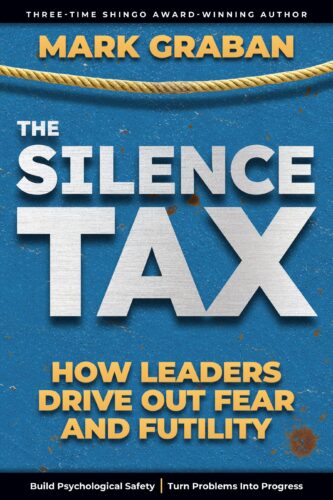
The Silence Tax: read a free sample or pre-order
My new book, The Silence Tax: How Leaders Drive Out Fear and Futility, is about why people stay quiet at work and what leaders can do about both causes. It comes out February 9, 2027. The Kindle edition is available for pre-order now.
"An essential guide for leaders who want to turn employee voice into organizational learning and improvement."
Amy C. Edmondson, Harvard Business School; author of The Fearless Organization
Pre-order on KindleGet the free sampleEarly edition on Leanpub