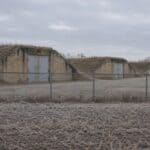


Iowa Army Ammunition Plant: Nobody Gets Promoted for Throwing Away Old Explosives
The big picture: At 9 a.m. Wednesday, the Army plans to detonate about five tons of degraded lead azide at the Iowa Army Ammunition Plant in Middletown, Iowa. Everybody wants to know who messed up.
Why it matters: The Defense Department raised concerns about a deteriorating lead azide stockpile at the plant in a 2004 environmental assessment. A known problem had two decades to get handled before it became an emergency, with neighbors getting a few days' notice.
Yes, but: There may be no single villain here. I don't think that's a reason to be less angry. It's a reason to be angry about the right thing.
What's happening this week
As I write this on Tuesday afternoon, the material sits in 68 barrels. Lead azide is a primary explosive, the kind used to set off other explosives. By weight, it's about 71 percent lead, according to Al Jazeera.
The Army released plume maps Tuesday morning showing the cloud heading southwest, possibly as far as 100 miles into northeast Missouri, with lead deposited over as many as 148 square miles, The New York Times reported (free gift link). A USDA official said about 350 farms could be affected. A FEMA alert said residents within five miles southwest of the plant could be evacuated. People within 20 miles were told to stay indoors.
The Army has described the detonation as something that “incinerates” the lead. Experts quoted by Al Jazeera disputed that. Lead isn't destroyed in a blast. It's spread around as fine particles, and where they land depends on the wind.
President Trump blamed Obama. Environmental groups sued the EPA over its emergency permit. Residents and local officials are angry about how little they've been told, and how late. Some of that anger is aimed at the generals giving this week's briefings.
I'm angry too. But I think much of the anger is aimed at the wrong moment.
This week's decision is bad, and it may also be the least bad option
The Army says freezing temperatures could fracture the unstable crystals and set off an uncontrolled explosion. According to Col. Aaron Teller, who leads the task force, less liquid in the barrels makes the mixture more likely to freeze. That makes the crystals on the rims and under the lids more sensitive. Moving or opening the drums adds friction, and friction is exactly what you don't want here.
The Army says it looked at chemical neutralization and thermal treatment. Officials say handling the drums would raise the risk of an accidental, deadly blast. The 8th Circuit Court of Appeals agreed the Army had evaluated a full range of options and lifted its pause on Monday. Maj. Gen. Eric Shirley, who leads the operation, told MPR News:
“Inaction is no longer an option.”
I'm not a munitions chemist. I can't tell you whether open detonation with foam, water, and blast barriers is the right call. The people making it are choosing between a planned release of lead and the risk of an unplanned explosion that releases lead anyway, on nobody's schedule.
That's a damned-if-you-do, damned-if-you-don't decision. And I suspect we'll judge it by the outcome, as people tend to do. If the plume behaves and the monitoring comes back clean, people will say the Army handled it. If it doesn't, they'll say it was obviously reckless. Same decision, different story.
The people making this call this week didn't create the situation. They inherited it.
How the Iowa Army Ammunition Plant problem became an emergency
This is the part that makes me angry, and it has very little to do with this week.
An i9 investigation by KCRG-TV9 found a 2004 environmental assessment in which the Department of Defense raised concern about an old lead azide stockpile at the plant that had been deteriorating for about 40 years. Other reporting says the current material sat in bunkers for about 20 years. The sources don't line up perfectly. Either way, this did not appear out of nowhere in March.
What the reporting shows:
- In 2009, as the military reorganized its bases, lead azide from installations around the country was moved to Iowa, according to Task and Purpose. The ATF director said it's the only military-owned lead azide stockpile the military knows of.
- The material went into plastic barrels filled with an ethanol-and-water mixture to keep it stable. The Army checked ethanol levels every September. Some of the mixture evaporated with swings in humidity and temperature.
- The Army was already seeking a contractor to neutralize lead azide at the plant by September 2025, about six months before it reported finding the stockpile unstable, Iowa Public Radio reported. A 2014 Army release traced concerns about deteriorating lead azide at the plant back to 2004.
- In March of this year, routine testing found the liquid had evaporated and the lead azide had recrystallized. The EPA says it learned of the problem on March 12.
- Starting April 2, the EPA issued emergency permits so the Army could keep storing the lead azide where it was, a location not covered by the plant's regular hazardous waste permit.
- In March, the Army hired MuniRem Environmental, a Georgia company that neutralizes munitions chemically, for about $120,000. Contracting officers canceled the deal in May, citing “an abundance of caution” and unspecified safety concerns. The Times reported that a contracting officer's email said the cancellation was unrelated to shortcomings in MuniRem's technical proposal.
- The bunkers are about 80 years old. At Tuesday's briefing, Teller said, “We've observed cracks in the concrete.” The Army is putting fire-suppressing foam on top because the bunker roofs may blow.
- This has happened before. In 1977, the Army openly detonated about 7,000 pounds of lead azide with no mitigation. About a quarter of the lead particles went into the air.
That cleanup contract may simply have come too late. Teller said the lead azide deteriorated quickly over the past eight months, and that crystals built up on the outside of the barrels and under the lids, which made it unsafe to open them. If that's right, the window for a careful chemical cleanup may have closed before anyone signed a contract. MuniRem's founder, Valentine Nzengung, told the Times that then-Army Secretary Dan Driscoll made the final decision to detonate.
Then a second company came in. On July 2, Army Contracting Command-Rock Island awarded PIKA International, a Texas company, a contract for lead azide environmental services at the plant. It's worth up to about $10 million, with about $771,000 committed at award. It was sole-sourced under the federal “unusual and compelling urgency” exception, with one offer received, according to Restoring Democracy's Promise, which has filed a FOIA request for the written justification. The award came nearly eight weeks after the Army chose detonation. The public records don't establish whether PIKA's work includes testing or cleanup on neighboring property.
Why a sole source? The urgency exception is legal when a delay would seriously harm the government, and by summer this was an emergency. PIKA also holds a large Army Corps of Engineers environmental and munitions response contract, which may explain why it was the firm the Army turned to. That's my guess, not something the records say. The justification document would answer it.
A problem the Pentagon flagged in 2004 got emergency-level attention in 2026.
Look at what waiting bought: two cleanup contracts in one year, three EPA emergency storage permits between April and September, a fight in a federal appeals court, evacuation warnings, and about 350 farms in the projected plume. I don't know what disposal would have cost years ago, and I haven't seen anyone publish that number. But no budget ever showed the cost of not doing it, either. The disaster you prevent never shows up on anyone's report.
Dr. Ron Sahu, an environmental engineer who filed in the court case, said stored lead azide shouldn't deteriorate if storage conditions are properly monitored. He also said the Army's “decision making process has not been transparent.”
He's not the only one asking. MuniRem's founder told Fox 5 Atlanta that his company's FOIA request for the government's risk assessments hasn't been answered. So the company the Army hired to neutralize the material can't see the analysis that ruled its method out. The information gap isn't only about the neighbors.
Secrecy also works against the Army here. Keeping the analysis private makes even a sound decision look like it's hiding something, and giving neighbors five days' notice did the same. If the Army is confident in its decision, publishing the risk assessments is probably the most reassuring thing it could do.
What a no-villain failure looks like
I don't think anybody set out to create this crisis. I suspect it was a long series of decisions that each looked reasonable at the time.
Consolidating the material in one place makes sense. Storing it wet is standard. Checking once a year probably seemed like enough. Deferring disposal is the easiest decision any organization makes, because the money to get rid of an old hazard almost never beats whatever feels more urgent this year. Nobody gets promoted for safely disposing of something that hasn't exploded yet.
Add those up, and you get a hazard that gets a little worse every year and an outcome nobody owns.
The words don't help, either. “Stockpile” and “storage” sound like assets sitting safely on a shelf. This was a liability that got more dangerous every year it sat there. There's an old saying that when the water level drops, you see the rocks. In Iowa, the liquid level dropped and exposed something far worse than rocks in a stream.
Between the lines: From a Lean point of view, what bothers me is the mismatch between the control and the risk. The whole safety strategy depended on liquid staying in barrels. Liquid evaporates. We know that from whiskey-making and wine-making. A once-a-year check only works if evaporation is slow and predictable. Apparently it wasn't. And a check is only useful if finding a problem triggers a fast response. A check that rarely leads to action can make an organization feel safer than it is. The reporting doesn't say whether earlier inspections found low levels or what happened next. I'd like to know.
I'd also like to know who did the work. The plant is government-owned and contractor-operated. According to the Army, American Ordnance LLC, part of Day & Zimmermann, has been the operating contractor since 1998. I haven't seen reporting on what the operator's standard work called for, who did the September checks, who saw the results, or what authority they had to act. Contractor arrangements can split responsibility so that everybody does their piece and nobody owns the whole hazard. I can't say that happened here. A review should ask.
Diane Vaughan called this pattern “normalization of deviance” in her study of the Challenger disaster, The Challenger Launch Decision. An abnormal condition persists without disaster long enough that it starts to feel normal. A stockpile that has been “a concern” since at least 2004 fits.
The phrase “normalization of deviance” gets used in healthcare, too.
If not a person, then a company name
Blame feels like accountability. It's satisfying to find the person responsible. When no single person fits, we look for the next best target: an administration, an agency, or a company name.
Three companies are now part of this story: American Ordnance, which runs the plant; MuniRem, which was hired and then dropped; and PIKA, which got the emergency contract. Depending on who's telling the story, I'd expect any of those names to become shorthand for the whole failure. MuniRem walked into a decades-old problem in March and was out by May. PIKA arrived after the decision to detonate. Neither created the condition of those drums.
American Ordnance's role in storage and monitoring is a fair open question. But even a clear answer there wouldn't explain why a concern documented in 2004 was still sitting in bunkers in 2026. Blaming a company gives the same satisfaction as blaming a person, and it fixes just as little.
Replacing a contractor or firing a commander doesn't change the system the next one walks into, where old hazards have no owner, budgets reward deferral, and inspections find problems without forcing a response.
As a society, I don't think we're good at problems with no clear villain. We know how to punish. We're less patient with “the system drifted for 40 years and lots of people participated in the drift.” It's not a satisfying story. It's probably the true one.
Accountability, as I'd define it, means the institution explains what it knew, when it knew it, and what it's changing. That's different from finding someone to take the fall.
Did anyone try to raise this?
Here's what I most want to know, and none of the reporting answers it yet: did anyone at the plant, in the Army, or at the operating contractor see this coming and say so?
The September checks were done by people. Somebody looked at the ethanol levels. Somebody wrote the 2004 assessment. Over 20 years, I'd be surprised if nobody thought, “This stockpile is a problem waiting to happen.”
There are a few possibilities, and they point to very different fixes:
- People spoke up and nothing happened. That's futility. In my experience, futility silences more people than fear does. After you've raised the same issue a few times with no response, you stop raising it.
- People were afraid to speak up, or saw what happened to someone who did. That's fear.
- Nobody had the full picture. The information was spread across a contractor, multiple commands, and budget lines, and nobody put it together. That's not silence so much as a system that was never set up to hear.
- People knew, said so through proper channels, and the concern lost the budget fight every year. That's a decision, even if nobody remembers making it.
It's also fair to ask what speaking up would have earned anyone. If raising the concern meant more work, an unfunded request, and maybe a reputation as the person who keeps complaining about the drums, while staying quiet cost nothing that year, then silence was the rational choice. I wouldn't call that a character flaw in the people at the plant. I'd call it an incentive problem, the same one in the title.
I've been writing about what I call The Silence Tax, the cost an organization pays when people don't speak up or aren't heard when they do. If that's what happened here, this is an expensive example, paid partly by farmers and families downwind who never had a say. I don't know yet that it is.
A congressional investigation would be the right place to find out. I hope it asks who knew, when, what they said, and what happened to them after they said it. Were they thanked, ignored, or punished? If an investigation only asks who signed what, it will produce a name. If it asks how bad news traveled, or didn't, it might produce something useful for every other storage site.
How to keep this from happening somewhere else
What's next: Acting Army Secretary Adam Telle announced a review of every Army storage facility in the U.S., to “ensure that something like this never happens again.” He expects the wider Department of War to do similar reviews. That's a good start.
But if Iowa really has the only lead azide stockpile, the next crisis won't look like this one. It'll be some other material, in some other old bunker, held stable by some other control that is quietly failing. Questions I'd want a review to ask:
- What do we store that gets more dangerous with age?
- For each item, how fast does it degrade, and does the inspection frequency match that rate, or just the calendar?
- When an inspection finds a problem, who hears about it, how fast, and who has the authority and budget to act?
- Is “store indefinitely” an explicit decision with a named owner and a date to revisit it, or is it what happens when nobody decides?
- When do neighbors find out about a risk: years ahead, or five days before the detonation?
- Do people at other sites feel safe reporting their own deteriorating drums?
That last one matters more than it might seem. If this review turns into a hunt for someone to punish, people at the other facilities will learn the obvious lesson: don't be the one who finds the problem. That's how you get the next Middletown.
This isn't only a military problem. Hospitals, factories, and offices all have their version of slowly evaporating ethanol: the workaround everyone knows about, the equipment past its service life, the risk that's been “on the list” for years.
If your organization took an honest inventory of what's quietly getting worse in storage, what would be on it?

The Silence Tax: read a free sample or pre-order
My new book, The Silence Tax: How Leaders Drive Out Fear and Futility, is about why people stay quiet at work and what leaders can do about both causes. It comes out February 9, 2027. The Kindle edition is available for pre-order now.
"An essential guide for leaders who want to turn employee voice into organizational learning and improvement."
Amy C. Edmondson, Harvard Business School; author of The Fearless Organization
Pre-order on KindleGet the free sampleEarly edition on Leanpub