

Why Speak-Up Programs Fail: Boeing, Wells Fargo, and Who Reads the Report
My wife and I watched Freefall: A Reckoning for Boeing last night. It's Rory Kennedy's follow-up to “Downfall,” and it's built around former Boeing employees, including quality managers and inspectors, describing what they saw on the floor and what happened after they reported it.
What stood out to me was the distance between two descriptions of the same company. The quality people described one Boeing. The executives, in earnings calls and congressional testimony, described another.
Both groups sounded sincere.
You could write that off as documentary framing. Films pick their contrasts. But a federal panel found the same gap before the film existed. The FAA expert panel that reviewed Boeing's safety culture conducted more than 250 interviews and reviewed thousands of pages of documents, and it reported a disconnect between senior management and the rest of the organization on safety culture.
I've spent enough time in factories and hospitals to know that kind of gap isn't unusual. What's unusual is how much evidence Boeing had that the gap existed, and how long it stayed open anyway.
Boeing Had a Program. Actually, Two.
Boeing's “Speak Up” channel, for product safety, quality, and compliance concerns, has been in place since 2019. “Seek, Speak and Listen,” a set of habits meant to get people asking and leaders listening, came in under CEO Dave Calhoun in 2021.
Both were running long before a door plug came off an Alaska Airlines 737 MAX on January 5, 2024.
I want to be careful here, because the easy version of this story is that Boeing didn't care and the programs were window dressing. I don't think that's right, and it isn't particularly useful.
Somebody at Boeing built “Speak Up” because they wanted to hear about problems. Somebody wrote the “Seek, Speak and Listen” habits because they wanted people to ask better questions. Oh, and managers listening seems like a good idea. As long as they help take action afterward.
The problem is that a speak-up program doesn't create the conditions it operates in. It inherits them.
The FAA Panel Found Two Barriers
The panel found that Boeing employees were reluctant to raise safety and quality concerns because they feared retaliation. That's the finding that made the news.
It also found that employees were hesitant to use Speak Up for reasons that included the belief that their complaints wouldn't be acted on.
That second finding doesn't make headlines because there's no obvious villain. Nobody gets fired. Nobody gets moved to another building. People just stop bothering, quietly, one at a time.
I've been polling audiences on this for about three years now, asking what keeps people from speaking up at work: fear, futility, both, or neither. Futility shows up more often than fear does, and the people who report fear almost always report futility too. Fear alone is the least common answer I get.
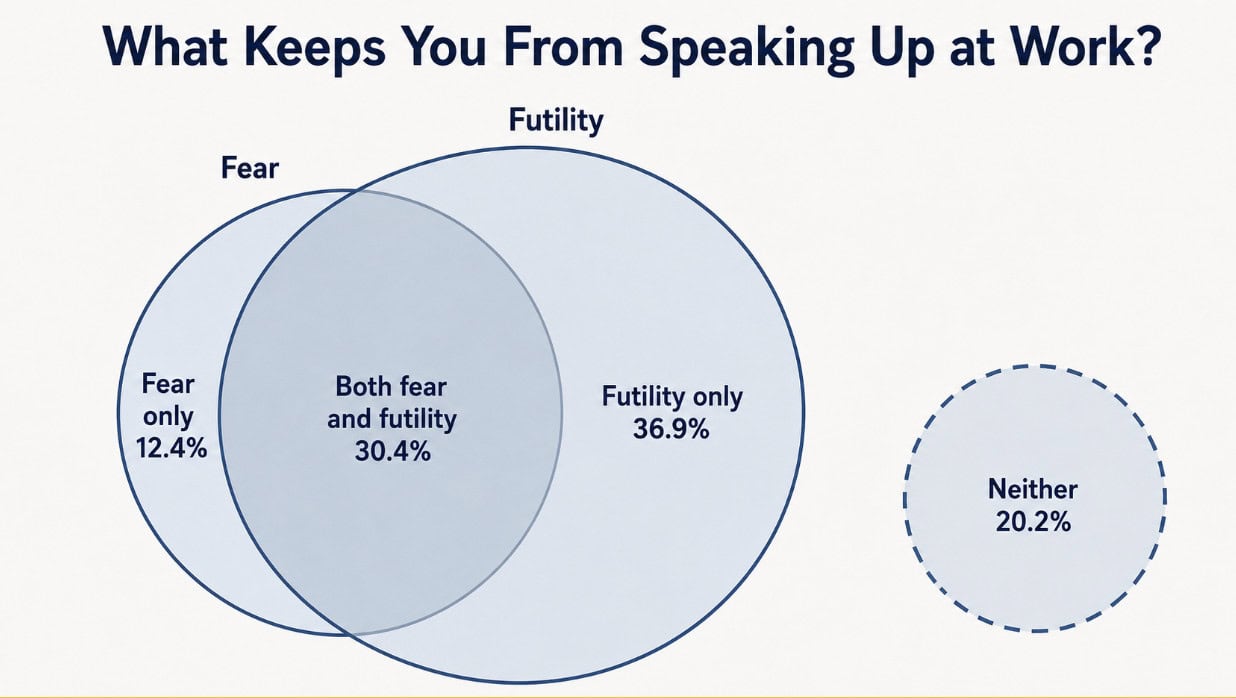
A federal panel reviewing an aerospace manufacturer landed on the same two barriers.
That distinction between fear and futility is the subject of my next book, The Silence Tax: How Lean Leaders Drive Out Fear and Futility. Boeing shows up in it, though not as the main character.
If your organization is planning a campaign to make people feel safer, and futility is what's actually going on, the campaign is aimed at the wrong problem.
People aren't waiting for permission.
They're waiting for evidence.
The Answer Was Training
Calhoun's written testimony to a Senate subcommittee in June 2024 runs about four pages, and it does something I see constantly.
He told senators that Boeing had asked every employee to consider themselves an “aviation safety advocate.” He said the company was committed to making sure employees felt empowered to speak up, that strict policies prohibited retaliation, and that Boeing had held stand downs, listened to employees, and acted on their ideas.
Every employee is now a safety advocate.
Nothing in that sentence about what the company becomes.
By then, the FAA panel's finding that employees didn't believe their complaints would be acted on was four months old.
Pressed by Senator Josh Hawley on cutting corners and eliminating safety procedures to protect profit, Calhoun walked through engineering reforms made after the MAX crashes and then Boeing's response to the door plug: slowing production, focusing on training employees, and making sure manufacturing quality processes were followed.
In the documentary, Calhoun blamed poor worker training for quality problems–as if that wasn't his responsibility as CEO of the company.
The training gap was real. At the NTSB investigative hearing two months later, a Boeing door master lead testified that his team was under heavy pressure to swap doors and had never received specific training on door plugs. Other workers told investigators they felt pushed to work too fast to avoid mistakes.
Around the same time, Calhoun was describing the post-Covid stretch in aerospace as extraordinarily difficult and employee training as a major challenge, with hiring especially hard in South Carolina.
I believe all of that.
It's what makes the conclusion strange.
If your workforce is newer than it has ever been, your training program is behind, and you can't hire fast enough, those are arguments for building fewer airplanes per month. Not for building the same number and adding a class. I mean that would be the case if safety truly is your top priority, instead of that being lip service.
The Lean version is old and unglamorous: don't run the line faster than your ability to build it right.
Boeing did slow down. But that happened after the FAA capped its 737 production rate in January 2024.
The cap came from outside.
The production rate is never a side topic at Boeing. At its 2022 investor day, Calhoun and CFO Brian West told analysts the company would reach about $10 billion in annual free cash flow by 2025 or 2026, and West laid out what that depended on: roughly 50 MAXs a month in Renton and about 10 787s a month in North Charleston, South Carolina.
North Charleston is where Calhoun said hiring was especially difficult.
On the January 2024 earnings call, days after the FAA halted the planned MAX ramp-up, Calhoun told employees that this was not the time to share financial objectives. Boeing reaffirmed the 2025 and 2026 targets the same day. Three months later, West was still describing the cash flow goal as tied to production ramps of 50 a month and 10 a month.
I'm not saying anyone traded safety for cash on purpose.
I'm saying the production rate had a public number attached to it and a cash flow target riding on it. Training didn't have a number like that.
Given two diagnoses, the one attached to a number usually wins.
Ed Pierson, a former 737 factory manager who testified to Congress after the MAX crashes, described the interaction differently: employees with good supervision, quality control, and supply chain support do great work; put an inexperienced worker in a system where parts are late and people are tired, and mistakes happen.
Training is a real gap.
It's also a comfortable one to name, because it puts the problem in the workforce and the remedy in a classroom. Nobody's target has to move. Whoever set the pace that produced the pressure doesn't appear in the analysis at all.
That's what makes this a futility problem and not only an accountability problem.
If you spent two years telling your manager the line was moving too fast, and the company's public answer is that you needed more training, you weren't ignored.
You were given an answer about something else.
That's harder to argue with than silence, because the organization can point to what it did.
Who Reads the Employee's Report?
Here's the part I'd want every leader to examine, because it's fixable and it has nothing to do with courage.
Hours before Calhoun testified, the subcommittee released a complaint from Sam Mohawk, a quality assurance inspector at the Renton plant where the 737 MAX is built.
Mohawk alleges that Boeing lost track of hundreds of nonconforming parts, that his superiors directed him and others to cancel records marking parts as nonconforming, and that he was told to conceal the problem from the FAA ahead of an inspection. He also says he asked for more storage space and staffing to handle the volume and was told finance had denied the request.
Boeing said it was reviewing the claims. Its statement that day added that the company continuously encourages employees to report concerns.
Here's the detail I'd put in front of anyone who owns a reporting system.
Those are his allegations. But the broader routing problem doesn't depend on his account.
The FAA panel found that at Boeing, managers who handled performance evaluations, pay, promotion, and discipline were in some cases also the people investigating the safety concerns employees raised. Whistleblower advocates made a related criticism to the Seattle Times, saying Speak Up regularly exposed complainants to the supervisors they were complaining about, and that managers sometimes investigated complaints against themselves.
You don't have to design that as retaliation.
It's what can happen when you bolt a reporting channel onto an existing org chart and don't think carefully enough about who receives the report. The manager owns the area, so the manager gets anything raised about the area.
That's a reasonable default.
It's fine right up until the concern is about the manager, or about a schedule the manager is being measured on.
Then the person deciding whether to act may also be the person with the most to lose from acting.
That's a design flaw, not a character flaw.
And healthcare should not feel smug about it, because most incident reporting systems I've seen route a report straight to the manager of the unit where it happened.
Same structure. Different industry.
Wells Fargo Had the Same Design Problem
Wells Fargo had an EthicsLine. Employees were told to use it.
Claudia Ponce de Leon was a branch manager in Southern California with about ten years at the bank. She called the ethics line to report suspected fraud by a personal banker she supervised. Twenty-one days later, she was fired.
The bank said she drank too much and behaved unprofessionally. OSHA reviewed the case and concluded the evidence didn't support that account, ordered her reinstated, and awarded her roughly $577,000. Wells Fargo said it would appeal, then settled confidentially.
Separately, OSHA ordered the bank to rehire a Los Angeles wealth manager who was fired in 2010 after calling the same ethics line about suspected fraud, and to pay him $5.4 million, the largest award in the program's history at the time.
Wells Fargo, responding to questions about how it treats whistleblowers, said that if a team member thinks they or someone else has been retaliated against for reporting an issue, they should report it as soon as possible to the EthicsLine, an HR advisor, employee relations, or their manager.
Their manager.
One of the places you're told to report retaliation is the person who may have retaliated against you.
I don't think anyone wrote that sentence with bad intent. Somebody listed the available channels and put the most familiar one last.
But put yourself in the position of an employee who just watched a colleague get walked out.
The existence of a reporting channel isn't the question anymore.
The question is where the report goes.
More Reports Is Progress. It's Also the Easiest Number to Move.
After the door plug, Boeing pushed employees to use Speak Up, and submissions in the first two months of 2024 came in more than 500 percent above the same two months in 2023. For the full year, total reports were up 220 percent.
Boeing described the increase as a sign of progress toward a stronger reporting culture.
It might be.
I'd want more before I believed it.
Rich Plunkett of SPEEA, the union representing Boeing's engineers, asked the two questions I'd have asked: 220 percent from what to what, and what is actually being reported?
A percentage with no denominator can hide a small base.
And I doubt Boeing employees collectively became braver in eight weeks.
Something else changed too: the expectation that this time somebody might have to act, because the entire country was looking at a hole in the side of an airplane.
That makes the increase difficult to interpret. The accident changed the calculation at the same time Boeing was trying to change the culture.
The number I'd want to see is year three, when there's no accident in the news.
There is one finding in Boeing's own reporting that I find more useful than the count. When the company asked employees how to improve the channel, they asked for two things: more confidentiality and better visibility into how their concerns were handled.
That second request is the futility measure, volunteered by the people using the system.
They were already reporting.
What they couldn't see was what happened next.
In Healthcare, Accountability Lands Somewhere Else
One more thing the film brought up for me.
When Boeing's problems became public, the CEO ended up in front of a Senate subcommittee. Calhoun testified. Muilenburg testified before him.
I'm not convinced that senators grandstanding and browbeating an executive fixes much. But the questions got pointed toward the top of the organization.
Healthcare often looks different.
RaDonda Vaught was criminally prosecuted for a medication error at Vanderbilt. The person at the sharp end became the public face of the failure.
Executives do get called to account sometimes. Ralph de la Torre, then CEO of Steward Health Care, was subpoenaed by the Senate HELP Committee in 2024 after Steward's bankruptcy and reports of widespread patient harm. He didn't appear. The committee voted 20-0 to hold him in criminal contempt, and the full Senate agreed unanimously. As of this month, senators are still asking the Justice Department why nothing has happened since.
The VA is another example. In 2014, after reporting on secret wait lists in Phoenix and allegations that veterans died waiting for care, there were hearings, whistleblower testimony, and eventually the Secretary's resignation.
Those are real counterexamples.
Look at what it took.
Steward was collapsing across dozens of hospitals. The VA had become a national scandal.
Two 737 MAX crashes killed 346 people in two events. Nobody can file that away.
Healthcare harm more often arrives one patient at a time. Different rooms, different shifts, different hospitals, spread across a year. Nobody is required to add it up in public, and mostly nobody does.
That's the difference. It isn't about the character of executives in one industry versus another.
Aviation failures are loud and countable. Healthcare failures are often quiet and distributed.
And distributed harm makes it easier for accountability to stay local. Or for there to be no accountability.
I wrote recently about four patients harmed at a Nashville hospital during routine joint replacements, where one family says potassium chloride was administered instead of the anesthetic.
That investigation is early, and I'm not going to guess at what happened.
But everybody in that hospital is watching what happens next.
They're learning where accountability lands and what happens to the people nearest the problem.
Boeing's response to the film, given to Kennedy and Netflix, was that the allegations have been widely reported over the years, that some remain unfounded and others were addressed, and that under its new CEO the company introduced new values and behaviors that are strengthening its culture.
Maybe so.
John Barnett, the quality manager the film is built around, spent 32 years at Boeing and filed his retaliation complaint with the Department of Labor in 2017. Seven years later, no hearing had been scheduled. He died by suicide in March 2024, during depositions.
Boeing and his estate reached a confidential settlement in 2025, which means nothing was ever decided on the merits.
Seven years without a hearing is its own lesson about whether speaking up changes anything.
And that delay isn't Boeing's lesson to answer for.
What I'd Actually Check
You don't need a survey for this one.
Pull the last ten reports your system received.
Find out who received each one, and whether that person had anything at stake in the answer.
Then find out how many of the ten produced a response the person who filed it could actually see.
I'd guess the second number is smaller than the first.
And I'd guess most leaders don't know either one.
New book coming early 2027: The Silence Tax
Most of the posts I write about fear, futility, and psychological safety come back to one question: what happens after somebody speaks up? When the answer is nothing, people stop. That silence has a cost, and leaders pay it without ever seeing the invoice.
The Silence Tax: How Lean Leaders Drive Out Fear and Futility -- it's a practical guide to what leaders do differently, starting this week.