
No Layoffs in 75 Years: A Lean Lesson in Good Business
The Wall Street Journal published a story this week about The Gund Company, a family-owned manufacturer in St. Louis that hasn't had a layoff since it was founded in 1951. Here's my gift link, so you can read it without a subscription: Bosses Want the Secrets of the Family Firm That Has Never Had a Layoff in 75 Years.
Gund makes composite components used throughout the power grid. According to the article, it has about 1,300 employees, nearly $400 million in sales, and average annual growth of 18% over the past decade. CEO Steve Gund says profit margins have doubled over that time. Leaders from more than 200 companies have visited to see how they do it.
My favorite line from Steve Gund:
“It sounds touchy-feely, but it's profitable.”
The no-layoffs record gets the headline. I think the less glamorous parts of the story, like how carefully they hire, are what make it possible.
It's Good Business
Gund told a group of visiting executives that spreading this message is one of his life's callings. He believes business is about taking care of people as well as delivering returns to shareholders. He also says the sustainable path for a family company is to build the business around a larger mission, for its workers and for future generations of owners.
Some executives will hear that as a values statement that gets dropped when sales soften. Gund's results suggest it's a business strategy that also happens to be decent.
I've seen this argument play out in healthcare for 20 years. When I worked with Johnson & Johnson's ValuMetrix Services group, we had a rule before taking on a hospital client: executives had to commit to “no layoffs due to Lean.” If they wouldn't, we declined the work. That was partly about ethics, but it was also practical. People won't improve their way out of a job. I wrote more about that in Lean Without Layoffs: Why Protecting Jobs Is Essential for Continuous Improvement.
Dr. Dean Gruner, when he was CEO of ThedaCare, put it simply. If employees feared losing their jobs, “Nobody would get very enthusiastic about improvement in that world.” A single layoff teaches everybody what happens to people whose work got more efficient.
Gund's Lean Journey
The Journal article never uses the word “Lean,” but Gund does. In a Shingo Institute article co-written with Cheryl Jekiel earlier this year, Steve Gund describes how the company's early improvement work focused on Lean tools like 6S, SMED, kanban, and poka-yoke. Looking back, he said, “We were educating people on compliance with the tools.” That produced activity and some gains, but it didn't change how people were involved in their work.
A lot of readers will recognize that story. Over time, Gund built its improvement system around Gemba, visual management, kaizen, standard work, and what the company calls cultural leadership, with A3 problem solving tying it together.
You can see that system in the Journal's reporting. Supervisors regularly do Gemba walks (Gemba is a Japanese term for “the actual place” where work happens). They ask what's going well, how people are taking care of each other, and what could be improved. Employees post problems on red cards on the factory floor, and a card turns yellow when a fix is underway.
I've seen plenty of organizations adopt Gemba walks and visual boards and get very little from them. The walk turns into an audit, or the board fills up with problems nobody addresses, and the cards stop coming. Steve Gund's explanation for why it works at Gund is simple: listen to people, then act on what they tell you.
The no-layoffs commitment is part of what makes that work. Asking people to point out waste is a reasonable request when they know the improvement won't eliminate their own job. Without that commitment, a Gemba walk can feel more like surveillance than support.
If you want to hear more about Gund's journey, the Shingo Principles Podcast used the company as a case study in Episode 57: Improvement as a Human Endeavor:
No Layoffs Has to Be Built Into the System
The part of the article I think matters most is easy to skim past. Gund has never had a layoff, but it also staffs sparingly so it can get through leaner stretches.
That's the trade-off. You can't make a credible no-layoffs commitment and also hire aggressively every time demand spikes. Without hiring discipline, the promise breaks the first time the market turns.
ThedaCare was careful about this under John Toussaint and then Dean Gruner. Before adding headcount, leaders asked whether they could keep that person employed through the next downturn, not just whether they needed the help this quarter.
KaiNexus, where I'm a senior advisor, works the same way. We have never had layoffs because of the economy or market conditions. People have left when an individual situation didn't work out, which is different. That's been possible because the company hasn't chased growth at all costs. Plenty of software companies hire hard when funding is easy, then announce layoffs when it isn't. The people who get laid off didn't cause that cycle. Leadership did, through hiring decisions made a year or two earlier.
Steve's father, Paul, used to say that telling hardworking people they didn't have a job because executives couldn't manage the finances was a failure of leadership. That's a very Japanese way of thinking about it. In many Japanese companies, a layoff is seen as a management failure, and executives are expected to take the hit first, through pay cuts or even resignation. Toyota's commitment to job security traces back to 1950, when a financial crisis led to job cuts and a long strike, and founder Kiichiro Toyoda stepped down as president. Toyota does use temporary workers as a buffer in downturns, but it treats job security for its regular workforce as a management obligation.
Radical Transparency and Safety First
Gund says hitting its goals requires “radical transparency.” Financials are posted in meeting rooms. Improvement ideas go on large boards that everyone can see. Salary ranges for each career track are shared. In a talk at Washington University, Steve Gund connected the company's employee ownership, now 30%, to open-book management, the approach Jack Stack and SRC Holdings made famous.
When people can see the numbers, a slow quarter doesn't come as a surprise, and leaders can't hide behind vague talk about “market conditions.”
Transparency has to go both ways, though. Posting the financials is easy. Making it safe for someone on the floor to post a red card saying a supervisor's decision is causing a problem is harder. I'd want to know how often those cards point upward, and what happens when they do.
I also noticed what comes first. Gund measures performance in three categories: taking care of each other, taking care of the customer, and taking care of the business. Taking care of each other starts with preventing injuries. That's the same order many Lean organizations use with SQDC, and it's the bet Paul O'Neill made when he opened his tenure as Alcoa's CEO by talking about worker safety instead of profits. Alcoa's performance improved, and O'Neill argued that a company that takes injuries seriously learns to take every other problem seriously too.
Safety first is easy to say. You find out whether leaders mean it when safety and a shipment deadline conflict, and someone on the line has to decide whether to stop.
Respect, Not Parenting
None of this makes Gund's model soft. People who don't adapt to the company's high-performance culture are managed out. Everyone, from line workers to managers, has a development plan.
That matches what I've seen in healthcare. Avera McKennan's former president Fred Slunecka described the deal as protecting careers, not specific jobs, in exchange for employees doing everything they can to keep the organization economically secure. The commitment goes both ways.
One word in the article bothered me a little. Steve Gund describes his management playbook as involving a “parental” level of care. I understand what he means. Leaders should care about people's lives, not only their output. Bob Chapman said something similar when he talked about caring for employees like family.
But I'm not sure parenting is the right model. Parents make decisions for children. In a Lean culture, respect for people means treating employees as capable adults, challenging and developing them, and trusting them to solve problems in their own work. Paternalism, even kind paternalism, can slide into leaders deciding what's good for people without asking them.
What Gund actually does looks more adult-to-adult than the word suggests: shared financials, published salary ranges, career plans built around what employees want, and an expectation that people will speak up. That's treating people as partners in the business. Maybe that's a quibble about one word. But the words leaders use tend to shape what they do.
Bob Chapman's Influence
Steve Gund says he didn't fully commit to this approach until a 2015 conversation with Bob Chapman, the longtime CEO of Barry-Wehmiller, another family-owned St. Louis company. As Gund recalls it, he told Chapman he felt more fulfilled helping people in need than running a manufacturing business. Chapman's response was that a growing company that employs people is a bigger way to make a difference.
Chapman died in March at age 80. He spent decades arguing that how you treat employees shapes the lives they go home to, and he built Barry-Wehmiller into a $3.6 billion company while doing it. His book with Raj Sisodia, Everybody Matters, made that case to a lot of executives who might otherwise have written it off as soft. It's good to see his influence showing up in results like Gund's.
Why So Few Companies Copy It
Steve Gund says many visiting companies try a few of his 12 steps and then give up, often because the top leader handed the effort to someone in HR. He says changing a culture takes two to three years. You can copy red cards and Gemba walks in a week. The hiring discipline, the patience, and the CEO's personal involvement are much harder to copy.
One caution: Gund is a single privately held company, and its growth includes acquisitions. A family owner without quarterly earnings calls has more room for long-term choices than a public-company CEO does. That doesn't make the approach less valid. It does mean leaders elsewhere should be honest about the pressures they face, and whether they're willing to push back on them.
So here's a question I'd put to any leadership team. If you had already committed to never laying anyone off, how would that change the hiring decisions you're making this year?
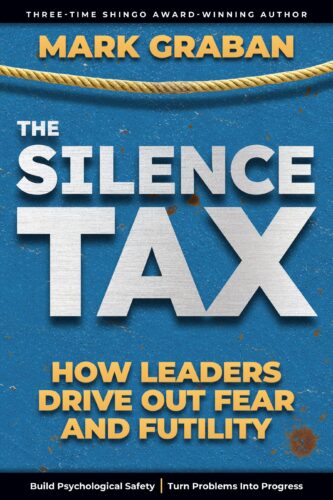
The Silence Tax: read a free sample or pre-order
My new book, The Silence Tax: How Leaders Drive Out Fear and Futility, is about why people stay quiet at work and what leaders can do about both causes. It comes out February 9, 2027. The Kindle edition is available for pre-order now.
Pre-order on KindleGet the free sampleEarly edition on Leanpub
New book coming early 2027: The Silence Tax
Most of the posts I write about fear, futility, and psychological safety come back to one question: what happens after somebody speaks up? When the answer is nothing, people stop. That silence has a cost, and leaders pay it without ever seeing the invoice.
The Silence Tax: How Leaders Drive Out Fear and Futility -- it's a practical guide to what leaders do differently, starting this week.