

TL;DR: A Toyota tour guide at the Tsutsumi plant once added a small hook to a catwalk railing because she didn't like setting her bag down. Her manager approved it. A colleague installed it. No ROI analysis was required. That single example reveals more about how kaizen actually works at Toyota than most training programs do — and explains why most “kaizen programs” outside Toyota stall.
The most useful thing I've ever learned about kaizen at Toyota came from a tour guide. Not from a Toyota engineer or a TPS expert — from the person whose job was to walk visitors around the Tsutsumi plant. She had added a small hook to a catwalk railing because she didn't like setting her bag on the floor when she stopped to speak. She wrote it up, her manager approved it, and a colleague installed it. That's it. One small improvement, made by the person doing the work, approved without ROI analysis.
Most organizations that say they “do kaizen” couldn't have made that hook happen. That's what this post is about.
Hear Mark read this post — subscribe to Lean Blog Audio
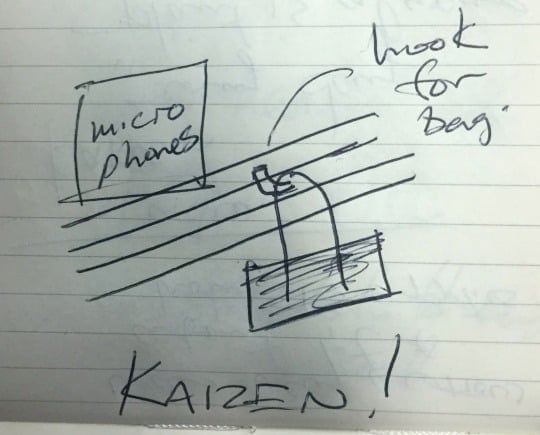
At each stop, there was a box with a microphone, other audio/visual equipment, and speakers. She didn't have to carry a microphone with her.
The guide was carrying a bag, something between a briefcase and a large purse.
A Simple Toyota Kaizen Example from the Shop Floor
This Toyota kaizen example shows how small, employee-driven improvements happen in daily work. A simple hook added to a catwalk eliminated an annoyance for the tour guide and made her job easier. The change was inexpensive, locally implemented, and fully aligned with Toyota's continuous improvement culture.
One of our sharp-eyed tour attendees, a Chief Medical Officer from a Canadian hospital, noticed a hook that she would hang her bag on while stopped and talking. He asked her about the hook.
Sure enough, it was a Kaizen improvement! And, it was her idea.
As she explained, she used to have to set her bag down on the catwalk, which she didn't like.
She had the idea of putting up hooks, an inexpensive change.
Here's my awful sketch:
How Toyota Encourages Small Kaizen Ideas
When a Toyota employee has an idea, she explained, they bring up the idea to their manager. Sometimes, they first implement the idea and then write it up and share it with the manager.
The write-up has the current condition and what you think should be changed (sometimes with pictures being added). In this case, she wrote it up and proposed it to her manager in public relations.
She said, “My manager normally approves things for me.” I asked her if all managers were like that and she said that some managers were “more strict” and didn't like to approve as many ideas, which is an interesting example of variation within their company culture.
The guide said that the managers generally encourage you to implement your own idea. I asked if she did that in this case and she said that a colleague actually attached the hooks for her.
I asked how they get new employees involved, and she simply said,
“The Kaizen idea suggestion system is explained to new employees, and they do it.”
The numbers she shared were:
- 430,000 Kaizens implemented per year in Japan
- 68,000 employees total
- Thats 6.3 Kaizens per employee per year, on average
She has personally done two Kaizens in the past month (I didn't catch what the second one was).
Toyota pays 500 yen to the employee for each Kaizen idea, which is currently $4.36 in US dollars. They can be paid up to 200,000 yen for special ideas ($1,743).
I love seeing the Kaizen principles that I'd recognize and teach in healthcare:
- Set an expectation that employee ideas are welcome
- Approve most ideas
- Let people implement their ideas
- Write up a simple before-and-after explanation, with pictures
- Let people solve problems that matter to them
Five things this small kaizen reveals about how Toyota does it:
- The improver is the person doing the work. Not a consultant, not a manager, not a kaizen office. The tour guide had the friction; she had the idea.
- Managers approve, they don't gatekeep. “My manager normally approves things for me,” she said. The default is yes.
- Implementation is local and fast. A colleague put up the hook. No work order, no ticket, no committee.
- The write-up is light. Current state, what changed, sometimes pictures. That's it.
- No ROI required. A bag hook produces no measurable savings. Toyota approved it anyway. The point is participation, not payoff.
I didn't ask why she needed the bag with her. Maybe a manager could ask that question in the course of a Kaizen discussion, but they let her have her hooks.
She pointed out another Kaizen as we walked down a flight of stairs. They have small green plants in the corners of the stairwells. Somebody suggested adding two small white cords to hold the plants in place, as I've crudely sketched:

Why Small Kaizen Improvements Matter More Than ROI
A bag hook saves Toyota nothing measurable. No labor hours, no material cost, no quality improvement that shows up on a metric. By the standards most US organizations apply to their “continuous improvement programs,” it shouldn't have been approved. And yet Toyota — the company that wrote the book on operational excellence — said yes.
The reason isn't sentimentality. It's a hard-headed bet on long-term capability. If you reject the bag-hook idea, you don't just lose the bag hook. You lose the employee's next idea, and the one after that, and the one that actually would have saved real money. You also lose the signal you were sending the whole team about what kind of place this is. Toyota knows that participation compounds. Most organizations are trying to skip to the compounding part without paying the entry fee.
Anyway, there is a little glimpse into life and Kaizen at a Toyota plant.
What This Looks Like in a Hospital
The Canadian Chief Medical Officer on our tour was the one who spotted the hook. That's not coincidence. He was looking for it. Healthcare leaders who study Toyota usually arrive looking for the dramatic interventions — the value stream maps, the kaizen events, the system-level transformations. What they often miss is the bag-hook layer.
In hospitals where this layer exists, you see nurses adjusting supply locations based on what they actually reach for during a shift. Pharmacy techs proposing label changes that reduce read-time. Lab staff suggesting small workspace rearrangements that cut walking. Most of these ideas would never survive an ROI review. Most of them, individually, don't matter much. Collectively, they reshape what it feels like to come to work.
The hospitals I've worked with that get this right share three traits with what the Toyota tour guide described: managers default to yes, the people closest to the work do the implementing, and nobody asks for a savings calculation on a $4 fix. The hospitals that don't get this right usually have well-funded “continuous improvement programs” that produce nothing of the sort.
Why Small Kaizen Ideas Matter More Than They Look
A bag hook isn't a transformation. But how Toyota responded to that bag-hook idea — quickly, locally, without a savings calculation — is what makes them Toyota. Most of the gap between organizations that talk about kaizen and the one that invented it isn't in tools or training. It's in what happens the next time someone proposes a small, inexpensive, hard-to-measure idea. The answer at Toyota is usually yes. Almost everywhere else, the answer is “what's the ROI?” — which is functionally the same as no.
If you want to know whether your organization actually has a kaizen culture, don't audit the dashboard. Watch what happens to the next bag hook.
Frequently Asked Questions
Kaizen is the practice of continuous improvement through small changes made by the people doing the work. The Japanese term roughly translates as “change for better.” At Toyota, kaizen is not a project or an event — it's a daily expectation that everyone notices problems, proposes ideas, and helps implement them.
The tour guide cited 430,000 kaizens implemented per year in Japan, across about 68,000 employees — roughly 6.3 kaizens per employee per year. Toyota pays employees 500 yen (about $3-$5 depending on the exchange rate) per kaizen idea, with special ideas eligible for higher payouts up to 200,000 yen.
No. Most kaizen ideas at Toyota produce no measurable savings. The goal is participation, capability-building, and culture — not return on investment. About one in 250 to 300 healthcare kaizens has a really large cost saving; the rest build the culture that makes the big ones possible.
Each employee's direct manager. The tour guide said her manager “normally approves things,” though she noted that some managers are stricter than others. There is no centralized kaizen committee or ROI review for small ideas.
A traditional suggestion box collects ideas that someone else evaluates and (usually) doesn't implement. Kaizen expects the person with the idea to participate in implementing it, often with a colleague's help. The write-up is light, the approval is local, and the change happens fast.





Kaizen as continuous improvement is great, but in the aspect of complexity do struggle many companies, including Japanese ones in setup of harmonized environment on a scale of GSC or supply chain. For many sites and factories small steps are being prefered and favouritized in favour to significant ones which can have much stronger impact on the Efficiency of the whole picture. This is what I see as weak point.
Perhaps it’s a definition of value in this context? The tour guide’s job is to guide people through the plant and impress upon them the sophistication of Toyota’s techniques, including kaizen. The hook is a very visible and tangible sign of the pervasiveness of kaizen at Toyota… or am I crediting the good and inscrutable sages at Toyota with too much cunning?
I’m certain it was only talked about because one of our attendees noticed the hook and asked about it, with me asking follow up questions.
Truely Impressed by the approach of doing and encouraging all the Kaizen having no or little impact on company s goal. When we started this approach we had a serious issue of quality of Kaizens. People just started to do use less Kaizens and wanted them to be included in the Celebrations. So our system of celebration was over burdened.
Like I commented below, if you’re just starting a Kaizen program and you’re starting to build a culture of continuous improvement, the quality of the Kaizens is not very important. The quality of the Kaizens will get better over time as you coach and develop people.
If the “system of celebration is over burdened,” is the system of celebration too complicated?
My co-author, Joe Swartz’s hospital has 4000 to 5000 Kaizens a year and their recognition system, with just 1 or 2 staff spending part of their time on it, doesn’t get overwhelmed.
In the workplace, shouldn’t the Kaizen be focused only on improvements to productivity, less defects, accuracy of info and so on ? Fixing a plant holder is about as helpful as recommending that someone fold the toilet paper in the washroom to give the appearance of a fancy hotel.
No. The Kaizen philosophy says that every small improvement is worthwhile. Why? Because at the very least it builds enthusiasm and confidence in the employee who had the idea.
If managers say “no” to ideas that don’t have a specific measurable benefit, then employees will often get discouraged and stop participating. Then, we lose the potential opportunity that their next Kaizen idea WILL more directly improve quality, or cost, etc.
Maybe the plant holder is a safety improvement, in that it reduces the risk that the plant gets knocked over and trips somebody on the stairs?
When we start with Kaizen, it’s especially important to say “yes” to as many Kaizen ideas as possible. This is taught by Masaaki Imai in his book “KAIZEN”and that has proven to be good advice in my own experience. You can’t mandate some sort of ROI threshold for each Kaizen, because again, you’re trying to build confidence and enthusiasm.
In data I’ve seen from my co-author’s organization and others, about 1 in 10 healthcare Kaizen examples has any sort of cost savings. About 1 in 250 or 300 has a really LARGE cost savings. If we don’t let people implement other Kaizens (especially inexpensive ones like bag hooks or plant holders) then we risk alienating an employee… and what’s the cost of that?
Mark
[…] guide (read about her Kaizen in this previous blog post), also explained that TPS […]
[…] Our Toyota Tour Guide’s Kaizen […]
[…] Source: Our Toyota Tour Guide’s Small Improvement — Kaizen in Action – Lean Blog […]