Mutual Trust and Respect: What Really Made NUMMI Work
TL;DR: NUMMI's success was not driven by Lean tools alone, but by leadership behaviors that treated people as partners in quality and improvement.
When you open the NUMMI Management Practices: Executive Summary–that thin, yellow-covered 1987 report preserved in the Don Ephlin Papers at the Walter P. Reuther Library–one sentence stands out before any discussion of production systems, metrics, or tools:
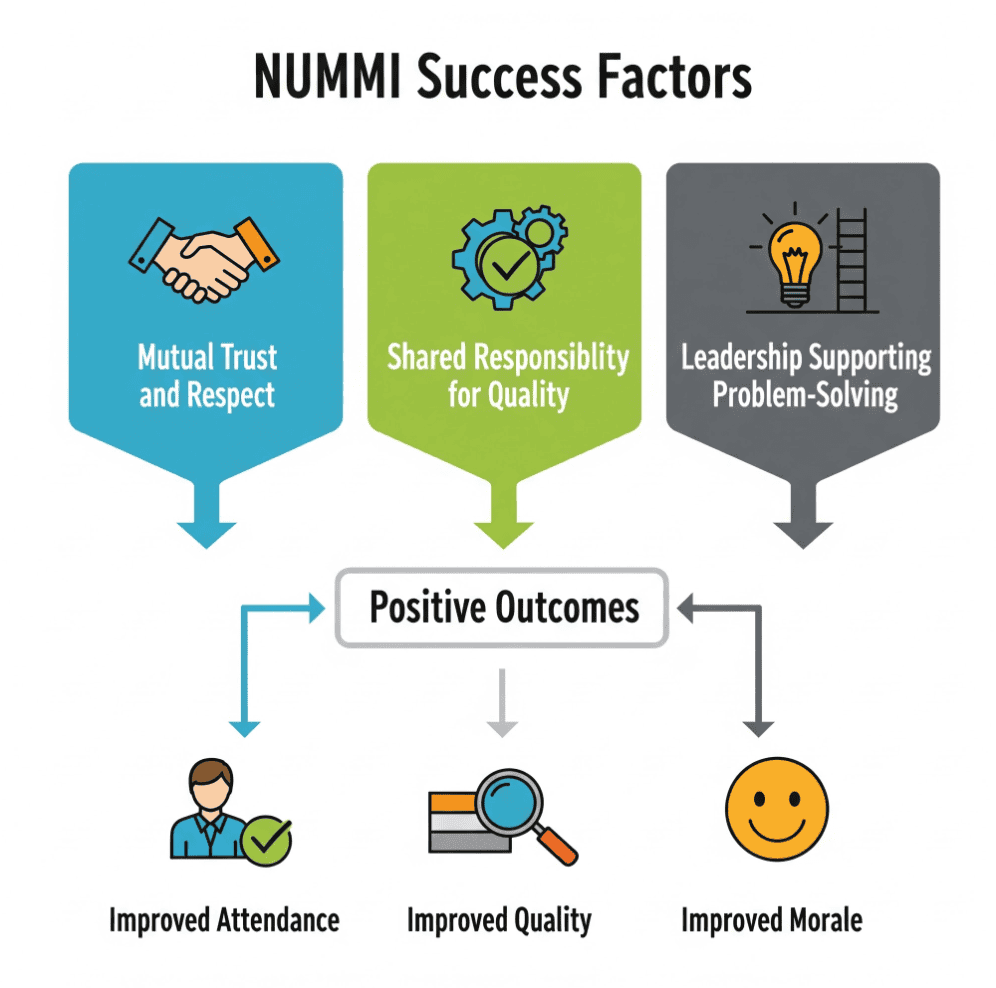
“The NUMMI philosophy is based on mutual trust and respect between management and employees, a shared responsibility for quality, and the belief that problems are best solved by those who do the work.”
That single sentence captures why NUMMI mattered. It wasn't just a joint venture between GM and Toyota. It was a real-world test of a different management philosophy–one that treated people not as a problem to be controlled, but as partners in improvement.
Nearly forty years later, that idea still feels both simple and radical.
Why Trust Came First

When the Fremont plant reopened as NUMMI in 1984, the workforce didn't magically change. The same employees returned–workers who had previously been labeled “unmanageable” under GM's old system.
Yet attendance improved dramatically. Quality improved. Morale improved.
The machines didn't change first. The relationship did.
Toyota leaders didn't begin with suspicion. They began with an assumption of capability. GM's earlier management approach had relied heavily on inspection, supervision, and control–signals, intentional or not, that workers were not trusted.
NUMMI reversed that logic. The implicit message wasn't, “Earn our trust.” It was, “We trust you–now let's solve problems together.”
That showed up clearly in policies like this:
“Each employee is responsible for the quality of his or her work and has the authority to stop the line if a problem cannot be corrected immediately.”
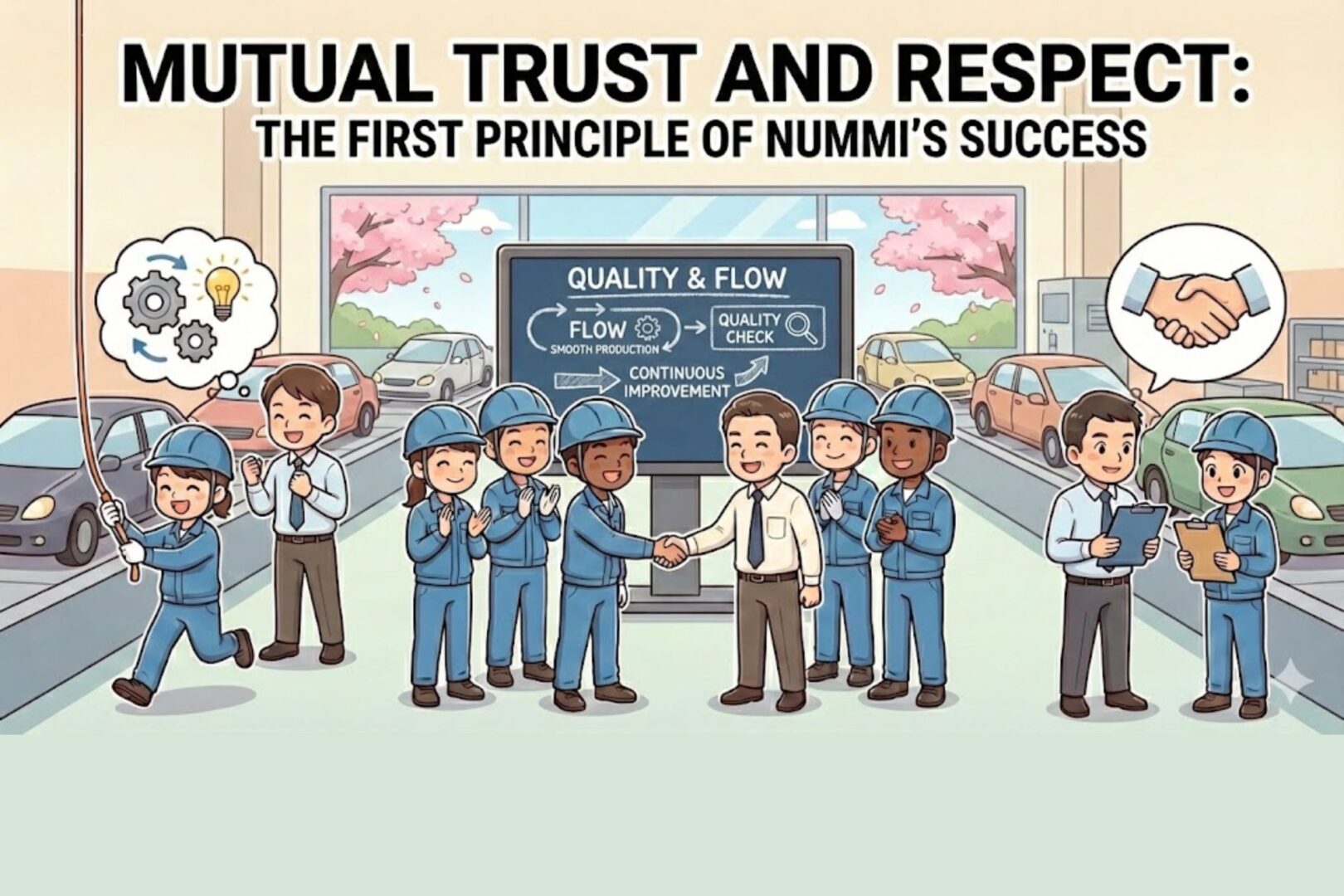
Giving frontline employees the authority to stop production (through an andon cord system) was not a symbolic gesture. It was a practical demonstration of trust. And it created mutual accountability–management depended on workers to protect quality, and workers depended on management to respond constructively.
Designing Trust Into the System
At NUMMI, trust wasn't a slogan. It was built into daily management practices.
Three elements mattered especially.
Shared responsibility for quality
Quality wasn't something inspected in later. It was owned at the source. When a team member pulled the andon cord, management didn't see an interruption–they saw the system working as designed.
Visible, responsive leadership
Supervisors didn't manage from a distance. They showed up, listened, and helped.
As the report put it:
“The role of management is to support the team members by removing barriers and by helping them solve problems at the source.”
That's a powerful redefinition of leadership: support instead of surveillance.
A genuine partnership with the union
NUMMI's relationship with UAW Local 2244 reflected Don Ephlin's long-held belief that dignity and performance go hand in hand. Union representatives were part of improvement efforts, not obstacles to them. Trust flowed both ways because actions reinforced words.
One misunderstanding about the NUMMI story still shows up today. Some assume its success depended on being non-union. That was not the case. NUMMI worked with the UAW under a different kind of relationship, not the absence of one.
What Trust Looked Like Day to Day
Respect for people wasn't abstract. It showed up in routines:
- Daily startup meetings that focused on problems, not blame
- Cross-training that assumed people could learn and grow
- Standardized work created with input from those doing the work
- Improvement circles that treated frontline ideas as necessary, not optional
The outcomes were well documented. Absenteeism fell from roughly 20 percent to under 3 percent. Productivity rivaled Toyota's best plants. The workforce once written off became one of the strongest performers in the system.
As the summary observed:
“Quality, productivity, and morale are the natural results of a system in which problems are seen as opportunities for improvement rather than as failures.”
That's not soft thinking. It's operational thinking.
Why These Lessons Didn't Spread Easily
Despite NUMMI's success, many GM plants struggled to replicate it. The tools were visible. The philosophy was harder to internalize.
Too often, respect was misunderstood as leniency, and trust was confused with a loss of control. Learning was treated as a program or department, not as daily work.
You can't copy and paste culture. Trust has to be reinforced every day through consistent leadership behavior–especially when problems surface. It comes down to leadership mindsets and behaviors.
Read more about this: “This American Life” on NUMMI Lessons, “Labor Notes” Still Hates Lean
NUMMI and Psychological Safety (Before We Had the Term)
Long before “psychological safety” became common language, NUMMI practiced it. People spoke up because experience taught them it was safe to do so.
The Executive Summary emphasizes this repeatedly:
“When a problem occurs, the emphasis is on finding and eliminating the cause rather than finding someone to blame.”
That statement aligns directly with what I describe in The Mistakes That Make Us: learning cultures replace fear with curiosity. They respond well to bad news. They see mistakes as information, not moral failures.
At NUMMI, trust was both an input and an output. You needed it to improve–and improvement strengthened it in return.
Why This Still Matters in Healthcare and Beyond
The parallels to healthcare are striking. Nurses, physicians, technicians, and staff want what NUMMI workers wanted: the ability to do good work without fear.
In environments where mistakes matter deeply, improvement depends on speaking up. An andon cord in a factory isn't so different from a nurse raising a concern during a procedure.
Each signal says the same thing: “I care about quality, and I trust the system to respond.”
Making Trust Practical
So what can leaders do today?
- Design trust into systems, not approvals into every step
- Model respect first, especially when under pressure
- Respond thoughtfully to problems, not emotionally
- Connect trust to outcomes, using data to reinforce learning
- Normalize reflection, making learning visible and shared
Trust grows–or erodes–one interaction at a time.
Closing Reflection
NUMMI showed that respect for people and high performance are not tradeoffs. They are inseparable.
Mutual trust and respect weren't slogans on the wall. They were daily practices, reinforced through leadership behavior and system design.
That lesson still matters–whether you're running an assembly line, a hospital unit, or any organization that depends on human judgment.
NUMMI suggests that sustainable improvement starts not with tools or programs, but with mutual trust and respect.