

Inside the 1987 NUMMI Management Practices Executive Summary: Why Leadership Mattered More Than Lean Tools
TL;DR: In 1987, GM accurately documented why NUMMI worked–and it wasn't tools, techniques, or discipline. This internal report reveals a management system built on trust, learning, and problem-solving, and exposes how hard it is to act on insight when it challenges entrenched beliefs.

When you read the NUMMI Management Practices: Executive Summary, it's hard not to notice the contrast it represents.
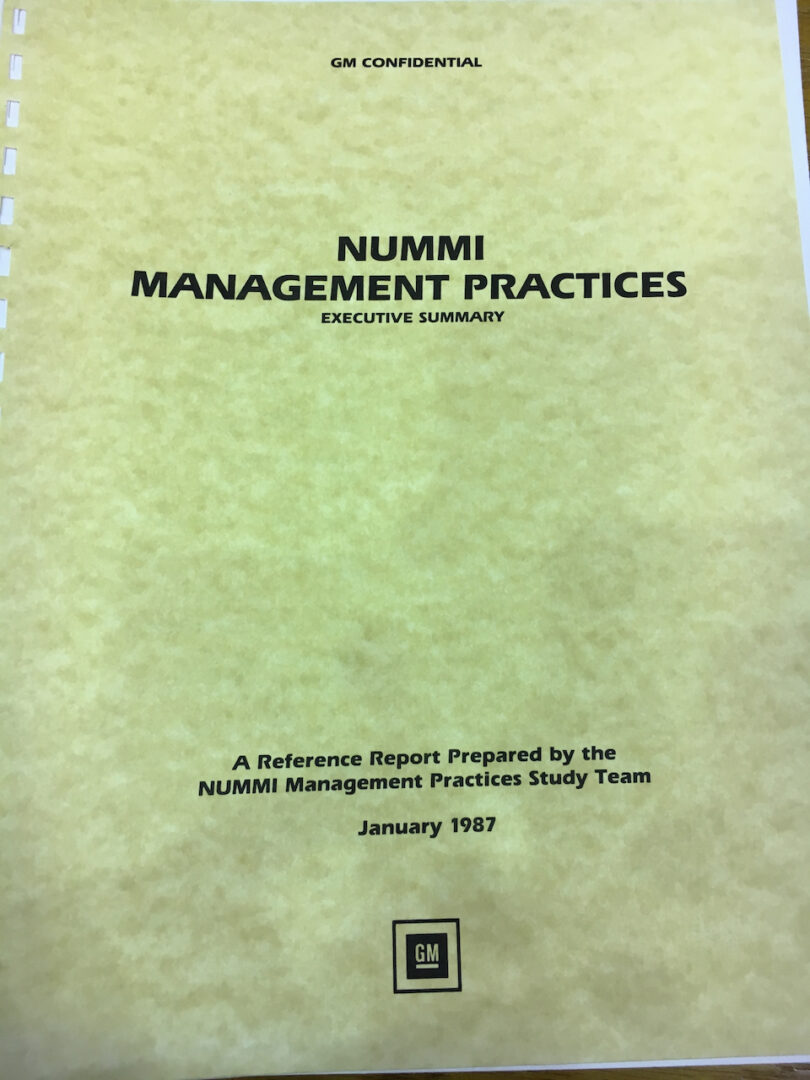
Printed in January 1987, marked “GM Confidential,” and written by the “NUMMI Management Practices Study Team,” this 35-page document tried to explain something that, at the time, seemed almost unbelievable: a joint venture between General Motors and Toyota, NUMMI, was achieving dramatic improvements in quality, productivity, and morale–using the same U.S. workforce that had previously been associated with some of GM's worst performance.
This wasn't a glossy marketing piece or an external case study. It was an internal attempt by GM leaders and engineers to make sense of what they were seeing at NUMMI. And in doing so, they produced one of the clearest early explanations of what many of us later came to call Lean management.
Preserved today in the Don Ephlin Papers at the Walter P. Reuther Library at Wayne State University, the Executive Summary is more than a historical artifact. It documents a moment when some GM leaders realized that NUMMI's success had very little to do with tools–and almost everything to do with management beliefs.
And that was almost 40 years ago.
Why This Document Was Created
By 1986, NUMMI (New United Motor Manufacturing, Inc.) had been operating for about two years. The Fremont, California plant–once infamous for absenteeism, rework, and adversarial labor relations–had become one of the best-performing auto plants in North America.
GM executives were understandably curious, and in some cases skeptical. Hell, I met some skeptical GM people working at the NUMMI plant in 2004 or so. They downplayed how special Toyota was–but I think that was their GM pride talking, or perhaps American pride.
In the 1980s, the company started sending delegations to Fremont to observe firsthand what Toyota was doing differently. Out of that curiosity came the NUMMI Management Practices Study Team, tasked with documenting the system and identifying the principles behind its success.
The stated purpose was modest and pragmatic:
“This study was undertaken to document NUMMI's management system and to identify the underlying principles that make it successful, so that they may be understood and, where appropriate, applied within General Motors.”
Not tools and techniques. Mindsets and management styles.
Not copied. Understood.
That distinction matters. The authors weren't arguing that GM should become Toyota. They were trying to articulate why NUMMI worked–and what that implied about GM's own management assumptions and practices–and the future.
Translating a Different Way of Managing
The Executive Summary was written for senior GM leaders, plant managers, and technical staff. But in many ways, it reads like a translation guide.
NUMMI itself was a hybrid: a unionized (UAW) American workforce, Japanese and American managers working together, and Toyota's production system adapted to U.S. labor law and culture. If this system could work there, the authors were asking, why couldn't it work elsewhere?
The core question running through the document is simple:
Can this system work here?
The answer, based on NUMMI's results, was clearly yes. But the document also makes it clear that success depended on changing deeply held beliefs about people, problems, and the role of management.
How the Document Is Organized
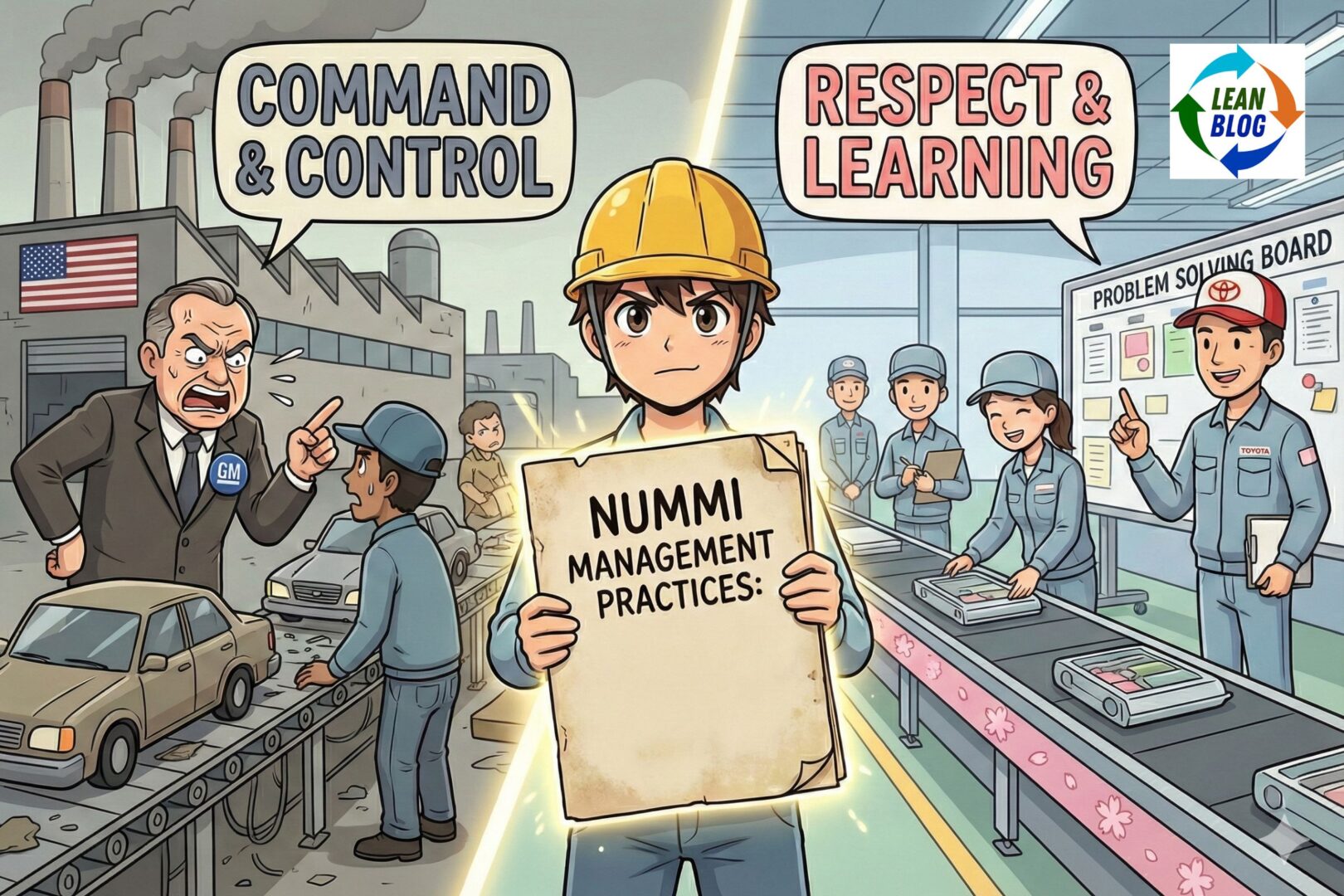
The report is concise, but it's not superficial. It's structured around a few key sections:
- Introduction and Purpose
- NUMMI's Basic Principles
- Major Management Strategies
- Supporting Systems and Practices
- Summary and Implications for GM
Two sections stand out as foundational: the articulation of NUMMI's basic principles and the five major management strategies that flow from them.
NUMMI's Basic Principles
The Executive Summary identifies a small set of beliefs that underpin everything else. They sound familiar today, but they were far from mainstream inside GM in the mid-1980s.
“The NUMMI philosophy is based on mutual trust and respect between management and employees, a shared responsibility for quality, and the belief that problems are best solved by those who do the work.”
And:
“Quality, productivity, and morale are the natural results of a system in which problems are seen as opportunities for improvement rather than as failures.”
These are not slogans. The authors emphasize that these principles drive system design–how work is structured, how supervisors behave, how problems are handled.
The mention of system design reminds me of what former Toyota leader Darril Wilburn says:
“It's the responsibility of leadership to provide a system in which people can be successful.”
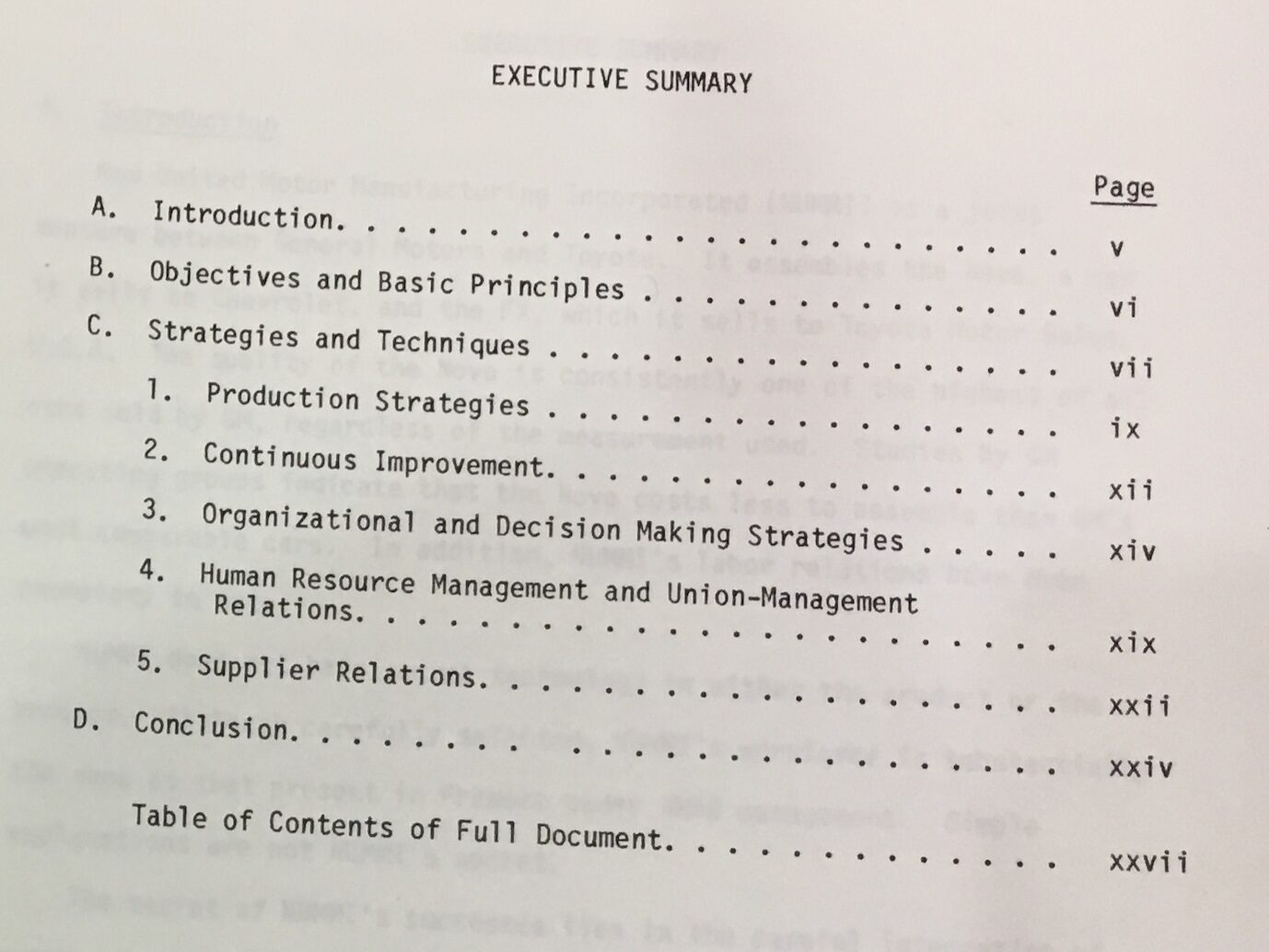
Implicitly, the document contrasts this with GM's traditional reliance on hierarchy, inspection, and control. NUMMI wasn't getting better results by pushing people harder; it was getting better results by designing a system that trusted people and expected problems.
The Five Major Management Strategies
From those principles, the report outlines five management strategies that made NUMMI different.
1. Building Mutual Trust and Respect
Trust wasn't left to personality or good intentions. It was designed into the work. Managers were expected to act as coaches and teachers, not enforcers.
“The role of management is to support the team members by removing barriers and by helping them solve problems at the source.”
That expectation alone represented a significant shift from traditional management roles.
2. Integrating Quality into the Process
Quality wasn't inspected in at the end. It was built in, supported by standard work and andon systems.
“Each employee is responsible for the quality of his or her work and has the authority to stop the line if a problem cannot be corrected immediately.”
Stopping the line wasn't treated as a failure. It was treated as responsible behavior.
3. Developing People Through Teamwork and Learning
Training at NUMMI was ongoing. Teams met regularly to review problems and propose improvements. Supervisors were developed to help people think and learn, not just comply.
“Supervisors are trained to help employees solve problems at the source, not to assign fault.”
That sentence alone anticipates much of what we now describe as Lean leadership.
4. Making Problem Solving Central to Management
NUMMI assumed that problems were systemic, not personal.
“When a problem occurs, the emphasis is on finding and eliminating the cause rather than finding someone to blame.”
Long before the term “psychological safety” became popular, this system created it through consistent managerial behavior. Psychological safety includes feeling safe to ask questions, to point out problems, and to admit mistakes.
5. Designing Systems to Prevent Errors
The report describes what we now call mistake-proofing, even if it doesn't use the Japanese terminology.
“The work system is designed to prevent errors whenever possible, and to detect and correct them immediately when they occur.”
Human fallibility was assumed. The system was designed accordingly.
What GM Saw–and Struggled to Act On
Reading the Executive Summary today, it's striking how clearly GM documented what mattered. The authors even acknowledged the difficulty of translating these ideas into GM's broader culture.
The problem wasn't a lack of insight. It was the challenge of unlearning deeply ingrained management habits.
As the report notes:
“The key to NUMMI's success is not its tools or techniques, but the management philosophy that gives meaning to them.”
That sentence could appear in a Lean healthcare book, a safety culture guide, or a leadership workshop today.
And hear my interview with Steve Bera, one of the original GM leaders who was sent to learn from NUMMI.
Why This Document Still Matters
The NUMMI Management Practices Executive Summary is a reminder that we've known the fundamentals of effective management for a long time.
- Respect people.
- Design systems that surface problems.
- Treat mistakes as learning opportunities.
- Expect leaders to coach, not control.
GM captured those lessons clearly in 1987. The harder work–then and now–is living them consistently.
In future posts, I'll take a closer look at specific sections of the Executive Summary, including NUMMI's approach to problem solving, the role of the team leader, and how training was designed to support learning rather than compliance.
If you're curious about where “Lean leadership” really came from–or why it's so often misunderstood–this document is a good place to start.
And thanks to Don Ephlin and the Reuther Library for preserving a moment in history when management briefly stopped blaming and started listening.






I’d love a link to the original document you’re talking about. I cannot find it after 30 minutes of searching.
I’m not sure if it’s OK to share the entire document. It’s marked GM confidential. I might need to look into the legalities of that.