Creating Value Without Command-and-Control — John Rizzo on Empowering People
In this episode of the Lean Blog Interviews Podcast, John Rizzo explains how organizations create lasting value by empowering people instead of relying on command-and-control leadership. The conversation explores continuous improvement, people development, and leadership behaviors that drive sustainable results across industries.
Scroll down for the full transcript, subscription links, and related resources.
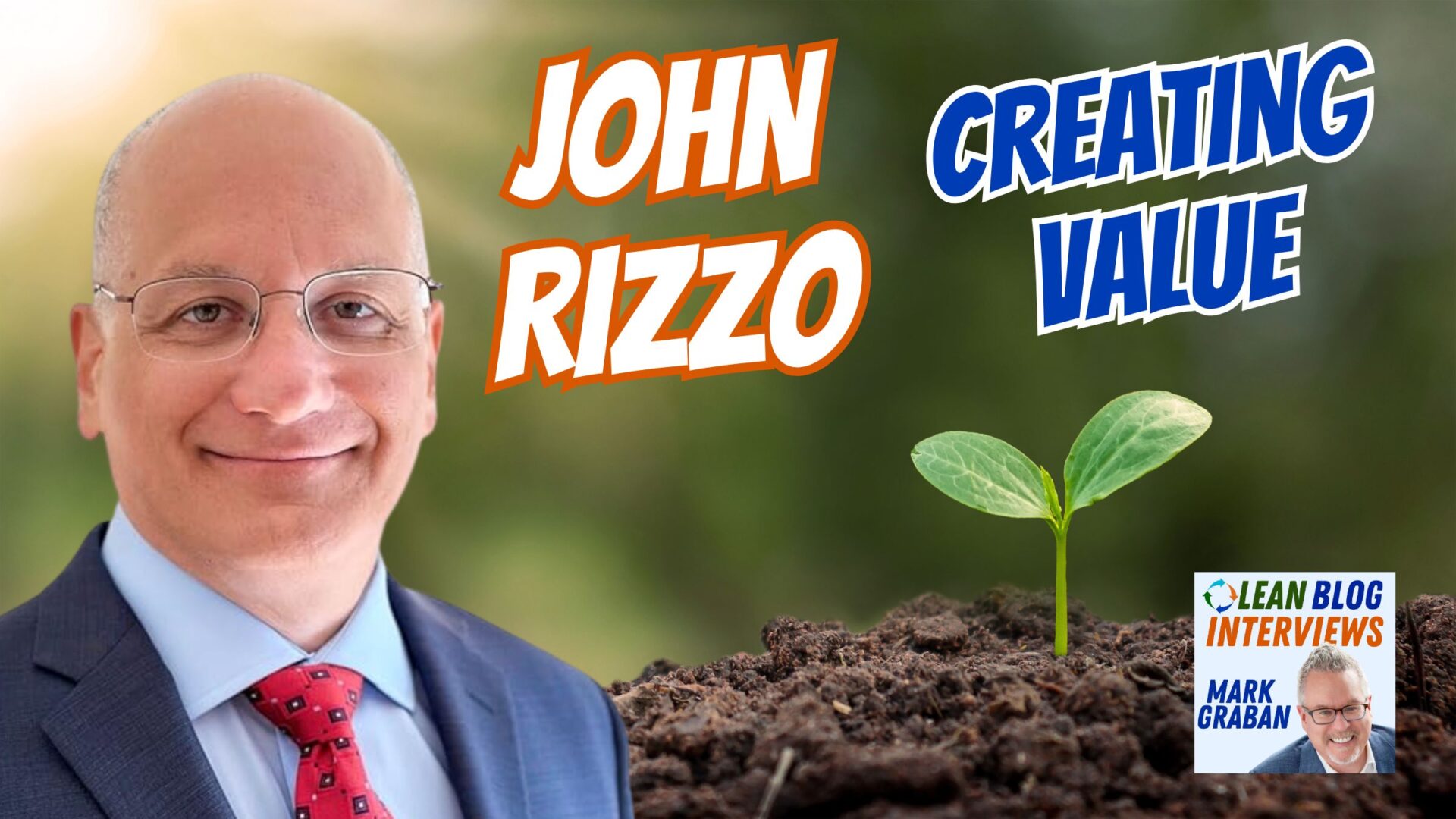
My guest for Episode #542 of the Lean Blog Interviews Podcast is John Rizzo, a senior executive, investor, and change leader who has led transformational improvement efforts across manufacturing, healthcare, retail, services, and nonprofit organizations. Over his career, John has worked with more than 1,000 teams across 50 organizations, helping create billions in value by focusing not on short-term extraction but on building sustainable systems rooted in people development.
We discuss John's new book (with Tom Ehrenfeld), Creating Value: Empowering People for Sustainable Success, and why he deliberately avoids framing improvement as “Lean tools” or command-and-control execution. Instead, John describes a holistic continuous improvement business system that starts with humility, listening, and respect for the people doing the work. Through stories from Wiremold, private equity-backed companies, healthcare organizations, and beyond, he illustrates how real improvement comes from enabling problem-solving at the front lines — not from leaders acting as firefighters or solution-givers.
A central theme of the conversation is empowerment. John explains why empowerment is not chaos or “figuring out your job every day,” but the ability to improve standardized work and change the system responsibly. We explore leadership behaviors that either unlock or suppress improvement, the dangers of over-relying on short-term financial pressure, and why putting employees first ultimately benefits customers and owners as well. John also shares lessons learned the hard way — including the importance of patience, guided discovery, and letting teams struggle just enough to truly learn.
This episode is especially relevant for CEOs, executives, managers, and internal change agents who want better results without burning out their people or defaulting to command-and-control leadership. John's perspective challenges common assumptions about trade-offs between people and performance, offering a practical and human-centered path to creating lasting value.
What We Discuss in This Episode:
- John Rizzo's early exposure to Lean and continuous improvement through Wiremold and what he learned by observing, not being told
- Why flow is the goal — and why tools like Kanban are countermeasures, not the objective
- The “six-inch move” story and how a small act of listening helped spark cultural transformation
- Why creating value is fundamentally different from short-term value extraction
- What “empowering people” really means — and why it does not mean chaos or lack of standards
- How leadership behaviors can either enable or suppress frontline problem-solving
- Common mistakes leaders make when they rely on firefighting instead of building systems
- Why guided discovery builds deeper learning than simply giving people the answer
- The role of humility, patience, and presence in effective Lean leadership
- Why continuous improvement works across industries — from manufacturing to healthcare to services
This podcast is part of the #LeanCommunicators network.
Why Does Command-and-Control Undermine Continuous Improvement?
This episode explores how command-and-control leadership suppresses learning, slows improvement, and disconnects leaders from the people doing the work.

Watch the Episode:
Thanks for listening or watching!
This podcast is part of the Lean Communicators network — check it out!

Introduction: John Rizzo and the Book “Creating Value”
Mark Graban: Hi, welcome to Lean Blog Interviews. I'm your host, Mark Graban. Our guest today is John Rizzo. He has led transformational change at companies, including Basin Holdings and Talus Holdings, creating billions in value across manufacturing, healthcare, retail, and nonprofit sectors. Working with more than a thousand teams at over 50 organizations. And we're going to be talking primarily about his new book that he has written with a friend of mine, Tom Ehrenfeld. That book is titled Creating Value: Empowering People for Sustainable Success That Benefits Employees, Customers, and Owners. So John, welcome to the podcast. How are you?
John Rizzo: I am well. Thank you for having me on.
Mark Graban: Well, it's great to have you here. I've known Tom a long time. He was the editor of my most recent books. So I'm glad that you were able to work with him and that he was able to connect us. Before we talk about the book, I like to pick people's brains and hear origin stories. How and where did you get started with Lean or TPS?
Early Lean Lessons: The Wiremold Experience
John Rizzo: It all got started when I was at Crouse-Hinds and I did a stint in sales, and our number one customer was Wiremold.
Mark Graban: Mm.
John Rizzo: And I was visiting Wiremold with the local salesperson. We go to the floor, talk to people that were using the products that we manufactured for them, and there was some commotion going on. I was like, “Well, what is that?” And it's like, “Well, that's those darn Japanese.” They said it knowing that they were helping their business. They were challenging, but helping their business.
Mark Graban: Right.
John Rizzo: And that was my first exposure to Nakao and to Lean. Fast forward a few years when I went from sales to plant management, I used Nakao and Bill Moffitt, who I met, and Art Byrne. All helped me with my transformation at Crouse-Hinds to get started.
Mark Graban: So had you stumbled into, or at least you were seeing something happening with the Kaizen event?
John Rizzo: Yeah, so Art allowed me to participate in President's Events at Wiremold. And the learning started right away. I remember one event where I created a Kanban system to be able to get material from one machine to another, from assembly to assembly. And it was interesting that I had learned how to do Kanban. I thought, “Oh, I'm going to nail this,” right?
Mark Graban: Mm-hmm.
John Rizzo: And Nakao came out and just stared at the machining, and stared at the assembly, and walked away. And I realized that flow was the goal, not Kanban. You put Kanban in when you can't get flow.
Mark Graban: Right.
John Rizzo: But in that case, I thought, “Oh, I knew how to do this.” And it was a very early lesson learned to just move the areas together and do single-piece flow. Many lessons from Art and from Mr. Nakao.
Mark Graban: Yeah. And you're not alone in that situation. This happens a lot. I think back to slightly different situations early in my Lean journey where you're taught something and how to do it, but you might miss some of the why or the context. At least you learned from it. I mean, he said nothing that just in and of itself was enough to spark you to think. He didn't even ask a question.
John Rizzo: He just shook his head almost in disgust, like, “How do you not know that? Let's just move this together.” It was an early lesson. I thought it was a good thing to do.
Mark Graban: Yeah.
John Rizzo: No, it's a countermeasure when you can't get flow. And it was just an early lesson that I learned.
Mark Graban: And I've heard a variation of what you were describing. I think the expression is, “Flow where you can, pull where you must.”
John Rizzo: Well said.
Mark Graban: That's a pretty basic thing. But yeah, we learn by doing. Tell us more. Not everyone knows the term “President's [Event].” If you could share a little bit more context and how they had you involved as a supplier.
John Rizzo: Yeah, so Art would allow people to participate in events if they were a supplier or if they were a senior executive. He would allow them–it was a long list of people who wanted to learn from Wiremold at the time. And so it was a partnership for suppliers or a way for Wiremold to share this business system with other companies. But it would have to be their senior person who would make the time and effort and then lead it at their organization. Those were my first experiences. And then I went back to Crouse-Hinds. I went from sales back into operations and started doing workshops or Kaizen events as we called them at the time. And Bill Moffitt was our mentor. And that's the “Six Inch Move,” which is in the book, which was really the start of my whole Lean journey.
The “Six-Inch Move”: Listening to Frontline Workers
Mark Graban: Yeah. So could you tell us that story briefly? I'm not trying to circumvent people from also reading the book.
John Rizzo: No, no, no. By all means. So, we had equipment scattered around the plant. We did a workshop. The goal was to move it into a similar area to get flow. And we had to get a rigger to come in and move the equipment because it was so heavy. So we paid a lot of money for somebody to come in and move this equipment into this department, which we call the cell.
Mark Graban: Mm-hmm.
John Rizzo: And the operator came in the next day and said, “You know, if you just move this piece of equipment six inches, it would've been better.” And I'm thinking, “I spent all this money. There's no way I can do this.” And Bill Moffitt said to me, “Move that piece of equipment six inches.” And we did, and that operator said, “I cannot believe they listened to me.”
Mark Graban: Yeah.
John Rizzo: We did something. And that operator turned out to be a union steward who was very influential and said to the rest of the union, “Let's give these guys a chance.” I mean, that was even before Lean Thinking had been written. So they had no idea what we were doing, but that one action said to them, “Let's give this a chance.” And we went on to do an incredible transformation. And my personal lesson that I learned was the importance of being present, observing the work being done, and listening to the people doing the work. That's guided my leadership style my whole career.
Mark Graban: And to do that six-inch move, did that require bringing the equipment back in or was it more the barrier?
John Rizzo: No. I mean, I was like, six inches, what's it matter? No, we went out and got the rigger. They came in that night at a really expensive rate to move that piece of equipment just six inches. But it really did make a difference in terms of how that person and that cell operated. And again, it was just the spark that ignited our journey at Crouse-Hinds and my Lean journey for my whole career. And I went on to implement at a number of companies that I led and then companies I worked with as an investor, and then companies I've worked with as a consultant. It's served me well in all of those areas.
Defining Value: Putting Employees First
Mark Graban: Yeah. And that's also such a relatable, sadly common situation. I think back to factories that I've worked in back in the day, or walking into a hospital department as a consultant, and that same element of people saying, “Nobody listens to us.” It's just something, maybe for a point for reflection. Let me turn it into a question for you: What goes wrong when a company learns the tools, even strategic-level Lean strategies, but misses out on that opportunity to listen to and engage the frontline staff? People might say, “Oh, we're implementing Lean,” without that very human connection, unfortunately.
John Rizzo: Yeah. And a continuous improvement business system is a system. It's not just the tools. And I think we all know that. Companies who have come to me over the years saying, “Hey, we're doing Lean and we're not getting the results,” I'd go in and look and say, “Where's your strategy deployment? Where's your analysis and your improvement plan? Where's the development of your people in terms of their problem-solving skills? Where are the workshops and the report outs and the follow-up and the KPIs?” And they'll be like, “Oh, well, we're just doing Kaizen events.” And it's not the system. And in that, people development is really at the heart of that system. We need to develop our people as problem solvers, and that's how we get the results and the sustainable improvement.
Mark Graban: Yeah. And speaking of development, before we dig into the book, I would ask about that relationship as a supplier to Wiremold. The classic Toyota-style approach with suppliers is collaboration. Not just demanding lower costs but partnering, helping you. Could you share more about that style of relationship and was that different than working with other companies?
John Rizzo: Well, sure. I mean, I can go from Wiremold, but you know, one of the businesses I am currently working with, we're a primary supplier to Toyota. And it's a substantial amount of business. We've been a Toyota Supplier of the Year award winner the last five years. And it's been that partnership. I mean, they work with us. It's interesting that we're getting an award for our results, which is based on a business system which we continue to learn from them. As we know, there's a lot of influencers in that. I've learned tremendously from Toyota as well as Wiremold and a number of other companies over the years.
Mark Graban: I know all of those experiences have influenced and informed the book. And again, congratulations on the release there. I know it's your first book. Creating Value is the title. Could you share some thoughts on defining value either in the context of Lean or in a corporate setting and thinking about value and not just waste? I noticed the title of the book is not “Reducing Waste.” Why Creating Value?
John Rizzo: So the alternative is value extraction. I've worked in the private equity world for a number of years, and in some cases, we treated people as costs to be minimized, squeezed short-term gains, did financial engineering as opposed to value creation. Value creation invests in people, builds problem-solving capability, and generates sustainable success. That doesn't just benefit the shareholders, which maybe the private equity world was a little bit more focused on, but also benefits the employees and the customers. And I use “employees” first in the title of the book.
John Rizzo: Because I've been an employee and that's just my philosophy. People say, “Oh, the customer always comes first. All about the customer.” Well, my personal philosophy, I put the employee first. My coworkers. And so when we talk about that value creation, to me it's most important that it starts with the people who do the work and then the customers and then the shareholders.
True Empowerment vs. Workplace Chaos
Mark Graban: Yeah. And that is notable in the subtitle like you said: Employees, Customers, and Owners. Do you run across people who think about assumed trade-offs? Like, “Good, fast, and cheap–pick two out of three.” Like, there are inherent trade-offs there? Do you still run across people who say, “Well, if we do things for the employees, that's going to hurt shareholder returns. If we do something good for the customer, that's maybe going to be rough on the employees”? You're shaking your head no.
John Rizzo: I definitely run across it because, especially in the consulting business that does quite a bit of work in the private equity world, there is huge pressure for short-term returns. Short-term gains. We get pushback more than I care to have to deal with. That's not the fun part of the job. But yeah, we definitely get pushback still on it. But in the end, the people who do the work already know how to improve it. And if you can understand that and be a humble leader and allow that to take place, you get the results. So it's a lot of education working with the private equity and with the leaders that think that their job is to make those decisions, to make those improvements, and that's why they're in that position. They don't have the humility to be able to let the people who do the work do it. And so that's another area where we get resistance. But through coaching and training, sometimes we overcome it, sometimes we don't.
Mark Graban: Right. But it seems like there's an opportunity, you know, this book is going to reach an audience that might not pick up a book with the word “Lean” or “Toyota” in the title. Tell us more about who you think the target readers are for the book and who you're trying to reach.
John Rizzo: Well, it's interesting, I have used that terminology on this call, but I don't use the word “Lean” in the book. It's referenced a couple of times in context of Wiremold using it or some of the early companies. But I don't use the word Lean. Frankly, I couldn't even define it for you today. So, I use the term “continuous improvement business system” or a “holistic business system,” which again, draws from a lot of thought leaders going back to Deming and Follett and Taylor.
Mark Graban: Yeah. So are you trying to reach CEOs, senior operations executives?
John Rizzo: People–and not just in business. A lot of the stories have to do with services and retail. So it's change agents. And in any of those organizations. That's who I'm trying to get to. People who want to bring about change. And again, it's a wide variety. It's not just manufacturing, it's services, it's retail, it's municipal government. So all those areas. I'm trying to go after the change agents.
Mark Graban: Yeah. And then the other thing I was going to ask about employees. It seems like there's an opportunity to reach the readers of the book and maybe open their eyes. When employees are viewed as a cost, we tend to think a lot of discussion even in society is about pay and benefits. And I wouldn't question that pay and benefits are important, but I think there's a lot more to it when it comes to creating a workplace that is really a great place to be beyond the pay. So I was wondering if you could share a little bit more in terms of the benefits to the employees. Because they might hear, “Oh, you're going to develop me. Oh, well you want more out of me.” What are some examples of where–I mean, I already agree with you–but how would you make that case that no, this is better for the employees?
John Rizzo: So the first word on the cover of the book is “Empowering”. It's the very first word: Empowering people for sustainable success. And empowerment doesn't mean trying to figure out your job. That's chaos. Empowerment is being able to make changes to the standard and how the work is being done. So, you know, we've got to have standards. And by the way, everybody's got to follow those standards every time because we want consistent quality, productivity, service, safety. But “Wait a minute, I got a better way.” Okay. We need a way for people to understand how to work through the organization to get that better way implemented so we change the standard. So empowerment is not figuring out your job today. That's chaos. It's being able to make improvements to your job. That's where the employee comes in and it helps improve their satisfaction because they now are able to improve their job, to improve the processes. And that's how you get over the, “Oh, this is all about cost or getting more out of us.” It's truly creating an environment where people are empowered.
Mark Graban: Yeah. And then reinforcing that being listened to and being empowered leads to benefits. Because there's an expression to me I think sounds great. I've heard it from Toyota people that everybody here has two jobs: to do the work and to improve the work. And some people freak out when they hear the two jobs. Like, “Well, I'm too busy.” Or it sounds like an added burden instead of something to take interest in and get some joy or benefit out of.
John Rizzo: That's interesting you talk about two parts of the job. You know, in the book I've got a copy of it here. This is a sign I give everybody when they start a position at a company that I'm involved with or run. And it's “Time Allocation.” And the first thing is “People Development”.
Mark Graban: And that was in big letters.
John Rizzo: That was in big letters. The medium letters is “Make Improvements.” And the small letters in red is “PowerPoint and Everything Else”. So really, the jobs are people development and make improvements. Those are the two things that I see. And I would put 50% on that people development, 30 or 40% on making improvements, and then 10% everything else–PowerPoint and everything else. So that's what I kind of communicate to people when we bring them into our organizations. I mean, that is their job. It's about do you have the right people? Are they trained? Do they have the resources to be successful? That people development is just so important. And then actually making improvements ourselves.
Mark Graban: Yeah. And that goes hand in hand. Some people there is a risk that people might hear, “Oh, okay, you want me to spend more on training, we're going to increase our training budget.” It's more to it than that, or different than that.
John Rizzo: Well, yeah. I mean, you're really changing a culture to be able to run a business that way. And it's–there's a lot to do it. And you know, we definitely get questioned on things that are not directly related to a return that next day. We get those all the time right through the workshop process and through the daily improvements that are happening. But we definitely get pushback on the costs of some of these things because you're not able to draw a straight line between training and that month's financials.
Mark Graban: Sure. But I think there's that change in mindset from managers or leaders at different levels being the ones who need to have the answers and then tell people what to go execute, as opposed to what you're describing–this more Toyota-ish idea of getting things done through people development. Can you share an example of a situation where it might've been faster to just tell someone what to do as opposed to behaving in a way that also develops the people involved or developing the leaders involved?
John Rizzo: I got many stories. One that just popped into mind is we were at a company and we were in an area, we were going to do a workshop. And this one woman said, “Not on my bench. I don't want any of that Lean stuff. Not in my area. I don't want it. I don't believe in it. I don't need it”. And so in the next area, we worked with the team and the person got new lights. They got a comfort pad to stand on. All the material was being replenished from the back to make it easy. The station was right-sized. It was really quite well done by the person who was doing the work.
John Rizzo: And the team was supporting her. The other person said, “I want all of that. I want all of that.”
Mark Graban: They do want all of that.
John Rizzo: So they said, “When can you come help me do all of that?”. So rather than telling this person that they needed to improve their workstation and get these things, especially the back feed which made it much better and line server and all of that, they had to see it. And then they would be able to make the change. They saw it elsewhere and then they had the opportunity to do it, so we didn't tell them to improve their workplace organization. If they saw it, then they did it, then they believed in it. So yeah, the top-down kind of command and control has got its own issues obviously.
Mark Graban: No, and I've seen, especially in healthcare the last 20 years, to me, one of the best signs that our Lean efforts in an initial area are going well is when word starts to spread. People go to the cafeteria, they eat, they run into friends from other departments. And when good things are happening with people instead of being done to them, I've heard those same questions of like, “Hey, why can't our area… help bring this approach to us next”.
Applying Lean Principles in Healthcare
John Rizzo: And congratulations on the work that you've done in the hospital. I think your book is one of those right over my shoulder right there, Lean Hospitals. And we have done work in healthcare. I have some experience. And I certainly have learned from you and your writings in that area. And one interesting thing is people ask me, “What's the most complicated company you've worked with?”. And I say, “It's healthcare, it's a hospital”. When you do a value analysis and an improvement plan, which as you know maps out all the processes and comes up with the roadmap for improvement, when you've manufactured something, even if it has thousands of components, it's pretty simple. You got the components coming in, metals maybe fabricated, you're doing some assembly. At shipping, it's pretty simple.
John Rizzo: The hospital with things coming in from all different directions and going all different directions and all the core competencies. It's been interesting. To me that's the most complicated implementation that I've dealt with. I don't know, do you feel the same there?
Mark Graban: I mean there is a lot of complexity. There are a lot of similarities. Any organization is built on people and processes and that all exists in healthcare. But some of the peculiar dynamics of a lot of very important frontline staff are powerful, independent contractors. And that's even adding the complexity of an academic medical center that has the dual purpose of treatment and teaching. And then there's–I mean, I think it's hard to find another industry where you have third-party payers and you think about value to who. Creating value for the patient. And would the customer want more of that? I'm like, well, the patient versus the payer, those are not always aligned.
John Rizzo: Oh my gosh. Yeah. That's complicated. It's you and others have proven that it can work there. And another point in the book is we have many examples of this working in all different industries. I mean you name it–whether it's manufacturing or services or retail or running a museum or we did work with laboratory animal science, with the largest hospital chain in the Northeast. It just works everywhere.
The Shift from Firefighter to Humble Leader
Mark Graban: Yeah. And we can focus on the people side of things. As you write about the wisdom of the people doing the work is the true source of sustainable improvement, but that doesn't mean leaders have nothing to do. How does the role of the leader shift? What are some of the behaviors that either unlock that wisdom or unintentionally maybe tamp it down?
John Rizzo: First there's humility. The leader has to have humility to allow the organization to make improvements and not have the mindset that they have to be the one to make those changes. The other thing on the leadership side is, a lot of times those leaders got promoted because they were the best firefighters.
John Rizzo: And they keep getting promoted up the line because they're the problem solver and they go in and tell people what to do and fix it. And they're really good firefighters. It's very hard for them to change from being that firefighter to being the person that sees the waste. So they're the ones who see the problems and having built a problem-solving organization, allowing that organization to resolve the problems or make the improvements. So that can be very difficult for some leaders to come out of this “I'm the firefighter, I'm the fixer, I've gotta do it” to be a different role where, when they're in the office or in the factory or in the warehouse, they're now looking for problems or sometimes we call 'em waste. Looking for that, pointing it out, and then making sure that somebody's grabbing it and running with it and getting it improved or implemented and things in place to make sure that it's sustainable. So it's a big change for some leaders going down this journey. One other thing that popped into my head: When I got started at Crouse-Hinds, Bill Moffitt came in and said to the president when we got started, he walked around the factory and he said to him, “Everything is wrong at Crouse-Hinds.” He said, “Everything you do is wrong”.
Mark Graban: Everything.
John Rizzo: Everything. And to Bill Tuck's credit, my mentor, he said, “Okay, show me”.
Mark Graban: Yeah.
John Rizzo: Teach me. As opposed to, “You don't understand. Our business is different, and all the other reasons. I know how to run this business. I know what to do”. It's that attitude of the senior leader that's so important. If it's, “This won't work here,” or “I know how to run this business…”.
Mark Graban: Or there's the excuses of like, “Yeah, well we know this isn't ideal, but this is the way it is. This is the way it has to be”. Because I've seen pride get in the way. People in healthcare might say, “Oh, well yeah, it's unfortunate that we have all these hospital-acquired infections, but that's just… that happens”. Or there's this implication of, “Well, if that was solvable, we would've solved it because we're smart and motivated.” But maybe we could still get at it, we just don't know how yet.
John Rizzo: It's so hard for some people to overcome that. That attitude that what you're saying is, “I'm not smart enough. If I was, I would've already done this”. But people jump to that. And it can be difficult to overcome. And fortunately for Bill Tuck, he was open to change, open to learning, and saw the results quickly and quickly became the leader of the entire process for us. Very fortunate because we might not be having this call today if that conversation had gone the other direction.
Mark Graban: So it is difficult to change these habits. I was thinking back this morning to a previous guest who had been a healthcare senior executive, Kim Barnas, who wrote a book called Beyond Heroes about creating systems where we don't need everyday heroic behaviors. And sadly just learned that she passed away. Um, so just kinda wanna give a minute for those who are listening who knew Kim to think about her and her family. But you know, she contributed so much in this area. I think part of the habit is an organizational habit of senior executives rewarding the firefighters, like you said, through promotions, bonuses, pats on the back, what have you. What's the role of a CEO? I wasn't there with Art Byrne. Does a CEO like Art Byrne kind of consciously shift their tone and say, “Okay, it's great you put the fire out, but we can't have more fires”? It's hard to reward people for the fires that don't start, right?
John Rizzo: Yeah. Certainly the CEO is responsible for creating the vision, communicating the vision. That's very important. And then deploying the strategy of the business. I mean, we use Hoshin, don't want to get hung up on words, but a process where the strategy of the business can be deployed throughout the organization. So that's another role as CEO, and then it's creating a sense of urgency. I mean, this is hard work and change is hard and for people to be able to be open to embrace change, maybe a sense of urgency can help that process along. Also it's their responsibility to bring in the right leaders and to lead the process and develop them accordingly and hold them accountable.
Mark Graban: Well, no, I mean, I think it's… generally things travel downhill and this question of humility, I mean, the systems and organizations may ignore the more humble leaders that don't toot their own horn, who don't claim credit for things. Organizations also maybe tend to promote and reward those that are less humble. I mean, it seems like that's something hopefully leaders already embrace: demonstrating humility, trying to reward it. Like rewarding somebody for saying, “I don't know, let's figure it out,” as opposed to getting punished for not knowing.
John Rizzo: Sure, sure. That's an important part of this culture.
Mark Graban: How can we help develop that? If a senior executive's not humble, it's not like we can send them to a humility workshop.
John Rizzo: You know, one of the things that I learned from Art Byrne, he would allow a CEO of another company to come in and participate in an event. But it would have to be the CEO though. I mean, a lot of people were down the line and they could come to Wiremold and be like, “Oh, this is fantastic”. But if the boss didn't believe it, it's just creating frustration. And I've utilized that. You know, the stint I did in consulting, sometimes we would have companies that would come to us and maybe they were pushed toward us a little bit by the private equity ownership. The CEO's like, “Oh, I don't know.” I would bring this CEO to another company. Because you're not gonna convince them in a PowerPoint presentation. But getting them to another company with a CEO-to-CEO conversation even. Ideally participating in a workshop, but it could just be a walk around the floor or the organization. So I found that the most useful way to get that CEO who doesn't get it to maybe have that light bulb turn on. Because you're just not gonna do it the other way. You're not gonna go in there and go, “Blah, blah, blah. Here's my PowerPoint.” This is what people have done in the past. I mean, there's a lot of documentation on this process and success stories, but getting them to appear and seeing it, that's been the most successful that I've found to get that light bulb on.
Mark Graban: Yeah. And eye-opening and hopefully humbling in what I think is the most correct use of the term. I mean, Nakao staring at your Kanban situation in the moment was probably humbling, but you chose to learn from it. Some people might just get upset and say, “Well, that guy's a jerk.” But going to a factory where you might see, “Oh, okay. There are places operating at a much higher level than we are”. Like I think of a friend and a former podcast guest here, Dr. John Toussaint, who was the CEO at that health system. Kim Barnas was at where John had a board member take him to a snowblower factory in Wisconsin, Ariens. Dan Ariens I think was actually on his board. And John reacted to that moment with the humility to say, I'm paraphrasing him, that they treated those snowblowers better than we treated our patients when it came to flow. And he made the choice to be inspired by that instead of being dismissive, which is I think a way of testing whether that humility is there or not. How do you react to a situation where you learned you're not the best in the world?
John Rizzo: Yeah. That sometimes people gotta see it. They just gotta go see it and talk to their peers. ‘Cause they may be able to answer their questions certainly better than a consultant or a book. So yeah, get that CEO to their peers or to other companies, and that can really engage them in the process. I have not seen that go backwards. It's a non-threatening situation. They're going into another company and in every case I've seen something positive come out of that.
Guided Discovery and the Art of Leadership
Mark Graban: Yeah. Oh, good. Yeah, I think one of the other habits that's interesting or it gets rewarded and becomes really a habit, is knowing things versus discovering things. Or demanding answers quickly, as opposed to encouraging people to learn through experimentation and iteration. How do you help leaders first off see that gap or that possibility? How do you help them make that shift?
John Rizzo: And I haven't done this in all cases, but it's really that guided discovery process where Nakao came out and turned his head, right? He didn't have to tell me that. I had to figure that out. I mean, by the way, when I learned that Kanban system, it was from a gentleman, Bob Pentland, who worked with the Moffitt Associates. And when we figured out how to do a Kanban system, a replenishment system, he didn't give us any formulas. He said, “There are no formulas for this. You gotta know your usage and how long it takes to replenish your container quantity and go figure it out”. And we kind of came up with something. He said, “Well, go simulate it on the orders for the last month.” And that didn't work. And we changed it. And we came out of that with a really good understanding of how to do that. Not some formula in a book. So guided discovery is a process that I use quite a bit. Uh, and again, I haven't always done a good job with it, but those leaders learn from me 'cause they see me modeling guided discovery. And then they have gone out and said, “Well, I don't have to tell them. I'm gonna let them figure it out”. And then certainly in this workshop process where we pull people together to go through a process where they're starting with understanding the current state, documenting the root cause, then they're going out and trying things. It's not me as a facilitator telling 'em the solution. They're coming up with it and I'll be like, “Should we do this?” I'll be like, “I don't know. Go try it”. They can learn at the team level too that they have to try things, they have to experiment, and I think some of the best learning has come from this guided discovery process.
Mark Graban: Now, when you said a minute ago you didn't always do that well, is that a matter of falling back into the telling habit and realizing, “Oops, I did that,” or what else can go wrong when trying to facilitate that approach?
John Rizzo: Yes. Guided discovery takes a certain amount of patience. With your organization to be able to try to make mistakes, to fail. And you know, I'm like, “Well, wait a minute, I've already done that. I've already tried a bunch of things and failed, and I figured it out now. So this is the way you could do that”. Because I've gone through that, so I lack patience.
Mark Graban: It sounds efficient. Like, “Hey, you should learn from my mistake”.
John Rizzo: Yeah. Or, having literally worked with around a thousand teams over my career, I've got a lot of kind of knowledge how other teams have solved this problem. So it's sometimes quick for me to not have patience and go, “Well, here's how another team solved it”. And it might be the right thing and they might go, “Oh, great,” but you're not getting the learning that you are if some people have to struggle and figure it out. And you may not get the success with implementation because, “Oh, this guy said the other person solved it. This other team solved it this way. Well, we must be able to do that.” But they haven't really internalized that that's the best way. So I mean, I've been impatient at times and wanted to share other people's success. You were able to speed along the improvement as opposed to people figuring it out now. Now sometimes people can go too far. I mean, people, if they're truly struggling. And I've probably made that mistake too, where they've struggled so far that they get fed up where I could have with some facilitation maybe have got them back on track. So there's a middle ground that if you live in, works really well.
Mark Graban: Yeah. I think with a lot of things involved with Lean, finding the balance point in the middle. I've seen people get frustrated by this leading by asking questions approach. I've seen people literally get frustrated and say, “Would you just tell me what to do?”. And you know, that's… but I think some of that is people have been conditioned that if you try something and you're wrong, you get punished. If you speak up with an idea that doesn't work, you get punished. So in a way, it's safer to fall back into that “Just tell me what to do, boss” kind of mode.
John Rizzo: Um, yeah, and I have one team that I'm working with that is military and they're familiar with command–centralized command and decentralized control. And as a leader, I am not about centralized command.
Mark Graban: Right.
John Rizzo: And that causes a lot of frustrations. I mean, they're used to, on the control side having a lot of leeway and not clear guidelines and ambiguity. But man, they're used to on that command side, that it'd be centralized, be clear and direct. So when I live in that boss mode and for those type of individuals–and that's not my leadership style–it does cause some significant friction and frustration.
Mark Graban: I think there's sometimes discomfort like thinking about strategy deployment. As you write about people used to being told what the strategy is and maybe go figure out how to execute it. That sounds like what you're describing with centralized command, decentralized control. What are some thoughts on helping people get comfortable with playing catch ball, with pushing back with less fear? You know, because a lot of organizations, it's so ingrained. “Well, if the boss tells you this is the direction you say aye-aye captain and move,” instead of the boss saying, “Well, what's your input on this?”. Help people move beyond saying, “That's great,” and actually we can't play catch ball if someone's not willing, doesn't feel safe to throw the ball back.
John Rizzo: Well, certainly in my role as a senior executive and I run a number of companies that's about having the right people in place. And them having the right conversations to understand their role with what you mentioned, the catch ball process where you're going back and forth. So, it's a little easier from a CEO standpoint. From the consulting standpoint, it's much more difficult and it's just a matter of coaching and mentorship to help people understand that they don't have to make all the decisions. They don't have to say anything that if they have an objective that maybe the senior teams come up with and they've passed it down to say one of the plant managers and they, it's going to be better for them to come back to you with how they're going to meet that top-line objective that's been sent. Then you saying, “Here's the top-line objective and here's your portion of it and how you're having to do it”. So it's just a coaching environment where, give this a try and you might be surprised that you know, you're going to get what you accomplished by giving them the opportunity to tell you how they're going to do it, rather than you telling them how to do it now.
Writing “Creating Value” and Future Plans
Mark Graban: All right. Well, John maybe one more question before we wrap up. John Rizzo has been our guest again. The book is Creating Value: Empowering People–the first words on the cover of the book–Empowering People for Sustainable Success that benefits employees, customers, and owners. Listed in that order, which I think is great. So, think about the writing process. What's the best thing that you learned along the way? Like, I think as authors we have the idea of what we're going to write, and then it hopefully evolves as we go and we learn things. What's the best thing you learned either about all of this topic or writing?
John Rizzo: I wish I had learned how to use commas and adjectives before I started writing. I had a lot to say and not a lot of experience with actually writing. I think if I had participated in some workshops on writing… obviously Tom helped me enormously.
Mark Graban: Yeah. It's Tom Feld again for this.
John Rizzo: Yeah. Thank you for clarifying that. Helped me and educated me. But I think if I had attended some workshops, I might've done a better job of a process. You know, “Let's come up with a premise. Let's come up with an outline. Let's build it out from there”. I started with a couple hundred pages of stories. So I would've gone through it a little differently. I'm actually working on Book two, which is a companion book. And that's going much smoother because I've kind of learned the process. What I'm actually doing is I'm actually writing a business novel in the spirit of The Goal.
Mark Graban: Oh, great.
John Rizzo: So it's a business novel about the main character about my experiences and all the principles are from the first book Creating Value, but I'm also tying back today's management theory to the original thought leaders in management. So I go back to Follett, I go back to Taylor. I go back to Deming and I draw the principles of today going back. So anyway, book two is in the works and it's just gone a lot smoother because I know the… well, I guess I just thought of this. I mean, we talk about process in the business system, right? There's a process for writing. I didn't know that process. I wish I had learned that process. It would've gone smoother, but it was tremendously enjoyable to do. And it's inspired me for this book two.
Mark Graban: Well, that's great. And Tom is a big help and having an editor is so helpful as a partner in that process. So I would love to have you back someday, John, to talk about that second book. I think that would be fun to dig into that talk about what you've learned and experience related to Deming. He is a hero of mine and a lot of people listening. John, thank you so much for taking time out of what's truly a busy schedule. Thanks for being on the podcast.
John Rizzo: My pleasure. Thank you for having me.