
Long-Term Thinking: What NUMMI Understood and GM Struggled to Practice
TL;DR: GM said it believed in long-term thinking. NUMMI actually practiced it. A 1987 GM executive summary admitted that short-term financial pressure drove decisions at GM far more than at NUMMI. The difference wasn't philosophy — it was system design. And that same tension between short-term pressure and long-term capability still undermines improvement efforts today, especially in healthcare.

When Toyota and GM launched NUMMI in the 1980s, they didn't just reopen a failed automotive factory. They created a living comparison between two different ways of thinking about leadership, improvement, and success.
Both had mission statements that sounded reassuringly similar. But what happened at NUMMI revealed an important difference–between espoused values and the management systems that actually shape day-to-day decisions, especially when tradeoffs get uncomfortable.
That contrast shows up clearly in the NUMMI Management Practices: Executive Summary (January 1987), a confidential GM report now preserved in the Don Ephlin Papers at the Walter P. Reuther Library. See an earlier post about that report:
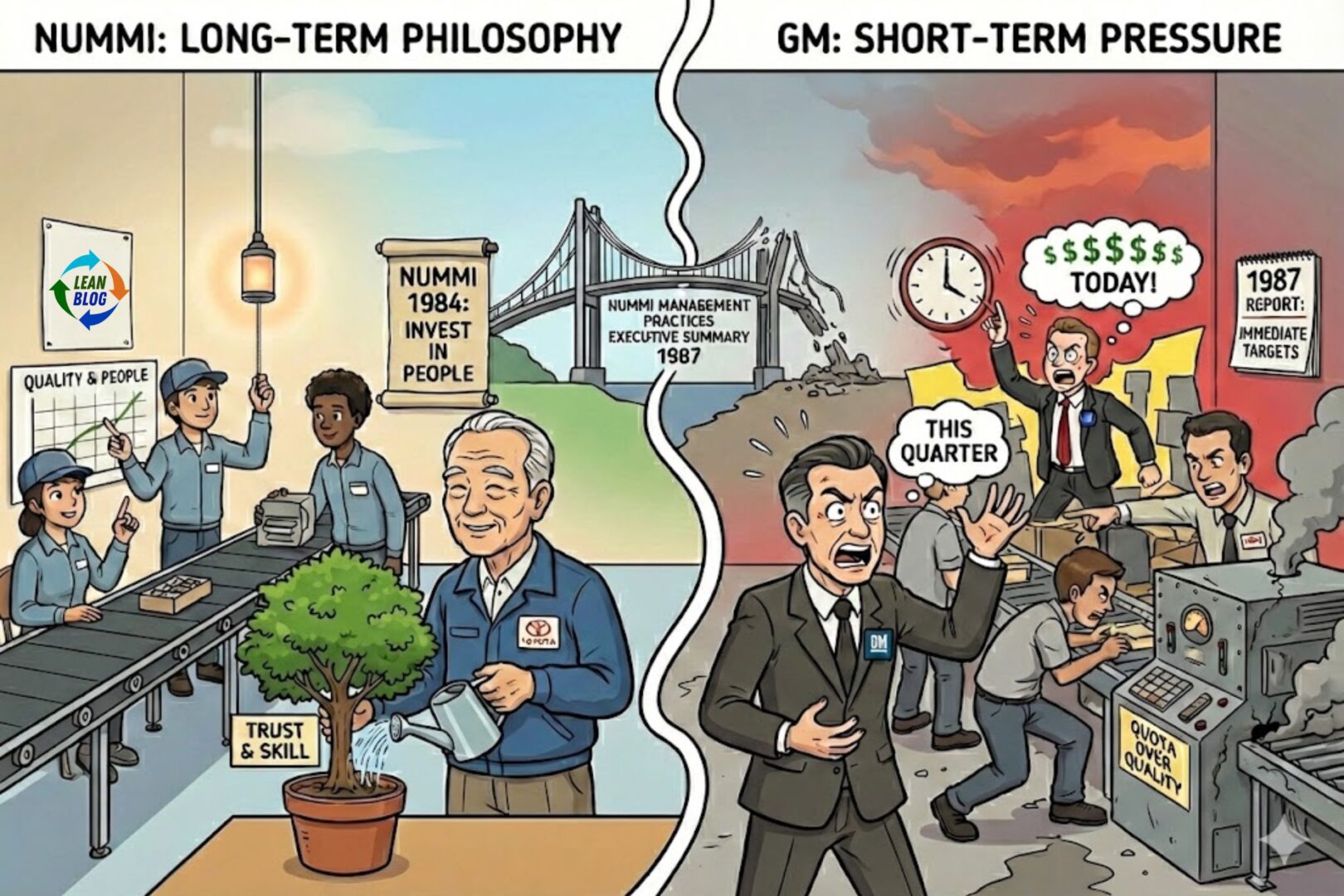
“GM's stated business objective is long run profitability–the same as NUMMI's, as evidenced by GM's commitment to ‘sustained, superior return' on investment. However, virtually all of the GM and NUMMI managers interviewed expressed the belief that short-term profitability was more often a major factor in management decisions at GM than at NUMMI.”
— NUMMI Management Practices Executive Summary, 1987
That paragraph is remarkably candid. And in hindsight, it may be one of the most revealing observations ever written about Lean and leadership.
GM said it was playing the long game. NUMMI actually organized itself to do so.
Toyota Way Principle #1–Before It Had a Name
Years later, Jeff Liker would formalize this mindset as the very first principle of The Toyota Way:
“Base your management decisions on a long-term philosophy, even at the expense of short-term financial goals.”
This concept was already visible at NUMMI in the mid-1980s. What GM's own study team saw–but struggled to translate into action–was that long-term thinking isn't a slogan. It's an operating system.
NUMMI's leaders understood that short-term optimization often creates long-term fragility. Toyota had learned, sometimes the hard way, that sustainable performance depends on patience, consistency, and respect for people–not constant pressure to hit the next number.
The GM study team captured this gap almost painfully well. They recognized that many GM managers were responding rationally to the system they worked in–one that emphasized near-term financial results over long-term capability.
NUMMI, by contrast, made decisions based on learning and trust, even when that meant sacrificing short-term output.
How Long-Term Thinking Showed Up at NUMMI
The Executive Summary shows how NUMMI's philosophy played out in daily management decisions.
1. Investing in People, Not Just Equipment
“The NUMMI philosophy is based on mutual trust and respect between management and employees, a shared responsibility for quality, and the belief that problems are best solved by those who do the work.”
Toyota understood that people–not machines–were its most important long-term asset. NUMMI invested heavily in training, teamwork, and problem-solving capability, even when those investments slowed immediate production.
At GM, training was often treated as a cost to be managed. At NUMMI, it was viewed as a multiplier.
2. Building Stability Before Speed
NUMMI leaders believed that quality and morale emerged from stability, not urgency.
“Quality, productivity, and morale are the natural results of a system in which problems are seen as opportunities for improvement rather than as failures.”
That's long-term thinking in action. When problems appeared, NUMMI slowed down to understand and address them. In many traditional GM environments, the pressure was to push through problems to meet today's target–often ensuring that tomorrow's problems would be worse.
3. Making Long-Term Goals Visible Every Day
Toyota didn't rely on posters or mission statements to reinforce its philosophy. It designed daily work around it. Andon cords, daily problem-solving, and structured coaching made improvement routine rather than episodic.
Every time a team member stopped the line, they were acting out Principle #1–trading short-term output for long-term quality, trust, and learning.
The No-Layoff Principle: Long-Term Thinking in Human Form
One of the most striking sections of the Executive Summary addresses employment security.
NUMMI's leaders recognized something fundamental: you cannot expect people to surface problems, stop production, or expose waste if they fear losing their jobs as a result.
“NUMMI management has made a commitment to stable employment and no layoffs as a result of productivity improvements. Employees are expected to contribute to continuous improvement, and management's responsibility is to ensure that these improvements do not threaten their jobs.”
— NUMMI Management Practices Executive Summary, 1987
Productivity gains at NUMMI didn't lead to headcount reduction. They led to redeployment–training, Kaizen work, and preparation for future demand. This was Toyota Way Principle #1 expressed in human terms.
It's also a lesson that remains highly relevant in healthcare and other industries, where improvement efforts can unintentionally trigger fear that “efficiency” means job loss. NUMMI showed that when people trust the system won't punish them for improving it, improvement accelerates.
Read More: Lean Without Layoffs: The Commitment That Makes Continuous Improvement Work

Why GM Struggled to Practice What It Preached
The 1987 report notes that GM's mission statement emphasized quality and people, much like NUMMI's. But the surrounding system told a different story.
“GM's Mission Statement also recognizes quality as a key operating objective, as does NUMMI, and highlights the importance of employees. Missing from the GM Mission Statement is any reference to cost, but cost competitiveness is part of General Motors' Guiding Principles.”
— NUMMI Management Practices Executive Summary, 1987
The words were there, but the incentives were not aligned.
GM managers faced relentless short-term pressure from internal metrics and external markets. NUMMI's leaders faced economic realities too, but they worked within a system that deliberately balanced today's needs with tomorrow's capability.
At NUMMI, philosophy guided decisions.
At GM, pressure often did.
Read and listen to one GM leader's experience with this struggle.
When I started at the GM Livonia Engine Plant in 1995, the NUMMI philosophy hadn't spread there.
The Ripple Effects of Short-Term Thinking
That difference showed up everywhere:
- Supervisors focused on daily output rather than learning
- Problem-solving focused on restarting production, not understanding causes
- Quality issues were treated as exceptions, not system signals
- Fear of delay or blame discouraged curiosity and learning
The organization stayed busy–but learned slowly.
NUMMI often looked slower in the moment, yet improved steadily over time. In Lean Hospitals, I wrote that organizations built on fear may achieve compliance, but rarely commitment. The same is true of short-term thinking. It generates activity, not sustained improvement.
Playing the Long Game
The NUMMI Management Practices Executive Summary captured the contradiction clearly. GM and NUMMI talked about the same goals–profitability and quality–but treated them very differently.
“Virtually all of the GM and NUMMI managers interviewed expressed the belief that short-term profitability was more often a major factor in management decisions at GM than at NUMMI.”
— NUMMI Management Practices Executive Summary, 1987
That sentence could easily describe many organizations today.
If you want sustained improvement, it's worth asking a simple question:
Are we optimizing for short-term wins–or building long-term strength?
Toyota Way Principle #1 reminds us that long-term thinking isn't just the first principle of Lean. It's the one that makes all the others possible.
Why This Matters So Much in Healthcare
The lessons from NUMMI matter deeply in healthcare because hospitals face the same tension between short-term pressure and long-term capability–often with far greater consequences.
In Lean Hospitals, I wrote repeatedly that most performance problems in healthcare are not caused by a lack of effort or professionalism. They are caused by systems that prioritize short-term throughput, cost containment, and compliance over learning, stability, and respect for people.
Healthcare leaders live under constant short-term pressure: daily census, length of stay targets, staffing shortages, budget gaps, regulatory requirements, and public quality scores.
Short-term thinking in healthcare often shows up in familiar ways:
- Asking staff to “just get through today” instead of fixing recurring problems
- Treating improvement work as optional when units are busy
- Cutting training, coaching, or improvement time to protect near-term productivity
- Responding to errors by asking “who made the mistake?” rather than “what in the system allowed this to happen?”
In Lean Hospitals, I emphasized that blaming individuals for system failures not only fails to prevent recurrence–it teaches people to stay quiet. Fear becomes a rational response.
NUMMI demonstrated the same principle decades earlier: you cannot ask people to stop the line, surface problems, or expose waste if doing so creates personal risk. In healthcare, that risk may not be job loss–but it can be blame, shame, reputation damage, or professional consequences.
This is why psychological safety is not an abstract cultural concept in healthcare. It is a prerequisite for patient safety.
Just as at NUMMI, long-term thinking in healthcare becomes visible through daily leadership behaviors and system design:
- Protecting time for improvement, even when volumes are high
- Investing in staff capability, not just new technology or buildings
- Treating reported errors and near-misses as learning opportunities, not liabilities
- Making it safe for anyone–nurse, physician, technician, or aide–to say, “Something doesn't feel right”
In Lean Hospitals, I argued that organizations built on fear may achieve short-term compliance, but they rarely achieve sustained improvement. NUMMI proved the same point in manufacturing. Long-term thinking creates trust. Trust enables learning. Learning drives better outcomes.
For healthcare leaders, the NUMMI lesson is not theoretical. It's practical and urgent: If we want safer care tomorrow, we must be willing to slow down, listen, and learn today–even when short-term pressures push us to do the opposite.
That's not idealism. It's strategy.