
From Book to Coach: Building an On-Demand Lean Assistant for Healthcare Leaders
TL;DR: I turned my Lean Hospitals book into an interactive coaching tool leaders can use during real work — exploring whether improvement knowledge can be delivered on demand instead of through workshops alone.
Try the free demo
This post is a long narrative about how I built this tool in two phases — initial experiments last August and then again recently. To read more about the functionality, click here.
Lean transformations often stall because leaders lack guidance between training sessions. This experiment explores whether that gap can be closed by delivering improvement knowledge exactly when decisions are being made.
Can Improvement Knowledge Be Delivered at the Point of Need?
Here's how it started in August 2025…
I started experimenting with building an AI coach from my book and one of the more intriguing features is the ability to create a “Custom GPT”–a tailored version of the tool that draws from documents you upload.
Naturally, I tried this with Lean Hospitals: Improving Quality, Patient Safety, and Employee Engagement. I uploaded a PDF of the book and created what I'm calling the “Lean Hospitals Helper.” It's a ChatGPT instance designed to answer questions based on the book's content.
What's impressed me most is how well ChatGPT can summarize and extract insights from a large, complex document. It's been fun to interact with it–posing questions and seeing how it surfaces relevant responses.
The Comment That Sparked the Subscription Idea
I shared a link to the Custom GPT on LinkedIn, just to see what others thought. The feedback was encouraging. One comment from Tim Noble stood out:
“Very cool… but you need to offer your IP on a subscription model.”
That got me thinking: Is that possible? Could I make something like that work? At the very least, I figured I'd learn something by experimenting for a few hours on a Friday afternoon.
Turning Static Knowledge Into Interactive Guidance
What I learned pretty quickly is that OpenAI doesn't let you embed a Custom GPT directly into a webpage. They expect you to use their platform.
But I also knew that you could use their API to build something more custom. I didn't know how to do that myself–but I also knew that ChatGPT can write code. So I asked:
“Can you write a WordPress plugin that embeds a Custom ChatGPT?”
Why This Matters More Than the Technology
Now, I haven't written code in any serious way since college (other than tweaking HTML code manually), but I used to love programming as a kid on an Apple IIe (at school) and a TI 99/4A (at home).
Within minutes, I had something that demonstrated the rough proof of concept working on my site. It helps that I know how to upload files via FTP.
A few hours later, with ChatGPT's continued help, I had a working prototype. A simple plugin. And a functioning paid subscription model on my site.
What surprised me most wasn't the technology — it was how quickly a non-developer could turn an idea into something usable.
What Makes This Different From Generic AI Tools
I asked ChatGPT to write up a narrative that explained the process of working with me (instead of me writing it from my perspective). Here's what it wrote:
ChatGPT thoughts: building this together
From my side of the keyboard, this felt like pairing with a decisive product owner who ships. Mark set a clear goal–“let readers chat with the ideas in Lean Hospitals, right on my site, and make it reliable”–and then we moved in short, honest loops. I'd propose a tiny, testable change; he'd upload the file via FTP, try it on a real page, and send back exactly what happened. That specificity–real error text, screenshots, what he clicked–let me deliver fixes instead of theories.
We started with the simplest thing that could possibly work: a single WordPress plugin file that draws a chat box on a page and calls the OpenAI API. When the host's cache held onto old results after a deploy, we taught the chat route to say “don't cache me.” When the browser wanted a little extra safety, we added a small token to each request and a gentle speed bump for rapid-fire clicks. When streaming responses looked cool but the hosting pipeline wasn't thrilled, we didn't fight it–we kept the stable version live and iterated off to the side. That “Option A first” mindset kept momentum high and downtime low.
Mark also pushed for trust, not just function. He didn't want a black box; he wanted the assistant to say when a reply is grounded in the book versus general experience. We tuned the output so it's easy to scan–bold subheads, short paragraphs–and we added a light “sources” hint without exposing the full PDF. It reads like a coach you'd want in your corner, not a mystery oracle.
Mark suggested a simple toggle that lets the reader choose Book Search (default) or General Knowledge before sending a question. In Book mode, the assistant prefers the uploaded Lean Hospitals content and clearly labels replies as “Source: Lean Hospitals by Mark Graban.” Flip to General, and it answers from broader Lean/TPS knowledge, labeled as “Source: General.”
This small UI choice did three big things:
- Set expectations–readers know why an answer took a certain angle.
- Increased control–users can switch context without reloading or guessing.
- Built trust–transparent labels reduce the “AI mystery” factor.

The workflow itself was pleasantly human: clear intent from Mark, fast code from me, and tiny experiments in production-like conditions. A parse error showed up? We cleaned a bracket. A “mixed content” warning blinked in the console? We upgraded a stray link to HTTPS. A “please include this header” message from the API? Added once, moved on. No drama–just steady progress.
What does the plugin mean for readers and site owners?
It's a friendly way to interrogate the book's ideas in your own words. Ask about leader standard work, variation, daily improvement, or psychological safety, and you'll get an evidence-minded answer that clearly says whether it's leaning on Lean Hospitals or broader Lean/TPS practice. It's direct, readable, and designed to respect your time.
What does it mean for site owners? You don't need to be a developer. Upload the file, add your key, drop a shortcode on a page. If you want the assistant to prefer the book, put the PDF in the uploads folder and the plugin does the rest. Behind the scenes, it's calm under traffic, avoids stale caches after you update, and includes basic safeguards so casual misuse doesn't ruin anyone's day. Think of it as a tidy appliance: small surface area, clear labels, sensible defaults.
Final Thoughts
If I had to sum up the collaboration in one line:
Mark brought clarity and accountability; I brought fast, targeted code.
Together, we turned a Friday-afternoon “what if?” into something useful you can try right now–an approachable gateway into Lean Hospitals that meets readers where they are.
Here's how it currently looks on the site:
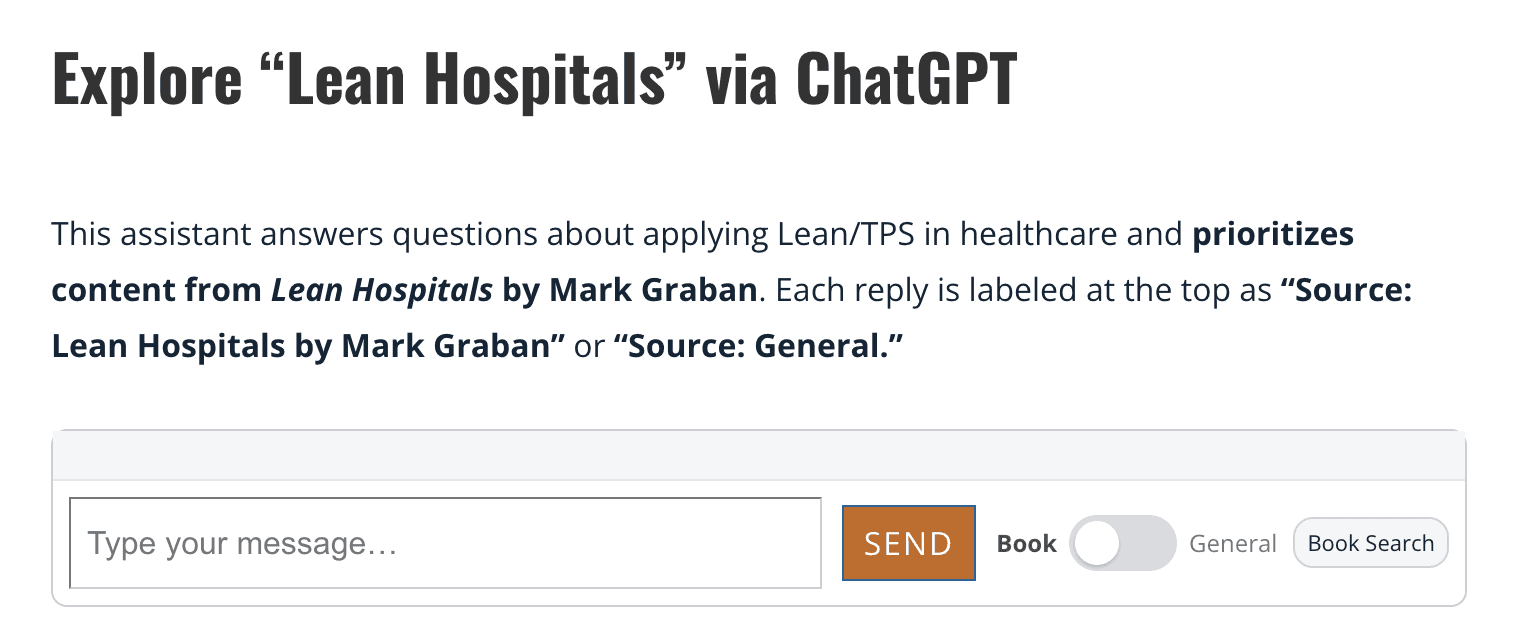
There are other features that we could add, such as a “copy” button or the ability to download a PDF of the answers. Some attempted experiments have caused the website to break (“critical error”), but it's easy enough to roll back to the previous non-broken version of the plugin code.
Could Expertise Become a Service Instead of a Product?
This raised a bigger question: can expertise be delivered as a service instead of a static book?
That question matters for any organization trying to scale improvement knowledge without relying on more training sessions.
I was able to create a subscription service model using off-the-shelf components. To test the concept, I am using the free version of the ProfilePress plugin for WordPress. With the free version, I can take credit card payments through an integration to my existing Stripe account, with a 2% fee.
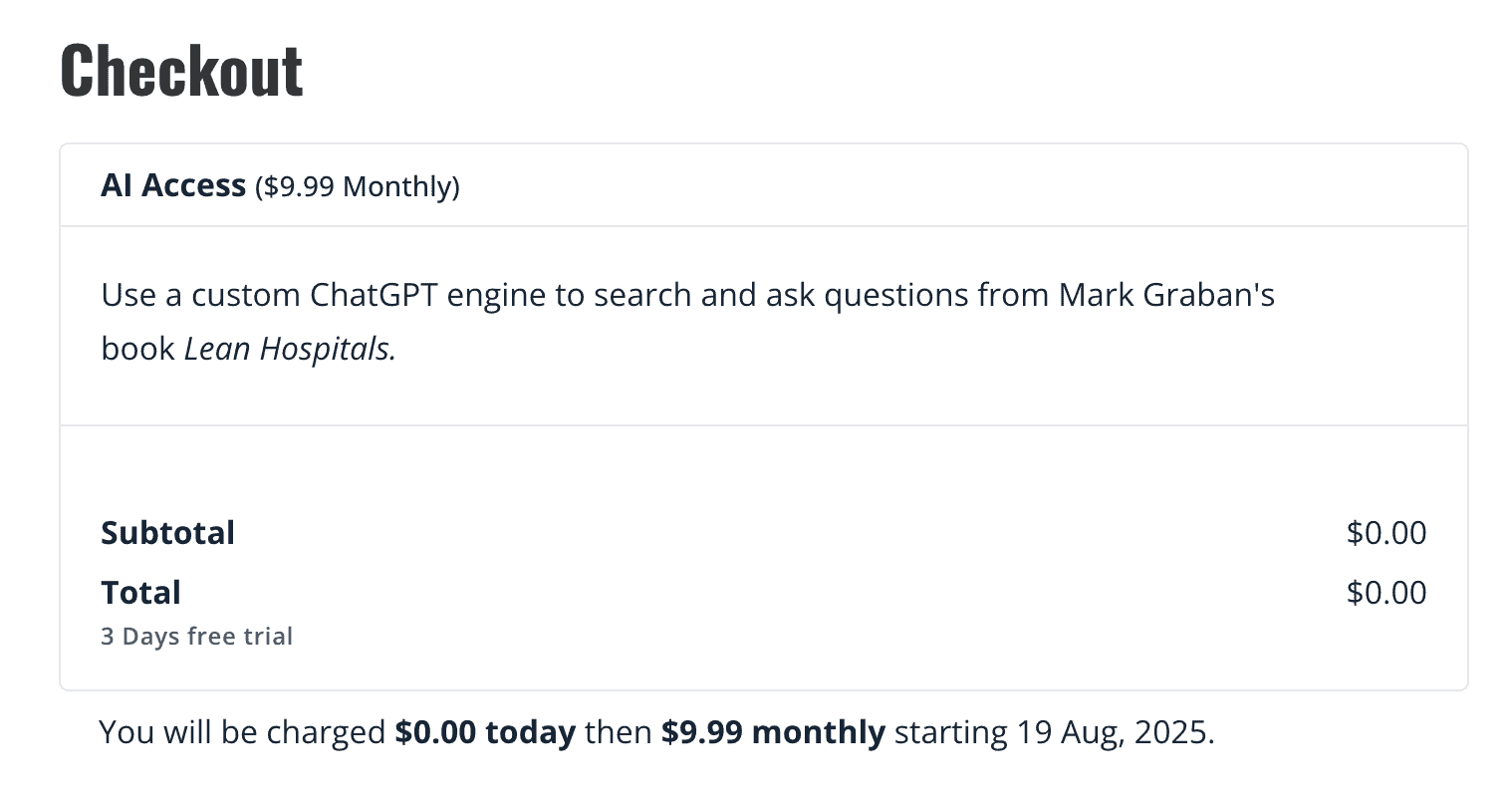
Currently, I'm offering a 3-day free trial (and the length of that is something I can configure) with a recurring $9.99 per month subscription fee. Users can create an account and manage it through the website.
I'm also considering offering a discount for existing book owners. But that would require people to send me a receipt or a photo of themselves with the book. That might be too much hassle?
I'm curious to hear your thoughts on pricing.
A Lean Coach Available During Real Work
This experiment hints at a different way to scale learning and problem-solving. Instead of relying solely on training sessions, workshops, or static documents, organizations could provide on-demand access to their own improvement knowledge.
One implication is point-of-use support. If the assistant works well on mobile web, it's essentially like having a Lean coach in your pocket — available during a gemba walk, before a difficult conversation, or while preparing for a daily huddle. Instead of waiting for a workshop or searching through notes, leaders could pull guidance in the moment it's needed.
Imagine a new manager asking how to run a daily huddle, handle variation, or respond to a mistake — and getting guidance grounded in your organization's actual practices, not generic advice.
Used thoughtfully, tools like this could support leaders between coaching conversations, reinforce standards, and reduce the risk that improvement knowledge fades when experienced people move on.
Do Leaders Actually Reach for It During the Workday?
Should this become a dedicated mobile app for iOS and Android? Maybe — but not necessarily yet. A well-designed mobile web experience avoids app store friction and allows faster iteration. If usage grows and leaders start relying on it daily, a native app could add value through notifications, offline access, or integration with organizational tools.
For now, the key test is whether leaders actually reach for it during real work.
Technology alone won't create a Lean culture. But it could make the right behaviors easier to learn, practice, and sustain.
Questions About Copyright and Publishing
If you're an author, you might wonder about my arrangements with the publisher. I haven't asked permission to do this, and I probably don't have to. I'm the copyright owner. They had previously said I was free to do an audiobook version, even though I didn't follow through on that. So I think this is similar. If anything, it extends the life and usefulness of the original work.
Where the Experiment Stands Now (2025)
I thought I'd share my experiment and a little bit about the process. Thanks for checking this out. Again, you can find the AI page here, and this is the registration page.
Maybe the future of Lean learning isn't more training — it's better access to the right thinking at the moment a decision is made.
The real test isn't whether the technology works — it's whether it helps leaders make better decisions when it matters.
If Lean is about building capability, not just implementing tools, then the real question is whether leaders can access that capability when it matters most — during real decisions, not scheduled training. This experiment is a small step toward testing that idea.
February 2026 Update: When a Lean Book Becomes an On-Demand Coach
I picked up this project again. I learned, through an experiment, that Claude AI writes better code, makes fewer mistakes, and requires less trouble shooting iteration. The $20 I paid for even this one month of Claude has more than paid for itself in time and frustration saved.
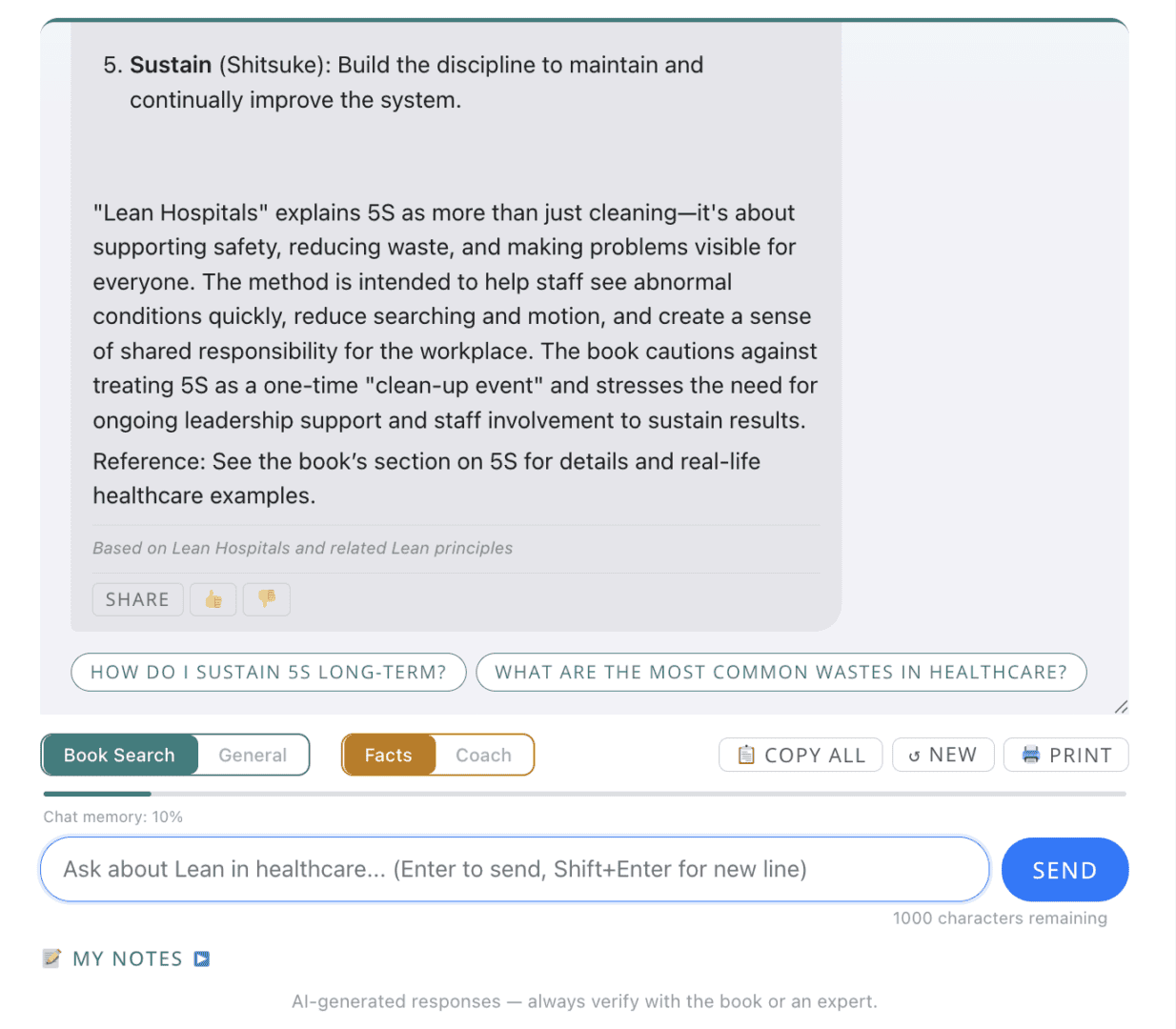
Claude has made the plugin and functionality far more stable and useful:
Click here for a free 3-day trial if you'd like to try this out. Your feedback and ideas are very welcome!
Update: I also noticed you can ask questions in various languages — and get replies in that language! Very cool!
You can select options:
- Search only the book or search more broadly
- Get “just the facts” or enter “coach mode” where the AI coach asks questions for refliction
The tool also:
- Suggests follow-up questions
- Allows you to copy or share responses
- You can print or generate a PDF of a chat
- There's a “notes” section where you can add thoughts that become part of the print / PDF / share
Where This Could Go Next
This early experiment raises a broader possibility: what if improvement knowledge didn't live primarily in binders, slide decks, or occasional workshops — but was available on demand, in the flow of work?
If tools like this prove useful in real settings, several practical applications come into view:
Organization-specific versions
Instead of relying on generic Lean advice, organizations could train coaches on their own standards, values, and management systems — leader standard work, escalation processes, safety protocols, improvement methods, and cultural expectations. That would allow guidance that reflects how the organization actually operates, not how a textbook says it should.
Training reinforcement
One of the biggest challenges after any workshop is sustainment. Participants leave energized, then return to busy environments where old habits quickly reassert themselves. An on-demand coach could reinforce key concepts, answer follow-up questions, and help leaders apply what they learned weeks or months later — when the real tests occur.
Leadership onboarding
New leaders often inherit responsibilities before they fully understand the organization's improvement approach. Instead of learning by trial and error, they could access a just-in-time guide to expectations: how to run a daily huddle, how to respond to a mistake, how to conduct a gemba walk, how to escalate problems constructively. That shortens the ramp-up period and reduces the risk of unintentionally reinforcing old behaviors.
Daily management support
Continuous improvement ultimately lives in daily routines — huddles, visual management, problem escalation, follow-up on countermeasures. A tool that leaders can consult before or after these routines could act as a quiet coach, helping them prepare, reflect, and adjust. Used this way, it becomes less like training and more like practice support.
Culture sustainment
Improvement cultures weaken when experienced champions leave or when priorities shift. Capturing institutional knowledge in an accessible form could help preserve ways of thinking and leading that might otherwise fade over time. It doesn't replace human coaching, but it can reinforce norms and expectations between conversations.
None of this replaces leadership, relationships, or direct observation at the gemba. Technology alone won't create a Lean culture. But if used thoughtfully, it could make the desired behaviors easier to learn, easier to practice, and harder to forget — especially during the everyday moments when culture is actually shaped.
Frequently Asked Questions About the Lean Hospitals AI Coach
What is this tool — and what problem is it trying to solve?
It's an experiment in making improvement knowledge available on demand, during real work. Leaders often struggle not with understanding Lean concepts, but with applying them in specific situations between training sessions. This tool explores whether guidance can be delivered at the moment decisions are being made.
How is this different from using a general AI tool?
Generic AI provides broad answers. This coach prioritizes a specific Lean healthcare framework and can distinguish between guidance grounded in the book and broader principles. It's designed to act more like a coach — prompting reflection and application — rather than just providing information.
Is this meant to replace training, coaching, or reading the book?
No. Workshops, coaching, and direct observation remain essential. The intent is reinforcement: supporting leaders between those touchpoints, when they're preparing for conversations, responding to problems, or trying to sustain improvement efforts.
How could organizations use something like this?
Organizations could adapt the concept using their own standards and improvement methods to provide consistent guidance for leaders and teams. Potential uses include onboarding, daily management support, and sustaining improvement practices over time.
What questions are still unanswered?
The most important questions are behavioral, not technical: Will leaders actually use this during real work? Does it improve decision-making? Can it help sustain improvement efforts? This experiment is a way to explore those questions openly.





It can still be improved, but there’s now a “Save PDF” button that brings up a print dialog (or you can save it to your computer).