
An Oregon Winery’s Experiment After the 2020 Wildfires
TL;DR After devastating 2020 wildfires blanketed Oregon vineyards in smoke, Native Flora Winery resisted quick judgments or panic decisions. Instead, the owners tested, learned, and experimented–prioritizing quality standards and long-term reputation over short-term financial pressure. Their response mirrors Lean thinking: investigate before concluding, learn through experimentation, and protect quality even during crisis.
A Lean Lens on Crisis and Experimentation
My wife and I love visiting wineries (as I've blogged about), and the Willamette Valley of Oregon remains one of our favorite places to return to. Beyond the wine itself, we're drawn to the people, the craft, and the long-term thinking that defines the best producers in the region.
I'm revisiting this post in 2026 because it captures something that still matters deeply: how organizations respond when conditions suddenly change in ways they didn't create and can't fully control. In this case, it was the devastating 2020 wildfires. More broadly, it's about learning, experimentation, and protecting long-term quality and reputation in the face of short-term shocks.
Shortly after the fires, my wife received an update from Native Flora in Newberg, Oregon–a winery we've visited before and admired for both its wines and its approach to the business. Their reflections stood out to me then, and they still do now, because they mirror many of the principles behind Lean thinking, even outside of manufacturing or healthcare.
Here's a photo I took of Native Flora a few years earlier, before any of us imagined how disruptive that season would become.

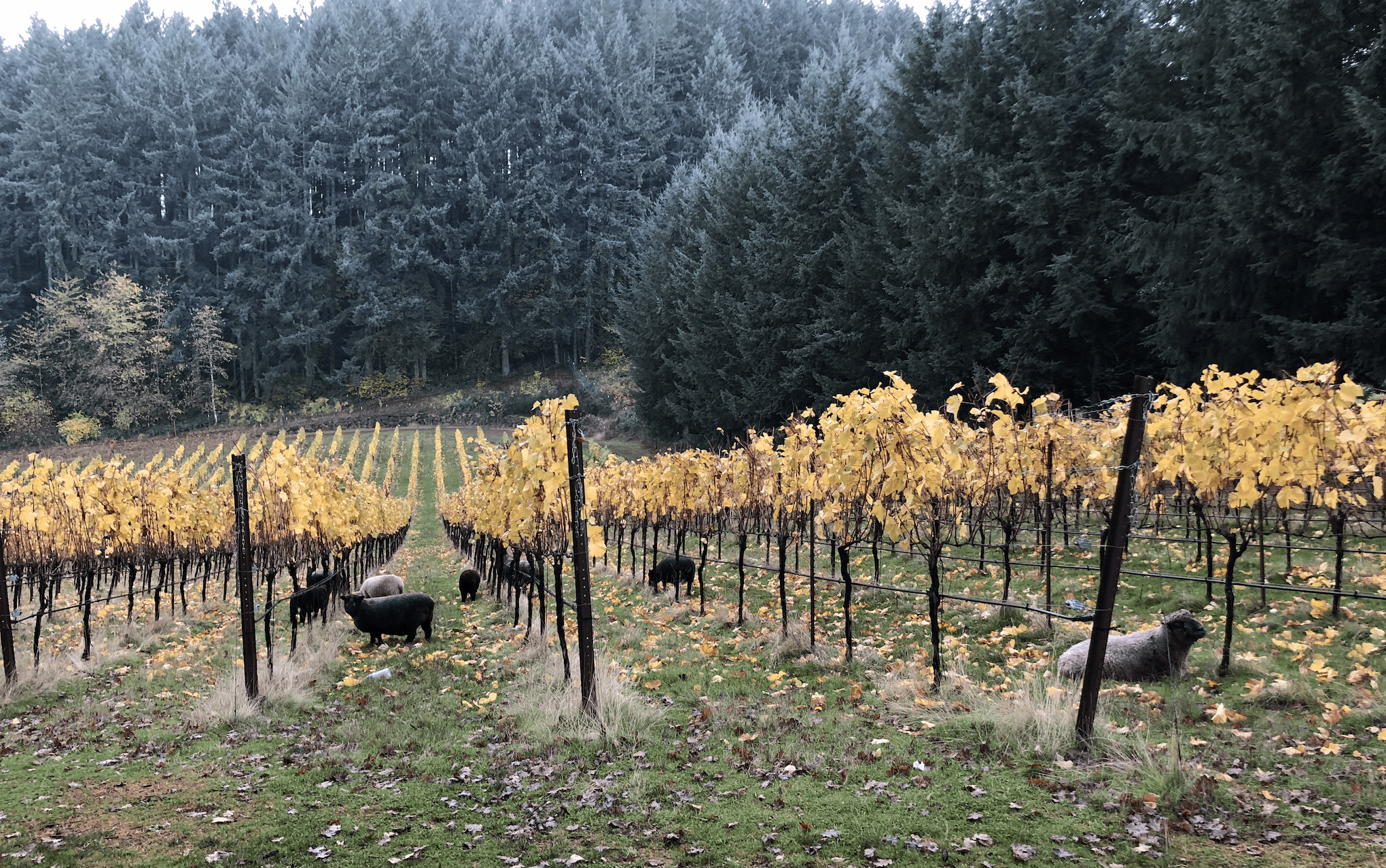
And here is a photo of their vineyard… and yes, those are sheep:
The 2020 Wildfires and the Risk of Smoke Taint
I'm sure you are aware of the severe wildfires that the West Coast, including Oregon, has been suffering through recently. My sympathies go out to all of those who have been affected and to those whose loved ones have been lost.
Among other harms and damages, many winery properties have been threatened by the fires — one in southern Oregon was sadly destroyed. Many have also been directly impacted in Northern California, with vineyards or winery buildings being damaged or destroyed by fire.
Native Flora has faced the effects of smoke in the air, which has affected the grapes on the vine. We have had California wines from years when wildfires were bad. Sometimes you can taste smoke in the glass — a little bit might make the wine more interesting, but too much can ruin it.
Scott and Denise Flora, owners of Native Flora, shared:
“The big wine story of 2020 is the massive fires endured by the western states this summer. We were not spared. The nearest major fire stopped about 3 miles from us, but we were engulfed in heavy smoke for 8 days. The smoke has had an impact.”
They then needed to determine the impact.
Investigating Before Judging: A Lean Problem-Solving Mindset
They aren't explicitly practicing Lean thinking, but I see some parallels.
They have what my Toyota mentors call “a big vague concern.” The next step is to investigate the situation to learn more to see if it's really a meaningful problem or something minor.
Learning Through Experimentation Instead of Quick Conclusions
The Floras continue:
“We ran micro-ferments last week to test, and there is smoke impact both in aromatics and flavor, but we are pressing ahead.”
They aren't giving up on the 2020 vintage yet. There is still more to learn. It's not good to give up or leap to a conclusion too quickly in any problem-solving efforts.
“This crop was nothing short of stellar coming into the fires, and still has superb natural chemistry hanging on the vine. Our intention is to harvest a good portion and learn.”
They don't know the answer. They have to work to figure things out. That's often the case in our own workplaces, healthcare or otherwise.
This kind of learning-through-doing is exactly what I later described in The Mistakes That Make Us: Cultivating a Culture of Learning and Innovation. Progress rarely comes from bold declarations or perfect plans–it comes from small tests of change, run thoughtfully, with the humility to learn from whatever happens next. Native Flora didn't pretend to know the answer; they created the conditions to discover it.
They aren't going to spend time right now on the “root cause” of the fires (that's for others to learn from and remove preventable causes). But Native Flora is going to try to evaluate what I would call countermeasures.
“We have the opportunity to try numerous remediation strategies before, during and after ferment. They might all end in failure, but the knowledge gain will be tremendous.”
I appreciate that they are focusing on learning. Yes, they want to save the crop because they face a huge financial loss if they can't have a 2020 vintage.
Protecting Quality and Reputation Over Short-Term Results
“Bottom line – if the finished wine doesn't measure up to our standards – our label will never go on the bottle.”
I appreciate that they won't let their quality standards suffer, even in the face of a potential disaster like this for their business. If they released a bad wine in a few years with the 2020 grapes, the damage to their reputation and name might be greater than the damage of not having a release.
Short-term pain can be survivable, perhaps, while the long-term pain of losing your reputation might be deadly.
A Clear Parallel to Toyota's Long-Term Philosophy
Principle #1 of “The Toyota Way” focuses on the long term:
“Base your management decisions on a long-term philosophy, even at the expense of short-term financial goals.”
Native Flora seems to take this approach, and they might have to be even more creative with their countermeasures and action plan, as they say:
“If all else fails, we are one of the few Oregon wineries who also holds a distillery license (surprise!) – can you spell “brandy” and “port”?”
One other challenge of winemaking (or whiskey-making) is that experiments and cycles of learning are often, by nature, very slow.
“For fun and the future, we're planting Chenin Blanc and Malbec this Fall! Madness or prescience? We'll know in 4 years!”
I really hope things work out for the Floras and Native Flora… fingers crossed.
A Founder's Perspective on Long-Term Thinking and Quality
Here are some thoughts from email exchange, shared with permission:
“I think the ideas and philosophies you're promoting are spot on. Our decline in manufacturing and corporate leadership, I think, is directly tied to the growth in shareholder return management. When you stop looking at the end consumer and market needs, instead focusing on rewarding yourself and shareholders with quick returns, you lose your competitive and efficiency edge.
Manufacturing moves away, technical innovation dies, companies are broken up for their pieces, a dead end cycle ensues. I fought it furiously in the corporate world for 20 years, with companies that no longer exist.
I think it's exceptionally fun to run a tiny business exactly the way we want — focus on product quality and consumer desires, run efficiently and innovate. We understand our operational and fiscal parameters, price accordingly, run sustainably, are growing steadily and remain highly profitable.
Ironically, we're regarded as a complete rebel business model for our industry, are underpriced according to our competitive set, and might be, on a percentage basis, the most profitable winery in Oregon. And, we have a lot of fun with our customers doing what we do.
If I'm wrong, I like being wrong.”
Thanks, Scott!
2026 Update: What Learning Made Possible After the Crisis
The 2020 vintage at Native Flora ultimately was said to reflect a deliberate, subtle “smoke impact,” rather than a flaw to be hidden or denied. Instead of abandoning the crop, the winery embraced learning and experimentation, producing a distinctive “Time to Burn” expression that acknowledged the conditions of that year. It's a fitting outcome for a story about resisting premature conclusions and prioritizing long-term learning over short-term certainty.
Their website says, of the wine:
“2020 was our year of massive wildfires. We made the deliberate choice to make a fine wine showing a touch of smoke impact. Everyone writes or talks about it; nobody makes one to try. We did! It's an incredibly elegant, compact pinot with a hint of cinder ash on nose and palate. It reminds us of a light Islay Scotch peat note. Cellaring is a great debate – no one knows for sure!”
Scott Flora's Comments
I emailed Scott to ask him to reflect on this post and to share his views on how the 2020 wines turned out:
“Great to hear from you, and equally fun to read back over something from 5 years ago. Best part? Nothing attitudinally has changed for us. I describe our lane as very narrow, very well known to us, and we manage to swim dead center in it almost every day.
As for the 2020, an anecdote. About 8 weeks ago, I had a very respected Master Sommelier of 30+ years drop in for a tasting. (He was enroute to Europe to go tasting with James Suckling!) During that tasting, he noticed the 2020 Time to Burn on the cellar inventory lkist. I explained its origin, deliberate intent, and taste profile. He asked if he could try it. I obliged. He loved it. He agreed that the aromatics and taste of the wine contained a peated note – much like an Islay scotch, he said – but that the whole wine, as an assembly, was wonderful. He bought 3 cases of mixed wine, including the 2020, and joined our wine club.
I know the wine is technically flawed, but I still like it. The smoke impact is not overwhelming, adding an interesting complexity to the wine. A bunch of people, especially our scotch and bourbon drinkers, think it's the best wine we've ever made. It will never be our top seller, but it has a cherished home with many of our customers.
Shoes, too, come in different sizes.”





Hi Mark-
It is so sad to hear about the devastation the west coast is going through with all of these wildfires. I never thought about how the smoke would affect the taste, I only considered the vineyard physically being affected by the fires. It’s interesting that they are practicing lean thinking and not even aware of it. First, they focused on meaningful problems or something minor, and using this time to still “harvest a good portion and learn”, and even if “numerous remediation strategies” fail, “the knowledge gain will be tremendous.” This particular vineyard winery will not put their label on something that does not meet their standards. Even though Native Flora and Toyota are two very different industries, they both focus on the long term of their companies. Native Flora has their distillery to fall back on and are even planting Chenin Blanc and Malbec for the future. Overall, great article and so interesting to see how creative and similar Toyota is to Native Flora. As a buyer of this winery, would you continue to buy from them if they continued to meet their standards yet the taste might differ? Thanks again for sharing!
Hi Abigail – Did you mean “meaningful problems or something major”?
I expect that there will be variation in a winery’s product from year to year… that’s one of the things that makes wine interesting. I trust Native Flora, and other top-notch producers, to sell something that lives up to their standards, even if it’s a little different than before.
Hello Mark,
I found your blog to be very interesting in how you compared Toyota and Native Flora comparing how they both value the long term of their companies and not the short term. By reading your article it really showed me that lean thinking is everywhere. It’s in every type of business no matter the field or how big and how small. I support any company that cares about their name and product instead of just making a quick buck. I’ll have to try this wine someday and hopefully I can see a future article regarding what the outcome of Native Flora is.
Hi Mark,
I appreciate you revealing this current situation Native Flora and many other vineyards face today. It makes you question, “Is this the new normal?” It is amazing to see the vineyard fallback on their distillery license in order to stay afloat. This just proves time and time again, “Supply Chain always finds a way.” However, will other vineyards out west be able to adjust their business model in time like Native Flora in order to stay economically stable? Will they be willing to change their core competencies? Only time will tell. The coming months will be intereting to see how the wine market prices will rise like many other perishable products. I reccomend posting a blog on how East Coast vineyeards will react to the rising demand of their wines. Thank you!
Dear Mark,
I would’ve never thought that wild fires are affecting the various vineyards on the West Coast. It is really sad to hear that their yearly harvest can cause harm to their product and can ruin their brand. I know that various distilleries around me have switched to producing hand sanitizer and less liquor to account for the lost sales. I wonder if the fires on the west coast will affect the price of wine in three to four years depending on how bad the fires impacted their grape yield. By the way the quotes you posted are worded it seems like they are in a positive mood and are optimistic about the future of Native Flora
Hi Mark,
This is a really insightful analysis of the current situation in wine country. Disruptions always occur in new ways, and this is certainly a first. It’s very interesting to see how the winery has pivoted in the face of the three-headed monster they’re facing with the fires, recession, and pandemic. The processes and thought processes they used to pivot are the same as lean’s thought processes. They are also thinking about the customer first, asking what their needs are, and making their decisions with the long term at the forefront. I really respect their dedication to a quality product even in the face of adversity. Thank you!
For those who have already read and commented, I recommend you go back and see the post update, with comments shared by Scott Flora.
A sad update from Schramsberg, a winery we love in Napa: