

John Dyer on Dr. Deming’s Red Bead Experiment, Word by Word (Podcast #280)
In this 2017 follow-up to Episode #229, John Dyer walks through Dr. W. Edwards Deming's Red Bead Experiment the way Deming actually ran it — down to the specific words, the eight-centimeter pour height, and the purpose behind every apparent quirk. John and I compare notes on facilitating the experiment ourselves, what it reveals about goals, fear, posters, and inspection, and why the real lesson isn't about statistics at all.

A returning guest today for episode #280 is John Dyer, president of his consulting firm, JD&A, Inc., and a contributor for IndustryWeek.com.
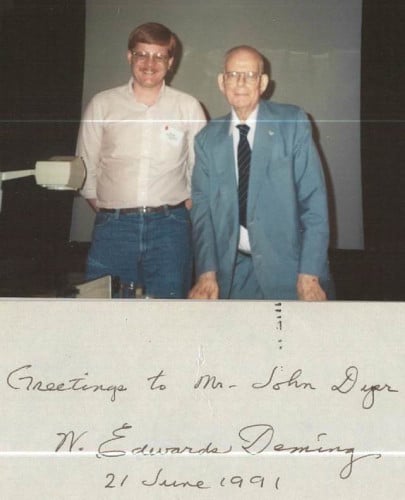
As we discussed in episode #229, John started his career at General Electric and later moved to Ingersoll-Rand, where he was VP of Operations for their Security and Safety sector. He also had the good fortune to learn directly from W. Edwards Deming, as he took the famed four-day seminar (that included the Red Bead Experiment) and was also invited to take the follow on course with a smaller group. You'll also want to scroll down to see the great picture that he posted on Twitter of him and Dr. Deming.
Today, our focus is that famed “Red Bead Experiment.” We'll talk about it, he'll share memories of Dr. Deming facilitating this, and we'll both share and discuss our reflections and our experiences with this, and the lessons learned. It's a pretty free-form conversation, and I hope you enjoy it as much as I did.
John continues facilitating the experiment and does so again next week. Tomorrow, I am facilitating the experiment as part of my “Better Metrics” workshop that I'm leading in Seattle through Catalysis. I'll also be doing this in June before the Lean Healthcare Transformation Summit (you can still sign up). And, of course, I'd love to come to your organization to do the workshop and help you with your approach to managing metrics, people, and improvement.
Streaming Player (Run Time 55:57)

For a link to this episode, refer people to www.leanblog.org/280.
For earlier episodes of my podcast, visit the main Podcast page, which includes information on how to subscribe via RSS, through Android apps, or via Apple Podcasts. You can also subscribe and listen via Stitcher.
PDF Episode Summary
You can download the PDF or read the summary below in this post.
- Low-res PDF (for reading on screen)
- High-res PDF (for printing)

Recent John Dyer Columns
What is the Greatest Impediment to Lean and Six Sigma Implementation?
The Dangers of Disguising Cost Cutting as Improvement
A Reason to Do Lean and Six Sigma Executives Will Embrace
Red Bead Videos with Dr. Deming & Others
Thanks to John for being such a great guest!
Podcast #280 — John Dyer on Dr. Deming's Red Bead Experiment
Recorded late April / early May 2017, published May 3, 2017
Intro
Mark Graban: Hi, this is Mark Graban and welcome to episode 280 of the podcast. It's May 3rd, 2017. A returning guest today is John Dyer, president of his consulting firm JD&A Inc. and a contributor to IndustryWeek.com.
As we discussed back in episode 229, John started his career at GE and later moved to Ingersoll Rand, where he had a number of roles. He had the good fortune to learn directly from W. Edwards Deming, as he was able to participate in and later assist Dr. Deming in his famed four-day seminar that included the Red Bead Experiment.
So today our focus is on that Red Bead Experiment. We'll talk about it. John will share memories of Dr. Deming facilitating this. We'll both share and discuss our reflections and our experiences with this and the lessons learned. Tomorrow, by the way, I am facilitating the experiment as part of my Better Metrics workshop that I'm leading in Seattle through the good folks at Catalysis. I'm also doing this workshop in June before the Lean Healthcare Transformation Summit that they sponsor with the Lean Enterprise Institute. You can still sign up for that workshop if you're attending the summit. And of course, I'd love to come to your organization to do the workshop, help you with your approach to managing metrics, people, and improvement.
If you're not familiar with the Red Bead Experiment, you can go to leanblog.org/280, see links including some video of Dr. Deming facilitating this famed exercise. So I hope you enjoy the discussion as much as I did. And again, to find links to John, his website, his articles, and such, go to leanblog.org/280.
We are again joined here on the podcast by John Dyer. John, thanks for coming back with us here.
John Dyer: Glad to be here, Mark.
Mark Graban: So we talked to you back in episode 229, but for any of the listeners who haven't heard that episode yet, can you give a quick synopsis about who you are, a little bit about your background, and what you do?
John Dyer: Okay. I've been in the continuous improvement field for most of my career, spans a little over 30 years now. Started with General Electric. I was with GE for 10. During that time I had one of those kind of dream jobs where for a couple of years they asked me to go around and collect best practices. This was in the very early days of lean and Six Sigma. I had the opportunity during that time to visit a lot of great companies, a lot of divisions within GE as well. I also spent some time with Dr. Deming back when he was still teaching, and I've got a very fond set of memories from my time with Dr. Deming during those days.
Anyway, like I said, I was with GE for 10 years, then Ingersoll Rand, the maker of products like Bobcat front-end loaders at that time, Schlage locks, air compressors, Club Car golf cars, a pretty wide variety of products. I headed up there a team of folks that was asked to drive lean and Six Sigma throughout the corporation on a global basis. I worked for them for 10 years as well, and then I've been out on my own for a little over 11 years now, working with a wide variety of great companies and organizations that are wanting to implement lean and Six Sigma.
Every Word Had a Purpose
Mark Graban: In the last episode you talked about getting to meet Dr. Deming, getting to work with him when you were at GE. But looking ahead here today, very contemporary, you and I have both facilitated Deming's, what's called the red bead experiment or the red bead game. But I'll defer to you. You've worked with Dr. Deming himself. You've done more of this. Maybe I'll throw the ball in your court to explain this exercise and a little bit about how it's facilitated — if you can describe that in a nutshell. Or a little bit more than a nutshell, I guess.
John Dyer: Well, I actually got a chance to see Dr. Deming do the Red Bead Experiment twice in person. And the second time I took very thorough notes because I was fascinated by the words Dr. Deming used. I realized the second time through that every word he used had a purpose to set up this experiment. I just found that very fascinating. Since then, I've done the experiment myself many, many times with lots of different organizations.
So right up front, I will apologize for one thing. Having done this now for many, many years, I have incorporated a few of my own twists and turns in the experiment. So if I get something a little bit wrong from what Dr. Deming did, I'll apologize upfront about that. But like I said, I do have very thorough notes and I have tried to use his words as much as I can.
“Six Willing Workers. Minimal Education Required.”
To start off — and again, all these things were very purposeful — to start off, he basically told the audience that they were now all unemployed. He put up on the screen, on an overhead projector, a series of want ads. The first one ad was for six willing workers. And he put on there “minimal education required.”
Now, think about this, right? Why would he use those exact words?
Mark Graban: Yeah. What do you think was behind “willing workers”? And you're right, he did use that very specific phrase.
John Dyer: My opinion is that he knew that in the audience there were a lot of CEOs and COOs and company executives that had come to see him. I think he wanted to make it clear to all of them right up front that these were their employees. These were the equivalent of the employees that come to work every day in their organizations, their factories, what have you. And that most of these workers, 99-plus percent, come to work every day wanting to do a good job. I think he planted that seed right up front — that these are willing workers, people who want to come and work and do a good job.
And on the “minimal education required,” I think that was more to set the minds at ease of the volunteers. He wanted to make it clear upfront that they weren't going to come up on the stage in front of hundreds of people and have to do some sort of complicated statistical analysis.
But he did play upon that during the actual experiment. He did joke around quite a bit about, now wait a minute, don't you understand? Don't you understand what gravity is? And again, playing upon the fact that, hey, minimal education required means that you've got to at least know what gravity is.
Two Inspectors
So that was the first thing he did. Get six volunteers. Then he asked for two quality inspectors and a quality supervisor, if you will.
Now again, why did he want two inspectors? Once you start to go through Dr. Deming's 14 Points of Management, you start to realize that many of these points play out in the Red Bead Experiment, and this is one of them. The point about ceasing inspection to improve quality.
Mark Graban: Yeah, I've got the points here. It's number three. “Cease dependence on inspection to achieve quality. Eliminate the need for inspection on a mass basis by building quality into the product in the first place.”
John Dyer: Right. So the gist of the experiment, for those who haven't seen it — and you can go on YouTube and see it for yourself, there are clips of Dr. Deming himself facilitating it — you have six willing workers. They're going to sample 50 beads from a bowl that's mixed of white and red beads. Then they take it to the quality inspection department and have the two inspectors count the number of red beads, which represents defects.
Now again, why did he use two inspectors? Because he knew — and this has happened 90-plus percent of the times I've done it as well — he knew that the inspectors at some point in the activity were going to disagree with each other.
Mark Graban: Right. Which just shows how flawed inspection is. And when they did disagree with each other, it was kind of like, wait a minute, you're just counting red beads. How obvious can these defects be? And yet you two can't agree on the number of defects. What does that say about inspection?
“Which One of You Is Average?”
John Dyer: Yeah. So once he got the two inspectors in place with their supervisor, he then turned to the six willing workers. And again, I found this really fascinating. He asked the six, “Which one of you six believes that you're average?”
And of course the six willing workers kind of all look at each other like, you know, whoa, what does he mean by average? But eventually someone will raise their hand, and he brought that person to the front of the line. Then he explained to the rest of them: now wait a minute. All right, let's just call this first person, um, Phil. He would say, all right, now the rest of you, the other five, that means that you are either better than Phil or worse than, since Phil considers himself average.
Now, again, it's kind of funny. It's like, okay, why did he do that? My opinion — I think that he did that in order to have the first person, the one he's going to demonstrate this whole process to, to be somewhat humble, if you will. Because usually, when you get six volunteers, you're going to have one or two really high-strung, CEO types in the mix that are going to want to jump in and do it first. I think he wanted to make sure the first person that went had a sense of humbleness about them, to say, yeah, okay, I'm kind of average. That way it starts the experiment off on the right foot, with someone who's not going to go overboard on doing the actual experiment.
The Procedure: “Gravity Is Cheap”
So once he got the average person identified, he brought that person up to the workstation. He had basically two containers, one full of red and white beads, and the other one empty. Then he went through a very specific set of steps to make these beads.
Now again, this is very important, because I have seen some people try to do the Red Bead Experiment and skip a lot of these steps. In fact, there's even a bead box that you can buy where you basically just shake the box and turn it over and it randomly samples 50 beads. That's great for doing statistical analysis kinds of training, but it's not good for the Red Bead Experiment, because you miss out on all of these steps.
Mark Graban: Right. There's nuance and there are different sources of variation in terms of how you hold the paddle, the angle of the paddle, which direction you dip it in. There are all sorts of different ways a person could do the job in this sort of classic design of it.
John Dyer: Right, exactly. But keep in mind, really none of those things impact the end results.
Mark Graban: Right, but it seems like it would somehow.
John Dyer: Exactly. The willing workers are sitting there going, wait a minute, okay, I better follow all these steps because I want to do a good job. In their mind they know it really doesn't have any impact, but in their heart they really are trying to do a good job, and they think, well, maybe if I follow all these steps, I might get lucky.
Dr. Deming tells the willing worker, okay, the first thing you do is you pick up the larger container with the beads in it. You've got to hold it on the side. You tip it so the beads come out of the corner. You let — and that's where he talks about letting gravity move the beads. You understand gravity, right? He says, gravity is cheap. And it's got to be eight centimeters above the other container. Like, wait a minute, eight centimeters. So he's throwing in these metrics that have really no impact to the process, but it sounds good. Whoa, okay, eight centimeters, I better do it. And the plane has to be perpendicular to the container you're pouring the beads into. Then you pour the beads back in using the same procedure.
And then — here, I wrote these down. He says, okay, then you take the paddle and you put the paddle in on the broad side. Put it into the beads — not on the beads, but into the beads. Agitate the paddle, and then do nothing. And then he repeated, do nothing. Then pull out the paddle at a 44-degree angle, using the horizontal axis. Then carry the paddle to Inspector Number One.
And then I love this. It's when he does it himself, right? He's showing the first person that he knows how to do it. And of course you're going to get some red beads. Very, very difficult not to.
Mark Graban: Yeah.
John Dyer: And he tells the workers, “I purposely made some red beads so you can see what they look like.”
Mark Graban: Just to show you.
Standardized Work in a Broken System
John Dyer: Now think about this. Back to why he was so adamant about following all these steps. He's establishing a standardized, well-thought-out, methodical process. But it's the wrong process when you think about the overall system.
Mark Graban: Right. So the system is broken because of the bead mixture. Has nothing to do with the workers. One modification I've tried, to modernize the presentation of this very particular, if not fussy, standardized best-practice way of getting the beads: I've created a TWI training within industry job instruction, with key points and reasons why. It might look like the type of document people are using today in the context of lean. I think it speaks to the lesson that having all of the super-detailed standardized work in the world won't make up for a badly or wrongly designed system.
John Dyer: That's exactly right. Think about it — in a typical system, you might have a hundred processes that are part of that system. All it takes is for one of those processes to have flaws and the entire system is going to have flaws. Here in this case, you have all these willing workers, they're very competent people. You have your quality inspectors, they're competent people. You have all these methodologies set in place to make sure that the samples are done correctly. Yet in this case, the flaw is that the red beads are mixed in with the white. That came from supposedly a supplier or somewhere in the supply chain. And that one flaw is causing the system to fail no matter how hard the workers try.
So that's one of the key learnings. In fact, I wrote this down from one of the willing workers. Basically, one of the willing workers said, “You know, I tried very hard, hoping that I would do a good job. I tried to follow the methodology as best as I could, hoping that I would do a good job. But my mind told me that this was impossible. Yet I still tried, because I didn't want to let Dr. Deming down. And that led to tremendous frustration.”
Think about all the workers out there that would say the same thing, right? About their job. They're trying to do a good job, trying to follow the methodology. They don't want to let their company down. They don't want to let their team down if they're on a team. Yet there's a flaw in the system that they really have no control over, and it's causing tremendous frustration and morale issues.
Variation: 58 Red Beads on Day One
Mark Graban: To further paint the picture about some of the mechanics: you're dipping that paddle in, you're drawing out 50 beads. 20% of the beads in the container are red. So on average you would expect each person — or not each person, but on average — you would get 10 red beads. That is designed into the system.
I pulled up a picture from the last time I ran this. You look at some of the variation from person to person in the first round. The first person got six red beads. The second person got four. The third person got 15. The fourth person got 14. And the last two people got nine and 10. So there's also sort of an inherent level of variation in the system, which I think is really interesting for people to see. On average in that first round, they got 58 red beads — slightly below the expected average — but you've got all this variation that really doesn't have anything to do with the worker.
John Dyer: And in fact, Dr. Deming, of course, is trying to, in a very tongue-in-cheek way, get the workers to think all along that it is their fault. He's trying to paint this picture — and again, talking directly to the executives in the audience — that, hey, you keep blaming your employees when in fact they really don't have any impact.
As an example, when the first person went up the time that I did it, they only got four, which was really a good result, right? Like you said, the average is going to be somewhere around 10. Could be as high as 15 or 20 depending on the mix of the beads. So four was great.
But he said, wait, what happened? He said, I said there cannot be any red beads. And then he yells out, halt the line, stop production. We have defects. He turned to the first worker. He said, what happened? The worker said, well, I tried to do my best. And he said, variation is uncalled for. We're using a very rigid procedure, so how could there be variation? Again, back to the system — hey, yeah, they are using a very rigid procedure, but the variation has nothing to do with the procedure. It has to do with the supply.
Employee of the Day and the One on Probation
John Dyer: So like you said, the first day, you have a good mix. And what Dr. Deming did — the way I put this to folks — is, think about rolling two dice, right? If you roll two dice, the average is seven, but the range can be anywhere from two to 12. Even though two is very rare and 12 is rare, the average is seven. Well, to your example, the average is going to be somewhere around — what did you say on yours?
Mark Graban: In that first round they got 58, so it was slightly below 10 per person.
John Dyer: Okay. But you're right, it depends on how the beads happen to be mixed. They're not going to always be uniformly distributed within that container. If you were to put this on some sort of a control chart, or even a histogram, you start to realize that like in your case, the average is 10, probably the low end of the extreme is one or two, and the high end of the extreme can be 18 or 19.
So think about it. In the first day, there's always going to be someone — well, not always, but most likely — someone well below average and someone else that's well above average. He turned to the one that was well below average and made a really big deal of it. So the guy who got four — he's like, oh, this is one of our best employees. They deserve all kinds of praise. In fact, let's make him employee of the day, and we're going to give him a nice bonus in his paycheck.
Then he turned to one — and that first day, someone got 13 — and he turned to that person and said, okay, clearly you don't care. You don't care about your job. In fact, you're now on probation. And if you do not improve, we're going to have to let you go.
Again, starting to introduce fear, which is one of his 14 Points. In fact, I think one of his favorite points is drive out fear, point number eight. “So that everyone may work effectively for the company.”
Regression to the Mean
Now think about it. When someone gets on the low end of the curve, the next time they do it, there's a high probability they're going to get something much higher. And someone who is high end of the curve, the next time they do it, there's a very high probability they're going to get something lower. So they're going to regress to the mean.
So what happened the last time I ran it — the employee of the day, Michael, who had gotten four in the first round, significantly better than average, he got 12 on day two. And the person I put on probation, the person who had 15, her performance improved a little bit, to 11. Right? Still that's significant.
So what Dr. Deming did in that case is, he said, okay, what does this teach me if I don't really understand the whole concept of variability and histograms and control charts? Well, if I just look at the raw data, and I'm a manager, not a leader — then what this would conclude is that the person who got four, I praised, and they got worse. So clearly praise does not have much of an impact.
Mark Graban: Yeah, and even today people laugh about that when they think of like, do people behave like that in the year 2017? Oh well, he slacked off because we praised him.
John Dyer: Right, which is not the right conclusion. And then the person that got the high number and was put on probation got better. So clearly fear works. Basically driving home the fact that, hey, I now need to start putting fear into everybody. And maybe that'll make them perform better. But again, the workers had no impact. And he knew that. So he was just, you know, this is all tongue in cheek, to try to make these points.
An Arbitrary Goal of Three
So the second day he put in a goal. And again, this addresses, I think, one of his 14 Points that's the most controversial. Every time I share these 14 with a group of executives, this is the one they have the most heartburn with, which is basically abolishing the whole idea of management by objective.
Dr. Deming was talking about how, hey, if you set an arbitrary goal, then that's going to drive behavior towards that goal, when in fact maybe you could do significantly better than that goal. Or maybe that's going to drive you to do stupid things — like people distort the system or they cut corners or they cheat.
We see that here in the year 2016, or the year 2017, like last year with the Wells Fargo scandal. Those employees were given outrageously unrealistic goals for the number of accounts per customer. And a couple thousand people were fired for cheating that system, when they were trying — it was a matter of survival — and executives got big bonuses because people distorted the system and made things look good. Now, there's finally some repercussions to some of those Wells Fargo executives.
Mark Graban: I've seen this in workplaces where I've been, and, you know, Dr. Deming or people like Brian Joiner or Don Wheeler always make the same point. You can — three things can happen. People can distort the numbers, they can distort the system, or they can improve the system. And those two distortion options are usually easier and more within people's control than actually improving the system. So of course cheating happens, right?
John Dyer: In one of my classes I always ask, let's assume that you're in charge of a fabrication department, and I was your boss and came to you and I said that you had to cut your scrap by half by tomorrow, or you're fired. Could you do it? And it's funny how many hands go up. And the type of answers they come up with pretty quickly usually are things like, “Well, I just wouldn't record the scrap anymore.” Right, hide the scrap. Or “just stop production. I'm just not going to make anything tomorrow, and then I won't have any scrap.”
Mark Graban: When I worked at GM, people — this is going back to 1995 — people in the plant, under all of this pressure, they literally hid scrap. And so it was as if it didn't exist until it got reported out financially. So you could stack it up someplace in the far corner of the factory, and people would pretend it didn't exist.
John Dyer: When I was at GE making refrigerators, production output was the number one goal. We would routinely put refrigerators into boxes without doors and put them onto trucks, just so that we could get credit for shipping them. And then take them off the trucks and unbox them and put the doors back on, on overtime, the next month. Just so that we could hit that production number. So yeah, it's very real for sure.
When a Goal Becomes a Limit
Mark Graban: The other side of that. You're saying if you set a goal, that becomes a limit. I heard somebody tell a story recently about an organization that set a goal something like, every employee should have two improvement ideas that they implement each year. So that too became a limit. And employees were purposely holding back. I've heard of that before, that people hold them back until the next time period, because they're afraid they won't come up with any.
But the thing that killed me in this version of the story is that people were actually selling ideas for cups of coffee or lunch. It was almost like some TV prison show scene, where these ideas had a street value and they were traded and swapped. It's understandable, though.
John Dyer: It's amazing how human behavior is very constant, and every action has a reaction. You've got to understand what those reactions are going to be. Setting a goal is a limiting factor, when in fact instead — and Dr. Deming talked a lot about the difference between managing and leading. A leader would say, “Hey, let's try to implement as many ideas as we can and work together as a team, with the understanding that this is going to help us meet our customer's needs and give better job security for everyone as we meet those needs.” Instead of playing games.
Just to continue on this real quick: he set a goal of three in his case, but his average I think was a little higher than yours. Because nobody came except for the one, four, that nobody really even came close to three. He started asking, well, wait a minute, why aren't people hitting the goal? He even said, “Management is deeply concerned with these figures. Management wants a complete report on what happened. Performance is horrible. Management will close the place down if we do not improve. Enjoy your work day, because this might be your last day.”
“Management Has Decided to Help” (By Buying Posters)
So that was the second day. On the third day, and I love this one — this was probably one of Dr. Deming's greatest pet peeves. Of his 14 Points, this is the one that probably gets the least amount of attention. But he talked about this quite a bit, and he emphasized this on the next day.
He basically said, “Okay, clearly we're not even coming close to the objective, the three. So management has gotten together, and we have decided to help the workers out.” And of course the willing workers are now thinking, “Oh good, they're going to let us sort the beads, or they're going to let us do something to help out here.”
And then all of a sudden he put up on the overhead screen, “We've decided to go out and purchase a hundred thousand dollars worth of quality posters and put them up all over the factory.” I even have them written down here. He says, “Yeah, we bought these posters at great expense.” And one was “Do it right the first time.” Another one was “Be a quality worker.” Another one, “Take pride in your work.”
All of these are implying — the posters are implying — that it's all the workers' fault. If they just tried a little harder, the system would improve. But the system's flaw has nothing to do with the workers.
This gets back to his point number 10, which is “eliminate slogans or targets for the workforce asking for zero defects, and instead institute leadership.”
Whenever I work with a group of executives and ask them to rate these 14 points on how relevant they are, that one usually gets the least amount of relevance. Because they don't really understand what's the meaning behind that. Hey, stop blaming the workers when it's the system that's broken.
Mark Graban: When I run this, I throw up on screen some different posters, and they're actually images of honest-to-goodness posters that you could go buy on the internet. They're not ironic joke posters. These are real posters that an organization sells, and one of them — I'll put a picture in the blog post — it says “Quality Begins with You,” and there's a slogan. It says “Think Quality.” And there's a man in a hat with a mustache pointing, and it looks like like a Joseph Stalin or somebody really terrifying. I don't understand where, what, who…
John Dyer: Well, people do buy them, right?
Mark Graban: Oh yeah.
John Dyer: They wouldn't be in business.
Mark Graban: Now I know that's frightening.
“Zero Defects or Everyone Is Fired”
John Dyer: Anyway, to kind of finish it out. He's gone through three days, and then what Dr. Deming does — and this is where I have a little bit different spin, like you were talking about before — but on Dr. Deming's last day, what he does is basically takes the three best-performing workers and fires the other three, or just tells them to leave. Takes the three best and has them do it twice. Again, emphasizing the fact that, hey, you know what, we're going to take our best-performing workers and have them do it. And of course the results are the same.
He of course gets very disappointed. In fact, I've got here, “Worst day ever.” He says, “What happened? Our best workers couldn't do it. Worst day with the best workers. Plant must close down. We'll keep your name on file.”
Now what I do is a little bit different. Again, it's all about that eighth point, about driving out fear. I basically, instead of picking the best workers, I basically tell all the workers that if you do not get zero defects, you're fired. And of course, they can't — they have no control over how many defects, but they're trying. They'll try to pick out the white ones and place them on the paddle when I'm not looking. Or they'll try to get two or three samples. But they can't get zero. It's very rare to get zero. So they start getting fired, but the data comes out accurate.
After doing that a few times, I changed it up slightly. I said, okay, this time, if any worker goes above zero, everyone is fired, including the quality department and the inspectors. It's fascinating, because by putting that one change in — and then I'll purposely kind of turn my back to the whole thing — and it's predictable what happens. All of a sudden the data comes up zeros, all the way down the column. I'll turn back around and I'll look at that and I'll say, wow, look how much better we've gotten. Yeah, this was amazing. So clearly we can do it. Clearly we can hit zero every time. Of course everybody's laughing, because they know what happened.
It really emphasizes this whole point about if you don't drive out fear, then it's going to cause people to do really stupid, bad stuff, including fudging the numbers. And at that point there is no hope for making improvement happen.
Wells Fargo, the VA, Erased Test Answers
Mark Graban: Think of situations in the real world. These willing workers had no interest in cheating. They were doing their best. When people get put under extreme pressure — I mentioned Wells Fargo. If you look what happened, the VA waiting time scandals — people, either managers are getting threatened with losing their job, or not getting promoted, or not getting bonuses. That leads to all sorts of cheating.
Look what happens in school districts with teachers, and sometimes principals, conspiring to cheat in different ways. Help the students cheat on standardized testing, or in some cases actually going and erasing and changing answers after the fact. That's not what anybody would naturally, deviously scheme to do. It's a reaction to pressure being put on them by the system, and that fear that you mentioned, that fear that Dr. Deming talked about.
John Dyer: Absolutely. And I've seen it myself. It's just amazing how that will drive good people, good willing workers, to do really dumb things or bad things, just in the name of trying to hit a target or trying to keep their job.
The Hidden Cost of Team Loyalty
Actually it's interesting, because we talk a lot — and I know you've talked about this quite a bit as well — the importance of teams when doing improvement. The one thing about teams though, that you have to be careful about, is that it will also drive a bit of this mentality, because people don't want to let the team down. Hey, if it's my job, well that's my own fault. But if I make the team look bad, now all of a sudden it's all of my peers and friends that I've got a connection to because I'm part of this team, and we're all in trouble.
So sometimes people that are connected really heavily to a team can also do kind of dumb things to make the team look better than it really is. You've got to be careful about that.
Why Deming Called It an Experiment
Anyway, it's a great exercise. Keep in mind, he called it the Red Bead Experiment, because again, this was all kind of a psychological exercise, if you will, to drive home these really deep points. About ones we've talked about — don't blame the workers. Instead look at the system. Emphasizing several of the 14 Points throughout the activity. The effect that setting an arbitrary goal has on the morale of the workers. The real meaning behind those posters. What fear can do to the organization or to the system. There are some very deep meanings behind everything that he did as part of this experiment.
Like I said, I've now done this myself many, many times. And a lot of eyes get opened, especially in the management ranks.
Mark Graban: And that's really who the experiment is designed for, to try to influence, senior executives.
John Dyer: That's exactly right. It is designed for the managers. But the workers that also participate in this, you can see a bit of a relief. It's kind of like, “I've been trying to tell people that it's not my fault. I've been trying to tell people that it's the system. The system is broken. Management has given me bad tools, bad material to work with, bad machines, and yet they're trying to tell me I've got to meet these quotas, meet these objectives, and it's not my fault.” It's like this relief. Wow, I've been trying to tell them this all this time, and finally someone gets it.
Quality Starts in the Boardroom
Mark Graban: And there's a difference between a dumb poster, or a person saying, “Oh, quality is everybody's responsibility. Quality starts with you.” Where Dr. Deming said “quality starts in the boardroom.”
John Dyer: Exactly. Starts with the company's leaders, understanding why this is so important.
Think about it — this is what I love about Dr. Deming. He was a statistician, a professor in statistics, and you would think he would be one of the last people to really emphasize the role that culture and leadership and understanding human behavior would have on the system. But look at the impact that he had in Japan. It was so deep that — many of the plants that I have visited in Japan, it's amazing how they have incorporated every one of these 14 Points and live it every day. Even, what is it, almost 25 years after his passing. It's pretty incredible to think that one person had such a profound impact on an entire country.
Mark Graban: And that these lessons and scenarios could still be so relevant today, whether it was 1987 or 2017. I think one thing — there are a lot of things fascinating about Dr. Deming — but he often gets labeled as a statistician, because that was his degree. But Dr. Deming said the most important aspect for a manager is understanding psychology and understanding people and understanding employees as individuals. Which sounds more like social sciences than math.
The Control Chart at the End
You mentioned earlier, and, you know, we'll maybe wrap up in a couple of minutes, you had mentioned control charts. You can use this exercise to learn how to do a control chart and to see common cause variation. But it sounds like from what you're saying, the greatest lessons from the Red Bead Experiment are not about the math and the numbers, but more about people, the psychology, the leadership.
John Dyer: That's absolutely correct. And that's how I use it as well. When I do the Red Bead Experiment, we go through all of what Dr. Deming went through, and then what we'll do is we'll take all that data that was collected and put it onto a control chart. And all of a sudden you start to see that, like you said, the average is 10, with a lower control limit of two and an upper control limit of 18. And all of a sudden it's like, whoa, okay — when you tell the worker they have to get zero, basically that would indicate a special cause, based on the chart, which means that they had to have cheated somehow some way. Because that's outside of the norm most of the time.
A One-in-a-Hundred Zero
Now, I will tell you, you'll get a kick out of this. In all the times I've done it, one time we got zero. And it was actually when I was demonstrating it to the willing workers at the beginning. I put the paddle in, pulled out the paddle, not a single red bead. And of course everybody was like, whoa.
Mark Graban: I would be really shocked.
John Dyer: I was too. But I'd done it enough up to that point to know that that was very unusual. So I played it. I went along with it and said, “Well, see, this is how you do it.” And from that point on, everybody, oh, there's got to be a trick. There's got to be something.
Mark Graban: They think you're a magician.
John Dyer: Right. I just got super, super lucky. One percent chance. And it actually played out.
The lowest I've seen is two. And this is the last time playing it, I've done one variation of setting a goal of three and then offering an incentive of 20 dollars. And leaving that open for a couple of rounds. I've never had to pay off the 20 dollars. When I was in Brussels, it was a 20-euro note. But when I was in Brussels, somebody actually got two in the second round, before I offered the incentive. When I offered the incentive, that guy said, “Well hey, I already did that. Do I get the 20?” I said, “Well, no. You proved it was possible. Now the incentive is to get others, or to get you to repeat your performance.” Of course nobody did.
Mark Graban: Right. Nobody did. I'm looking at the results. Nobody did better than six after I offered the incentive.
John Dyer: That would come very close to saying, “Hey, I'll give you 20 dollars if you roll a one on two dice.”
Mark Graban: Very, very improbable.
Variability and Capacity (A Plug)
John Dyer: But again, the real key to all of this is how we look at data, understanding how variation works, understanding the impact that data can have on decision-making, correctly or incorrectly.
One last thing, if you don't mind. A quick plug. I do also write articles for Industry Week. I've been writing now for three and a half years. I do have one coming up that will hopefully be out in the next couple of weeks, that is all about the role that variability plays in understanding capacity — capacity in both product and service — and how that can have a huge positive impact if you figure out how to reduce that variability in your capacity to produce. Which basically is almost like getting free product, other than the material cost. You're already paying for the labor. You're already paying for the overhead. So any additional capacity you can squeeze out of a system, assuming you can sell it, that product or service has tremendous margins.
Again, it kind of ties right in with understanding how the data works, how variability works, and how that relates to the output of a particular system. So if somebody would like to learn more about that, they can go to the IndustryWeek.com website at some point in the next couple of weeks and find my article.
Close
Mark Graban: It's certainly okay you mention that, because I was just about to ask you to give a plug for your columns, your articles, and how people can find you online if they'd like to contact you.
John Dyer: There are a lot of John Dyers out there. So if you want to follow me on Twitter, it's @JohnDyerPI, all one word. PI for process improvement. Not, not for private investigator.
Mark Graban: Oh, you — I stepped on your joke. I'm sorry.
John Dyer: That's all right. But yeah, @JohnDyerPI. If you'd like to see some of my articles at Industry Week, you can go to IndustryWeek.com/author/john-dyer, D-Y-E-R. And there's a webpage there where you can pull up the articles I've written for Industry Week.
Mark Graban: And there's a lot of good stuff there. I will link to those articles. Again, if this is your first time hearing a discussion with John here, go back to episode 229, to hear more of John's reflections on Dr. Deming, Six Sigma, his time at GE, and beyond. You can find that by going to leanblog.org/229. You can find it in the podcast feed. If you subscribe to the podcast, you can find that episode on iTunes or wherever else you find podcasts.
So John Dyer again has been our guest today. John, a real pleasure talking to you, and I really appreciate you sharing about the Red Bead Experiment, having a conversation about sharing recollections of your time with Dr. Deming, and what you're doing today. So thank you again for being our guest.
John Dyer: All right, thanks Mark, for having me.






Comments from LinkedIn
Sid Joynson:
I was an early attendee at the British Deming Association meetings, and joined after attending a weekend Deming workshop in 1990. I was much impressed by his teachings. On one of my early visits to Japan, I tried to discuss the red bead experiment with one of our Japanese instructors. He asked me why I had allowed red beads to enter the white bead box, and told me that I did not appear to understand the concept of zero defects through source inspection. He explained that the red bead experiment demonstrates the variability of the process. Source inspection removes the variability of the inputs to the process. If you ensure that only one colour of bead enters the box, there is no output variability to measure.
This is the basic thinking behind the quality section of the Jidoka element of TPS.
The most impressive example of this system I have experienced was on an assembly line for inlet manifold assembly in Japan. We were allowed to work on the line and challenged to produce a defective assembly. It was impossible to produce one, and we had some very talented people trying.
No statistical methods could have achieved this result.
Kenneth Stem:
The Red Bead Game is one of the most powerful teaching tools ever invented. You learn about management, about random samples (actually about how sampling plans virtually never include random samples), stable systems of variability and quite a bit about psychology.