

The Evolution of ‘Lean Production’: Reflecting on 25 Years Since the Term Was Coined
TL;DR: This post revisits the origins of lean production through John Krafcik's 1988 article, reflecting on how lean manufacturing began as an integrated management system rooted in culture, leadership, and respect for people–and why those foundations still matter more than tools today.
Where the Term “Lean Production” Came From
Executive takeaway: Lean began as a leadership and culture system–not a toolkit–and organizations that miss that distinction repeat the same mistakes 25 years later.
People often ask me where the term “Lean” comes from. It's not an acronym, so it shouldn't be spelled “LEAN” (but it often is). Lean is not a synonym for “lacking or deficient” in resources, as some dictionaries will tell you or as it gets used in news headlines about “surviving the lean economy.”
The 1988 Article That Coined “Lean Production”
The term “lean production” arguably was first used in an MIT Sloan Management Review article by John Krafcik that was published 25 years ago this fall (Fall 1988), titled “Triumph of the Lean Production System” (free pdf via LEI).
In the 1980s, Krafcik worked with Jim Womack in MIT's International Motor Vehicle Program. Since then, his career has spanned senior leadership roles including CEO of Hyundai North America, TrueCar, and most recently Waymo.
I'm told by LEI that Womack and Krafcik are writing an article, with their reflections, that will be published soon at lean.org. For now, you get my humble thoughts as somebody who read it 15 years ago… and again just recently.
Rediscovering the Original Article
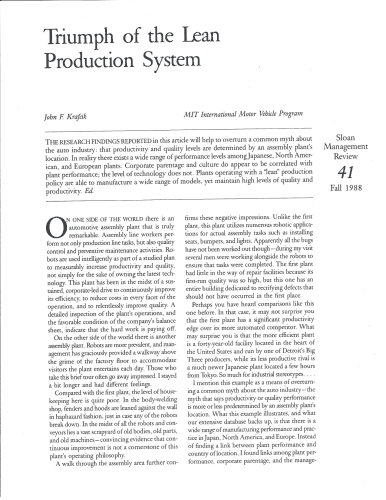
The article was assigned as reading when I was a student at MIT in 1998, but I hadn't returned to it until recently. Click the image at left to read the first page.
The article is now available from the Lean Enterprise Institute (free PDF).
Why does this article still matter? Not because it coined a term, but because it described Lean as a management system rather than a collection of techniques. Krafcik focused on leadership behavior, decision-making, and culture–arguments that remain just as relevant today as organizations struggle with superficial or tool-centric implementations of Lean.
Lean vs. Buffered Production Systems
Krafcik wrote about the origin of the term “lean” in contrast to what might be called the traditional approach – a “buffered” production system.
When I started my career at a GM engine plant in 1995, the plant certainly followed the “buffered” approach. The plant's management philosophy attempted to keep, for example, the engine block machining line running at all costs by storing large (and virtually unlimited) buffers of parts in many locations.
If one machine were down, they would run all of the other machines, building a “buffer” of parts that would be used later. These “buffers” often contained defective parts, which caused problems down the line. It was a never-ending game of production whack-a-mole, constantly offloading and loading buffered parts to and from the line. Ironically, our highly buffered line had exactly one half the productivity of our benchmark Toyota plant. Krafick said this strategy was “a safe bet for a steady, if unexceptional return.”
Krafcik went on to describe a “lean” plant, which had inventory levels that were “kept at an absolute minimum” so that quality problems and downtime occurrences could be “quickly detected and solved.” He said this strategy presented higher risks but had greater potential gains. Many of the “risks,” such as downtime or poor quality, could be “neutralized given an experienced, well-trained workforce, responsive suppliers, and good product designs.”
Today's lean thinkers would recognize the roles of methods like mistake-proofing and Total Productive Maintenance, as well as more collaborative relationships among factories, suppliers, and manufacturing and product development.
In an endnote, Krafcik cites earlier work that used the terms “robust” and “fragile” instead of “buffered” and “lean.” For all of the handwringing that takes place about the negative connotations of the word “lean,” we can count our blessings that the term “fragile” wasn't used. There would be no “Fragile Enterprise Institute,” I'm sure. No bestselling book called The Fragile Startup, either.
Lean as a Coherent, Integrated Management Policy
Some people criticize the “early days” of the Lean movement as focusing too much on tools or for not fully understanding the implications of Toyota's management system. I think people who review this article (or even re-read The Machine That Changed The World) would appreciate how much attention Krafcik paid to Toyota's “production management policies,” as he called them. He didn't write about tools like 5S, kanban systems, or heijunka boxes. He wrote primarily about management, leadership, and culture.
Krafcik's article builds on two years he spent working as an engineer at NUMMI, the GM-Toyota joint venture plant that started operations in 1984. Krafcik experienced the noticeably different management environment of NUMMI, much as I did in 1996 when the GM plant that employed me brought in a new plant manager who was transformed by his experience as an early NUMMI employee.
What were some of these philosophies and management practices? They included:
1) Lean is respect for humanity and continuous improvement
In a Lean environment, Krafcik “Management did not think of workers as replaceable cogs in a great production machine… and gave them the responsibility to continuously improve… Scientific management techniques were not thrown away; they were just performed by different, more appropriate employees” who had a “true grass-roots involved with all aspects of the operation.”
2) Lean is an integrated management and operational system
Krafcik explains, “This system encourages the full development and integration of all existing technology, policies, and human resources in a way that traditional… policies seem to miss.”
3) Lean is about culture change
Krafcik explains how one automotive company that made great improvements on both quality and cost “implemented more and more lean production management policies in its plants, in effect incrementally altering its own corporate culture to better fit the lean model.”
Lean Management Was (and Still Is) the Best Predictor of Success
Krafcik described a “management index” that predicted a plant's productivity far better than its level of automation or national location. The four components of the index that predicted success were:
- Levels of teamwork throughout the plant
- “Visual control,” as “a proxy for worker span of control” (a Lean plant has more cross-training than a traditional plan)
- Unscheduled absentee-ism rates, “an indicator of worker participation and management's expectations”
- The amount of space dedicated to repairs, illustrating management's expectations about quality being built in (traditional plants planning and expecting to do a large number of repairs as part of normal daily operations).
Krafcik seemed optimistic that the “lean production management policies” could be adopted in the U.S., as “perhaps the most important competitive weapon in the U.S. industry's arsenal [is] the ability to accept and digest new ideas rapidly,” whereas “Most European plants are saddled with… the not-invented-here syndrome.” Some say healthcare is saddled with that very problem today.
Looking back, what's striking is how closely Krafcik's observations align with what we now describe as psychological safety, systems thinking, and respect for people. Lean was never meant to be fragile or punishing. It was designed to surface problems, develop people, and improve performance through learning. When organizations struggle with Lean today, the issue is rarely that the ideas are outdated–it's that the original intent has been forgotten.
What Has (and Hasn't) Changed 25 Years Later
25 years later, what is your assessment? Has “lean production” triumphed in the auto industry? At the plant level, I would say yes, this seems clear, as GM, Ford, and Chrysler have made great strides in changing their factories' cultures. But what about other manufacturing industries or, more importantly, healthcare?
Why This Still Matters for Lean Leaders Today
I hope you'll check out the article. I think it's really important for the Lean community to understand the roots of the concepts and principles, not just the word “Lean.” As much as people are discovering the importance of culture and management systems, not just tools, the wisdom of a truly Lean approach has always been out there in articles like Krafcik's.








Nice article Mark! Very cool trying to get that article available again!!
[…] See on http://www.leanblog.org […]
[…] The Term “Lean Production” is 25 Years Old – Some Thoughts on the Original John Krafcik Articl… by Mark Graban – “Lean is respect for humanity and continuous improvement… Lean is an integrated management and operational system…” […]
[…] I wrote the post The Term “Lean Production” is 25 Years Old – Some Thoughts on the Original John Krafcik Articl… back in September, I was frustrated that this groundbreaking article was NOT available for viewing […]
Here’s a good follow up post by Jason Yip:
LINK
[…] there was the Lean Production System, The Machine That Changed the World, and Jim Womack and Dan Jones’ book, Lean Thinking. Today, […]
[…] John — Term “Lean production” is 25 years old — link to the original article can be found in my blog post […]
[…] the “Lean” in the “Lean Startup” methodology basically comes from Toyota, it was […]
Krafcik ended up as CEO of the company True Car after leaving / being replaced at Hyundai:
Article Link
[…] de la production “lean”, veuillez-vous référer à cet article; pour un article fêtant les 25 ans du “lean management”, veuillez-vous référer […]
[…] started with “Lean Production” over 25 years ago, as a different name or adaptation of the Toyota Production System. Lean became the “Lean […]
[…] The roots of “Lean Production” go back further than that, with the origins in Toyota post 1945 and as the term “Lean Production” was coined over 25 years ago. […]
[…] term “Lean” was coined by American researchers to describe the management and leadership practices they observed at Toyota (and subsequently applied […]
Mark, thanks much for posting. John Krafcik’s observations remain very relevant. The ongoing challenges that I encounter in work with clients are these: 1) leadership focusing on results rather than the work processes that drive results; 2) a lack of respect for the knowledge, creativity, and intelligence of line workers. The most important teaching of Lean is the absolute importance of a leadership team going to the line and interacting with line workers in ways that demonstrate their clear understanding that line workers, the employees who make the product or deliver the service, are the organization’s most important employees and that they are greatly respected.
[…] term lean was first used in manufacturing by John Krafcik in an article published in the late ’80s based on his master’s in management thesis at […]
[…] and eliminate waste while still creating value for customers. Lean encompasses a variety of things and Lean manufacturing terms, tools, and practices are mainly derived from the Toyota Production System and was first coined in the 1980s by John Krafcik. […]