Notes from Paul O’Neill Speaking at the Lean Healthcare Transformation Summit
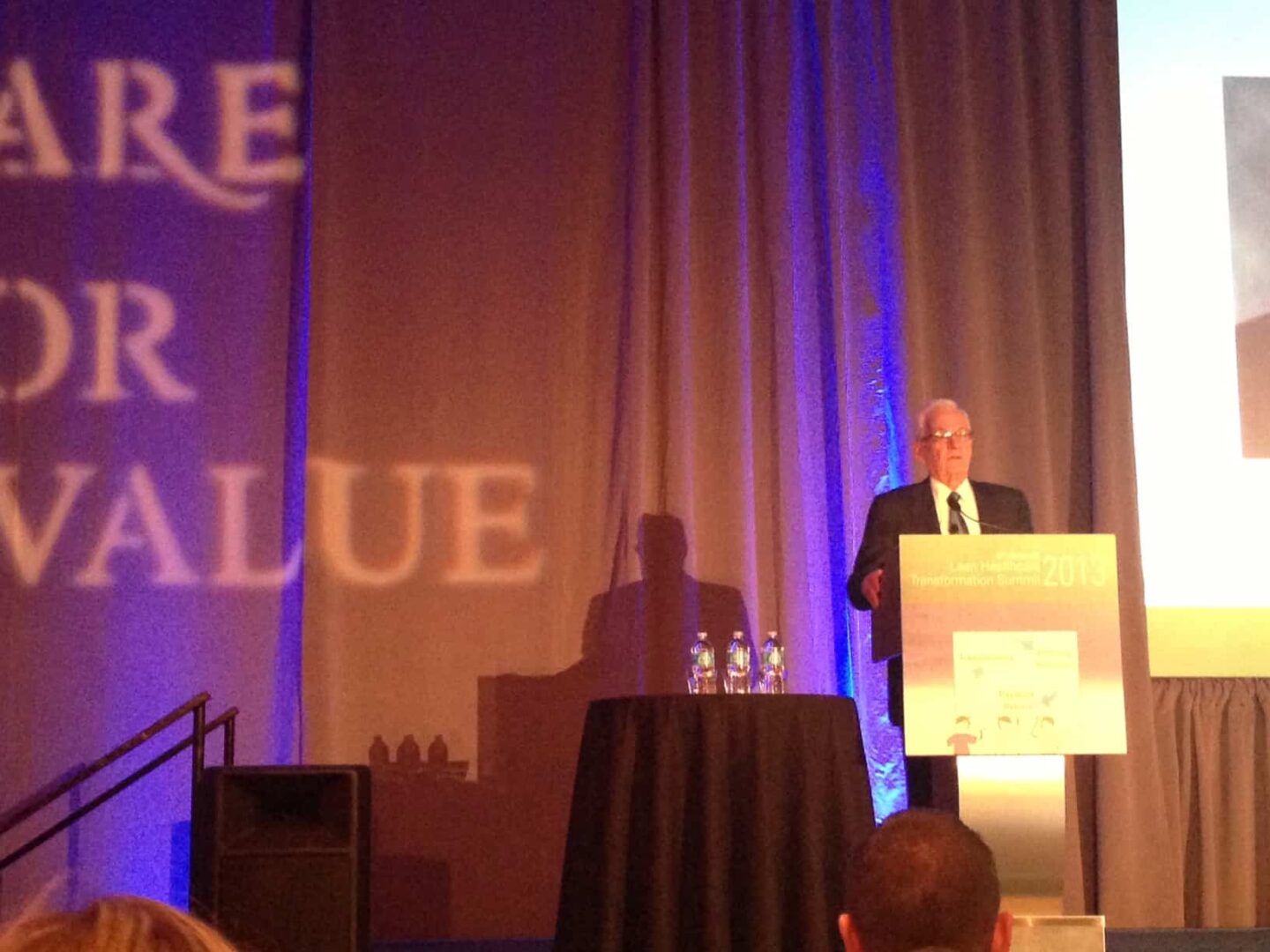
It was a real thrill to be able to meet Paul O'Neill in person yesterday at the Summit (he was my guest for Podcast #124). His powerful message about leadership and patient safety was well received by the audience.
Below are my raw notes as I typed live in this Google Doc. I hope the notes do his talk justice…
Why Safety Is the First Test of Leadership
Paul ONeill opened with a simple but unsettling question. How many organizations can see their real time workplace injury data at any moment of the day?
Many organizations say that people are their most important asset. ONeill challenged that claim with a simple response. Show me the evidence. If leaders truly care about people, that commitment should be visible, especially when it comes to safety.
In ONeills view, organizations are not accidentally excellent. They are either habitually excellent, or they are not. One clear signal of that habit is whether leaders are willing to set an aspirational goal to be the best in the world at what they do.
The Moral Case for Zero Harm
Healthcare, ONeill reminded the audience, is one of the most dangerous industries in the United States.
Each year, roughly five out of one hundred workers experience an OSHA recordable injury. About three out of one hundred suffer injuries serious enough to miss work. This measure is difficult to manipulate and therefore hard to ignore.
When ONeill became CEO of Alcoa in 1987, the national average lost workday rate was about five per one hundred workers. Alcoas rate was already much better at one point eight six, and people were proud of that performance.
ONeill was not impressed.
He declared that the goal would be zero injuries. This stunned many people inside the company. Behind his back, some said he did not understand the industry, that aluminum manufacturing was inherently dangerous, and that safety improvements would cost too much.
ONeill rejected those excuses outright. A non zero goal, he argued, is morally indefensible. No one volunteers to get hurt.
Culture Owns Safety
ONeill made it clear that organizations do not reach zero harm through slogans or posters. Safety is owned by culture, and culture is shaped by leadership behavior.
At Alcoa, employees were told they owned one anothers welfare. Leaders were expected to remove safety barriers immediately. ONeill famously said that Alcoa would never again budget for safety. If a safety issue was identified, it would be fixed.
To prove he meant it, ONeill gave workers his home phone number and told them to call if supervisors failed to act. One call came three weeks later. A broken conveyor had forced workers to lift six hundred pound ingots by hand for several days.
ONeill called the plant manager in the middle of the night and told him to fix it immediately and call back when it was done. By four in the morning, the repair was complete.
That story spread quickly. The message was clear. Leadership was serious, and safety excuses were no longer acceptable.
Safety as a Leading Indicator of Excellence
ONeill told Wall Street analysts that safety performance would be a leading indicator of Alcoas overall success. This surprised analysts who were used to hearing only financial metrics.
ONeill believed that working toward perfection in safety produced better financial results than any form of financial engineering.
Over thirteen years, Alcoa improved its injury rates by thirty to fifty percent annually. During the same period, the companys market value increased eight hundred percent.
The financial results, ONeill said, took care of themselves.
Respect, Leadership, and Eliminating Fear
ONeill asked a question that resonated deeply in healthcare. Do the people who clean patient rooms receive the same respect as surgeons?
True respect, he argued, cannot exist unless leaders are committed to eliminating abusive behaviors and systemic disrespect. This is why he replaced the term management training with leadership training. He noted that the root of the word management implies manipulation.
Leadership requires articulating aspirational goals and removing excuses that prevent people from achieving them.
Lessons for Healthcare Leaders
ONeill concluded with a powerful conviction. A perfectly safe healthcare system is possible if the people doing the work are empowered to fix problems.
If nothing stops you, he said, you can do it.
By comparing current performance to what perfect looks like and by refusing to hide problems, organizations can eliminate waste, fear, and harm.
The lesson was clear. Start with worker safety. Excellence in patient care, quality, and financial performance will follow.
Below is a photo taken by Bobby Gladd. See his blog post about the Summit here.






THAT is a leader.
Paul O’Neil is A great demonstration of real leadership which is rare to find.
O’Neill told his finance people, “If you ever calculate the cost savings from improving safety, you’ll destroy my moral authority on this…”
Do we lose moral authority when we calculate the cost savings for:
reducing infections?
reducing falls?
reducing sentinel events?
I think that’s what he is saying… he didn’t say so directly, but that’s a reasonable extension of what he’s saying.
It seems if O’Neill were a new hospital CEO, his approach would be to focus exclusively patient safety and worker safety as “the right thing to do” AND a way of demonstrating operational excellence.
Let me throw this down:
In manufacturing if you focus (almost) exclusively on flow you will inevitably make all kinds of operational improvement and eliminate all sorts of waste.
I have seen some healthcare organizations, Seattle Children’s for example, that have patient safety as the top priority and they have eliminated all kinds of waste. Patient safety isn’t an exclusive focus but nonetheless it is much more inspirational than reducing labor hours per unit of service and patient safety keeps the organization grounded.
What Paul is saying is start with worker safety and it’s inevitable that you’ll be excellent at other things.
I think starting with patient safety (AND worker safety) is the right approach in healthcare. Improve safety and other results (like efficiency and cost) will follow.
I spoke to many people about what they liked about the 4th Annual Lean Healthcare Transformation Summit. Paul O’Neill’s presentation came up often. At the end of the Summit, everyone in the audience was asked to spend a few minutes to write down and talk about an experiment they will try on monday based on what they learned at the Summit. One CEO shared his experiment with me – he’s going to make the employee injury rate transparent on his company’s website – updated every day. Watch for this story at the 5th Annual Lean Healthcare Transformation Summit . PS Paul O’Neill will return. He told everyone in the audience of 600 he would invite himself back. Stay tuned for continued examples of great leadership
Mark– you did an impressive job of capturing Paul’s talk. Thank you! One of my favorite points: A leader must (1) “articulate unarguable aspirational goals”, and (2) “take away excuses”.
[…] Paul O’Neill talks a lot about the only morally defensible goals being zero. […]