

David Veech, His New Book “Leadersights”

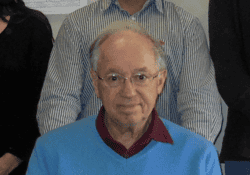
Joining me for Episode #273 of the podcast is David Veech, author of the new book Leadersights: Creating Great Leaders Who Create Great Workplaces.
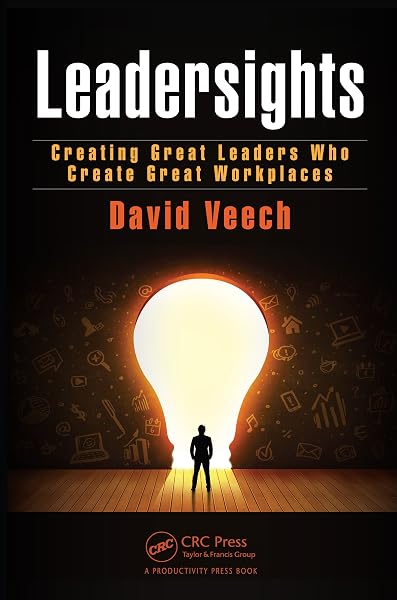
Leadersights
by David Veech
How leaders create great leaders by developing the people and conditions around them.
David is a senior lecturer in the Department of Management Sciences at Ohio State University and their Fisher College of Business, teaching in the MBOE program (see his full bio).
Veech was previously a lecturer in the College of Engineering at the University of Kentucky. He joined the University of Kentucky after retiring from the US Army in 2001. He taught in the Defense Acquisition University from 1998 to 2001 and was assistant professor of military science at Stetson University from 1988 to 1991.
In today's episode, we talk about his book, how his background and career in the Army influenced his views on Lean and leadership, “self-efficacy,” and more.
Streaming Player (Run Time 48:44)

For a link to this episode, refer people to www.leanblog.org/273.
Topics and Links for this Episode:
- Follow David on Twitter as @davidveech and @leansights
- Find David on LinkedIn
- Introduce yourself and your background… and how you got introduced to Lean
- How did your career in the Army influence your approach to and your understanding of Lean?
- Tell us about your first book… what is the C4 process?
- His first book: The C4 Process: Four Vital Steps to Better Work
- What led to the new book?
- What are the three categories you call “leadersights?”
- Learning
- Loving
- Letting go
- Chapter 4 is about “self-efficacy” – what does that mean? What's the importance of that concept related to change management and teams?
For earlier episodes of my podcast, visit the main Podcast page, which includes information on how to subscribe via RSS, through Android apps, or via Apple Podcasts. You can also subscribe and listen via Stitcher. Please leave us a review and rating!
Thanks for listening!
Podcast Summary
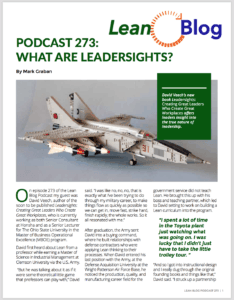
You can also read and download this 4-page PDF summary of the podcast:
Webinar & Presentation by David Veech:

Follow the Lean Blog Interviews podcast
Since 2006, I've been talking with leaders, authors, and practitioners about how Lean thinking works in the real world, in healthcare, manufacturing, and beyond. Follow the show so you don't miss new episodes.
Full Episode Summary
This summary was originally published as a PDF in January 2017. The text below is from that PDF.
Jump to a section:
- The Lean Strike Fighter
- Leadership in the Military
- Leadership and Educational Psyschology
- Self-efficacy
- Love
- Learn
- Let Go
- Connect
On episode 273 of the Lean Blog Podcast my guest was David Veech, author of the soon to be published Leadersights: Creating Great Leaders Who Create Great Workplaces, who is currently working as both Senior Consultant at Honsha and as a Senior Lecturer for The Ohio State University in the Master of Business Operational Excellence (MBOE) program.
David first heard about Lean from a professor while earning a Master of Science in Industrial Management at Clemson University via the U.S. Army.
“But he was talking about it as if it were some theoretical little game that professors can play with,” David said. “I was like no, no, no, that is exactly what I've been trying to do through my military career, to make things flow as quickly as possible so we can get in, move fast, strike hard, finish rapidly, the whole works. So it all resonated with me.”
After graduation, the Army sent David into a buying command, where he built relationships with defense contractors who were applying Lean thinking to their processes. When David entered his last position with the Army, at the Defense Acquisition University at the Wright-Patterson Air Force Base, he noticed the production, quality, and manufacturing career field for the government service did not teach Lean. He brought this up with his boss and teaching partner, which led to David setting to work on building a Lean curriculum into the program.
“And so I got into instructional design and I really dug through the original founding books and things like that,” David said. “I struck up a partnership with the guys at the University of Kentucky, who had a partnership with Toyota, and I spent a lot of time in the Toyota plant just watching what was going on. I was lucky that I didn't just have to take the little trolley tour. Over the course of a year/year and a half we put together this pretty comprehensive Lean curriculum, and I worked up a new kind of system-level simulation that I'm still using.”
The Lean Strike Fighter
David calls the system-level simulation he developed the strike fighter, after the F-35 Strike Fighter. He built the simulation based on the way the military acquires defense systems. This method brings industry teams together to build systems, often putting fierce competitors into situations where they have to collaborate to succeed on high-dollar government projects.
“It's Lego based, so we're assembling a Lego airplane, but the lessons that I pull out of it are way more than just assembly,” David said, explaining how the strike fighter simulation works. “Each team provides certain parts, and everybody has to buy certain parts from every other team, so there's a whole lot of supply-chain, material handling, system-level integration. If they don't make the whole system work together, if we optimize for one table to do well, they can do really well, but everybody else flops. The overall objective is to make 15 of these aircraft systems in 15 minutes, and if they don't build a system that allows them to keep working at that fact rate of one minute, then the system collapses and it's obvious where those failures are.”
Leadership in the Military
David's military background has influenced his approach to Lean thinking in other ways, as well. The most significant lessons that David carried from his career in the military into his work on Lean was about leadership. David explained that he was given a large amount of responsibility very early in his career, which looking back now he realizes was a bit overwhelming. At the same time, David was working with various types of leaders, both good and bad.
During our conversation, David picked out one person he worked under for just 15 months as the type of leader that exemplified the type of leadership that he speaks about in his new book.
“For the first year, God, I hated working for this guy. He was meticulous. He would ask me to write up a training plan, I'd send it over to him and he would bring it back dripping with red ink. But he would sit down and he would tell me everything that I'd misunderstood or miscommunicated or ways that things were rough. And then he would say, “Ok, now give it another shot.” It was very frustrating at the time, as I was working long hours and everything else, but I didn't realize how much I was learning,” David said. “I found out from other people, that my boss, the one who was making all my papers bleed, was presenting them [to the brigade commander] as if they were first drafts of mine. So he didn't take any credit for anything that he did. That has stuck with me.”
Leadership and Educational Psyschology
While David didn't undertake much work on leadership during his master's degree studies, this experience came full circle when he began to undertake some PhD work at the University of Kentucky.
“I learned pretty quickly that a Lean system, ultimately, is a learning system. And if we can figure out how people learn, and we figure out how to design systems that allow people to learn in these quicker learning loops, then we can create organizations that are really self-sustaining. And I thought that was very insightful, so I started studying educational psychology.”
Though David eventually put his PhD studies on hold because of the demands of his consulting business (and because it turned out to not be a necessity for his career path) he rolled a lot of the lessons he learned while studying educational psychology into Leadersights: Creating Great Leaders Who Create Great Workplaces.
However, the real impetus for the book started at the Lean HR Summit in 2012 after David had given a presentation on self-efficacy. Following his talk, Michael Sinocchi from Productivity Press approached him as he had not heard anyone speak on that topic in Lean and the two spoke about what a book on that topic might look like.
Self-efficacy
Wanting to delve deeper into the idea of self-efficacy, I asked David about balancing performance and systems.
David began by explaining the data shows a “satisfied” employee is not necessarily the most productive employee. Anecdotally, many leaders also know employees who are happy with their jobs, but when they are asked to complete tasks, never seem to get around to them. On the other hand, employees who seem to hate being at work can sometimes be the ones management can rely on to complete tasks on time. With that said, David pointed out that building a proper Lean system will lead to the productivity a company needs.
“So why then should we focus on satisfaction? Because the things we do get from a satisfied employee that we don't necessarily get from a dis-satisfied employee are things like loyalty, things like presence – they turn up to work, and they stick around longer. The biggest thing is they are more willing to share a problem with you, understanding that they're surfacing a problem so that the problem can be solved, and they're more willing to share an idea with you,” David said. “We've got Lean tools to build those key elements that contribute to satisfaction as well.”
He outlined the three key elements of satisfaction as: significance, variety of work, and identity.
Speaking to the element of significance, David explained, “Standardized work is designed to build that mastery, which is designed to make people feel like the work they are doing is significant, which is one of the key elements of meaningfulness, which drives satisfaction more than anything else.”
For variety of work, David mentioned how Toyota has its employees rotate through several jobs throughout the day. He also pointed to the team structure that has been promoted at Toyota discussing the key element of identity.
On the topic of identity, David said, “That small team structure that Toyota has promoted forever, really gives you a bonding experience with a group of folks. So it's not like you're coming to work because the company says ‘you're coming to work', and it's not like you're coming to work just to get a paycheck, you're coming to work because you don't want to let your team down.”
I asked David about the term “Leadersights” in his book and the three key elements under that term. He explained that love, learn, and let go are things a leader really needs to be able to act on.
Love
David admitted that talking about love and workplace can raise eyebrows, but it is not about being mushy or about inappropriate romance in the workplace, it is about decision.
“Love is a decision that we make. It is very much an option for us, even in terms of parents and children, and husbands and wives,” David said. “But it's really more of the love we have for our kids that motivated [my] thinking on this, because when we think about the things we want to do for our kids, we want to challenge them to do things, to try things that they've never done before, and we want to challenge them to continue to get better. And we want to know enough about them to know what is an appropriate challenge and what isn't. I don't want a child who is not particularly athletic to get into this really hard-core athletic regime. So I as the parent, knowing what I know about my child, I'm going to set an appropriate challenge for them.”
David explained that for leaders, one of the most important things is to get to know their employees as people to learn what will excite each person. This knowledge will allow a leader to tailor each challenge to each employee so that challenge becomes an expression of that love and attention in the workplace.
“In the Army, I had the privilege to work with a great many very good leaders, and when those leaders leave to take a new position, move up higher, or maybe they retired, the thing that they all speak about was how much they loved working with the people; the soldiers that they had. And they honestly spoke about love when they were leaving,” David said. “A leader that's really engaged with his or her workforce really feels a huge heartbreak when they leave. So it's very much that love is there. We just want to call it out and say what it is because I think we've got an obligation to love our people.”
In addition to getting to know employees personally, another part of having love in the workplace is also having the courage to stand up and correct employees when they don't get it right. David explained that this correction is needed to get them back on track so that you continue to have the tools to help them improve.
Finally, this loving leads leaders to make the decision to learn each day. Leaders can learn the most from everyone in the organization because they have more contact with more things than one leader will ever get a chance to, so there's always something to learn.
Learn
“The learning piece really focuses on developing robust problem solving systems that teach people how to do the analysis, creation, and evaluation,” David said. “Practical, rigorous problem solving is really a practical, rigorous learning system.”
Let Go
In regards to letting go, David explained that leaders have a broad range of responsibilities and most organizations are so complex there's no way they can control everything and doing so can appear as micromanagement.
“So you're frustrated because you can't control the things that you need, your folks are frustrated because you won't let them do anything because you're trying to control everything, and so the workplace just gets darker and darker. And so if we don't learn as leaders to build a system that's going to allow us to let go, then we're not going to be able to promote a healthy workplace that contributes to the economy and drives our society to a better place.”
David admits that letting go is difficult, but that it's not about ignoring things, it's about creating systems that enable rapid assessment, diagnoses and analyzation, and ultimately the solution of any issues that may arise.
Connect
David ended our conversation by adding a fourth element, connecting.
“I want you to be confident, I want you to be capable, I want you to be outgoing as a leader, and I want you to tell the world about the great things that your folks are doing. I want you to convince the world that this is the best place to come to work, that these are the best people, that this is the best company, this is the best support, these are the best products, this is the best healthcare; everything about it is best. And I want you to have the confidence and the assuredness to go out and tell people that. I think that connecting people from the outside world allows you to really put the needs of your inside people way above your own, and to create the right kind of work environment,” David said.







Some quotes that can be shared in social media:
[…] Podcast #273 – David Veech, His New Book “Leadersights” […]
[…] also recently recorded a podcast with Mark Graban if you want to learn even […]