

A Locked Complaint Box in Greece: Learning From Customer Complaints, or Just Bureaucracy?
I just got back from a vacation that included some time in Greece. On the way to the airport, we stopped for a slow, delicious breakfast at a seaside cafe. Excellent food, better view. Check out the menu and some photos:




On the way out, tucked by the door, I noticed something I'd never seen before: a locked metal box on the wall labeled, in Greek and English, “Complaint Box.”
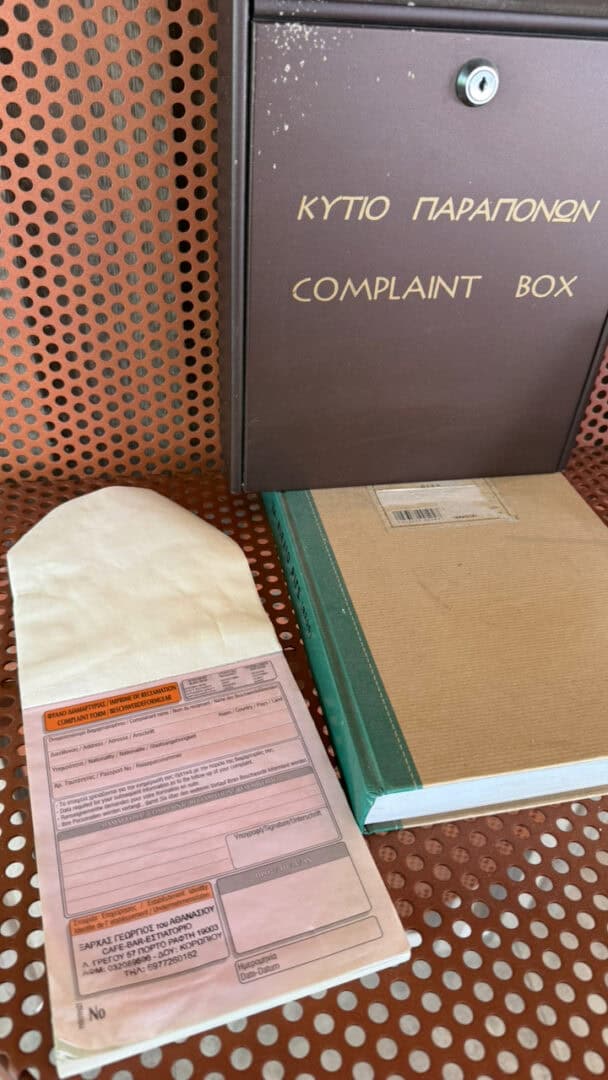
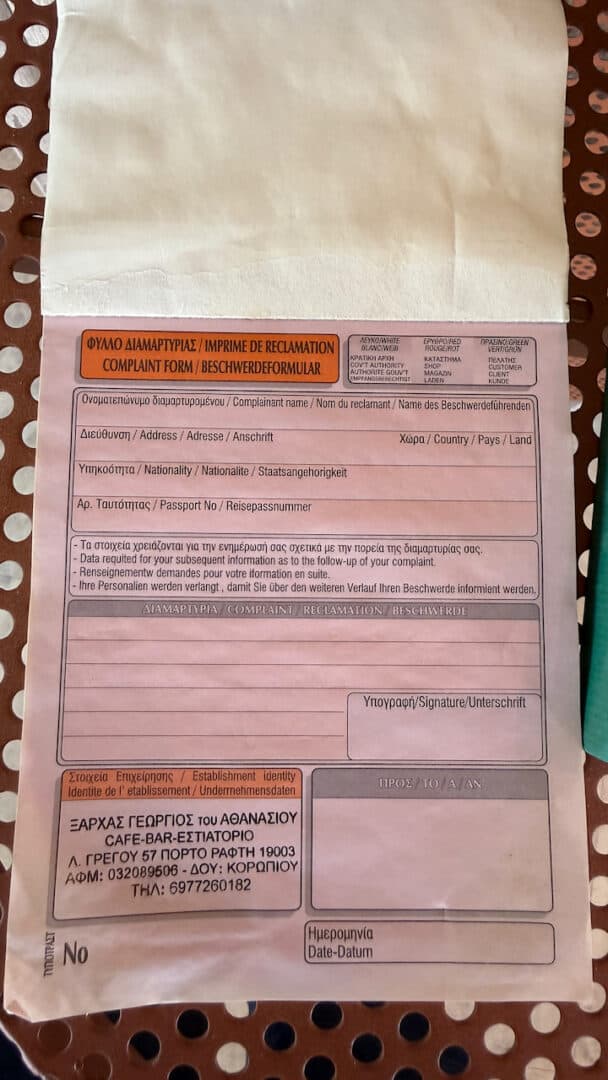
Next to it sat a pad of carbonless forms and a bound ledger. The form was printed in four languages. If I'd had a complaint (I did not), it asked for my name, address, country, nationality, and passport number, plus a signature. I'm the kind of person who photographs a complaint box on the way to breakfast, so of course I looked into it.
It turns out this isn't the restaurant's idea. It's the law.
What the law actually requires
In Greece, food-service, cafe, bar, and entertainment venues are required to keep these complaint forms available for customers. The requirement appears in Article 135 of the country's market rules (the DIEPPY code, most recently codified in a 2017 ministerial decision). A few specifics stood out to me:
The form has to sit in a holder in a visible spot, right next to the exit. It has to be printed in Greek, English, French, and German, and the menu has to carry a notice, in all four languages, telling customers the forms are there. The form is a numbered triplicate: one copy for the state authority, one for the shop, one for the customer. After it's filled in, the shop keeps its copy, and the customer takes the other two. If the customer wants the matter pursued, they mail one copy to the regional development office, which logs it, routes it to the right authority (health, police, tax), and reports back on progress. Skip all this and the fine is around 500 euros.
None of this is new. The specific requirement was already on the books in a 2009 market provision and was re-codified into the current rules in 2017. The parent framework, Greece's Agoranomic Code, dates to 1946. So the form reflects a mid-twentieth-century regulatory instinct, lightly refreshed. The surrounding enforcement system is more current: a 2025 law created a new independent authority for market control and consumer protection. The paper form, however, remains largely unchanged.
This is a real, structured, government-mandated complaint system. But collecting complaints is not necessarily the same as learning from them.
Two very different jobs
A complaint system can serve at least two very different purposes. One system may not do both equally well.
One job is compliance and escalation: create an auditable paper trail, protect a customer who has no other recourse, and route serious grievances to a neutral third party. That's what this Greek system is built for. It is designed, in part, for a tourist who feels wronged, does not speak the language, and has no relationship with the owner. Sending the complaint to a government office instead of handing it directly to the business may provide useful protection. A neutral authority protects a person who might reasonably fear friction with the business. (That last part is my read on why the routing works the way it does, not something the statute spells out.)
The other job is learning and improvement: find out where you're falling short so you can fix it, fast, and get better. That's the job most of us in the continuous improvement world care about. But it is poorly designed for rapid learning and improvement.
Friction is the enemy of feedback
If your goal is to learn, you remove as much unnecessary friction as possible. You make it effortless and safe to tell you something is wrong. This is true in any workplace, I'd add.
This form does the opposite. It asks for a passport number. It asks for a signature. It drops your words into a locked box you can't see into, to be read later, by someone else, for reasons that have nothing to do with helping the cafe make a better breakfast. Every one of those is a barrier. Most mildly dissatisfied customers will never fill it out. They may simply leave, never come back, and never tell the business why.
One detail illustrates the problem. The form is supposed to tell you where to send it, with the business stamping the destination government office right next to the word “To.” On the copy I was handed, that box is blank. The one field that answers “where do I submit this?” had been left empty. And even filled in, the process expects a visitor to keep two carbon copies, work out that one gets mailed to a regional Greek government office, and do that, possibly from another country, with no envelope and no online option at the door. That is not a submission process. It is the concept of one.
That creates another problem. If the box stays empty, the business might conclude that everything is fine. No complaints, no problems? But an empty complaint box tells you almost nothing about how you're doing. Silence is not the same as satisfaction. Absence of evidence is not evidence of absence. Again, this also applies to workplaces and continuous improvement.
There's also the routing problem. Even when a complaint gets written down, the formal process is slow. The shop keeps one copy, so the operator can see it. But escalation still depends on the customer mailing another copy to a government office. That delay makes it harder to understand what happened and respond while the details are still fresh.
What a good system does instead
Contrast that box with a well-run andon system, where a worker pulls a cord or pushes a button to signal a problem the instant it appears. A good andon is low-friction, immediate, and psychologically safe, and it routes the signal straight to someone who responds right now. Nobody has to show ID to pull it.
Voice of the customer works the same way. A better example of responsiveness came from a server on our cruise ship. The server remembered that my mother-in-law has a seafood allergy and quietly steered us away from a dish before she ordered it. That is what a responsive system looks like: attentive people, close to the work, who can act before a concern becomes a complaint.
Respect for People runs through all of this, and it runs both directions. Respect for the customer means valuing their time and their voice enough not to make them jump through hoops to be heard. Respect for the frontline staff means trusting them to receive a concern and respond, rather than assuming every problem has to be documented, locked away, and escalated to headquarters.
How I'd redesign it
A QR code would remove some obvious friction, but it would not solve the whole problem.
A code by the door or on the receipt could open a short form in the visitor's own language, with the venue already identified and the complaint routed automatically to the correct authority based on the registered address. That alone removes the blank-box failure, because nobody has to remember to stamp anything. It can be timestamped, tamper-evident, and it can text the customer a tracking number with status updates, which is what the passport field on the paper form is fumbling toward. Digital does that job far better.
Since the whole point is to improve the thing, a few cautions, because a careless version would be worse than the paper.
It would probably be best to keep the paper as a fallback. A QR-only channel excludes the phone-less and the poorly connected.
Preserve the neutral routing. Part of the current design's value is that it sends the complaint to an authority, not to the owner, which protects a customer who has to walk back past the person they just complained about. A QR that simply emails the restaurant deletes that protection. Route to the authority, not to a confrontation.
Don't strip the friction blindly. The passport requirement is a poor identity check, but it also filters spam and competitor abuse, and a public portal collecting complaints about named businesses carries data-protection weight a locked box never did. Replace the check with something smarter, asking for identity only when a complaint escalates, rather than removing it and inviting noise.
Most important, digitizing the form would only make the existing escalation path faster. It would not help the business hear and address concerns in the moment. Automating a weak process gives you a faster weak process. The better target is upstream: noticing and responding to problems before they become formal complaints.
The question for leaders
I'm not knocking Greece here. The system is well-suited to the job it was built for. The mistake would be confusing that job with a different one.
So I would ask any leader–in a hospital, factory, or office–which job their feedback system is actually designed to do. Does it create evidence that you asked, or does it help people raise concerns quickly and safely so the organization can learn?
A survey nobody answers, a suggestion system nobody uses, or a hotline nobody trusts may satisfy a compliance requirement. It does not prove that the organization is listening or learning.
The breakfast, for what it's worth, needed no complaint form at all.
New book coming early 2027: The Silence Tax
Most of the posts I write about fear, futility, and psychological safety come back to one question: what happens after somebody speaks up? When the answer is nothing, people stop. That silence has a cost, and leaders pay it without ever seeing the invoice.
The Silence Tax: How Lean Leaders Drive Out Fear and Futility -- it's a practical guide to what leaders do differently, starting this week.