
If This Were Assembly Line Medicine, You Could Stop the Line
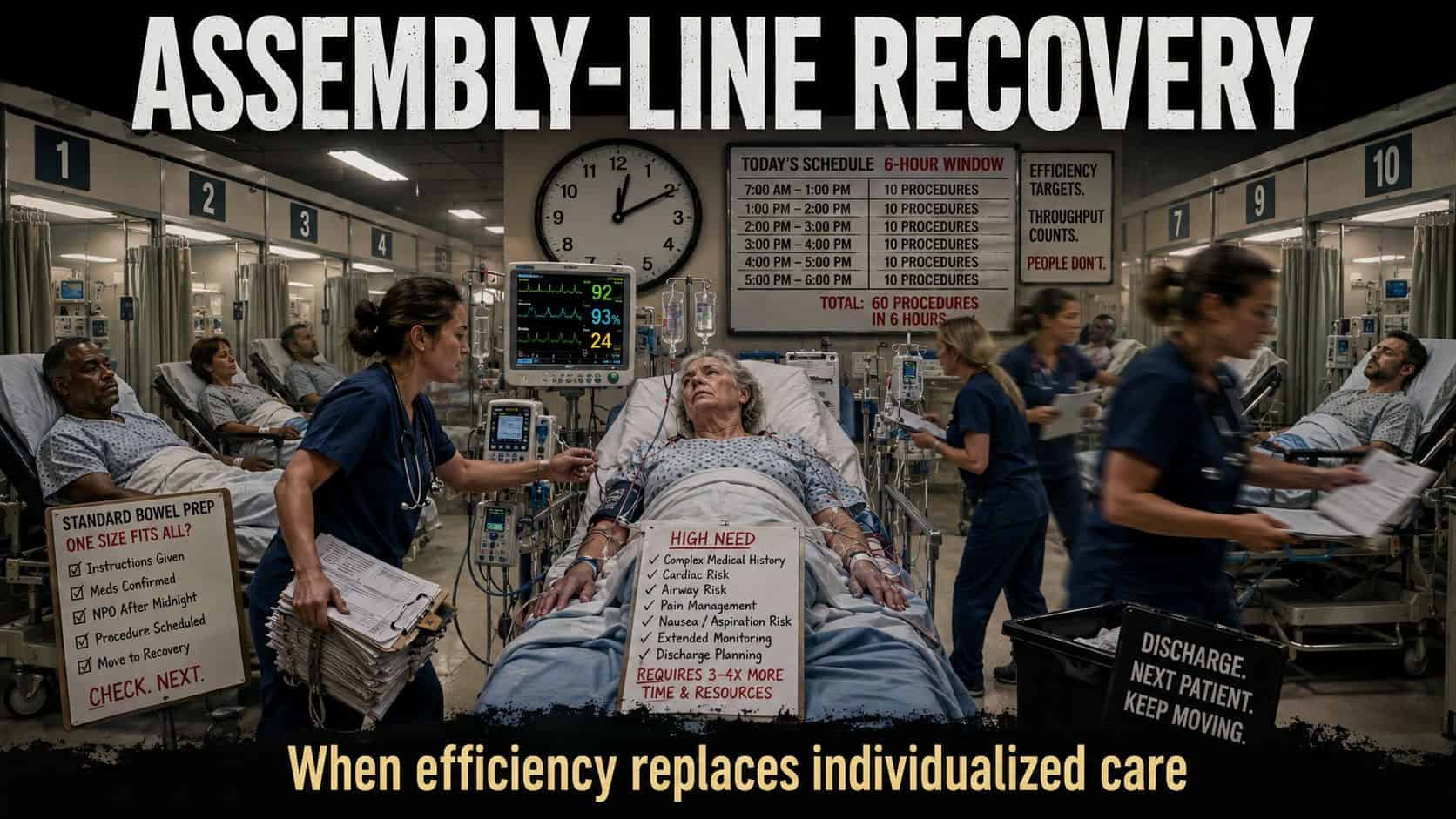
A nurse executive posted on LinkedIn this week about what she called “assembly-line medicine.” She was describing an ambulatory surgery center where she once worked, where physicians booked roughly 80 percent of the day's procedures into a six-hour window.
Then one patient arrives with pain, nausea, unstable vital signs, and poor mobility. Caring for that patient can require as much nursing work as three or four routine recoveries. The staffing model still counts that patient as one. The nurse absorbs the difference and keeps the same turnover pace.
Her post ran under an image headed “Assembly-Line Recovery.”
When I pushed back in the comments, she defended the analogy. She said it captured the robotic, inflexible way patients were moved through a fixed sequence.
I want to be careful here, because I agree with her about everything except the name. That schedule is wrong. That staffing model is wrong. Somebody approved that schedule, and somebody approved that staffing model. A manufacturing methodology approved neither. Nor did the nurse standing in that bay, and she is the person left to absorb the consequences.
But I have worked in factories, and that is not what an assembly line is. Or at least a good one.
On a Well-Designed Line, You Can Stop It
In a well-designed Toyota-style system, when the work exceeds what a person can safely complete within the work cycle–or when a quality problem arises–the worker signals for help. A team leader responds quickly, and the line stops if the problem cannot be resolved before the vehicle reaches the fixed stop position. That is not a courtesy somebody grants on a good day. It is the design. Toyota built it in because a problem caught at the station is cheaper and safer than one caught three hundred cars later, and because a system cannot respond to overload it has been designed not to see.
The nurse in that recovery bay has no equivalent mechanism for getting help when the work exceeds capacity. You can't stop the patient care the way you could stop production on an inanimate product. But you can provide help and proper staffing.
The nurse is not being treated like a worker in a Lean factory. Toyota gave production workers a way to call for help and stop the line decades ago. She is being asked to absorb whatever the schedule hands her, silently, and to keep the pace either way.
That is a bigger complaint than the one she made, and it is a more accurate one.
This Is Not One Health System
I am not writing about one organization. She named hers; I am leaving it out. Naming one health system would make it too easy for everybody else to treat this as somebody else's problem.
Front-loaded block schedules like this are common. Staffing models that count a high-acuity patient as one unit exist everywhere. Nurses being asked to make up the difference out of their own capacity exist everywhere. This is a common pattern in how healthcare work gets planned. Calling it an assembly line does not explain who created that plan or why the system keeps using it. Calling it “McDonald's medicine” wouldn't explain it either.
It isn't new and it isn't American.
On 31 July 1964, the House of Commons debated the welfare of hospital patients. A member cited Ann Cartwright's research: 62 percent of patients were being woken before 6 a.m., and 35 percent before 5:30. Of 723 patients she studied, two said they were satisfied with it.
The reasons given in that debate were staff shortage, night nurses having to finish before the day staff came on, and wards needing to be ready for the consultants.
Then he asked whether hospitals were “for the convenience of consultants and nurses, or for the welfare of the patients.”
That's the National Health Service in 1964. No throughput targets, no productivity bonuses, no private equity, nobody selling anybody a belt. Just a schedule built around when staff arrived and left, and patients absorbing the difference.
When I started working in healthcare in 2005, the same thing was being practiced and debated. Why wake the patient at 4 am for lab draws, when good sleep is so important for healing? The answers were anything but patient focused. Why wake them early? They needed lab results before physicians rounding in the morning. But why 4 am? Because laboratory test result turnaround times were so long, meaning slow.
The real patient-focused fix was using “lean manufacturing” methods to improve flow and reduce turnaround times. This means reducing batches and improving the physical layout of the lab–not demanding people work faster.
You Cannot Hold a Method Accountable
Here is my practical objection to the phrase. “Assembly-line medicine” cannot be held accountable for anything. You cannot assign responsibility to it. You cannot put it on a performance improvement plan. You cannot test a countermeasure against it.
The same is true in the other direction, and I should be honest about that. When someone tells me that Lean Six Sigma did this to their unit, they are also naming a method instead of a person. I have spent 20 years responding that cost cutting programs are not Lean. That answer is not good enough on its own either. A method did not approve anything.
Methods do not sign staffing models. Methods do not build block schedules. Methods do not decide that a high-acuity recovery patient counts as one unit. People with titles and budgets do those things, in meetings, on dates, and their names are on the documents.
Somebody approved that six-hour block. Somebody built the staffing model that treats acuity as a rounding error. The people who own those decisions have names, titles, and the authority to reconsider them.
The schedule is the place to start. Front-loading the day is also why the afternoon cases go worse, which shows up in the colonoscopy literature she was drawing on. Procedures after noon have higher rates of inadequate bowel preparation. Cramming the morning does not just overload the nurses; it degrades the exams.
Name the schedule, the staffing assumptions, and the decision owner, and something can change. Name “assembly-line medicine” or “Lean Six Sigma,” and everyone can agree without deciding what to do next.
A Necessary Concession
Plenty of nurses met process improvement in its worst form. Some consultancies sold Lean Six Sigma through the 2000s as headcount reduction with a belt program attached, and some hospitals bought it that way. I wrote about that in 2016 and said then that leadership can choose to focus on cost cutting, they just should not call it Lean.
If that is what somebody was handed, their anger is earned. But the consulting firm had a name. So did the executive who signed the contract, and so did the one who set the savings target. That is where accountability belongs. Directing the anger at an acronym may be easier, but it leaves the responsible decisions and decision-makers untouched.
Faster and Better Are Not Opposites
The assumption underneath the phrase is that speed and care trade off, so anything that makes the work faster must be taking something from the patient.
John Tebbetts, a plastic surgeon in Dallas, tested that assumption in his own practice. He filmed his own breast augmentation cases, analyzed the video using motion and time study, and published the results in Plastic and Reconstructive Surgery. He reported that changes to patient education, preoperative planning, instrumentation, and surgical technique reduced surgical trauma and bleeding, reduced perioperative complications, and allowed 96 percent of 627 consecutive patients to return to full normal activity within 24 hours.
Read the order of that sentence. Less trauma is what produced the faster recovery. The shorter case came out of redesigning the work, not out of working faster. One of his stated principles was a zero tolerance for even the smallest amount of bleeding, which is not something anybody writes while chasing throughput.
“Applying motion and time study principles to analysis and refinement of instrumentation and surgical techniques resulted in a substantial reduction in perioperative morbidity and a simpler, shorter 24-hour return to full normal activity for 96 percent of the patients undergoing breast augmentation in group 3 compared with groups 1 and 2.”
This was not an efficiency consultant measuring throughput from the outside. Tebbetts studied his own work, and the outcomes he emphasized were patient outcomes.
The Complaint Is Older Than the Assembly Line
Ford's moving assembly line started running at Highland Park in 1913.
Forty years earlier, in May 1873, Florence Nightingale wrote her annual address to the nurses at St. Thomas's. She warned them that without a real sense of purpose, hospital life
“becomes a mere routine and bustle, and a very hardening routine and bustle.”
She named three things that prevent it. The second was a practical interest in the case and how it's going. Without that, she wrote, “the patients might as well be pieces of furniture, and we the housemaids.”
Read the second half of that. She isn't only worried about patients being turned into objects. She's worried about the nurse going the same way.
Hurry, routine, hardening, patients becoming things, nurses becoming things. That's the complaint being made now, written down four decades before anyone built an assembly line.
Her third defense is the one that never gets quoted. She called it the pleasures of administration, and described it as learning to manage a ward well, keeping up its order and punctuality, and reporting cases with absolute accuracy. The founder of modern nursing put competent ward management on the short list of things that keep hospital work from hardening.
Where ‘Assembly Line Medicine' Actually Comes From
The industrial thinking showed up in hospitals a century ago, and when it did, it was pointed at the nurse.
In 1922, Henry Ford wrote about the hospital he was developing in Detroit. He asked a question I don't often hear put that plainly now: “It is not at all certain whether hospitals as they are now managed exist for patients or for doctors.”
He didn't stop at the complaint. He wrote that nurses in an ordinary hospital make many useless steps and spend more time walking than caring for patients, so the building was designed to save steps. He objected to surgeons setting fees according to the patient's wealth. He called professional etiquette a curse, because it made a wrong diagnosis hard to correct. He said there seemed to be a notion that a patient in a hospital becomes the property of the doctor. And then: “It has been an aim of our hospital to cut away from all of these practices and to put the interest of the patient first.”
Those weren't just words. Henry Ford Hospital was the first in the country with a closed, salaried medical staff. It was among the first to use a standard fee schedule and to favor private and semi-private rooms over open wards.
So “put the patient first” was being offered as a correction to how hospitals were run, by a manufacturer, more than a century ago.
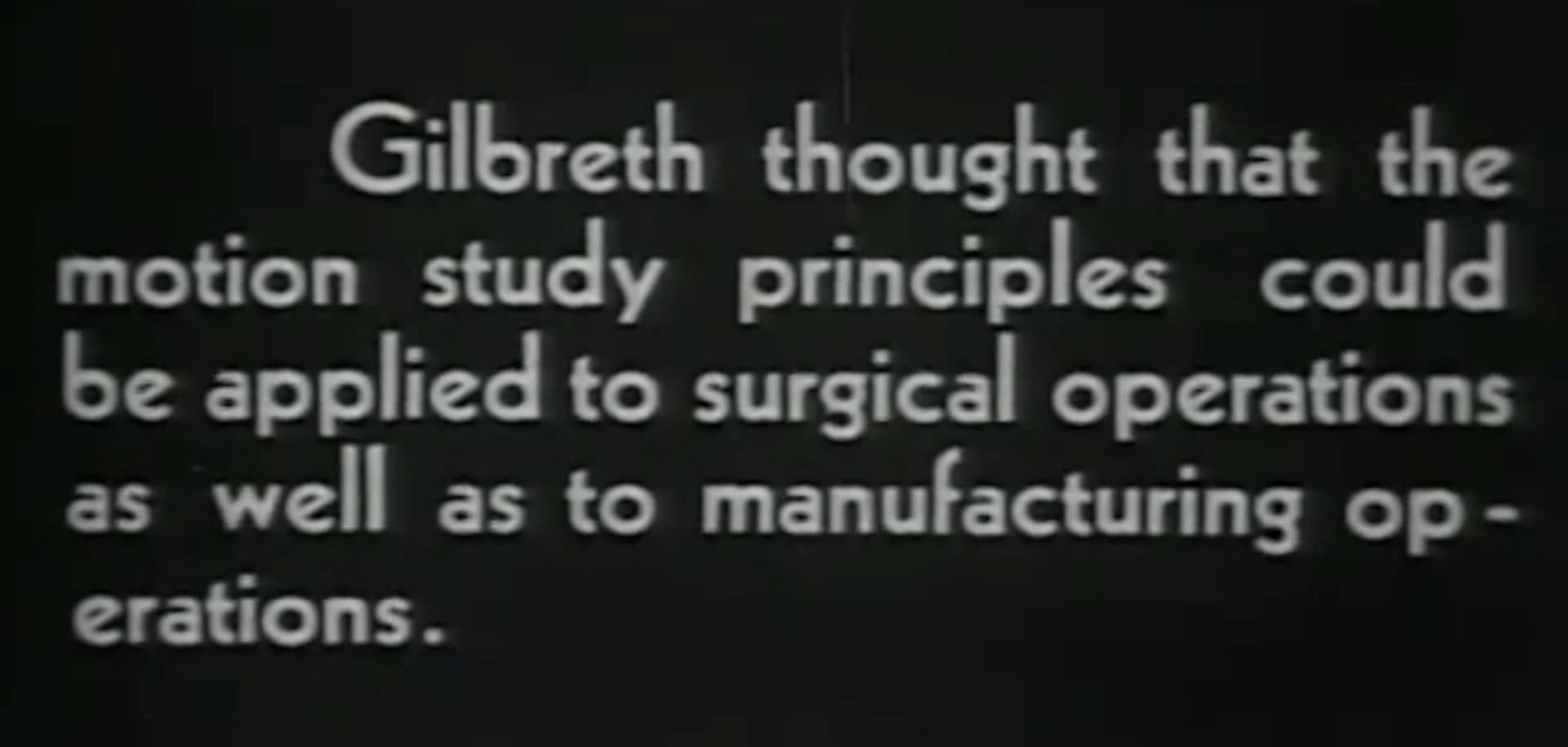
Around the same time, Frank and Lillian Gilbreth were filming surgeons at work. 2025 archival study drawn from their papers at Purdue calls the two of them the founders of surgical ergonomics. Frank called surgeons the most interesting of all mechanics, and he published what he found in the Canadian Journal of Medicine and Surgery in 1916.
The part that gets left out is that the surgeons invited him.
The historian Caitjan Gainty went through this in Representations. Gilbreth offered a group of New York Hospital surgeons a free motion study, on the condition that he control how it was run, and they took the deal. Some of them traveled a couple hundred miles to perform surgical motions in front of his camera. Gainty's argument is that this is hard to square with the story we usually tell, where efficiency shows up from outside and gets done to medicine.
Two things came out of that work. Laying surgical instruments out in a consistent order traces back to their filmed analyses. So does having a nurse hand the surgeon instruments, so nobody is hunting for them mid-case. If that's an element of “assembly line surgery,” what's wrong with that?
Lillian's half of the partnership was the human side. She pushed toward fatigue and well-being rather than speed alone, and their operating room work moved that direction over the years. The people who brought a camera into surgery were also the ones asking how tired the surgeon was.
Ninety years apart, the Gilbreths' surgeons and Tebbetts both went looking for this on their own. Nobody made any of them do it.
This video should start at 25:36 or jump there:
But industrial engineering was not the only influence shaping what people expected medical care to look like.
One year after Ford wrote about the hospital, a Harvard professor of medicine named Francis Peabody stood up at a medical meeting in Seattle and opened with this: “System and Efficiency,” the watchwords of modern American business life, were being adopted by the learned professions.
Peabody is the man who wrote that the secret of the care of the patient is in caring for the patient. This is the same man, four years earlier, and he was worried. He wrote about patients being put “through the mill,” passed from specialist to specialist, and about families describing the relationship with medicine as unsatisfactory, incomplete, remote and cold. He called the diagnostic clinic an offspring of the “American God of Efficiency,” and said that at its worst it becomes a machine.
So the complaint had reached print by 1923, one year after Ford and ten years after Highland Park.
But read what he actually concluded, because almost nobody quotes this part. The trouble, he wrote, arises “not from a lack of organization but from lack of personal supervision and responsibility.” No one physician had seen the case through from beginning to end.
He also wrote, in the same speech, that doctors' somewhat casual methods would benefit from being supplemented by those of the business world.
That's not an argument against efficiency. It's an argument about who is responsible for the patient, made by someone who thought medicine could stand to be better organized, not less.
In 1949, the American Medical Association ran a national campaign against a health insurance bill. I am not relitigating the policy fight. What matters here is what they hung on the wall. The centerpiece was Luke Fildes' painting The Doctor, from 1891: a physician sitting by lamplight with a sick child, the parents off to the side.

By Luke Fildes – Unknown source, Public Domain, Link
TIME reported that December that more than 55 million pieces of literature went out and more than 65,000 posters went up in medical offices and elsewhere. The slogan was “Keep politics out of this picture.”
Fildes had deliberately left out the ordinary medical equipment of his own era. He cleared the room of everything that was not the doctor and the child. It was a painting about attention, and it was already a fiction about how medicine worked when he painted it.
John Harley Warner, a medical historian, wrote about that campaign in The Lancet in 2013. Warner's argument, as I read it, is that the campaign set expectations about the doctor-patient relationship far higher than the system was ever going to deliver, and people were already disappointed by the early 1950s. They had seen the posters. They wanted what was in them. That is not what they got.
So a picture of one physician with unlimited time for one child went up in tens of thousands of waiting rooms. Then people sat in those waiting rooms.
What Is Actually Being Measured Against
Part of what anybody means by assembly line medicine is that the care did not look like that painting.
No health system can literally provide every patient with one clinician's unlimited time. But the underlying desire is not unreasonable: attention from somebody who knows the patient and is not visibly racing the clock. What people are reaching for is real. Attention, and somebody who knows them and is not watching the clock. Nurses want to give that at least as much as patients want to receive it, and when they cannot, the loss is real and it is usually not their doing.
But that yardstick did not appear by accident. The AMA selected that image because it represented a relationship people valued and feared losing.
Back to the Bay
The nurse in that recovery room is absorbing variation the schedule refuses to acknowledge, and she has no way to ask for help.
That's all pulling the cord is. Not a protest, not a refusal, not a complaint filed with somebody in an office. Just a person saying “I need help,” out loud, in the moment, and expecting somebody to show up.
Who would come? And what would happen to her afterward?