GM Adopted Forced Ranking in 2024. Ford Dropped It in 2001.
Phoebe Wall Howard reported recently that a fired GM engineer is suing the company over its employee evaluation system. Tuan Le, 58, spent 27 years at General Motors, moving from industrial engineer to senior throughput simulation engineer. GM terminated him on January 17, 2026. He is the third GM employee represented by attorney Michael Pitt to allege that GM's forced ranking system (as they describe it) requires managers to hit job-elimination quotas that fall hardest on older workers. GM declined to comment for the story.
The age discrimination claim is an allegation, and a court will sort that out. I have no prediction there.
What is less in dispute is the design of the system, based on internal GM documents Howard obtained. In 2024, GM moved from a three-point rating scale to a five-point scale with target percentages attached to each level:
- 5 percent Significantly Exceeds,
- 10 percent Exceeds,
- 70 percent Achieves,
- 10 percent Partially Meets,
- 5 percent Does Not Meet.
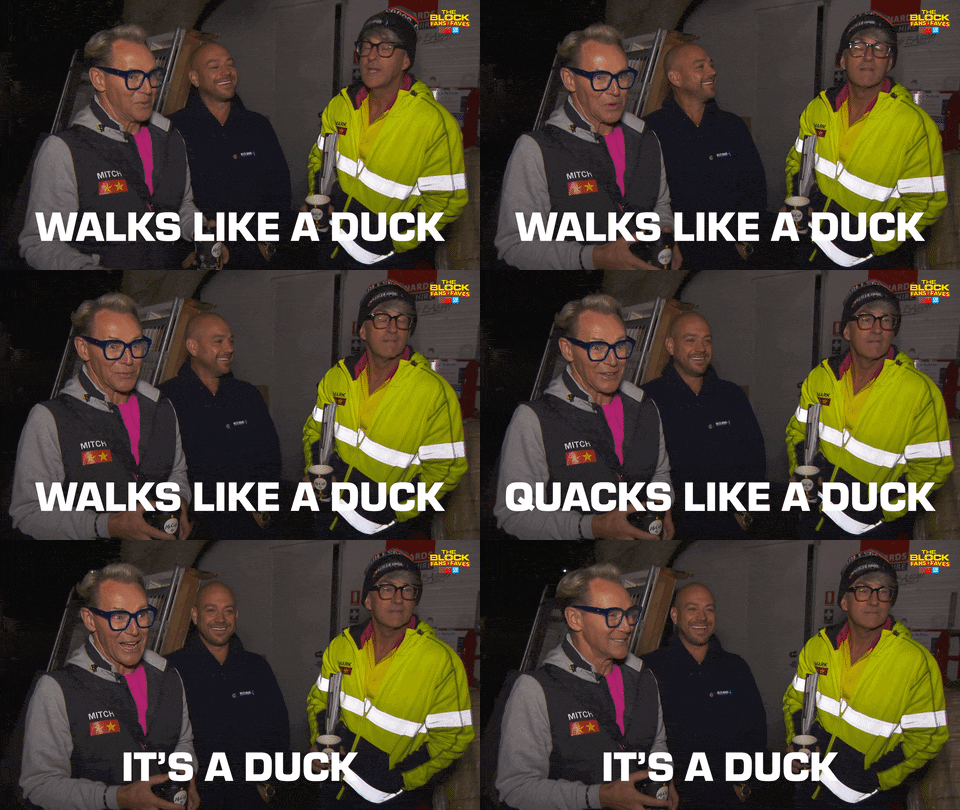
Sounds like… a forced ranking system.
Fifteen percent of people land in the bottom two buckets. Whether that's a target or a hard floor is the whole fight.
Pitt described how that works in practice. He told Howard he has documents showing HR tracking manager quotas. If you have 800 people, 40 of them have to come in as Does Not Meet, and if you have only identified 25, you go find 15 more.
It's worth being clear about the language, because it matters later. GM does not call this forced ranking.
It's a duck.
When Reuters first reported the change in August 2024, GM described a five-point scale with bonuses attached, and a spokesperson said the company is proud of a culture that rewards high performance. GM's internal vocabulary, as quoted in the lawsuit, runs to People Leaders, Calibration Session, and Plan for Improvement. The phrase “forced ranking” comes from Pitt and from reporters, not from GM. So does the claim that the percentages are mandatory rather than guidance, and GM hasn't publicly confirmed that part.
GM Didn't Have to Look Far
GM began using this in 2024.
Ford abandoned essentially the same practice in 2001 after settling class action claims for $10.5 million without admitting wrongdoing. Goodyear dropped its version in 2002 after being sued by older workers and the AARP. Microsoft ended stack ranking in November 2013. GE, the company most identified with the practice, moved away from the strict 20-70-10 curve in the mid-2000s, not long after Jack Welch retired, and then eliminated numerical ratings and the annual review entirely in 2015 and 2016 under Jeff Immelt.
Dr. Deming would have been proud.
So the practice GM adopted two years ago is one Ford quit 25 years ago, Microsoft quit 13 years ago, and GE walked away from in two stages, the first of which was about twenty years ago.
I'll admit this is a familiar shape. GM had a front-row seat at NUMMI starting in 1984, watched Toyota run a plant with the workforce GM had just laid off, and then took decades to spread what it saw there. Being late to a good idea is one thing. Being early to a bad one everyone else already returned is something else.
GM May Have Run This Experiment Already
Here's a thread I can't pull all the way.
My dad spent 40 years as an engineer at GM. His recollection is that something like this existed at Cadillac in the 1980s and that GM eventually dropped it. I haven't found any public source documenting that, so treat it as one person's memory rather than established history. I trust his memory, though.
The surrounding facts make it plausible. Forced distribution wasn't Welch's invention. Sandia lost a class action age discrimination case over its forced distribution appraisal system in 1975, six years before Welch became CEO of GE. And Deming spent much of that era attacking merit rating in front of American manufacturing audiences. My dad attended one of Deming's four-day seminars at Cadillac and came home with a signed copy of Out of the Crisis. Deming wasn't warning American managers about a hypothetical problem. The practice was already out there.
If GM did try this before and abandon it, the story isn't a company adopting somebody else's discarded idea. It's a company reissuing its own, under a new CEO who isn't old enough to remember what happened in the 80s.
A Comeback That Never Quite Left
Here's what surprised me while reading around on this.
In December 2013, NPR's Yuki Noguchi did a Morning Edition segment titled “Companies Revisit ‘Rank And Yank' of 1980s.” Microsoft had just dropped it. Other companies were picking it up. Deb Keary of SHRM told NPR that forced ranking was falling out of favor and that the new buzzword was engagement. She also said something more honest than most HR advice: it's fine for a manager to have a private sense of who's strongest and weakest, but she wouldn't share that ranking with a soul, because it would be too destructive.
That was thirteen years ago. The practice was simultaneously dying and coming back, which is roughly where it has stayed ever since.
To be fair to the other side, NPR quoted Robert Simons of Harvard Business School defending stack ranking as a way to identify people who are excelling and people who need help, and arguing that companies facing hard international competition shouldn't handle employees with kid gloves. Noguchi then asked whether Harvard Business School has forced ranking among its professors. Simons said they have an up-or-out system, and those not promoted are asked to leave. Noguchi's closing line was that this applies unless, like Simons, you're tenured.
Good for her.
The strongest criticism in that segment came from analyst Rob Enderle, and it wasn't about fairness. It was about what the system makes managers do. Enderle described managers hiring people they know they can fire, in order to protect the rest of the team from the mandatory cut. He said the practice “pretty much ensures you won't have collaboration.” He compared it to surgery. Sometimes you operate to remove something. You don't schedule the same operation every year on principle.
The Label Died. The Practice Didn't.
Search around and you'll find two confident and opposite headlines.
Business.com runs a piece called “The End of Rank and Yank,” updated this past April, describing a management style that has fallen out of favor. Kim Seeling Smith wrote last summer asking whether rank and yank is making a comeback and whether we should be worried.
We should be worried if that's truly a comeback.
Korn Ferry ran something similar in January. Reworked ran a piece in February titled “Stack Ranking Makes a Comeback.”
Both camps have evidence, because the label died and the practice didn't.
Meta told managers in 2025 to put 15 to 20 percent of employees on teams of 150 or more into its “below expectations” bucket, up from 12 to 15 percent the year before. Amazon runs something comparable. Goldman Sachs, per reporting cited by Reworked, targets roughly 25 percent exceeds, 65 percent fully meets, and 10 percent partially meets. Nobody calls any of it “rank and yank.” GM's internal FAQ, according to Howard's reporting, told employees that many top-performing public companies use a similar system.
GM is top performing???
That last argument is the one I'd push back on hardest. “Other companies do it” is not a reason. It's a description of the sample you chose.
The business.com piece has one line worth keeping as a plain statement of the mechanism: the people at the bottom aren't necessarily poor performers, they're ranked there because somebody has to be. Tara Furiani, quoted in the same article, called the approach “cowardly leadership masquerading as corporate jargon,” and made a point worth borrowing. Businesses aren't sports teams. You don't bench a player and send in fresh legs without first looking at the playbook, the coaching staff, and whether the field is level.
Deming Said It in 1986. Dilbert Said It in 1997.
W. Edwards Deming put performance appraisal on his list of the deadly diseases of management.
It nourishes short-term performance, annihilates long-term planning, builds fear, demolishes teamwork, nourishes rivalry and politics.
W. Edwards Deming, Out of the Crisis, p. 102
Then comes the sentence that matters most for GM's situation. Deming wrote that the practice is unfair, because it assigns to people in a group differences that may be caused entirely by the system they work in.
The lawsuit contains an example of exactly that. An engineer misses a timeline because a supplier couldn't deliver equipment during a material shortage. In the calibration session, that shows up as a missed deadline. The supply chain doesn't get a rating. The engineer does.
Scott Adams got there in 1997, and he got the mechanism right, which is more than most management writing manages.
In a Dilbert strip dated January 20 of that year, the Pointy-Haired Boss delivers bad news about Wally's performance review. Everyone on the team performed the same, he explains, but he's required to rank the group on a bell curve. So he had to make up some flaws to move Wally down. He hands Wally a pen and tells him to sign. Wally looks at the review and finds an accusation that he doesn't wash his hands after using the restroom.
A follow-up strip takes it further. Wally refuses to sign a review full of misdeeds his boss invented to lower his rating. The boss doesn't deny inventing them. He says the review reflects the sort of thing Wally might do, and that he had to make all the reviews fit the curve. Wally's response is the punchline: “I am NOT selling crack from my cubicle!!!”
What Adams understood is that the fabrication isn't a manager being a jerk. The manager is complying. The distribution came down from somewhere, the numbers have to add up, and the written justification gets reverse-engineered afterward to fit the number that was already assigned. That's not far from what Pitt alleges is happening in GM's calibration sessions, minus the crack.
When a management practice is hard to distinguish from a comic strip that ran during the Clinton administration, that's usually a sign.
Jack Welch Changed the Name, Not the Practice
Worth being precise about Welch, since his name shows up in every one of these stories. Welch did not disown the practice. He disowned the nickname. Just like he probably hated the nickname “Neutron Jack.”
In a November 2013 Wall Street Journal column, published the week Microsoft dropped stack ranking, Welch called “rank-and-yank” a media-invented, politicized “sledgehammer of a pejorative.” His preferred word was differentiation. He defended the bell curve as candid and humane, on the grounds that we grade nine-year-olds in school and nobody calls that cruel.
I don't remember my elementary school being forced to fail X number of students — in a “gifted and talented program” no less.
That distinction matters, because it's one reason the old terminology keeps disappearing while versions of the practice survive. Welch called it differentiation. GM has its own vocabulary now. Meta has “below expectations.” The practice survives every round of criticism partly because each round is aimed at a name that the next company won't use.
Meanwhile the company he built it at got rid of it, twice. And the GE that exists today, GE Aerospace under Larry Culp, runs a Lean operating model rooted in the Toyota Production System, with Culp saying out loud that a problem-solving culture beats a finger-pointing culture. Same three letters. Opposite management theory.
What the System Teaches People to Do
The most useful part of Howard's reporting isn't the legal claim. It's the behavior.
Le told Shifting Gears that some engineers admitted they wouldn't teach younger employees everything they know, because holding onto that knowledge protected their own ranking. According to the lawsuit, Le's supervisor Dave Hilger described a lot of fighting and backstabbing in the calibration process, because managers were trying to keep their own people out of a bottom 15 percent being forced on them. A former GM engineer told Howard about watching a manager select someone for a low score, then walk into the bathroom and throw up.
An anonymous GM employee on Reddit called performance calibration the Hunger Games. I can't verify who wrote that or how typical it is. But the mechanism people keep describing is consistent and it isn't mysterious. If my rating depends on where I sit relative to my coworkers, helping a coworker improve costs me something. Nobody has to be told that.
That's the system question. Not whether GM's engineers are collaborative people. They probably are. The design just made collaboration expensive.
Now read what the lawsuit says happened to Tuan Le. On July 8, 2025, he emailed roughly 800 colleagues in his group, pointed out the resemblance to Ford's system, and included news links about how that ended. Two weeks later he was in a meeting with his manager and HR, given two options: a 30-day improvement plan or severance. He took the plan, completed it, and was told he could not regress to old behavior. He was fired six months later.
Again, that's his account through his attorney, and GM hasn't responded to it publicly. But if it holds up, the message that traveled through that group of 800 engineers didn't need a memo.
The Question I'd Ask
Charles Elson of the University of Delaware told Howard he couldn't imagine why GM would pick up something other companies dumped years ago, and asked simply why it's returning. That's the right question, and nobody outside GM can answer it. USC's Alec Levenson has a guess, and it isn't flattering. He called the approach “boneheaded” and said it sounds like a labor-cost-cutting exercise.
But I'd ask another question.
What behavior did GM expect this system to produce?
We already know what the incentives are. If helping a coworker improve could hurt my ranking, I have a reason to hold something back. If my manager has to put somebody in the bottom bucket, my coworkers aren't just colleagues anymore. They're competition.
And if Le's account is accurate, roughly 800 engineers saw what happened after one of their colleagues challenged the system itself. Two weeks later, he was put on an improvement plan. Six months later, he was gone.
A court may eventually decide whether those events were connected. The people watching didn't need to wait for a verdict to draw their own conclusions.
That's the problem with systems like this. Leaders can call them calibration, differentiation, or performance management. Employees learn from what the system rewards, what it punishes, and what they watch happen to other people.
If GM wanted more candor, collaboration, and performance, I'd want somebody to explain how making coworkers compete for survival was supposed to produce any of the three.