What a “Perfect” Process Map Missed: A Lesson From Third Shift
A food company had a flowchart any auditor would love. Every step mapped.
Every step mapped. Every critical control point identified. The HACCP plan (Hazard Analysis and Critical Control Points, the standard food safety framework that identifies where contamination can enter the process) reviewed, signed off, and approved by the people whose job it is to look for trouble.
And then they had a major food safety failure.
That's a story Deborah Coviello shared on a recent episode of “My Favorite Mistake.” Deb, known as The Drop-In CEO, was working with the company when the failure surfaced. Everyone was shaking their heads. How did we get here? The map said everything was fine.
What the map missed was the third shift.
The Map Describes the Plan, Not the Workaround
The janitorial team on third shift couldn't always find their cleaning tools where they were supposed to be. So they did what people do everywhere: they improvised. They crossed from one production zone into another to track down what they needed. In the process of solving a small problem (missing tools), they created a much bigger one (a cross-contamination path that wasn't on any flowchart).
The flowchart wasn't wrong, exactly. It described the production process, as it should have been. It didn't describe what people did between the steps, or what they did when supplies were missing, or what they did at 2 a.m. when no one was watching and the work still had to get done.
A perfect map of the planned process. A complete blind spot for the actual process.
Why Audits Don't Catch This
Audits are typically scheduled. People know they're coming. The teams who are being audited are usually the day-shift teams who designed the work in the first place. They're prepared. They're present. The supplies are in place because someone made sure they would be.
Third shift is a different country. The lights are on, the work is happening, but the people who write the procedures usually aren't there. Neither are the supervisors who could remove a barrier in real time. When a tool goes missing on third shift, nobody is around to put it back. The workaround becomes the work.
Deb's phrase for what a leader can do about this sounds like the classic “Ohno circle”:
“Stand in one place and look around.”
That's different from walking through. Walking through is what a leader does when they're checking that the boards are updated and the metrics are green. Standing still is what a leader does when they're trying to learn something the boards can't tell them.
The Same Pattern Shows Up in Healthcare
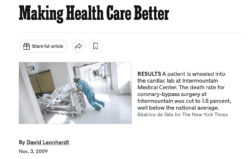
In Lean Hospitals, I wrote about a unit where leadership assumed that nurses weren't following fall-prevention protocols. After actually going to observe, two things turned out to be true. Some nurses thought they were following protocol, but were following an old version. Other nurses knew the protocol but didn't have time to complete every step in the time they were given. Either way, the issue wasn't the people. It was the conditions the system created.
The endoscope cleaning case I cite in the book has the same shape. The procedure called for a 30-second cleaning step. Some staff, sometimes, didn't do the full 30 seconds. Roughly 10,000 patients over three years were affected. A hospital leader described it as “a step incorrectly applied by our staff.” That framing puts the issue on the people. The Lean framing puts it on the system that made the workaround possible, the training that didn't stick, and the supervision that wasn't observing.
In both cases, the procedure document was fine. What happened in the room on a Tuesday night was different from what the document described. Nobody had been there to see it.
There are often three forms of a process:
- What the process is supposed to be
- What people say / think it is
- What people actually do
What Leaders Can Do Instead
Standing in one place and watching is harder than it sounds. The instinct, especially for technical leaders, is to assess. To read the chart, glance at the metrics, ask a quick question, and move. The skill Deb is pointing at is the discipline to not do that.
A few practical shifts that come out of her story and the healthcare cases:
Visit when nobody is expecting you. The third shift, the weekend, the holiday coverage. The point is not to “gotcha” catch people doing something wrong. The point is to see what the work actually looks like when the conditions are most variable.
Watch what people do when something is missing. Out of supplies. Missing a teammate who called in sick. Not having the right tool. The improvisations are where the real risk lives, and they're rarely in the SOP.
Don't trust the data without understanding how it was created. Deb said this directly, and it's worth repeating. A good chart built on a flawed input still looks like a good chart. The only way to know is to see how the number got there.
Speak last. When you're observing with a team, hold your interpretation. Let people describe what they see first. You'll learn more about the work, and you'll learn more about the team.
What I'd Still Want to Know
I'd want to know what happened at that food company after the failure. Did they redraw the map? Did they put a janitorial cart in each zone so nobody had to cross? Did they train their auditors to walk third shift? Did anyone get blamed, or did the system get fixed?
The story Deb told is mostly about what the leaders could see once they stopped trusting the document and started watching the room. That's a Lean lesson worth carrying. The map is not the work. The audit is not the work. The work is what people do, including what they do when no one's looking.
A “gemba walk” has to include more than stopping to look at boards. You have to stop and look at the work. Talk to people (and listen to them).
If you're a leader reading this, here's the question I'd put to you: when was the last time you stood in one place on your own gemba and just watched for an hour? Not on a scheduled tour. Not with the team prepared for your visit. Just watching.
What might you find that isn't on the map?
You can watch or listen to the full conversation with Deborah Coviello on “My Favorite Mistake.“